This site is supported by our readers. We may earn a commission, at no cost to you, if you purchase through links.
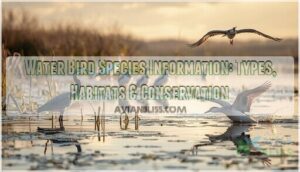
You can spot them from across a marsh—the elegant curve of a heron’s neck, the synchronized V of migrating geese, the sudden plunge of a diving cormorant. Water bird species information reveals over 800 distinct species that have mastered life at the boundary between water and sky.
These birds don’t just visit aquatic environments; they’ve evolved extraordinary adaptations that let them swim, dive, wade, and fish with precision. Webbed feet propel ducks through currents, specialized salt glands let seabirds drink ocean water, and waterproof plumage keeps diving species warm in frigid depths.
Understanding these adaptations, along with their habitats and conservation needs, unlocks the intricate connections that keep wetland ecosystems thriving across every continent.
Table Of Contents
- Key Takeaways
- Defining Water Bird Species
- Major Groups of Water Birds
- Habitats and Geographic Distribution
- Ecological Roles and Behaviors
- Conservation and Threats to Water Birds
- Frequently Asked Questions (FAQs)
- What are some interesting facts about seabirds?
- What kind of birds live in the water?
- What are the characteristics of a water bird?
- What defines a waterbird?
- What are the different types of water birds?
- What is the rarest water bird?
- What are birds that live on water called?
- What is the difference between a seabird and a waterbird?
- How do water birds survive winter temperatures?
- What sounds do different water birds make?
- Conclusion
Key Takeaways
- Over 800 water bird species have evolved specialized adaptations, including webbed feet for propulsion, waterproof plumage maintained by oil glands, salt glands enabling seabirds to process ocean water, and beak structures ranging from flat filter-feeding bills to spear-like fishing tools.
- Water birds organize into distinct taxonomic families based on skull structure and ecological roles, with Anatidae (ducks, geese, swans) comprising 180+ species, Ardeidae (herons, egrets, bitterns) containing 64 species with S-shaped necks for ambush feeding, and specialized divers like loons, grebes, pelicans, and cormorants each displaying unique hunting adaptations.
- These species anchor aquatic ecosystem health through nutrient cycling between water and land via their droppings, sediment aeration during foraging that improves oxygen dynamics, pest control by consuming aquatic insect larvae, and creating habitat structure through colonial nesting that increases local biodiversity.
- Wetland ecosystems have declined 50% since 1900 through drainage and development, threatening water bird survival through habitat fragmentation, water pollution from agricultural runoff, coastal erosion eliminating nesting sites, and climate-driven shifts in migratory timing that demand urgent conservation action, including protected breeding sites and wetland restoration efforts.
Defining Water Bird Species
Water birds represent a diverse group of avian species that have evolved to thrive in aquatic and wetland environments. You’ll find these birds sharing several distinctive features that set them apart from their terrestrial counterparts.
From coastal shorebirds to diving ducks, you can explore the full spectrum of these adapted species in this comprehensive waterbird species list.
Understanding what defines a water bird requires examining their key characteristics, classification systems, and the notable adaptations that enable their aquatic lifestyle.
Key Characteristics of Water Birds
You’ll recognize water birds by their outstanding aquatic bird characteristics, starting with waterproof feathers coated in oil for buoyancy control. Their webbed feet act like paddles, propelling them through water with powerful strokes.
Beak adaptations vary dramatically—from flat bills filtering tiny organisms to spear-like structures catching fish. These avian adaptations to water include aerodynamic bodies and specialized diving techniques that let them thrive in diverse water bird habitats.
To better understand these adaptations, explore water bird physical adaptations.
Classification and Types
Beyond these physical traits, you’ll find water bird species organized into families based on skull structure, beak shape, and leg placement.
The family Anatidae—ducks, geese, and swans—includes over 180 waterfowl types worldwide. Herons belong to Ardeidae with 64 avian species showing distinct feather adaptations.
This avian classification reflects how beak variations and ecological roles shape different bird species groups.
Adaptations for Aquatic Life
These taxonomic groups reveal species adaptation through notable aquatic adaptations.
You’ll notice Webbed Feet create thrust for Swimming Birds gliding through stream habitats. Waterproof Feathers lock air beneath dense plumage, maintaining warmth during dives. Salt Glands in seabirds excrete excess sodium from brackish environments.
Wading Birds evolved long legs for shallow foraging, while divers developed sleek torsos reducing drag—each modification perfectly matching their ecological niche.
Many aquatic species demonstrate unique features and adaptations that allow them to survive and thrive in water environments.
Major Groups of Water Birds
Water birds aren’t all the same—they fall into distinct groups based on their physical traits, behaviors, and evolutionary history.
From the familiar ducks paddling in your local pond to the striking herons wading through marshes, each group has carved out its own niche in aquatic ecosystems. Let’s explore the major families that make up this diverse collection of species.
Ducks, Geese, and Swans
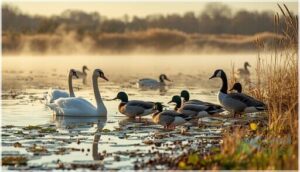
You’ll recognize ducks, geese, and swans as the family Anatidae—your classic waterfowl. Feather adaptation and beak specialization vary widely among these groups, supporting diverse aquatic foraging strategies from dabbling to grazing.
Each species thrives when their diet mirrors what they’d naturally eat in the wild, which is why understanding wild bird food nutrition helps ensure waterfowl get the energy and nutrients they need year-round.
Flocking behavior peaks during waterfowl migration, when thousands follow ancestral routes. Ducks show compact builds, geese prefer terrestrial grazing, while swans display notable neck length for reaching submerged vegetation.
Herons, Egrets, and Bitterns
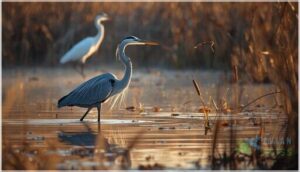
You’ll find herons, egrets, and bitterns in the family Ardeidae—wading specialists with dagger-like bills measuring 2 to 6 inches. Heron migration shifts seasonal presence in temperate regions, while egret feeding relies on ambush strikes in shallow wetlands.
Bittern habitat demands dense reeds for camouflage. These water bird species excel at wading techniques, using long legs and S-shaped necks as aquatic adaptations. Habitat preservation and conservation efforts protect their vulnerable nesting colonies.
Loons, Grebes, and Coots
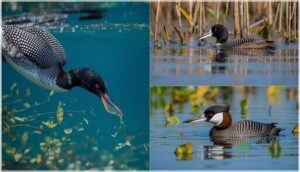
Loons, grebes, and coots represent specialized water bird species with notable diving techniques and feather adaptations. You’ll observe loons using rear-positioned feet for aquatic locomotion, while grebes display lobed toes enabling swift underwater maneuvering.
- Loons feature dagger-like beak specializations perfectly adapted for grasping slippery fish during rapid underwater pursuits
- Grebes construct floating nesting strategies anchored to submerged vegetation in wetlands
- Habitat preservation and bird conservation protect these diving specialists from water pollution and wetland loss threatening their survival
Pelicans, Cormorants, and Puffins
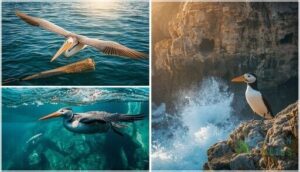
You’ll recognize pelicans by their expandable throat pouches used for scooping fish, while cormorants dive with less waterproof feathers requiring wing-spreading drying sessions afterward. Puffins exhibit bright orange beaks during breeding season, fading to duller tones post-reproduction.
| Species | Key Adaptation | Habitat Preference |
|---|---|---|
| Pelicans | Totipalmate webbing, air-filled bones | Lakes, rivers, coastal waters |
| Cormorants | Hooked bills, laterally flattened bodies | Estuaries, inland waters, shores |
| Puffins | Wing-propelled diving, burrow nesting | North Atlantic/Pacific cliff colonies |
| All Three | Colonial nesting behaviors | Productive marine environments |
| Conservation | Protected breeding sites | Monitoring programs [] |
Pelican migration patterns shift between breeding islands and wintering grounds based on fish availability. Cormorant diet consists primarily of fish captured during underwater pursuits. Puffin breeding occurs in steep cliffside burrows where pairs return annually. Seabird conservation efforts focus on protecting colonial nesting sites from habitat loss and human disturbance affecting these seabirds’ survival.
Unique and Lesser-Known Species
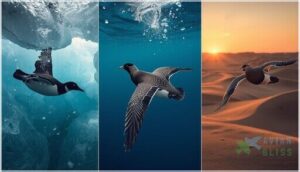
You’ll discover notable water bird diversity among island endemics like the flightless kakapo traversing dense forest terrain through scent marking. Arctic adaptations enable the long-tailed duck to molt into stealth feathers for midwinter feeding beneath ice.
Desert dwellers such as sandgrouse transport water in specialized belly feathers across vast distances. Ocean giants include the razorbill reaching dive depths exceeding 60 meters, while hidden divers like the Pacific loon breed on inland lakes despite offshore feeding habits.
Conservation of aquatic ecosystems protects these unique ecological roles.
Habitats and Geographic Distribution
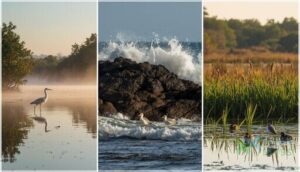
You’ll find water birds wherever there’s water—from quiet marshes to windswept coastlines. Their ranges span every continent except Antarctica, shaped by food availability, breeding needs, and seasonal movements.
Let’s explore the specific habitats these species call home and how they’re distributed across the globe.
Wetland and Marsh Ecosystems
You’ll find wetland environments shaped by saturated soils and specialized aquatic plants that support diverse water birds year-round. These marsh ecology systems deliver ecosystem services including water quality filtration and flood control.
Wetland restoration efforts rebuild habitat connectivity for migratory species while protecting the ecological roles of water birds. Conservation of aquatic ecosystems depends on understanding wetland ecology’s fundamental link between hydrology and biodiversity.
Lakes, Rivers, and Coastal Areas
You can observe water birds thriving across diverse aquatic ecosystems, each shaped by distinct river dynamics and freshwater ecology. Coastal conservation efforts protect these critical zones where aquatic biodiversity peaks.
- Lakes provide stable habitats with littoral zones supporting juvenile fish and invertebrates
- Rivers transport nutrients downstream, creating varied feeding grounds from rapids to floodplains
- Coastal areas blend freshwater and seawater, forming brackish wetland environments essential for water bird conservation and ecological importance
Global Distribution Patterns
Spanning continents, water bird watching reveals how climate shifts and habitat fragmentation shape species dispersion across aquatic ecosystems. You’ll find habitat distribution follows predictable patterns tied to temperature gradients and water availability.
| Region | Key Distribution Drivers |
|---|---|
| North America | Mississippi wetlands, Atlantic coast marshes support dense duck populations |
| Europe | Netherlands and Baltic shallow waters concentrate diverse wading birds |
| Asia | Siberian summer lakes, Southeast Asian estuaries host seasonal peaks |
Geographic isolation creates endemic species on island chains, while migratory patterns connect distant breeding and wintering grounds.
Migratory Routes and Ranges
Understanding global ranges naturally leads to examining how migratory birds traverse continents. You’ll notice flyway patterns connecting temperate breeding wetlands to milder wintering grounds through predictable corridors each year.
Migration timing shifts with climate modes like El Niño, while route fidelity varies—some species show strong stopover ecology preferences at key lakes. Habitat conservation of these stopovers determines migratory birds’ survival and breeding success.
Ecological Roles and Behaviors
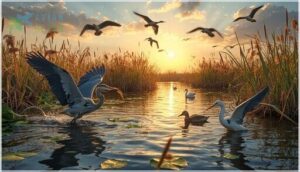
Water birds aren’t just beautiful creatures floating on your local pond—they’re essential players in keeping aquatic ecosystems healthy and balanced.
From the way they hunt for food to their impressive seasonal journeys, these species have developed fascinating behaviors that help them survive and thrive.
Let’s explore how water birds feed, nest, migrate, and contribute to the environments they call home.
Feeding and Foraging Strategies
You’ll notice water birds employ impressive foraging tactics shaped by prey selection and dietary flexibility. Ducks sweep their beaks sideways to filter insects while maintaining balance, whereas herons freeze mid-stalk before striking fish with precision.
Pelicans coordinate group dives using expandable throat pouches, while puffins trap multiple catches between beak and tongue. These foraging adaptations enhance energy intake across diverse aquatic ecosystems.
Mating and Nesting Habits
After securing food, you’ll see water birds turn their focus to reproduction. Nest site selection on reed beds and floating platforms reduces flood risk while concealing eggs from predators.
Elaborate courtship displays—wing spreading, sky-pointing, and vocal duets—drive mate attraction and strengthen pair bonding. Both parents share incubation strategies, coordinating brooding shifts and feeding trips to support fledgling care until independence arrives.
Seasonal Migration Patterns
Each year, you’ll witness extraordinary bird migration as water birds travel established flyways spanning 1000 to 3000 kilometers between breeding and wintering grounds. Altitude migration and stopover ecology shape these journeys, while climate adaptation increasingly influences timing and routes.
- Ducks commonly shift 1500 to 4000 kilometers from northern breeding sites to southern wintering habitats
- Traditional migration routes follow continental margins, connecting key wetlands and estuarine systems
- Stopover sites provide critical refueling every 200 to 400 kilometers along the corridor
- Temperature cues and day length jointly trigger spring departures toward breeding areas
Importance in Aquatic Ecosystems
Water birds anchor ecosystem balance through roles that ripple across aquatic health and biodiversity support. You’ll find their foraging stirs sediments, improving water quality by boosting oxygen and nutrient cycling. Their droppings enrich marshes, while feeding controls pest larvae and invasive species.
Water birds balance ecosystems by stirring sediments, cycling nutrients, enriching marshes, and controlling pests through their foraging and feeding
Migratory stopovers link habitat networks, building ecological resilience essential for conservation of aquatic ecosystems and effective ecosystem management across wetlands.
| Ecosystem Function | Water Bird Contribution | Biodiversity Impact |
|---|---|---|
| Nutrient Cycling | Excreta transfers nutrients between water and land | Boosts productivity in adjacent habitats |
| Pest Regulation | Prey on aquatic insect larvae and adults | Reduces pest populations in wetlands |
| Sediment Aeration | Foraging disturbs sediments, aiding decomposition | Improves oxygen dynamics and microbial activity |
| Habitat Structure | Nesting colonies create refuges for other species | Increases local biodiversity around breeding sites |
Conservation and Threats to Water Birds
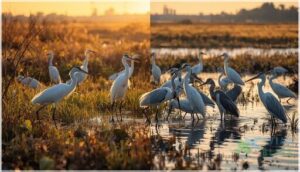
Water birds face mounting pressures that threaten their survival across the globe.
From disappearing wetlands to shifting climate patterns, these species navigate challenges that demand immediate attention and coordinated action.
Understanding the specific threats and conservation approaches helps you appreciate what’s at stake for these extraordinary birds.
Habitat Loss and Environmental Change
You’re witnessing habitat destruction on a massive scale—wetlands have declined 50 percent since 1900 through drainage and development. Water pollution from agricultural runoff triggers algal blooms, while coastal erosion eliminates nesting sites.
Climate shift alters migratory timing, and habitat fragmentation isolates populations. Wetland degradation demands urgent environmental conservation and ecosystem management to guarantee biodiversity conservation and habitat preservation for future generations.
Conservation Initiatives and Research
International agreements now set binding targets for wetland preservation, while national wildlife laws designate critical habitats with restricted development.
You’ll find satellite imagery monitoring wetland changes monthly, and standardized bird banding programs tracking survival rates. Research methods include bioacoustic sensors detecting secretive species, genomic tools informing captive breeding, and machine learning forecasting population trends using climate data for effective species preservation.
Community Engagement and Bird Watching
You can join bird watching tours and citizen science programs that turn your observations into conservation data. Local bird clubs host monthly walks where you’ll learn bird identification while recording sightings for national databases like eBird.
Community outreach events, volunteer conservation days at wetlands, and bird friendly cities initiatives connect you directly to water bird protection efforts, transforming casual interest into meaningful habitat stewardship.
The Role of Wetlands in Species Survival
You’ll find that wetland ecosystems function as irreplaceable sanctuaries for water birds, providing breeding grounds, sheltered nesting sites in reeds and cattails, and nutrient-rich sediments that support invertebrates and fish.
Habitat preservation and restoration efforts protect these wildlife habitats, ensuring stable foraging conditions during bird migration while buffering floods and moderating temperatures. Wetland conservation directly determines species conservation success, making aquatic adaptations viable across generations.
Frequently Asked Questions (FAQs)
What are some interesting facts about seabirds?
Seabird migration spans hemispheres, connecting Arctic breeding grounds to subtropical waters.
You’ll find these ocean wanderers using agile soaring to ride wind currents across vast marine ecosystems, showcasing impressive bird adaptations for aquatic life.
What kind of birds live in the water?
You’ll encounter ducks, geese, swans, herons, and loons near water. These aquatic birds have webbed feet and waterproof feathers.
Freshwater birds inhabit lakes and rivers, while seabirds prefer coastal areas and open ocean.
What are the characteristics of a water bird?
You’ll recognize aquatic birds by their paddle-like webbed feet, waterproof feather structure maintained through oil glands, and specialized beak shapes—each trait perfectly engineered for thriving in lakes, wetlands, and coastal waters.
What defines a waterbird?
You’ll recognize water birds by their dependence on aquatic habitats for feeding and nesting.
Their webbed feet, waterproof feathers, and specialized beaks enable swimming, diving, and capturing prey in wetland environments.
What are the different types of water birds?
In the context of feathered friends, water birds span numerous types—from webbed-footed waterfowl diversity like ducks and swans to elegant herons, deep-diving loons, coastal seabirds, and specialized wetland species.
What is the rarest water bird?
The White-winged Flufftail stands among the world’s rarest water bird species, with fewer than 250 adults surviving globally.
You’ll find this endangered species inhabiting isolated wetland patches requiring urgent habitat restoration and conservation biology efforts.
What are birds that live on water called?
You’ll find over 800 aquatic birds worldwide—they’re called water birds, aquatic species, or seabirds.
Wetland life includes wading birds like herons, while marine birds such as pelicans inhabit coastal bird habitats.
What is the difference between a seabird and a waterbird?
Seabirds live primarily in oceanic environments and possess specialized salt glands for managing seawater intake, while water birds inhabit diverse freshwater and coastal wetlands, showing varied aquatic adaptations without requiring salt management mechanisms.
How do water birds survive winter temperatures?
You won’t believe how water birds defy brutal winter cold—they fluff feathers to trap air pockets for thermal regulation, crank up metabolic rates, and use behavioral adaptations like group roosting for climate adaptation survival.
What sounds do different water birds make?
You’ll hear distinctive bird call patterns across wetlands—ducks quack rhythmically, geese honk during migration, while loons emit eerie yodels.
These water bird vocalizations shape aquatic soundscapes, revealing complex avian ecology through sonic adaptations essential for bird communication and behavior.
Conclusion
Just as wetlands form the meeting point between land and water, water bird species information connects scientific understanding with conservation action. Your awareness of their adaptations, habitats, and ecological roles transforms casual observation into stewardship.
Each species—whether a diving cormorant or wading heron—depends on thriving wetland ecosystems. By recognizing their vulnerability to habitat loss and supporting preservation efforts, you become part of the solution that ensures these extraordinary birds continue traversing the boundary between water and sky.