This site is supported by our readers. We may earn a commission, at no cost to you, if you purchase through links.

A flash of red darts past your window. You grab your phone, snap a photo, and wonder what you just saw. Bird identification used to mean flipping through thick field guides and memorizing hundreds of species. Now technology does the heavy lifting.
Apps analyze your photos in seconds and match them against massive databases. But knowing how these tools work makes you better at spotting birds in the first place. You’ll learn to read the clues that matter most—size, color patterns, beak shape, and wing markings. These features enable identification faster than any app alone.
Table Of Contents
Key Takeaways
- Modern bird identification apps use AI to analyze photos in seconds by comparing visual features like plumage, beak shape, and wing patterns against massive databases containing thousands of species with accuracy rates reaching 89-98%.
- The most reliable identification starts with observing key physical traits—size relative to familiar birds, body shape, color patterns, distinctive markings, and beak characteristics—before relying solely on technology.
- AI confidence scores above 0.9 indicate very high accuracy for common species, but scores below 0.7 require manual verification using field guides since lighting, photo quality, and juveniles or hybrids often create identification challenges.
- Combining multiple methods—visual observation, photo analysis, sound recognition, and participation in citizen science projects like eBird—dramatically improves your identification skills and contributes valuable data to real conservation efforts.
How Bird Identification Works
When you spot a bird and wonder what species you’re looking at, identification tools use a clear process to give you answers.
Modern technology breaks down what your eyes see into measurable details that match known patterns.
Let’s walk through how these systems turn a simple photo into an accurate identification.
Visual Feature Analysis
Visual feature analysis forms the backbone of bird identification. When you look at any bird, you’re examining multiple traits at once. Here’s what matters most:
- Plumage irregularities — Color and pattern variations help distinguish species
- Beak quantification — Shape and size reveal feeding habits
- Eye metrics — Positioning indicates hunting style
- Wing analysis and tail analysis — Proportions show flight capability
Image analysis captures these details instantly for accurate identification.
Birds’ vision varies, influenced by their habitat spatial complexity.
AI-Powered Recognition Technology
Behind every AI-powered bird identification app sits a neural network trained on thousands of images. Machine learning algorithms—like YOLOv5—analyze your photo and match features against massive datasets. Recent studies show these systems reach 89–98% accuracy on common species.
Image recognition has come far: acoustic recognition limits still exist, but image analysis excels. Conservation applications now depend on this technology to monitor populations faster than humans ever could. Devices like the BirdWeather PUC are improving bird detection accuracy.
Database Comparison Process
Once the image recognition system extracts features from your photo, the matching algorithm compares them against vast datasets. The GBDD1433-2023 database holds 148,000 annotated images spanning 1,433 species—annotation quality matters here.
Regional coverage varies: North American databases integrate 1,604+ species through data integration efforts. Database growth continues as citizen science expands these collections.
This comparison drives the accuracy metrics you’ll see next.
Confidence Scores and Accuracy
After the comparison runs, you’ll see a confidence score. Think of it as the AI’s certainty level—BirdNET achieves precision above 0.70 for most species.
Here’s what influences accuracy:
- Image quality affects recall greatly
- Common species get identified more reliably
- Best thresholds vary by species
- False positives rarely exceed 0.50 confidence
- Distinctive markings boost precision rates
Modern systems now reach 95%+ accuracy in real-world conditions.
Key Features to Identify Birds
When you spot a bird, certain features jump out if you know what to look for. These physical traits work like clues that narrow down your options fast.
Let’s walk through the key characteristics that make identification easier.
Size and Body Shape

Size is one of your first clues in bird identification. Start by comparing the bird to familiar species—is it sparrow-sized or closer to a crow? Then check body proportions. Long-winged birds often soar in open air. Short, rounded wings suggest dense vegetation.
This overall impression, called “jizz,” helps AI morphometrics and your own eyes narrow down possibilities fast.
Plumage Colors and Patterns
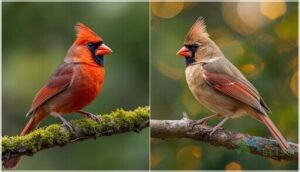
Plumage colors tell the story of a bird’s identity. Look beyond basic hues—male birds often show brighter patterns than females due to sexual dimorphism. Complex markings with multiple color patches help you narrow species faster.
Climate and habitat shape these colors too. Melanin creates blacks and browns, while carotenoids produce reds and yellows. Pattern complexity matters just as much as individual shades in bird identification.
Beak Shape and Size

A bird’s bill acts like a calling card—revealing what it eats and where it lives. Beak morphology drives foraging efficiency and helps you nail species identification fast. Environmental factors and evolutionary trends shaped these tools over millions of years, making them essential for bird identification.
- Spatula-shaped beaks spread wide and flat for filter-feeding in ducks like Northern Shovelers
- Pointed bills excel at precision work, letting pintails snag aquatic insects
- Curved beaks show specialization in honeycreepers with distinct curvature patterns
Distinctive Markings and Field Marks
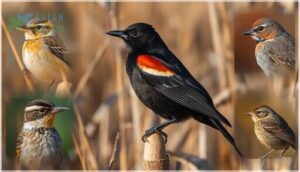
Stripes, spots, and patches tell you exactly what you’re looking at. Field marks—those distinct patterns on a bird’s body—separate similar species in seconds. An eyebrow stripe or throat patch can clinch identification. AI field marks now mimic expert assessment with over 90% accuracy, scanning plumage visual contrast and marking shape diversity to match your photo against millions of labeled images.
| Field Mark Type | Common Examples | ID Value |
|---|---|---|
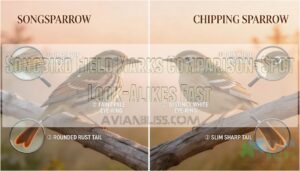
| Facial patterns | Eyelines, eye rings, superciliary stripes | Separates warblers and sparrows instantly |
| Body markings | Wingbars, breast streaks, crown stripes | Distinguishes 700+ North American species |
| Color patches | Throat colors, wing patches, rump spots | Single mark often confirms species |
| Seasonal variations | Breeding vs. winter plumage contrast | Requires knowledge of seasonal mark changes |
| Regional differences | Subspecies marking patterns across ranges | Critical for bird identification tips in overlapping territories |
Look for consistent patterns first. A red-winged blackbird‘s shoulder patch never lies. Regional mark variations appear in populations just 250 km apart, so your field guide should match your location. Lighting and plumage wear affect visibility, making clear photos essential for any bird identifier tool to work properly.
Wing and Tail Characteristics

Wing morphology separates species mid-flight faster than any other feature. You’ll spot raptors by their soaring posture and tail spread, while wing patterns—like the mallard’s iridescent speculum—clinch identification instantly.
Standard measurements in databases track wingspan and tail variability across 11,000+ bird species, powering every bird identifier tool. Flight patterns reveal body proportions that transform birdwatching from guesswork into confident avian identification.
Using Photo-Based Bird Identification Tools

Modern bird identification has never been easier thanks to AI-powered photo tools. These apps can recognize thousands of species in seconds just by analyzing a picture you take.
Here’s how to use them effectively to identify any bird you encounter.
Capturing Clear Bird Photos
Sharp digital photography starts with ideal camera settings. You’ll want a shutter speed between 1/500s and 1/1000s to freeze movement. Set your aperture around f/4 to let in enough natural daylight. For lens choice, use 400mm or longer to capture distant subjects.
Good lighting conditions matter—position yourself with the sun behind you.
Focus techniques like back button focus help you track moving birds. Photo quality directly affects identification accuracy.
Step-by-Step Identification Process
Once you’ve captured a clear photo, upload it to your bird identification app. The AI scans the image in 1–2 seconds, focusing on GISS importance—the bird’s overall shape and size first. It then analyzes feature prioritization like plumage color and wing patterns.
You’ll see ranked species identification suggestions with confidence scores. Always practice result verification by comparing these with field guides to confirm accuracy factors and avoid common bird identification mistakes.
Interpreting AI Results
AI results show confidence scores from 0 to 1. Scores above 0.9 mean very high accuracy for common species. Between 0.8 and 0.9 signals strong confidence thresholds. Anything below 0.7 needs your careful error analysis—check field guides to verify.
User trust grows when you understand these accuracy metrics. For serious species identification or conservation work, always confirm AI results manually. This application guideline helps you avoid common image analysis mistakes.
Understanding Bird Species Information

Once you’ve identified a bird, the real learning begins. Every species comes with a rich set of details that tell you where it lives, what it eats, and how it behaves throughout the year.
Let’s break down the key information you’ll encounter and what it means for understanding the bird you’ve spotted.
Scientific Names and Taxonomy
Every bird has two names. The common name is what you call it in conversation. The scientific name follows strict naming conventions used worldwide in ornithology. This binomial system uses Latin terms for genus and species.
Recent taxonomic revisions rely on phylogenetics to improve avian species classification. Major checklists now achieve strong checklist alignment, helping avian research and species recognition.
Understanding subspecies variation adds depth to identification.
Geographic Range and Habitat
Beyond taxonomy, knowing where a bird lives matters just as much. Each species occupies a distinct habitat within its geographic range. You’ll find raptors in open grasslands while warblers prefer dense forest canopy.
Regional occupancy patterns shift with latitude variation, and habitat loss drives range shifts that affect endemic species.
Understanding these connections sharpens your birdwatching skills and aids wildlife identification across different regions.
Migration Patterns and Seasonal Behavior
When you track migration status, you’ll notice spring arrivals now happen several days earlier than they did two decades ago. Climate impacts drive these timing shifts, especially in warming regions. Nocturnal migration dominates among songbirds, while larger species fly by day.
- Spring migration timing has progressed with temperature increases
- Stopover ecology reveals which sites matter most for refueling
- Route changes occur as breeding ranges shift eastward
Understanding these migration patterns sharpens your bird identification skills during peak birdwatching seasons.
Feeding Habits and Diet
Understanding feeding ecology helps you distinguish between bird species. Chickadees eat up to 35% of their body weight daily, while hummingbirds consume their entire weight in nectar plus 2,000 insects. Dietary composition varies by habitat—desert birds rely 85% on arthropods, while urban diets shift toward plant matter.
Seasonal variation matters too. Conservation impact grows when you recognize how feeding behavior connects to habitat health and species survival.
Vocalizations and Bird Calls
Bird sounds reveal identity as clearly as feathers. Call loudness ranges dramatically—the white bellbird hits 125 dB while urban birds drop volume by 30% in quiet zones. Song complexity varies too, with male Great Tits mastering six distinct songs showing geographic variation. Acoustic adaptation shapes these patterns as vocal learning occurs across populations.
Bird sounds are as distinctive as plumage, ranging from the white bellbird’s deafening 125 dB call to intricate multi-song repertoires shaped by geography and habitat
- Bird calls are short signals for alarms and contact
- Bird songs contain multi-syllabic breeding sequences
- Sounds songs differ by habitat through acoustic adaptation
- Call loudness correlates with body size and environment
- Song complexity increases with species-specific vocal learning
Improving Your Bird Identification Skills

Getting better at identifying birds takes practice and a bit of strategy. Even experienced birders make mistakes when they’re learning new species or spotting birds in tricky conditions.
Here are five practical ways to sharpen your skills and become more confident in the field.
Common Identification Mistakes
Even experienced observers mix up common species for rare ones. Visual feature errors happen in poor lighting or at a distance. AI errors can reach 23% to 63% depending on settings.
Species confusion is highest between look-alikes—think Horned Lark versus McCown’s Longspur. Distribution conflicts flag up to 25% of app-based IDs during migration.
Building your bird ID skills means knowing these birdwatching pitfalls before you hit the field.
Tips for Identifying Raptors
When you’re watching raptors overhead, silhouettes matter most. Look at the head-to-body ratio and wing shape first—hawks soar on broad wings while falcons show narrow, pointed profiles. Plumage patterns help too, like the Red-tailed Hawk‘s dark patagials.
AI tools now reach over 90% accuracy for identifying raptors from photos. Expert networks at hawkwatch sites boost your bird ID skills fast through live practice.
Regional Bird Species Recognition
Where you live shapes which birds you’ll see. Learning your region’s common species speeds up bird identification and helps you spot rarities.
- The Palearctic region holds 18 billion individual birds across Europe and northern Asia
- Deep learning models reach 92% accuracy when trained on regional bird species
- Citizen science projects in China engaged 801 participants at 191 monitoring sites
Habitat recognition bias can affect accuracy, so train yourself across different ecosystems.
Using Multiple Identification Methods
Relying on photos alone limits your bird identification success. Hybrid survey methods that combine visual observations with acoustic-visual integration boost detection rates by 13%.
You’ll catch more species when you cross-validate bird behavior across multiple sources. This observer bias reduction approach improves accuracy in any habitat or region.
Continuous protocol improvement means mixing field guides, apps, and your own ears makes you a sharper bird watcher.
Participating in Citizen Science Projects
Your observations can power real conservation work. Join platforms like eBird or the Christmas Bird Count to log bird species you identify.
Over 100,000 volunteers across 47 states already contribute data that tracks wildlife behavior and migration patterns. You’ll sharpen your bird identification skills while helping scientists monitor populations.
These citizen science projects turn everyday bird watching into meaningful conservation contributions that build public awareness.
Frequently Asked Questions (FAQs)
What if the bird is a juvenile or non-breeding adult?
Juvenile plumage and molting patterns create seasonal variation that increases misidentification risks. AI limitations mean these birds often need manual review.
Watch for streaked feathers and behavior clues to improve bird species identification accuracy.
How do lighting conditions affect identification accuracy?
Light is truth in bird identification. Poor lighting hides field marks and creates AI Lighting Bias in image analysis.
Urban Light Pollution, shadows, and Seasonal Variations reduce Observer Accuracy.
Low-Light Species need clearer photos for reliable bird identification results.
Can hybrids between species be correctly identified?
Hybrid bird identification is challenging. AI struggles with accuracy, often scoring below 90%.
Genetic verification is the best method. Visual analysis alone produces errors.
Citizen science platforms underreport hybrids due to identification difficulty.
What resources exist for identifying birds by sound only?
Like a tuning fork to birdsong, AI-powered apps including Merlin Bird ID and BirdNET analyze audio to identify over 3,000 species.
These bird identification resources boost your birdwatching skills through sophisticated Sound Dataset Scope and AI Model Performance.
How do rare or vagrant species get verified?
Rare bird species require committee expert review before official acceptance. Photographic evidence and audio verification support most submissions. Field verification by trained observers confirms sightings.
Regional boards reject roughly 20% of insufficient documentation annually.
Conclusion
What bird is this? Identification skill comes down to practice and patience. You’ve learned the features that matter—size, shape, color, and markings. You’ve seen how apps speed up the process while sharpening your eye for detail.
Now every walk becomes a chance to test what you know. The more birds you spot, the faster you’ll recognize patterns. Start with common species in your area. Build your skills one sighting at a time. The birds are waiting.