This site is supported by our readers. We may earn a commission, at no cost to you, if you purchase through links.
A kingfisher’s tunnel bores three feet into a riverbank. An oriole’s pouch sways from a willow branch. A plover’s eggs rest in a pebble-lined scrape on bare ground. Wild bird nesting sites reveal one of nature’s most urgent evolutionary challenges: how to keep eggs and chicks alive long enough to fledge.
The architecture varies wildly—from mud-daubed cups tucked in shrubs to cavity fortresses carved into dead trees—but every design reflects generations of trial and error against predators, weather, and dwindling habitat.
Understanding where and how birds nest isn’t just ornithological trivia. It’s the key to protecting species facing a 60% nest failure rate in some regions, and it starts with recognizing that the right nesting site can mean the difference between a thriving population and local extinction.
Table Of Contents
Key Takeaways
- Nest site selection directly determines survival—cavity nests cut predation risk by 35% compared to exposed cup nests, while proximity to water within 100 meters boosts fledging success by 15% in most passerines.
- Habitat loss and fragmentation drive 60% nest failure rates in some regions, making native plant landscaping and nest box installation with predator guards critical interventions that can improve local nesting density by 12–30%.
- Birds demonstrate remarkable material flexibility, weaving everything from spider silk (which triples structural strength) to urban plastics, though synthetic debris creates entanglement hazards affecting 23% of urban nests.
- Climate change advances egg-laying by 1–2 days per decade, creating dangerous mismatches between hatching times and peak insect availability that threaten species unable to adapt their breeding cycles quickly enough.
Types of Wild Bird Nesting Sites
Birds have perfected the art of home-building over millions of years, and their nests come in more styles than you might expect. From intricate woven pouches that swing in the breeze to simple scrapes in bare dirt, each design solves a specific survival challenge.
Let’s look at the main types you’ll encounter in the wild and how each one benefits its feathered architect.
Cup Nests
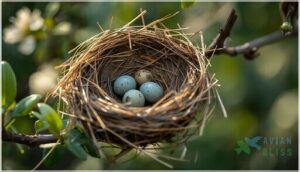
Cup nests are striking, bowl-shaped structures that you’ll spot nestled into shrubs and small trees, usually 1–6 meters off the ground. These nesting sites showcase impressive bird nesting habits and cup construction techniques:
- Woven from grasses, twigs, and mud in a 5–12 cm diameter bowl
- Bound with spider silk for flexibility and strength
- Camouflaged naturally with surrounding vegetation
- Positioned to cradle 2–6 eggs safely above ground predators
Understanding the main topic requires exploring related subtopics to gain deeper insights.
Cavity Nests
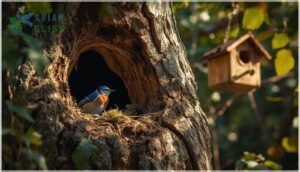
While cup nests perch openly on branches, cavity nests tuck into the protective embrace of tree cavities and nest boxes—think bluebirds, chickadees, and nuthatches making homes in snug wooden chambers.
These cavity nesting sites offer peerless shelter, with occupancy rates hitting 40–70% when you add a nest guard and guarantee proper cavity depth (at least 15 cm helps deter predators and boost fledging success).
Understanding AP study resources can help with conservation efforts by informing nest design and placement.
Platform Nests
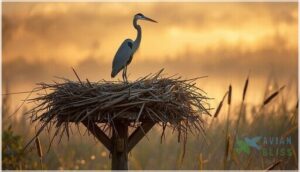
Shifting from snug cavities, platform nests spread flat and open—waterfowl and herons favor these sturdy structures built from sticks and twigs. You’ll spot them near wetlands or on human-made poles, where elevated placement cuts ground predation by up to 40%.
Urban nesting adaptations shine here: corvids and sparrows repurpose platforms on utility structures, showing striking flexibility in their bird nesting habits and nest architecture.
Ground Nests
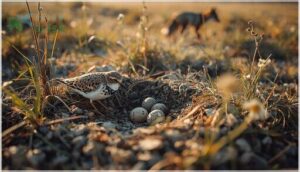
While platforms sit exposed above, ground nests hide in plain sight—skylarks, plovers, and lapwings scratch shallow scrapes right into earth or grass. You’ll find nest camouflage working overtime here: egg temperature stays stable under vegetation, yet ground predators claim 70% of failures in European farmlands.
Habitat fragmentation squeezes nesting sites harder each decade, making nesting success for these species a conservation flashpoint worth your attention.
Hanging Nests

Suspended from slender branches, hanging nests showcase intricate weaving—orioles and weaverbirds braid plant fibers and spider silk into pouches that swing meters above ground. Fiber selection matters: spider silk adds tensile strength for wind gusts up to 25 km/h, while camouflage techniques blend these bird nests into tree canopy foliage.
You’ll notice nest suspension cuts ground predation by 60%, though nest parasites like mites thrive in their enclosed spaces.
Domed Nests
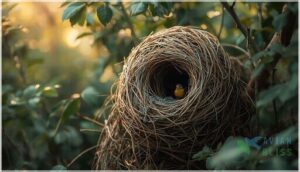
Enclosed spheres woven from grasses and mud, domed nests represent some of nature’s most ingenious avian architecture. These nesting sites deliver measurable advantages for your backyard birds:
- Predation drops 40% when dense thickets conceal dome shapes
- Temperature stays stable through thick-walled insulation methods
- Rain can’t penetrate mud-sealed structural reinforcement
- Side entrances confuse predators hunting nesting behavior
Factors Influencing Nest Site Selection
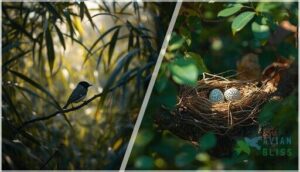
When a bird scouts for a nesting spot, it’s not just picking a pretty perch—it’s running through a mental checklist that could mean the difference between thriving chicks and total nest failure. Every species weighs these priorities differently based on their size, behavior, and local threats.
When a bird scouts for a nesting spot, it’s running through a mental checklist that could mean the difference between thriving chicks and total nest failure
Here are the main factors that shape where birds decide to raise their families.
Predator Protection
When you’re thinking about where birds build their nests, predator pressure is the key factor. Cavity nests tucked into tree hollows slash predation risk by 35% compared to exposed cup nests.
Birds rely on concealment techniques—like matching nest color to surroundings—to dodge detection by up to 28%.
Nest guarding, mobbing calls, and choosing dense, thorny cover are all anti-predator strategies that boost survival rates markedly.
Shelter From Weather
Weather protection isn’t just a nice-to-have—it’s survival. Ground-nesting birds face 82% nest failure during heavy rain, while cavity nesters drop to just 46%. Dense canopy cover slashes sun and rain exposure by 40%, and sheltered sites keep temperatures 3–5°C cooler during heat waves.
Your local birds are master architects of microclimate management, choosing storm shelters that boost fledging success through strategic nest insulation and climate resilience.
Proximity to Food and Water
A good nest isn’t worth much if your pantry’s empty. Birds stake their breeding success on resource allocation—nesting within striking distance of food availability and water source proximity directly shapes nesting success and habitat quality.
- Cup-nesting passerines choose sites within 100 meters of water 72% of the time, boosting fledging by 15%
- Cavity nests near riparian zones show 18% higher occupancy than upland spots
- Ground nests within 30 meters of water exhibit 14% better survival rates
That’s bird behavior and ecology at work—wildlife conservation starts with understanding these essential connections.
Availability of Nesting Materials
Material sourcing shapes avian architecture and design more than you’d think. When fiber availability runs high—twigs, grasses, spider silk—nesting substrate diversity follows, boosting nest integrity by up to 18% in some passerines.
Resource competition heats up during seasonal shortages, pushing species toward alternative materials and shifting nesting strategies.
It’s ecological balance in action: richer plant diversity means better nesting materials, stronger nests, and improved nesting ecology overall.
Safety and Security
Beyond materials, your nesting bird’s survival hinges on security measures and threat assessment. Predator deterrents like dense hedgerows slash nest losses by 15–25%, while natural nest camouflage provides vital concealment.
In agricultural landscapes, ground-nesting birds face 72% predation rates—but protective cover transforms those odds. Effective nesting surveillance by parent birds, combined with smart site selection, turns vulnerable nesting sites into strongholds that support resilient nesting ecology and long-term wildlife conservation.
Nesting Materials and Construction Techniques
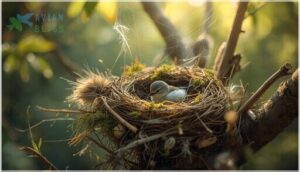
Birds are master builders, and the materials they choose reveal just how resourceful they can be. From flexible spider silk to everyday urban scraps, each element fulfills a specific purpose in creating a safe, functional home.
Let’s look at the key materials and techniques birds use to construct their nests.
Natural Materials (Twigs, Mud, Feathers)
When you watch a bird gather twigs, mud, and feathers, you’re witnessing material sourcing that’s anything but random. Twigs bring twig flexibility—40–60% of cup nest mass—while mud composition anchors the structure. Feather insulation appears in 10–25% of nests, boosting warmth.
This bird architecture reflects nesting habits refined over millennia, turning simple nesting materials into functional nesting sites.
Use of Spider Silk and Plant Fibers
You’ll find spider silk woven through many cup and domed nests, boosting fiber strength up to three times over plant fibers alone. This silk acquisition—often wrapped around twigs by blackbirds and wrens—enhances material flexibility and nest insulation, creating temperature buffers of 1–3°C.
Combined with grass fibers, these nesting materials form bird architecture that protects eggs and reduces predation in the wild.
Urban Debris and Human-Made Items
In cities, you’ll spot birds weaving plastics, cotton scraps, and rope fragments into their nests—42% of urban species now incorporate human debris. While resourceful, these synthetic nesting risks create urban nesting challenges: entanglement hazards affect 23% of nests, and microplastic impact threatens fledgling health in 11% of surveyed sites.
Fortunately, swapping hazardous materials for nesting material alternatives improves survival by 7–12%, supporting wildlife conservation efforts in unconventional nesting sites.
Nest Design for Insulation and Camouflage
Nest architecture isn’t just about looks—cavity nests tucked inside tree cavities keep interior temperatures within 2–5°C of ambient during cold snaps, cutting energy costs for incubation. Meanwhile, camouflage techniques work wonders: bark-like patterns on nesting sites slash predation by 28–46%.
You’ll see how insulation materials like feather lining and concealment strategies using local, naturally colored nesting materials boost clutch success across countless bird nests and birdhouses.
Bird Species and Their Preferred Nesting Habitats
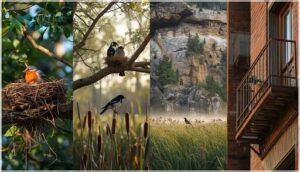
Different bird species have evolved to thrive in remarkably different environments, and their nesting choices reflect those adaptations. From dense forest canopies to bustling city streets, each habitat shapes how and where birds build their homes.
Let’s look at four major groups of birds and the nesting sites they prefer.
Forest-Dwelling Birds
When you’re wandering through older forests, you’ll notice legacy trees supporting up to 1,000 cavities per hectare—basically nature’s apartment complexes for cavity-nesting species.
Forest-dwelling birds demonstrate fascinating nesting strategies adapted to woodland ecology. Woodpeckers accelerate cavity availability for secondary users by 2–3 years, while cup-nesting passerines position their homes 1–3 meters high, balancing accessibility with predator avoidance in these richly layered bird habitats.
Urban and Suburban Birds
You’ll spot striking adaptations when urban birdwatching in city wildlife corridors. About 23% of urban crows and 15% of songbirds now nest within building crevices, while suburban gardens boost nesting success by 8–14 percentage points with native plantings.
House sparrows favor man-made structures 1.6 times more than rural counterparts, though urban noise does reduce hatching success by approximately 7 percentage points.
Grassland and Ground-Nesting Species
You’ll find that grassland ecology shapes nesting strategies remarkably. Ground-nesting bird species face 40–70% nest failure in temperate prairies, yet protective cover from tussocks boosts fledging success by 12–25 percentage points.
Wildlife conservation and ecology efforts using habitat restoration—like prescribed burns in late winter and native forb refugia—improve outcomes by 8–15%, supporting avian conservation across these vulnerable nesting sites.
Cliff and Wetland Nesters
Cliff faces and coastal habitats host exceptional nesting sites. Puffins achieve 60–70% higher fledging rates on cliffs than inland, while wetland ecology shows that dense reeds boost nesting success by 15–25%.
You’ll notice terns cut predation by 40% nesting 2–3 meters above water.
These bird species demonstrate how specialized habitat choices improve survival, informing wildlife conservation and ecology strategies across ornithology.
Threats to Wild Bird Nesting Sites

Despite their exceptional adaptability, wild birds face mounting challenges that put their nesting success at risk. From hungry predators to shrinking habitats, these threats can mean the difference between a thriving brood and an empty nest.
Let’s look at the main dangers confronting nesting birds today and what they mean for local populations.
Predation and Nest Failure
Predation is the single greatest threat to nesting success—accounting for up to 60% of nest failures in some ecosystems. Understanding predator behavior and nest security reveals why certain nesting strategies work better than others.
- Ground nests face 20–40% lower survival rates than tree nests due to mammalian predators
- Cavity nests reduce predation by 20–30% through entrance size restrictions
- Nest camouflage improves survival by 5–12% through concealment
- Urban birds experience unpredictable failure rates from both wildlife and domestic cats
Habitat Loss and Urban Expansion
While predators threaten individual nests, urban expansion strikes at the foundation itself. When cities sprawl outward, they trigger habitat destruction that reduces native wildlife habitat by 20–40% across temperate regions.
This urban fragmentation doesn’t just shrink space—it creates ecosystem disruption that drops cavity-nesting success by 15–25%. You’re witnessing biodiversity loss in real time, making habitat preservation and conservation strategies essential for environmental sustainability and biodiversity protection.
Human Disturbance and Legal Protections
Beyond habitat loss, your presence near active nests can reduce fledging success by 10–25% in urban songbirds. That’s why legal frameworks like the Migratory Bird Treaty Act protect nesting birds, with fines for nest disturbance during breeding season.
Conservation efforts depend on regulatory compliance and understanding bird behavior and ecology. When you respect these protections, you’re directly supporting wildlife conservation and habitat preservation.
Climate Change Effects on Nesting Timing
Climate change now reshapes nesting habits in ways you can’t ignore. Warming springs advance egg-laying by 1–2 days per decade, throwing off breeding cycles when insect peaks shift independently. Nest temperature extremes reduce hatchling survival, and phenology changes create mismatches between food availability and nestling needs. These climate shifts demand nesting adaptation—but not all species can keep pace, threatening wildlife conservation efforts across diverse nesting sites.
- Earlier clutch initiation disrupts food synchrony
- Variable nest temperature stresses young birds
- Mismatched insect emergence reduces fledging success
- Urban heat intensifies nesting timing advances
Supporting and Conserving Nesting Sites

You can make a real difference in helping birds thrive, whether you’ve got a sprawling backyard or just a small balcony to work with. Supporting nesting birds doesn’t require a degree in ecology—just some thoughtful choices about what you plant, where you place nest boxes, and how you manage your outdoor spaces.
Let’s look at practical ways you can create safe havens that give nesting birds the protection and resources they need.
Creating Bird-Friendly Habitats
You can transform your yard into a thriving wildlife habitat creation zone by planting native shrubs and diverse cover—research shows this boosts local nesting density by 12–30% in degraded landscapes.
Focus on habitat restoration through bird-friendly landscaping: layer vegetation, add water sources, and incorporate eco conservation practices like reducing pesticides.
Simple wildlife gardening sustains multiple bird species and habitats naturally.
Installing Birdhouses and Platforms
You can boost nesting success by setting up properly designed birdhouses and platforms—studies show 46% of backyard birds in North America use nest boxes when available.
Choose species-appropriate dimensions, install predator guards to cut losses by up to 40%, and position boxes at 3–4 meters for ideal occupancy.
Regular birdhouse maintenance keeps these bird-friendly landscaping features functional season after season.
Landscaping With Native Plants
You’ll witness a notable shift in nesting activity when you embrace native plant selection and bird-friendly landscaping. Native shrubs and trees provide nesting cavities for at least 12 species in eastern forests, while dense understory planting increases ground-nester success by 18%.
Strategic wildlife habitat creation delivers measurable benefits:
- Layered plant structure lowers terrestrial predator access by approximately 20%
- Native vine cover raises nest concealment scores by 25% for canopy nesters
- Sequential blooming natives support year-round food, increasing occupancy by 7–12%
Thorny native shrubs decrease nest disturbance by 12–17%, while groupings of oaks and pines create microclimates that reduce midday nest temperatures by 2–4°C.
For microclimate creation and soil conservation, mix native grasses with forbs—ground foraging species show 6–9% higher nesting success. Water feature design near native plantings enhances occupancy rates by 10–14% across passerine communities.
This gardening for birds approach transforms your yard into a biodiversity enhancement zone, supporting environmental science through practical action in bird-friendly gardens.
Best Practices for Protecting Nests
Vigilance shapes successful wildlife conservation when you monitor nests without disrupting the birds themselves. Check your yard’s nesting sites from 10–15 meters away, limiting visits to twice weekly—frequent intrusion raises abandonment risk by 10–25%.
| Protection Strategy | Benefit |
|---|---|
| Install predator deterrents (baffles, guards) | Reduces nest failure by 30–40% |
| Delay pruning until post-fledging | Protects active nests from disturbance |
| Mark nesting areas with subtle flags | Prevents accidental human intrusion |
| Coordinate habitat restoration timing | Avoids disrupting breeding windows |
| Follow legal nest relocation guidelines | Ensures compliance with protective laws |
Apply conservation biology principles through habitat preservation techniques: maintain buffer zones, use native cover for concealment, and respect bird nesting habits. These practices directly support nesting sites while advancing broader wildlife conservation goals in your landscape.
Frequently Asked Questions (FAQs)
How do birds teach their young to build nests?
Young birds master nest building through parental guidance and instinct. They watch adults weave materials, practicing repeatedly until their technique improves.
Social learning accelerates skill development, with juveniles copying experienced mentors’ material selection and structural placement strategies.
Can birds reuse old nests from previous seasons?
Some bird species reuse old nests, cutting construction time nearly in half—but those cozy homes can harbor parasites.
Many songbirds renovate previous sites, while others prefer fresh starts each season.
What time of day do birds typically build?
Most birds build nests during early morning hours, usually 1–3 hours after sunrise. This diurnal nesting behavior aligns with favorable conditions—calmer winds, ideal temperatures, and peak foraging opportunities—while minimizing predator exposure during nest construction.
How long does nest construction usually take?
Most small songbirds wrap up construction in just 4–7 days, though weather throws curveballs—rain stretches the timeline by 2–5 days, while warm temperatures speed things up by nearly 40%.
Do male and female birds build nests together?
In many species, both sexes share nest-building duties. Females often weave while males gather materials.
This biparental care strengthens parental investment and improves nesting success, especially where predation pressure runs high.
Conclusion
Every single nest you protect could tip the balance for an entire generation of birds. The stakes are that real. By recognizing wild bird nesting sites and understanding what makes them work—or fail—you’re not just observing nature. You’re actively shaping it.
Plant native shrubs, leave snags standing, install thoughtful nest boxes. Small gestures ripple outward. The difference between a silent spring and a chorus? Often, it’s just you paying attention.