This site is supported by our readers. We may earn a commission, at no cost to you, if you purchase through links.
Step outside on any quiet morning and count how many birds you notice before your coffee goes cold. Most people spot three or four—robin tugging a worm from the lawn, cardinal blazing red at the feeder, chickadee hanging upside down from a branch like it’s showing off.
What surprises most beginners is how few common bird species actually make up the majority of what we see every day. North America hosts over 900 species, yet the same dozen or so show up in backyards coast to coast.
Learning to tell them apart—by color, call, even the way they fly—opens up a whole new layer of the world you’re already living in.
Table Of Contents
- Key Takeaways
- Most Common Backyard Bird Species
- How to Identify Them Fast
- Birds by Habitat and Range
- Favorite Feeder Foods and Visits
- Seasonal Patterns and Conservation
- Frequently Asked Questions (FAQs)
- What are the 10 most common birds?
- What juice is safe for birds?
- What are the 10 basic birds names?
- What do baby birds eat in the wild?
- How long do common birds typically live?
- Why do birds sing at dawn and dusk?
- Can birds recognize individual human faces?
- What diseases can birds transmit to humans?
- How long do common backyard birds typically live?
- Do birds carry diseases transmissible to humans?
- Conclusion
Key Takeaways
- A dozen or so species—robins, cardinals, chickadees, jays, sparrows, and finches—make up most of what you’ll see in North American backyards, even though over 900 species exist on the continent.
- You can ID birds fast by stacking four quick clues: body size, color pattern, bill shape, and flight style—no field guide required, once you get the hang of it.
- What you put in your feeder matters more than where you put it—sunflower seeds draw the widest crowd, while suet keeps cold-weather birds like woodpeckers and chickadees fueled through winter.
- Bird ranges are actively shifting northward as winters warm, and habitat loss is the single biggest pressure driving long-term population declines across nearly every common species.
Most Common Backyard Bird Species
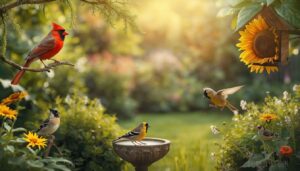
Some birds show up in your yard so often; you probably know them by heart. But knowing a name is different from really knowing a bird — its habits, its quirks, what it actually wants from your feeder.
A good starting point is matching your feeder to each species — these bird feeding food tips by bird type break down exactly what your regulars are actually hungry for.
Here are six species you’ll almost certainly spot.
American Robin
The American Robin is one of the easiest wins in identification of North American birds — that bold orange chest gives it away instantly. Males are darker-headed; females are more olive-gray.
Watch their lawns-and-ledges lifestyle: they tug out earthworms with impressive focus.
Courtship displays, molting patterns shifting seasonally, smart predator avoidance instincts, and a lifespan averaging two years make this thrush endlessly fascinating to observe.
Their clutch usually contains four pale blue eggs.
Northern Cardinal
From a worm-hunter to a showstopper — meet the Northern Cardinal.
The male’s vivid red plumage and Crest Coloration make him unmistakable at any feeder. He’s a year-round neighbor, relying on Winter Food Sources like sunflower and safflower seeds.
Three things that make cardinals fascinating:
- Vocal Repertoire includes sharp chirps and rich whistled phrases
- Territory Defense stays active all year long
- Nest Site Selection favors dense shrubs 1–4 meters up
House Sparrow
Now, the House Sparrow — perhaps the boldest of all common backyard bird species. These chunky little birds measure just 14–16 cm, but their territorial behavior is anything but small.
Males flash a black bib and white cheeks like a badge of authority at any bird feeding station. Watch for their molt patterns in fall — that bib softens noticeably.
Compact, scrappy, and endlessly entertaining.
House Finch
If the House Sparrow is bold, the House Finch is charming.
Males wear a rosy-red blush across their face and chest — intensity shaped by diet and population genetics. At 5–6 inches, they’re built for urban adaptation, nesting in your eaves or hanging baskets.
Their seed and suet preferences make sunflower feeders irresistible. Listen for their bright, warbling song year-round.
Blue Jay
Few backyard birds command attention quite like the Blue Jay.
That electric blue, bold black necklace, and signature raised crest — Crest Erection signals everything from alarm to excitement. They’re a staple of urban bird populations in the US.
- Acorn Preference drives their oak woodland habitat and range of common birds.
- Winter Flock Dynamics make them noisy, social feeders at your station.
- Juvenile Plumage is duller, missing the sharp adult necklace.
- Cooperative Breeding and hawk mimicry keep the whole family safe.
Black-capped Chickadee
If there’s one bird that earns its spot at every feeder, it’s the Black-capped Chickadee.
From coastal forests to prairie edges, this bold little bird shows up almost everywhere—making it a great starting point if you’re just getting into identifying common bird species in North America.
| Trait | Detail |
|---|---|
| Size | 5–6 inches, ~12 grams |
| Nesting Box Preferences | Dead tree cavities or nest boxes |
| Winter Food Shifts | Cache Behavior — seeds stored for cold months |
| Predator Alerts | "Chick-a-dee" calls signal threat level |
Their Bird vocalizations and calls are surprisingly complex — more dee notes mean bigger danger. Stock your Bird feeding station guide with sunflower seeds and suet, and they’ll show up daily.
How to Identify Them Fast
Once you know what to look for, identifying birds gets surprisingly quick. The trick is breaking it down into a handful of simple clues you can check off in seconds.
Here’s what to focus on.
Size and Body Shape
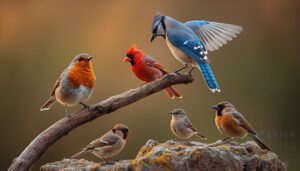
Size is your first clue — and honestly, it’s one of the best Bird ID Skills you can sharpen. Here’s a quick bird identification guide by length:
- American Robin – 10–11 inches, sturdy and round
- Blue Jay – 9–12 inches, sturdy with a broad frame
- Northern Cardinal – 8–9 inches, compact and chunky
- House Finch – 5–6 inches, small with a bulky chest
- House Sparrow – 4–5 inches, short and plump
These Body Shape Adaptations reflect real Size-Related Habitat Use. Cardinals maneuver dense shrubs; sparrows squeeze through urban clutter. Tail Proportion Metrics matter too — robins carry longer tails, finches go short and square. Seasonal Body Mass shifts also affect how birds look in winter versus summer, so trust your eyes and note the whole silhouette.
Color Patterns and Markings
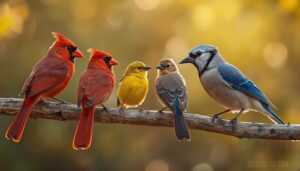
Color is your shortcut — if you know what to look for. Sexual Dimorphism makes this easier than you’d think: male Cardinals wear full crimson, females go warm brown with red hints. That’s not random — it’s evolution.
Seasonal Plumage Shift changes birds too; goldfinches go dull in winter, bright yellow in spring.
Factor in Structural Iridescence on jays, and your Bird ID Skills level up fast.
Bill Shape and Tail Length
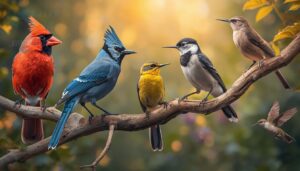
Think of a bird’s bill as its lunchbox. Dietary Bill Morphology tells you everything — seed crackers like Cardinals have short, stout beaks, while insectivores go slimmer and pointier. Bill Curvature Variations and Thermoregulatory Bill Size add another layer.
Tails matter too: Maneuverability Tail Length and Tail Feather Stiffness separate the acrobats from the straight-line fliers in any bird identification guide.
Flight Style and Posture

Watch how a bird moves — it’s your fastest Bird identification guide shortcut.
Wingbeat Patterns tell the story instantly: cardinals glide smoothly with drooped wings, while sparrows use rapid, compact beats.
Body Tilt and Tail Dynamics reveal even more — robins stay nearly horizontal, tails fanning on landing.
Flight Speed and subtle Soaring Techniques separate species faster than color ever could.
Songs and Calls
Sound is your secret weapon. Once you know the dawn chorus timing — that explosion of bird vocalizations just before sunrise — you’ll ID species before you even lift your binoculars.
Bird song identification techniques rely on recognizing patterns: cardinals whistle "birdie-birdie," robins repeat "cheer-up."
Even alarm call function differs by threat. Your ears, honestly, work faster than your eyes.
Birds by Habitat and Range
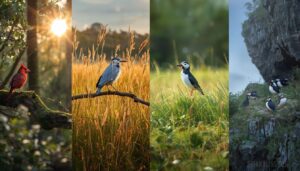
Where a bird lives tells you almost as much as what it looks like. Once you know the habitat, you’ve already narrowed your list down before you even raise your binoculars.
common species break down by the places they call home.
Urban and Suburban Neighborhoods
Your backyard is basically a five-star hotel for birds — and whether you’re in a dense city block or a quiet suburb, urban and suburban bird habitats are surprisingly rich. High Walkability Index streets with good Street Tree Coverage attract common bird species in the United States like Northern Cardinals and Black-capped Chickadees.
Even noise levels and parking policies shape which feeder birds show up for sunflower seeds.
Forests and Woodlands
Step into the woods, and everything changes. Forests and woodlands operate in layers — from emergent treetops down through canopy layer dynamics, midstory shrubs, and understory plant communities teeming with life.
Woodpecker species diversity thrives here, exploiting cavities for nesting. These wildlife connectivity corridors link habitats seamlessly, while soil nutrient cycling keeps the whole system humming beneath your feet.
Grasslands and Open Fields
Swap forests for open sky, and you meet a whole new crowd. Grasslands reward birds that love wide horizons — think Red-winged Blackbird, Eastern Bluebird, and American Goldfinch, each with distinct habitat preferences.
- Native grass restoration and fire management keep woody shrubs out.
- Pollinator corridors and wildflowers support the food web.
- Grazing regimes and soil carbon storage shape ground-nesting success.
A smart seed mix makes all the difference.
Wetlands and Waterways
Wetlands and waterways are where birding gets truly wild. These soggy, reed-filled edges punch way above their weight — delivering Flood Mitigation, Water Filtration, and Carbon Sequestration all at once.
Habitat Biodiversity here is stunning: Great Blue Herons stalk the shallows, Red-winged Blackbirds claim every cattail, and rails vanish into the reeds. A healthy Riparian Buffer sustains entire wetland bird communities, you won’t find anywhere else.
Year-round Residents Vs Migrants
Think of your backyard as a shared apartment — some tenants never leave, others show up seasonally.
Year-round residents like Northern Cardinals hold tight territories year-round, relying on Diet Flexibility and a small Home Range Size to survive winter. Migrants, meanwhile, follow Breeding Phenology cues, timing arrivals perfectly.
This mix drives Population Turnover and keeps Seasonal bird behavior in the US endlessly fascinating to watch.
Favorite Feeder Foods and Visits
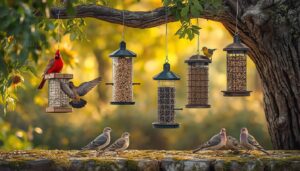
What you put in your feeder matters more than most people realize. Different birds are picky eaters, and the right food can turn a quiet yard into a busy little hotspot.
Here’s a breakdown of what actually works and for which birds.
Sunflower Seeds and Safflower
Sunflower seeds are basically the universal currency of backyard bird feeding. Their nutritional profiles are impressive — around 584 calories and 51 grams of fat per 100 g — giving common backyard birds in the United States serious energy.
Sunflower seeds are the universal currency of backyard bird feeding, packing 584 calories per 100g of pure avian energy
Safflower’s thinner shell thickness and lower oil yield make it a smart secondary choice, especially since squirrels tend to ignore it. Both seed sizes impact which species visit your feeder.
Suet, Peanuts, and Mealworms
High-Fat Suet is basically bird fuel — hitting 7 to 9 calories per gram; it keeps woodpeckers and chickadees going through bitter cold snaps. No-Melt Suet works year-round without turning into a greasy mess.
Toss in Protein-Rich Mealworms for bluebirds and wrens, and always choose Peanut Safety-certified, unsalted nuts.
These Blend Formulations cover the widest range of typical North American feeder birds, fast.
Cracked Corn, Millet, and Fruit
Cracked corn, millet, and fruit are the budget-friendly trio that sparrows, doves, and thrushes absolutely love. Cracked corn is pure carbohydrate energy — great for ground feeders, but watch your Varmint Management since squirrels and raccoons find it irresistible. White proso millet nails Nutritional Balance for finches.
Store both with smart Storage Conditions — cool, dry, sealed — and practice solid Feeder Hygiene by rotating fresh batches weekly.
Nectar and Hummingbird Feeders
Hummingbirds run on pure sugar — and getting the Nectar Recipe Ratios right matters more than you’d think. Nail these basics:
- Mix 1 part sugar to 4 parts water (Hummingbird nectar done right).
- Follow Temperature Storage Guidelines — refrigerate up to two weeks.
- Add Bee Guard Design ports to keep insects out.
- Apply Cleaning Protocols weekly, more in heat.
Feeder Placement Strategies and the Rufous Hummingbird’s migration timing do the rest.
Best Feeder Setup for Common Species
Once your nectar feeder’s sorted, the rest of your setup deserves the same attention.
Feeder Height matters — aim for 4 to 6 feet off the ground. Keep Window Distance at least 10 feet to prevent collisions. Choose Shade Placement to slow spoilage.
Add a Squirrel Baffle, stick to a solid Cleaning Schedule, and you’ve cracked backyard birding.
Seasonal Patterns and Conservation
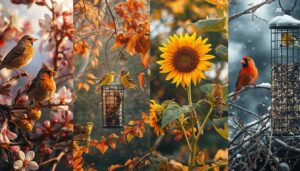
Birds aren’t the same year-round — their habits shift with every season, and so should your approach to watching and supporting them. From winter feeder crowds to spring nesting rushes, there’s always something new happening in your backyard.
Here’s what you need to know about seasonal patterns and how they connect to the bigger conservation picture.
Winter Feeder Changes
When cold snaps hit, birds ramp up their energy intake by 20–30% — so your feeder becomes a lifeline. Winter bird feeding practices matter more than most people think.
Switch to high fat seeds like sunflower hearts, add suet feeders, and don’t skip feeder hygiene — mold spreads fast in damp winter air.
A heated water dish and roosting additions nearby make a real difference.
Spring Nesting Behavior
Spring flips a switch. As daylight stretches, nest construction timing kicks in fast — most birds start building within a week or two of pairing up.
Here’s what’s happening in your yard right now:
- Material selection — grasses, mud, and spider silk get woven into sturdy cups
- Egg laying schedule — one egg daily, 3–5 total
- Parental feeding frequency — every 10–20 minutes, all day
- Predation defense strategies — alarm calls, distraction displays, clever nest placement
Nesting habits, territorial behavior, and habitat preference all shape where and when this unfolds. Watch closely — it’s worth it.
Migration and Local Movements
Once nesting slows, bird movement picks up. Partial migration kicks in — some birds leave while others stay put year-round.
Watch flocking dynamics shift as birds band together, using navigation cues like the Earth’s magnetic field and stars. Many follow migratory pathways through key stopover sites to rest and refuel.
Smart feeder placement keeps your yard on their radar.
Range Expansion in Common Birds
Birds don’t respect old maps. Climate velocity is literally pushing species northward — some boundaries shift tens of kilometers per decade.
Here’s what’s driving bird species distribution across North America:
- Warmer winters open new territories for cardinals and house finches.
- Urban green corridors connect neighborhoods, easing movement.
- Supplemental feeding impact sustains pioneer populations long enough to breed.
- Dispersal mechanisms like social learning help juveniles follow scouts.
- Phenological mismatches sometimes slow establishment despite favorable conditions.
Habitat Loss and Bird Populations
Habitat loss isn’t just an abstract threat — it’s reshaping bird population trends right in your backyard.
Fragmentation impacts break continuous forests into isolated patches, spiking nest predation through edge effects. Food web disruption follows when native plants vanish, starving insectivores. Migration corridor loss leaves birds stranded mid-journey. Meanwhile, nest site scarcity compounds everything. Even urban and suburban habitats struggle to compensate for what’s disappearing.
Frequently Asked Questions (FAQs)
What are the 10 most common birds?
Some birds thrive in your backyard while others vanish into the wild. The ten you’ll spot most — robins, cardinals, sparrows, finches, jays, chickadees, and more — are masters of urban adaptation.
What juice is safe for birds?
Honestly? No juice is truly safe for birds. Skip citrus juice avoidance isn’t just a guideline — it’s essential. Offer whole fruit moisture instead. Plain water wins every time.
What are the 10 basic birds names?
Your Core Species Top Ten Birds Essential Bird Names starts here — American Robin, Northern Cardinal, House Sparrow, House Finch, Blue Jay, Black-capped Chickadee, Mourning Dove, American Crow, European Starling, and American Goldfinch.
What do baby birds eat in the wild?
Baby birds thrive on protein-rich insects and moisture-rich larvae — nature’s perfect first food.
Parents deliver regurgitated meals at intense feeding intervals, fueling rapid growth before a gradual dietary shift toward seeds begins.
How long do common birds typically live?
Most backyard visitors live 2–10 years, shaped by predation, weather, and food access. Blue jays can hit 20 years max, while robins average just 2– Size matters — bigger birds generally outlive smaller ones.
Why do birds sing at dawn and dusk?
Birds sing at dawn and dusk because of Hormonal Triggers, Circadian Timing, and Acoustic Advantages — cooler, calmer air carries sound farther.
It’s pure Territorial Signaling and Mate Attraction wrapped in one beautiful performance.
Can birds recognize individual human faces?
Yes — and it’s wild. Crows and corvids use comprehensive face processing to remember you for months. Mask experiment insights prove it’s truly about your face, not your jacket.
What diseases can birds transmit to humans?
Most birds are harmless, but some carry real risks.
Avian Influenza, Psittacosis Risk, Salmonella Transmission, Fungal Dropping Infections, and Avian Tuberculosis are the main ones worth knowing — especially if you handle birds regularly.
How long do common backyard birds typically live?
Most common yard birds live 2 to 10 years, though first-year mortality hits hard. A robin might average 3 years, while a blue jay’s average lifespan can hit
Do birds carry diseases transmissible to humans?
Short answer? Yes — but don’t panic.
Birds can carry Zoonotic Pathogens like Chlamydia psittaci and Salmonella, passed through droppings or dust.
High‑Risk Groups include immunocompromised folks and pet bird owners.
Conclusion
Here’s a theory worth testing: once you learn your local common bird species, you don’t just see more birds—you see the whole neighborhood differently.
The yard stops being background noise and becomes a living map. That chickadee isn’t random; it’s a regular. The cardinal isn’t decoration; it’s a neighbor.
Step outside tomorrow morning with fresh eyes. Your coffee might actually go cold this time.