This site is supported by our readers. We may earn a commission, at no cost to you, if you purchase through links.
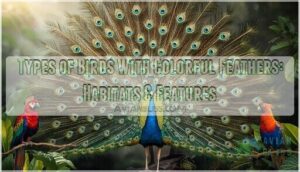
A peacock spreads its tail feathers like a living kaleidoscope, each iridescent eye-spot catching the light in ways that seem almost impossible. This stunning display isn’t just nature showing off—it’s a survival tool millions of years in the making.
From the electric blues of tropical tanagers to the flame-orange crown of a golden pheasant, colorful plumage fills critical functions in the bird world. These vibrant feathers help birds attract mates, defend territories, and even confuse predators with sudden flashes of color.
You’ll discover which species wear the most striking coats, where to find them in the wild, and why some birds look like they’ve been dipped in rainbow paint while others stick to earth tones.
Table Of Contents
Key Takeaways
- Colorful feathers serve three main survival functions: attracting healthy mates through vivid displays, defending territory by signaling dominance, and confusing predators with disruptive patterns that break up body outlines.
- Bird coloration comes from both diet (carotenoids from fruits and insects create reds, oranges, and yellows) and structural features (microscopic feather layers create iridescent blues and greens that shift with viewing angle).
- Tropical rainforests hold the highest concentration of colorful bird species, with Latin America hosting over 4,600 breeding species, but habitat loss has caused grassland bird populations to drop more than 40% since 1970.
- Birdwatching focused on colorful species generates $95 billion globally and directly funds conservation efforts, making ecotourism a critical tool for protecting threatened populations from illegal trade and climate change.
Why Birds Have Colorful Feathers
When you spot a bird dressed in eye-catching colors, there’s usually a good reason behind those striking feathers. From finding the perfect partner to blending into their surroundings, colorful plumage has several important purposes in the bird world.
Let’s explore why these feathered friends evolved such stunning displays.
Purposes of Bright Plumage
Brilliance aids survival in the bird world. You might think bright feathers simply look pretty, but avian coloration does serious work. These vivid displays have evolved for specific reasons:
- Social signaling – Brighter plumage tells rivals about dominance and status, with studies showing intensified colors trigger stronger territorial responses.
- Predator avoidance – Contrasting patterns break up body outlines, making detection harder in complex habitats.
- Mate quality – Saturated colors indicate better parenting ability and physiological health.
Eastern Bluebirds use coloration to signal resource holding potential. Habitat signaling and thermoregulation also play roles in plumage coloration evolution.
Attracting Mates and Courtship Displays
You’ll see the showiest feathers during breeding season, when males compete for attention. Studies across thousands of bird species confirm that brighter plumage dichromatism signals genetic health to females. Display intensity matters too—males performing more elaborate courtship rituals secure most matings.
Visual perception plays a role, since birds detect ultraviolet wavelengths invisible to us. Signal evolution has favored colorful birds whose survival interaction with habitat allows safe displays while attracting mates.
A recent study indicates that natural selection matters in shaping bird plumage as well.
Camouflage and Survival Strategies
While bright feathers attract mates, many birds rely on plumage patterns for predator avoidance. Countershading—darker backs, lighter bellies—helps you blend into environments by matching light and shadow. Ground-nesters choose spots matching their feather colors, improving survival.
Disruptive coloration breaks up outlines against variegated backgrounds, while posture camouflage lets species mimic branches or reeds.
Even colorful birds assess their habitat and adjust escape distances based on how well their bird color patterns conceal them.
Role of Diet in Feather Color
You might be surprised to learn that what birds eat directly shapes their feather colors. Carotenoid absorption from fruits and insects creates red, orange, and yellow pigmentation—flamingos get their pink from astaxanthin in shrimp.
Protein intake during molt affects feather characteristics and iridescence intensity. Even mineral cofactors like zinc support melanin-based bird plumage.
Molt timing matters, too, since coloration depends on pigment biotransformation when new feathers grow.
Iconic Birds With Vibrant Feathers
Some birds look like they’re dressed for a party, with feathers so bright they practically glow in the sunlight. These species have earned their place as some of the most recognized and admired birds on the planet.
Let’s take a closer look at five iconic birds that showcase nature’s most dazzling color palettes.
Lilac-Breasted Roller
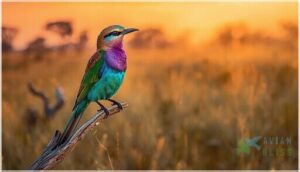
If you’re looking for a showstopper among colorful birds, the lilac-breasted roller delivers. This medium-sized African bird species sports a stunning mix of lilac, turquoise, and green plumage variations that make it instantly recognizable.
- Hunting strategies: You’ll spot rollers perched high, scanning for insects and small prey below
- Nesting habits: They use existing tree cavities rather than building from scratch
- Conservation status: Thankfully, populations remain stable across their savanna range
Their vibrant bird coloration isn’t just beautiful—it reflects excellent health and holds deep cultural significance across eastern Africa.
Scarlet Macaw
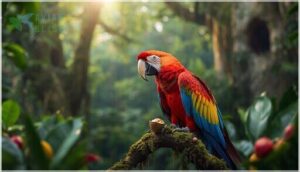
You can’t miss the scarlet macaw—this impressive parrot species stretches over three feet from beak to tail, wearing vibrant red feathers with splashes of blue and yellow. These colorful birds thrive in Central and South American rainforests, cracking tough nuts and dispersing seeds.
Unfortunately, habitat loss and illegal trade threaten populations, though macaw conservation efforts are helping some groups recover. Their breeding habits include nesting in tall tree cavities.
Golden Pheasant
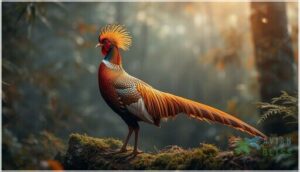
You’ll find the golden pheasant in western China’s dense forests, where males dazzle with their fiery orange crest and golden-yellow body. Plumage genetics and dietary carotenoids work together to create these stunning displays of bird coloration.
Introduced populations exist worldwide, though the conservation status remains Least Concern. In captivity, this pheasant species can live up to 15 years with proper care.
Gouldian Finch
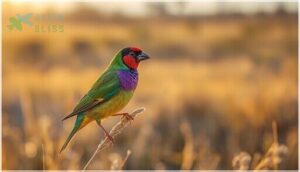
You’ll recognize the Gouldian finch by its head-color morphs—black, red, or rare yellow. This granivore diet specialist inhabits northern Australia’s savannas, where fire management creates patchy grasslands for seed production.
Among colorful birds, finches like this one exhibit striking bird coloration that’s dimorphic between sexes.
The breeding season runs January through April, though wild populations number under 3,000 while captive populations thrive worldwide.
Mandarin Duck
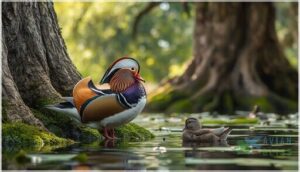
You’ll find the Mandarin duck (Aix galericulata) showcases remarkable plumage dimorphism—males display ornate orange “sails” and multicolored patterns, while females wear cryptic grey-brown feathers. Among duck species, this one’s stunning bird coloration makes it instantly recognizable among colorful birds.
This waterfowl species faces habitat loss challenges despite its Least Concern conservation status:
- Native populations in eastern Russia and China dropped below 1,000 breeding pairs each
- Japan maintains approximately 5,000 pairs as a regional stronghold
- Feral populations now thrive in Europe and North America
- Breeding success depends on mature cavity-bearing trees near water
Unique Features of Colorful Bird Species
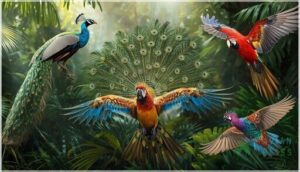
Colorful birds don’t just catch your eye with bright feathers—they also have some truly striking physical features that make them stand out. From plumage that seems to change color as they move to tail feathers that can grow longer than their entire body, these adaptations serve important purposes in survival and reproduction.
Let’s look at some of the most fascinating features you’ll find among the world’s most vibrant bird species.
Iridescent and Shimmering Plumage
Iridescence transforms avian plumage into living rainbows through nanostructure arrangement in feather barbules. These optical mechanisms rely on melanin layers creating multilayer interference—a trick that expands the color gamut by 56% in hummingbirds and traces back to Cretaceous evolutionary origins. You’ll see angle dependence when peacock neck feathers shift from cyan to violet as light hits them differently.
Iridescence in bird feathers creates living rainbows through nanoscale structures that manipulate light, expanding color possibilities by over half and shifting hues with every angle
| Bird Species | Iridescent Feature |
|---|---|
| Peacock | Breast feathers with mechanochromic blue-violet shifts |
| Anna’s Hummingbird | Gorget with narrowband reflectance from melanosome stacks |
| Satin Bowerbird | Ultraviolet chroma controlled by barbule cortex thickness |
| Resplendent Quetzal | Emerald-green coloration from ordered melanosome layers |
| Nicobar Pigeon | Green iridescent plumage across body feathers |
Remarkable Tail Feathers
Beyond shimmering color, tail morphology drives courtship. Long-tailed widowbirds grow rectrices exceeding 20 inches—sexual selection pushing 9–20% past ideal display aerodynamics.
The fossil record shows that tail feather adaptations appeared 120 million years ago in Yuanchuavis, proving early avian plumage invested heavily in mate attraction despite energetic costs.
Species examples like ribbon-tailed astrapias and superb lyrebirds demonstrate how elongated tails sacrifice flight efficiency for reproductive success. Bird tail feather adaptations ultimately balance survival with striking signaling.
Distinctive Male Vs. Female Coloration
Sexual dichromatism is common—males often outshine females in brightness and hue. In many species, brighter plumage signals genetic health to attract mates, driven by sexual selection. Carotenoid-based reds and structural blues show the biggest sex differences.
However, this colorful strategy carries predation risk. That’s why male Eurasian siskins stay more alert at feeders than females.
Ecological context matters too—warm climates with steady resources boost both sexes’ colors.
Seasonal Changes in Color
Many birds don’t stick to one look year-round. Instead, they swap flashy breeding colors for drab winter tones through molting patterns driven by hormonal influence and photoperiod. This shift balances sexual selection with survival—bright feathers attract mates, while muted ones offer camouflage from predators.
Key drivers of seasonal plumage coloration include:
- Biannual molt cycles replacing feathers before and after breeding
- Photoperiod cues triggering hormonal rhythms that time color changes
- Diet availability during molt, especially carotenoids affecting feather pigmentation
Climate impact matters too—birds in highly seasonal environments show more dramatic color shifts than tropical residents.
Habitats and Behaviors of Colorful Birds

Colorful birds don’t just pop up anywhere—they live in specific environments that suit their needs and behaviors. From dense rainforests to open grasslands, each species has adapted to thrive in particular habitats.
Let’s explore where you can find these stunning birds and how they interact with their surroundings.
Tropical Rainforest Dwellers
Tropical rainforests host an astonishing concentration of colorful bird plumage. The Amazon alone contains over 1,300 bird species, exhibiting striking species richness. These layered rainforest habitats create distinct strata—from the forest floor to the canopy—where different tropical birds thrive. Endemism patterns reveal that at least 31 bird families exist only in these forests. However, forest fragmentation threatens avian diversity, making conservation efforts critical for protecting these vibrant ecosystems.
| Bird Species | Rainforest Region | Notable Feature |
|---|---|---|
| Scarlet Macaw | Central & South America | Bright red body with blue-yellow wings |
| Resplendent Quetzal | Central America | Emerald-green feathers, culturally significant |
| Keel-billed Toucan | Mexico to Colombia | Rainbow-colored beak in tropical canopy |
Grassland and Woodland Species
Open landscapes showcase striking plumage patterns from grasslands to wooded edges. Habitat structure shapes which colorful species you’ll find, with grassland specialists declining sharply in North America—down over 40% since 1970. Conservation efforts focus on protecting these vibrant birds:
- Golden Pheasant inhabits Chinese mountain forests with bamboo undergrowth
- Gouldian Finch clusters in Australian savannas with native seeding grasses
- Lilac-breasted Roller thrives across African grasslands and open woodlands
- Splendid Fairywren displays seasonal blue breeding plumage
- Indian Peafowl shows iridescent green feathers in woodland clearings
Land-use change and population trends reveal urgent challenges for maintaining these striking species in their natural habitats.
Social and Breeding Behaviors
Across colorful bird species, you’ll find diverse mating systems ranging from faithful partnerships to elaborate courtship displays. Nearly 90% of birds form social pairs, yet genetic studies reveal 10-40% of chicks have different fathers.
Plumage coloration signals mate quality—brighter feathers often indicate healthier birds.
In lekking species like manakins, males perform coordinated dances while only a few dominant males achieve breeding success.
Migration and Nesting Patterns
During spring and fall, you’ll witness some colorful birds traveling thousands of kilometers between breeding and wintering grounds. Migration distances, climate effects, and individual consistency shape these extraordinary journeys, while nest-site selection directly influences nesting outcomes and survival.
Key aspects of bird migration and bird nesting habits include:
- Bar-tailed godwits complete non-stop flights of 11,000-12,000 km
- Purple martins maintain consistent timing over 12,000-24,000 km circuits
- Nest success rates vary from 33% to 71% depending on habitat selection
- Dense vegetation improves daily nest survival by reducing predation risk
Conservation and Diversity of Colorful Birds

Colorful birds live in nearly every corner of the world, from steamy rainforests to wide-open grasslands. But even though these vibrant species fill about a quarter of all possible bird colors, many face serious threats that put their survival at risk.
Let’s look at where you’ll find the most diversity, what dangers these birds face, and why protecting them matters for everyone.
Global Distribution and Species Richness
You’ll find the highest concentration of colorful birds in tropical regions—Latin America alone hosts 4,626 breeding bird species, double Africa’s count. Latitudinal gradients show tropical forests in Brazil, Indonesia, and Ecuador support bird species 30% more saturated in color than temperate zones. These tropical hotspots, especially the Andes and Southeast Asia, concentrate striking avian diversity.
| Region | Bird Species Count |
|---|---|
| Latin America | ~4,626 breeding species |
| Afrotropical Region | ~2,134 breeding species |
| Southeast Asia | High concentration (smaller area) |
| Jamaica Mountains | 101 species (32 endemic) |
| Sri Lanka | ~29 endemic species |
Global abundance patterns reveal South America leads in bird species richness, with Colombia topping national lists. Endemic areas like the Western Ghats and Madagascar concentrate restricted-range colorful birds, making these habitat and range hotspots critical for preserving tropical bird species and overall avian diversity.
Threats to Colorful Bird Populations
Habitat loss tops the threats colorful birds face—you’ll see rapid population drops when forests shrink below 30% coverage, especially in parrot habitats.
Here’s what endangers them most:
- Illegal trade targets stunning species, with Brazil’s markets moving 4 million wild birds annually
- Climate change cuts tropical bird survival 63% per degree of warming
- Collisions with glass kill over 1 billion birds yearly in the U.S. alone
Wildlife conservation efforts focus on protecting endangered species from these mounting pressures.
Importance for Birdwatching and Ecotourism
Birdwatching generates massive economic returns—you’ll find the global market hitting $95 billion by 2030, with colorful birds driving destination marketing. Here’s what bird species deliver:
| Economic Impact | Value Generated |
|---|---|
| U.S. birder spending (2016) | $39 billion annually |
| Alaska bird tourism jobs | 4,000 jobs supported |
| Colombia birdwatching growth | 40-fold increase since 2010 |
| Rare bird events | $213,000+ per sighting |
| Conservation funding boost | 29% wildlife viewing rise (2011-2018) |
Local livelihoods thrive where tropical birds attract high-value tourists—you’re supporting communities when choosing bird-focused travel.
Growth trends show visitors prioritize destinations with stunning plumage, making birdwatching as a hobby essential for habitat protection.
Frequently Asked Questions (FAQs)
How do colorful birds recognize their own species?
Colorful birds use plumage recognition and multimodal signals like song to identify their own species. For example, wrens combine visual cues with calls.
UV coloration, invisible to humans, also helps birds distinguish similar species through signal divergence.
Can colorful feathers indicate a birds age?
Yes, plumage ontogeny reveals age in many colorful birds. Juvenile plumage often appears duller than adults, while color intensity in carotenoid-based feathers increases with age. Older males display brighter, more saturated pigment correlates.
Do colorful birds have different predators than dull birds?
Think of a hawk’s eye scanning the forest—it hunts both colorful and dull birds. Predators are the same, but conspicuousness and survival differ.
Bright plumage increases predator detection distances, raising color-related predation risk for colorful birds.
How long does it take feathers to grow back?
Most birds regrow feathers during their annual molt cycle, which can take several months. However, if you manually remove a feather, regrowth generally begins within two to three weeks.
What are the most colorful nocturnal bird species?
Most nocturnal bird species feature subdued browns and grays for camouflage, but exceptions exist.
The kakapo displays moss-green plumage, while barn owls show striking white coloration that actually enhances hunting success under moonlight.
Conclusion
Like nature’s own jewelry box, the world’s types of birds with colorful feathers reveal evolution’s boldest experiments. You’ve seen how diet shapes hue, how iridescence catches light, and why males often outshine females.
These vibrant species face real threats—habitat loss, climate shifts, illegal trade—but they also drive ecotourism and conservation funding.
Next time you spot a flash of scarlet or electric blue overhead, you’re witnessing millions of years of survival strategy in motion.