This site is supported by our readers. We may earn a commission, at no cost to you, if you purchase through links.
You’ll find around 900 bird species across Europe—more than triple the diversity of North America’s entire eastern seaboard. From the robin’s red breast in your garden to the blackcap’s silvery song echoing through ancient woodlands, these birds don’t just inhabit the landscape. They define it.
Yet many species you might consider common are disappearing faster than most people realize, their decline masked by the handful of urban adapters thriving in cities. Understanding which birds call Europe home, where they live, and what threatens their survival gives you the knowledge to recognize what’s at stake.
Whether you’re scanning treetops in the Scottish Highlands or listening to the dawn chorus in a Berlin park, knowing these species transforms casual observation into genuine connection with the continent’s living heritage.
Table Of Contents
Key Takeaways
- Europe hosts roughly 900 bird species, but many common ones are vanishing faster than most people realize—masked by the handful of urban adapters thriving in cities while farmland birds have crashed by about 50% since 1980 due to agricultural intensification and habitat fragmentation.
- Physical traits like plumage colors, songs, and foraging behaviors vary wildly across species—from the European Robin’s blazing orange breast to the Eurasian Jay’s electric-blue wing patches and remarkable ability to cache thousands of acorns that regenerate oak woodlands.
- Conservation hinges on EU legal frameworks like the Bird Directives and protected areas covering roughly 20% of the continent, where breeding success jumps 25% compared to unmanaged sites, proving that habitat preservation actually shifts species toward recovery.
- Responsible birdwatching means staying at least five meters back to reduce stress, avoiding playback calls at sensitive sites, and sharpening identification skills through observer training—which cuts misidentification by 6–15% and strengthens data quality for ornithological research.
Most Iconic European Bird Species
Europe’s skies and gardens are home to some of the world’s most recognizable birds. You’ll find species here that have inspired poets, puzzled scientists, and become regular visitors to backyard feeders across the continent.
Let’s look at nine birds that define the European avifauna—each one distinct in appearance, behavior, and the role it plays in local ecosystems.
Common Chaffinch

The Common Chaffinch is a true rebel of European bird species—thriving where others struggle, adapting freely across woodlands and gardens. You’ll spot males by their blue-grey crowns and pinkish breasts, while females wear subtler brown tones. Watch for white tail flashes in flight.
What makes chaffinches remarkable:
- Chaffinch migration patterns vary—northern birds journey south while western populations stay put year-round
- Bird feeding shifts seasonally from insects during breeding to seeds in winter months
- Nesting habits involve cup-shaped structures hidden in dense shrubs, producing 4-6 eggs per season
- Feather molting transforms juveniles into adults during their first autumn
- Beak structure efficiently cracks small to medium seeds, shaping local plant communities
Their abundance across Europe—millions in the UK alone—proves that European bird conservation efforts work when habitats remain diverse. European wildlife preservation benefits greatly from these adaptable passerines thriving in mixed woodlands and human-modified landscapes alike. Students can explore AP study resources to learn more about science subjects like biology.
European Robin

While chaffinches flaunt their colors boldly, the European Robin takes a quieter yet equally iconic path. You’ll recognize its red-orange breast instantly—a signature that makes Robin Migration Patterns fascinating, as some stay put while others head south.
The European Robin Diet switches from insects to berries in winter, showing impressive Robin Winter Survival skills. Robin Nesting Habits favor dense shrubs in gardens, making Garden Bird Feeding essential for Conservation of European Birds across diverse habitats.
Eurasian Blackcap
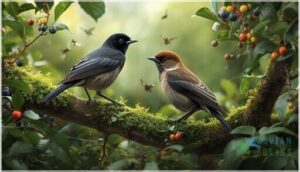
The Eurasian Blackcap breaks the mold with its distinctive cap—jet black on males, rusty brown on females. You’ll spot this warbler across temperate forests where Eurasian Habitat meets dense undergrowth. Blackcap Migration fascinates researchers: some populations now winter in Britain instead of Africa.
Their Blackcap Diet shifts seasonally:
- Spring insects fuel breeding energy
- Summer caterpillars nourish nestlings
- Autumn berries trigger Feather Molting
- Winter ivy sustains survivors
Conservation of European Birds benefits from their adaptability to garden feeding. Understanding theme identification techniques is essential for effective analysis of bird species and their habitats.
European Wood Pigeon

If you’ve admired a large pigeon in your park lately, that’s likely the European Wood Pigeon—largest of all pigeon species. You’ll recognize its pale grey body, pinkish breast, and white neck patch.
Woodland Ecology drives its crop selection: wheat, maize, and acorns dominate its diet. Pigeon Migration patterns vary regionally, with some populations staying year-round.
Nesting Habits involve flimsy twig platforms in trees, where Feather Molting later reveals age. Woodland Bird Conservation benefits from understanding European Bird Species like this adaptable Eurasian Wood Pigeon.
Eurasian Blackbird
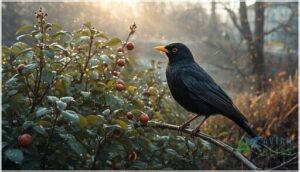
You’ll spot the male European Blackbird by his glossy black plumage and bright yellow eye-ring—this Common Blackbird ranks among iconic Bird Species of Europe.
Breeding Habits include cup-shaped nests in shrubs, while Feeding Strategies shift from invertebrates in spring to fruits in autumn.
Migration Patterns vary regionally; many stay year-round. Territorial Behavior peaks during breeding, and Population Dynamics remain stable across urban and woodland habitats.
Eurasian Collared Dove

You’ll recognize this pale brown bird by its black neck collar and pinkish underparts—a standout among European Bird Species. Collared Dove Diet centers on seeds and grains, perfect for Urban Nesting in gardens.
Dove Socialization peaks in winter flocks, while Dove Migration stays minimal across most of Europe. Their soft Feather Camouflage aids survival in cluttered city habitats alongside European Wildlife like the Eurasian Magpie.
Dunnock

You won’t mistake the Dunnock for showier Garden Birds—its dull brown streaks and quiet manner let it slip through leaf litter unnoticed across European Wildlife haunts.
Nesting Habits favor dense hedgerows, yet Habitat Fragmentation threatens these European Bird Species in farmland zones. Dunnock Migration remains minimal; most populations stick close year-round.
Conservation Status reads Least Concern, though Bird Conservation Efforts monitor declines where intensive agriculture removes ground cover essential for Bird Feeding and nesting success.
Eurasian Jay

You’ll hear a Eurasian Jay’s harsh “jay” alarm before you spot its pinkish-brown body and electric-blue wing patches slicing through deciduous canopy—it’s a living link in Forest Ecology across temperate Europe.
- Acorn Storage: Thousands of caches per season fuel winter survival and regenerate oak woodlands
- Jay Behavior: Mimics other European Bird Species and mammals, blending distraction with social calls
- Woodland Conservation: Thrives where mature forests meet Bird Conservation Efforts protecting habitat structure
Magpie

Magpies strut across European Bird Habitats from city parks to farmland edges, flashing iridescent blue-green wings you won’t confuse with European Robin or European Goldfinch.
Their Social Behavior includes clever Foraging Strategies—omnivorous opportunists raiding everything from invertebrates to human scraps. Urban Adaptation keeps populations stable year-round since Magpie Migration is rare; most stay put, building massive Nesting Habits structures that rival any Bird Watching spectacle.
Habitats and Distribution Across Europe

Birds don’t follow human boundaries—they carve out their territories based on what they need to survive. From dense forests to bustling city parks, each species has adapted to thrive in specific environments across Europe.
Let’s break down where you’ll find these iconic birds and how they’ve claimed their corners of the continent.
Forest and Woodland Birds
Europe’s forests boast remarkable avian diversity, with tree canopy structure playing a pivotal role in shaping woodland bird communities. Deciduous forests are particularly notable, hosting 48 passerine species, including blackcaps and robins that thrive in dense understory environments.
Forest ecology significantly influences bird migration patterns, with peak detections occurring in late spring as species exploit insect-rich canopies.
Woodland management and bird habitat preservation remain vital, as fragmentation reduces species richness by 15% per 100-kilometer barrier.
Urban and Garden Birds
You’ll spot 5–12 species in most European gardens, with House Sparrows, Eurasian Blackbirds, and European Robins dominating backyard habitats. Garden bird diversity thrives when you set up bird feeders—winter seed stations boost urban bird adaptation by 30–70%.
City bird migration shows partial patterns, with some populations shifting by 20% depending on food availability. Garden bird watching reveals feeder strategies that advance breeding by five days in well-fed populations.
Farmland and Open Countryside Species
You’ll encounter dramatic shifts moving from gardens to agricultural landscapes. Open countryside hosts 60–70% of Europe’s breeding farmland birds, but declines hit hard since the 1980s—habitat fragmentation and intensification stripped away hedgerows and field margins.
Here’s what drives farmland ecology for European bird species:
- Hedgerows boost nest survival markedly
- Mosaic landscapes outperform monoculture fields
- Bird migration patterns shift north with climate change
- Crop timing mismatches threaten breeding success
Wetland and Water-Associated Birds
Step into Europe’s wetlands and you’ll see a wild tapestry where Anatidae, sandpipers, and other waterbirds carve their stories. Wetland Ecology isn’t just mud and reeds—it’s pulsing with aquatic habitats that host bitterns and bustling flocks.
Aquatic Avian Adaptations shape each marsh and muddy bank, while conservation across coastal edges keeps migratory birds circling back each season.
Geographic Range and Migration Patterns
Bird migration stirs the fabric of Europe—each season, familiar flocks trace ancient migration routes, shaped by shifting climates and human footprints. Watch closely: range expansion, habitat fragmentation, and climate shifts rewrite maps and stories.
From urban green belts to wild river corridors, bird tracking has uncovered European bird migration patterns as fluid as the continent itself—nothing ever stands still for long.
Key Physical and Behavioral Traits
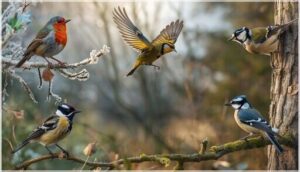
Every bird species in Europe brings its own quirks and colors to the mix. You’ll spot differences in how they look, sound, and even the way they eat.
Let’s take a closer look at some of the main traits that set each species apart.
Plumage Colors and Markings
Ever wonder how Feather Pigmentation shapes your first impression of a Bird Species? From the European Robin’s blazing orange breast to the Magpie’s bold Iridescence Effects, Plumage Variation is nature’s paintbox. Color Patterns shift with Molt Cycles, helping you decode identity, age, and region. Here’s what to look for:
- Nuptial color shifts
- Sex-based dimorphism
- Seasonal dulling
- Regionality cues
- Identification with field guides
Songs, Calls, and Communication
Acoustic Signals are your gateway to Bird Identification—each species broadcasts a signature sonic landscape. The Common Chaffinch’s sharp trill and the European Robin’s fluty dawn chorus reveal Vocal Learning at work, shaping Communication Styles across regions.
Bird Songs peak during breeding, while Bird Calls signal alarm or contact. Tune into these patterns, and you’ll decode Avian Behavior and Ecology hidden in every note.
Unique Feeding and Foraging Behaviors
You’ll discover Avian Behavior and Ecology by watching how European Bird Species tackle meals. Foraging Strategies split by niche—Great Tits boost feeding efficiency 60% at Bird Feeders with mixed diets, while Eurasian Jays nail Cache Management with 90% spatial recall. Seed Preferences and Insect Hunting shift seasonally:
- Urban robins increase insect foraging 25% in parks versus rural woods
- Blackbirds spike berry intake 30% near fruiting hedgerows
- Dunnocks attain leaf-litter invertebrate diversity at 40%
- Farmland birds gain 15–25% more prey near pesticide-free margins
These Feeding Innovations reveal Bird Behavior shaped by habitat and human influence.
Nesting and Breeding Habits
You’ll notice Nest Site Selection varies wildly—European Robins tuck into garden shrubs while European Goldfinches weave high in conifers.
Breeding Cycles kick off March–May, with Great Tits incubating 12–14 days and most passerines raising 1–2 broods. Egg Incubation and Chick Rearing depend on habitat quality; farmland fragments slash Fledgling Success, making Habitat Preservation essential for sustaining Bird Behavior and vibrant Bird Plumage across Europe.
Conservation Status and Threats

Europe’s birds face real pressure from shifting landscapes and human activity, and not all species are weathering these changes equally. Some are holding steady under legal protection, while others struggle as farmland intensifies and woodlands disappear.
Here’s what’s shaping their survival and who’s stepping up to help.
Protected and Endangered Species
Wildlife protection in Europe isn’t just bureaucracy—it’s a lifeline for species on the brink. You’ll find several endangered birds facing real threats:
- Corncrake (Crex crex): declined over 50% across multiple decades
- Lesser kestrel (Falco naumanni): regional recoveries show species recovery is possible
- White-tailed black tern: range contractions from wetland loss
- Red kite: significant population declines despite habitat preservation efforts
- Near-threatened passerines: fragmentation threatens entire populations
Conservation efforts through EU directives provide legal frameworks for endangered species, though enforcement varies widely.
Impact of Habitat Loss and Agriculture
When you turn open fields into industrial cropland, you’re not just changing scenery—you’re dismantling entire ecosystems. European farmland birds have crashed by about 50% since 1980, driven by agricultural intensification and habitat fragmentation. Wetlands drained, hedgerows ripped out, and pesticides eliminating insect prey have triggered ecosystem disruption on a massive scale.
Industrial cropland has dismantled entire ecosystems, crashing European farmland birds by 50% since 1980 through intensification, fragmentation, and pesticide-driven prey loss
| Threat Type | Species Impact | Decline Rate |
|---|---|---|
| Agricultural intensification | Ground-nesting breeding success | ~30% reduction |
| Pesticide use | Insectivorous bird prey availability | 20–40% drop |
| Wetland drainage | Waterfowl and wader communities | 25–40% habitat loss |
| Hedgerow conversion | Small passerine foraging populations | 40% decline |
Habitat preservation and wildlife conservation efforts can reverse these trends, but environmental degradation continues outpacing restoration. You’re witnessing biodiversity loss in real time—farmland bird habitats vanishing while species struggle to adapt. Ecological balance demands urgent action against habitat loss and fragmentation threatening Europe’s avifauna.
Conservation Laws and Directives
You can’t fight habitat loss without legal muscle behind you. Europe’s bird conservation hinges on powerful Wildlife Legislation that turns Environmental Governance into real-world Habitat Protection:
- EU Bird Directives (2009/147/EC) mandate Special Protection Areas for migratory and threatened European bird species conservation
- Habitats Directive (92/43/EEC) shields ecosystems supporting avifauna
- Nature Restoration Law proposals target degraded habitats
- LIFE funding finances Conservation Policies implementation
These Wildlife Conservation frameworks transform Environmental Protection from aspiration into enforceable action against Habitat Loss and Fragmentation threatening Conservation Status of European Birds.
Role of Nature Reserves and Protected Areas
Laws on paper mean nothing without ground to protect them on. Europe’s nature reserves and protected areas—covering roughly 20% of the continent—are where Wildlife Conservation turns real.
These zones deliver Habitat Restoration and Reserve Management that stabilize European Birds populations through Biodiversity Protection and Ecological Connectivity.
Inside protected wetlands, you’ll see breeding success jump 25% compared to unmanaged sites. That’s Habitat Preservation working, offering Environmental Protection that actually shifts the Conservation Status of European Birds toward recovery.
Community and Organizational Efforts
Reserves hold the line, but people power the comeback. Collaborative Conservation through Cross-Border Partnerships now links 54% of European bird groups across neighboring nations. Volunteer Engagement jumped 28% from 2019 to 2022, while 63% of ornithological societies run joint Habitat Preservation projects.
Community-Led Initiatives pull in local Stakeholder Engagement, turning backyards into frontlines for Wildlife Conservation Efforts that actually move the needle.
Tips for Bird Identification and Watching

Getting out into the field and identifying birds takes more than just luck—it’s about knowing where to look and how to watch. Whether you’re tracking migrants through a coastal reserve or spotting garden visitors from your kitchen window, a few practical strategies make all the difference.
Here’s what you need to sharpen your skills and make the most of Europe’s remarkable birdwatching opportunities.
Birdwatching Hotspots in Europe
You’ll find Europe’s birdwatching hotspots scattered from Portugal’s coastal corridors—where spring migration peaks in May—to the Baltic’s shorebird-rich estuaries and protected wetlands showing 5–12% waterfowl increases. Avian tourism and wildlife conservation converge at these nature reserves:
- Spain’s southern wetlands: Cross-continental migration routes teem with passerines.
- Northern forests: Boreal specialists thrive in continuous woodland.
- Urban parks: Western European cities host 25–40% higher spring abundances than nearby rural sites.
Best Practices for Responsible Observation
You’ll protect what you love by keeping your distance—stay at least five meters back to cut stress in target species by measurable margins. Respect quiet hours at dawn, skip playback calls, and blur location data for sensitive sites. Observer training slashes misidentification by 6–15%, sharpening your bird identification guide skills and lifting data quality across ornithological research networks.
| Observation Ethics | Bird Disturbance Mitigation | Conservation Guidelines |
|---|---|---|
| No playback calls | 5+ meter minimum distance | Report distress within 24 hours |