This site is supported by our readers. We may earn a commission, at no cost to you, if you purchase through links.
Franklin’s Gull crosses the equator twice a year, traveling over 9,000 miles between the Canadian prairies and the coast of Chile—while a Laughing Gull on the Gulf Coast barely shifts its position at all. Same family, completely different playbook.
Gull migration isn’t a single phenomenon but a spectrum, shaped by food availability, breeding requirements, climate cycles, and centuries of adaptation. Northern Herring Gull populations push south when ice locks up their feeding grounds, while their southern counterparts stay put.
Understanding these differences reveals how migration strategies aren’t fixed instincts—they’re flexible solutions to an ever-changing environment.
Table Of Contents
- Key Takeaways
- Key Drivers of Gull Migration
- Full Vs. Partial Migration in Gulls
- Short-Distance and Resident Gull Species
- Population-Level Migration Differences
- Hybridization and Migration Patterns
- Tracking and Research Methods in Gull Migration
- Individual Variation in Gull Migration
- Climate Change Effects on Gull Migration
- Conservation Implications of Gull Migration
- Frequently Asked Questions (FAQs)
- Conclusion
Key Takeaways
- Gull migration varies wildly by species, with some like Franklin’s Gull crossing the equator twice a year while others, like Laughing Gulls, stay put year-round.
- Food availability, breeding needs, climate shifts, and human activity are the main forces shaping where, when, and how far gulls travel.
- Climate change is causing earlier spring migrations, shifting routes, and increasing risks for both migratory and resident gull populations.
- Tracking tools like banding and GPS tags reveal individual differences in migration strategies and highlight the urgent need for coordinated habitat conservation.
Key Drivers of Gull Migration
Gull migration isn’t random — it’s driven by a handful of forces that shape where and when birds move each year. Some of these factors are purely biological, while others tie directly to the world gulls share with us.
Species differences alone can be striking, as explored in this overview of seagull migration behavior that breaks down how and why certain gulls travel farther than others.
Here’s what’s actually pushing them to pack up and go.
Food Availability and Seasonal Changes
Food is the compass that guides gull migration — when prey becomes scarce or locked beneath winter ice, gulls don’t hesitate to move. Seasonal foraging shifts drive them toward reliable wintering grounds where prey dynamics remain favorable. Think of it as following the buffet: resource access dictates direction.
Winter scarcity reshapes diet and foraging behavior, making food availability the single most predictable trigger for movement across species.
Breeding Ground Requirements
Beyond food, gulls are remarkably selective about where they raise their young — and that selectivity shapes their entire annual journey. Successful nesting success depends on three core resource needs driving nest site selection:
- Stable, low-disturbance terrain supporting colony dynamics
- Proximity to reliable food availability within foraging range
- Habitat selection that minimizes predation pressure
These environmental factors make breeding grounds non-negotiable destinations, not seasonal suggestions.
Weather and Climate Influences
Weather conditions shape gull migration as powerfully as any biological drive. Wind impact is immediate — tailwinds cut energy costs dramatically, while headwinds stall departure entirely.
Storm displacement can push Franklin’s Gulls hundreds of kilometers off-course. Temperature shifts and ocean warming alter prey availability, disrupting established flyways.
Broader climate modes like El Niño quietly reshape climatic patterns that gulls have relied on for generations. Birds often adopt different survival strategies during hurricanes, as described in this overview of bird behavior before a storm.
Human Impact on Migration Patterns
While storms and shifting climates push gulls off familiar flyways, human activity introduces a different kind of disruption — one that’s reshaping migration patterns from the ground up.
Three forces drive this change most sharply:
- Landfills and waste management sites supply anthropogenic food resources year-round, making migration unnecessary for some populations.
- Coastal development and urbanization fragment habitats, forcing behavioral shifts mid-route.
- Fishing practices and pollution effects alter prey distribution, pulling gulls into new wintering areas entirely.
Full Vs. Partial Migration in Gulls

Not all gulls follow the same playbook for migration — some commit to the full journey, while others barely leave their backyard. These differences run deeper than just distance, touching on behavior, species traits, and regional quirks that shape how populations move across the globe.
Here’s a closer look at what separates full migrants from partial ones.
Definitions and Behavioral Differences
Not every gull packs its bags for winter — and that single behavioral choice, to stay or to go, divides gull populations into two fundamentally different survival strategies. Full migrants complete seasonal journeys between distinct breeding and wintering grounds, while partial migration means only some individuals move. Resident gulls don’t migrate at all, revealing striking adaptability insights through individual variation in migratory behavior.
| Strategy | Key Characteristic |
|---|---|
| Full Migration | Entire population relocates seasonally |
| Partial Migration | Only some individuals migrate |
| Resident | Population stays year-round |
Species Exhibiting Each Strategy
Knowing which species commit to full migration — and which don’t — makes the behavioral split concrete. Black-headed Gulls span from Eurasia to India, while Gulf Coast Residents like laughing gulls rarely leave home. Lesser Black-backed Variation is especially striking: some individuals travel 4,000 km to West Africa, others stay within 50 km. Partial migration, it turns out, isn’t one behavior — it’s a spectrum.
| Species | Strategy | Key Behavior |
|---|---|---|
| Black-headed Gull | Full migrant | Eurasia to India/Philippines |
| Sabine’s Gull | Full migrant | Arctic transoceanic routes |
| Laughing Gull | Resident | Year-round Gulf Coast |
| Lesser Black-backed Gull | Partial migrant | 50 km to 4,000 km range |
| American Herring Gull | Partial migrant | Inland breeders shift coastward |
Gulls are impressive for their ability to thrive in a.
Regional and Population Variations
Even within the same species, gulls breeding in Norway and gulls breeding in Portugal can lead surprisingly different lives — one group logging thousands of kilometers each winter, the other barely moving at all. That’s population divergence in action. Geographic influences, local adaptations, and climate shape these regional migration variations more than genetics alone.
These patterns are just one piece of a bigger picture — bird migration types and strategies vary widely across species, shaped by millions of years of ecological pressure.
| Population | Migration Strategy | Approximate Distance |
|---|---|---|
| Norwegian Herring Gull | Full migrant | 2,000–3,500 km |
| Portuguese Herring Gull | Resident | Franklin’s Gull breeds on the Great Plains, then crosses the Equator to winter in South America — 12,000 kilometers one-way |
- Equator Crossing: A twice-yearly feat few species attempt
- South American Winters: Pacific coasts of Peru and Chile serve as primary wintering grounds
- Migration Challenges: Contending with shifting weather systems and shrinking stopover habitats
- Foraging Adaptations: Opportunistic feeding sustains energy reserves during long-distance travel
- Climate Change Impact: Altered migration patterns increasingly affect timing and route reliability
Ecological Adaptations for Long Travel

Covering thousands of kilometers without a pit stop requires more than just strong wings — it demands a finely tuned biological toolkit that took millions of years to develop.
Long-distance gulls rely on ecological adaptation at every level: metabolic adjustments that increase energy storage before departure, flight efficiency shaped by wind-reading navigation cues, and strategic stopover decisions that replenish reserves exactly when needed.
These survival strategies don’t happen by accident — they’re written into the biology.
Short-Distance and Resident Gull Species
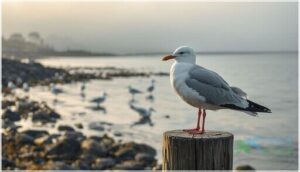
Not every gull needs a passport. Some species stay close to home year-round, or shift only short distances with the seasons, and they’ve got good reasons for it.
Here’s a look at the species and factors that make short-distance movement — or no movement at all — a perfectly smart survival strategy.
Western European Herring Gull Movements
Across the windswept coastlines of western Europe, Herring Gulls don’t follow a single migratory script—many stay put year-round, while others make modest seasonal shifts depending on where they breed and what the weather demands.
These Western Sedentary Gulls demonstrate fascinating local adaptations, with coastal movements rarely exceeding a few hundred kilometers.
Bird migration studies confirm that coastal habitats provide enough year-round resources, making short shifts sufficient for survival within gull migration ecology.
Year-Round Gulf Coast Laughing Gulls
While their European cousins shuffle up and down the coastline with the seasons, Laughing Gulls along the Gulf Coast have worked out a simpler arrangement—they simply don’t leave.
Year-round residency here isn’t laziness; it’s smart ecology. Coastal foraging opportunities remain stable enough that migration patterns become unnecessary.
Warm temperatures, consistent food access, and resilient coastal habitats support strong population stability, making these gulls a textbook example of resident adaptations shaped by local ecology.
Factors Supporting Residency
What keeps a gull planted in one place year-round usually comes down to a few reliable constants: stable food sources, mild climates, and habitat that doesn’t force a seasonal gamble.
Urban areas sweeten the deal—landfills and fishing docks create food availability that doesn’t dry up in winter.
Add reduced predation pressure and strong site fidelity, and year-round residency becomes the smarter evolutionary bet.
Population-Level Migration Differences

Not every Herring Gull follows the same playbook, and that’s what makes this group so fascinating to study. Within a single species, migration behavior can shift dramatically depending on where a population breeds, how far north they nest, and which wintering grounds they’ve historically claimed.
Here’s a closer look at the key population-level differences that shape how these birds move across the continent.
Northern Vs. Southern Herring Gull Populations
Migration distances among Herring Gulls vary dramatically depending on where they breed. High-Arctic breeders travel roughly 7,360 km to Gulf of Mexico wintering habitats, while southern Atlantic coast populations barely move at all—true residency patterns shaped by local climate and food access.
Here’s how latitude shapes their seasonal migration:
- Arctic breeders push south to Louisiana and Texas each autumn
- Newfoundland colonies cover about 2,360 km to mid-Atlantic wintering habitats
- U.S. Atlantic coast gulls remain resident year-round, skipping migration entirely
Migratory Connectivity in North America
Beyond simple north-south movements, North American Herring Gulls maintain surprisingly tight links between their specific breeding colonies and distinct wintering grounds—a phenomenon researchers call migratory connectivity. Each breeding population in effect has its own migration corridor, year after year.
| Breeding Population | Wintering Region |
|---|---|
| Arctic Canada | Gulf of Mexico |
| Great Lakes | Mid-Atlantic Coast |
| Newfoundland | Southern New England |
| Sable Island | Chesapeake Bay |
| Bay of Fundy | Carolina Coast |
Breeding site fidelity keeps these North American populations remarkably separated across wintering grounds.
Distinct Wintering Regions
From the frigid shores of Arctic Canada to the milder waters of the Gulf of Mexico, each Herring Gull breeding population claims its own distinct slice of coastline for winter—territory it returns to with excellent consistency, year after year.
This wintering ground fidelity and population segregation mean geographic zones rarely overlap.
Climate change, however, is already nudging these migration patterns and range shifts in ways that could blur regional connectivity and habitat specialization over time.
Hybridization and Migration Patterns

When two gull species interbreed, their offspring don’t just inherit mixed looks — they often inherit mixed migratory instincts too. This makes hybrids like the Caspian-Herring Gull a fascinating window into how migration is wired into a bird’s biology.
Here’s what that means for gene flow, speciation, and the blurry lines between species.
Caspian-Herring Gull Hybrids
When two species meet at the edges of their ranges, nature doesn’t always draw a clean boundary—and the Caspian-Herring Gull hybrid is a perfect example of that blurred line. These hybrid zones are expanding, partly driven by climate change and range expansion of both species. Here’s what makes gull hybridization and migration patterns so fascinating:
- Caspian Gulls usually migrate farther southeast than Herring Gulls
- Hybrid zones form where breeding ranges overlap in central Europe
- Genetic mixing produces offspring with traits from both parent species
- Hybrid fitness varies depending on local environmental conditions
- Migration evolution in hybrids reflects influence from both lineages
Intermediate Migration Behaviors
Hybrid gulls don’t fully commit to either parent’s migratory playbook—instead, they chart a course somewhere in between, migrating distances and directions that split the difference between Caspian and Herring Gull strategies.
These blended routes reflect genuine behavioral plasticity, with individual differences shaping how far each bird travels. Think of it as mixed strategies in action: some hybrids lean Caspian, others lean Herring, and gradual shifts in their seasonal movements reveal just how flexible adaptive strategies can be.
Implications for Gene Flow and Speciation
Imagine migration acting as a sieve for gene flow—hybrid zones become living laboratories where barriers and divergence mechanisms play out. Philopatry’s role is key, as faithful colony returns reinforce reproductive isolation. Reticulate histories emerge when hybridization blurs boundaries, yet distinct migration routes can still spark speciation mechanisms. You’re seeing gene flow barriers shape gull evolution in real time.
- Gene Flow Barriers limit mixing between populations
- Philopatry’s Role strengthens reproductive isolation
- Divergence Mechanisms arise from varied migration strategies
- Reticulate evolution reflects hybridization’s complex impact
Tracking and Research Methods in Gull Migration

Understanding how gulls actually move across the globe took decades of creative science and a lot of patience. Researchers have developed a handful of key methods that transformed guesswork into real data. Here’s a closer look at the main tools driving that work.
Bird Banding and Ring Re-Encounters
Bird banding has quietly built one of ornithology’s richest datasets over the past century, turning a simple aluminum ring into a passport that traces each gull’s journey across continents.
Ring re-encounter data has revealed striking movement fidelity — many individuals returning to the exact same wintering beaches year after year. Analysis of bird migration using ring re-encounter data also unlocks longevity insights, with some Herring Gulls documented living beyond 30 years.
GPS and Satellite Tagging
Rings can tell you where a gull ended up, but solar-powered GPS tags can tell you exactly how it got there — every stopover, detour, and course correction mapped in real time.
This tagging technology has transformed how researchers interpret seabird migration patterns, revealing individual strategies that banding simply can’t capture. Flight paths now include precise stopover analysis, giving scientists rich data on how migratory movements respond to climate change.
Insights From Tracking Data
What GPS tags reveal goes well beyond simple routes. Tracked gulls show distinct individual differences — some maintain consistent flyways year after year, while others shift corridors entirely. Stopover duration shortens noticeably during spring return trips. Winter foraging spreads across broad ocean bands rather than fixed points.
For Ivory Gulls, migration patterns track sea ice directly, and as climate change shrinks that ice, their journeys grow measurably harder.
Individual Variation in Gull Migration

Not every gull follows the same playbook regarding migration — and that variation is more fascinating than you might expect. Age, sex, and environmental conditions all shape how and when individual birds decide to move. Here’s what drives those differences.
Age and Sex Differences
Not every gull in a flock is playing by the same rules — age and sex can quietly dictate who stays, who leaves, and how far they’re willing to go. Juvenile dispersal usually pushes young birds into unfamiliar territory, while adults follow refined routes shaped by experience effects.
Sex-specific timing also matters — females often depart earlier, reflecting deeper individual differences in migratory behaviors driven by breeding demands and climate change pressures.
Behavioral Flexibility and Decision-Making
Beyond age and sex, individual gulls can surprise you with just how much decision-making happens on the fly. Some birds shift their strategies mid-season based on conditions rather than following a fixed internal script.
Route choice and habitat selection aren’t hardwired; they reflect real-time risk assessment. This behavioral flexibility in animals like gulls means timing cues and strategy shifts vary bird by bird, revealing distinct individual variation in migration strategies.
Environmental Triggers for Movement
Weather, in all its unpredictability, is one of the most powerful forces nudging gulls into motion—sometimes literally overnight. A sudden drop in temperature or shifting weather patterns can flip a gull’s internal switch from “stay” to “go.”
Food availability tied to food cycles, habitat changes along coastlines, and rising sea levels all compound these environmental cues, making migration less a fixed calendar event and more a constant read of climate conditions.
Climate Change Effects on Gull Migration

Climate change isn’t just reshaping weather patterns — it’s rewriting the rules gulls follow every migration season. Some species are adapting faster than others, and not all of them are keeping pace.
Here’s what’s shifting, what’s at risk, and what that means for long-term conservation.
Shifting Migration Timelines and Routes
You mightn’t expect gulls to change their plans so quickly, but climate change is pushing Spring Timing Shifts forward—earlier departures, earlier arrivals, and new migration patterns. While Autumn Route Stability keeps fall movements close to tradition, Inland Habitat Use and diverging Ocean routes show gulls weaving fresh migration strategies as they chase shifting resources and wintering grounds.
Vulnerability of Migratory Vs. Resident Species
Resilience isn’t shared equally among gull species — migratory birds face a gauntlet of climate-driven disruptions across multiple sites, while resident populations stake everything on the stability of a single location. Migration Risks compound across stopovers; Resident Threats center on Habitat Dependence at a single site. Both face Climate Vulnerability, but differently:
- Migratory species encounter Disease Exposure along flyways
- Residents suffer faster species decline when local conditions collapse
- Climate Resilience varies by migratory behaviour flexibility
- Conservation status worsens when breeding and wintering habitats degrade simultaneously
- Resident gulls can’t relocate when their ecosystem shifts
Adaptability and Conservation Concerns
Some gulls are rewriting their survival playbook in real time — shifting routes, adjusting timing, and exploiting new food sources — but adaptability alone won’t outpace the speed at which climate change is reshaping the landscapes they depend on.
Species with strong genetic resilience may adjust future migrations, but habitat protection and coordinated management strategies remain non-negotiable.
Without them, even the most flexible survival strategies can’t offset the compounding environmental threats to wildlife and worsening conservation status across gull populations.
Conservation Implications of Gull Migration

Gull migration doesn’t stop being a conservation issue once the birds land — it shapes every decision managers make about habitat, policy, and genetic health.
The more you understand how these birds move, the clearer it becomes why protecting them requires coordinated effort across borders and ecosystems.
Here’s what that looks like in practice.
Protecting Breeding and Wintering Habitats
If you think of migratory gulls as living bridges between distant ecosystems, then protecting their breeding and wintering habitats isn’t just a conservation goal — it’s the structural work that keeps those bridges standing. Habitat preservation across both ends of the migratory route is essential, since losing either site can collapse an entire population.
- Coastal Restoration stabilizes nesting and foraging areas that gulls depend on seasonally
- Reduce Disturbances near breeding grounds during nesting to prevent abandonment
- Policy Development and Funding must prioritize both breeding and wintering grounds simultaneously
International Cooperation for Migratory Species
Migratory gulls don’t recognize borders, but the humans trying to protect them have to. That’s why Global Policy frameworks and Cross-border Protection treaties matter — species like Franklin’s Gull cross multiple national jurisdictions in a single season. Joint agreements, including those enforced under the International Union for the Conservation of Nature, are the backbone of effective conservation of migratory birds.
| Framework | Region Covered | Focus Area |
|---|---|---|
| AEWA | Africa-Eurasia | Shared Habitats, Treaty Enforcement |
| MBTA | North America | Avian conservation, legal protection |
| CMS | Global | Global biodiversity monitoring, impact of climate change on migration |
Managing Hybridization and Genetic Diversity
While international treaties keep gull populations connected across borders, a quieter genetic story is unfolding within those same populations — one where Caspian and Herring Gulls interbreed, producing hybrids with intermediate migration distances that blur the boundaries between species and complicate efforts to preserve distinct genetic lineages.
Hybrid Zone Management strategies in Conservation Genetics aim to balance gene flow against Genetic Diversity Loss, since unchecked hybridization erodes Species Integrity and weakens reproductive isolation — outcomes with serious Conservation implications of hybridization for long-term population resilience.
Conservation Status and Threat Assessments
Status assessments tell a stark story. Great Black-backed Gulls have declined 43–48% since 1985, meeting thresholds for an IUCN Reassessment from Least Concern to Vulnerable. Ivory Gulls, flagged for Arctic Vulnerability on the IUCN Red List Category, face compounding extinction risk from shrinking sea ice.
Regional Declines often outpace global listings — making Conservation Status Evaluation and Climate Change Impact on Birds genuinely urgent work for threatened species.
Frequently Asked Questions (FAQs)
How do gulls navigate during long oceanic crossings?
Gulls rely on celestial navigation, magnetic fields, and visual cues during oceanic crossings. These layered bird navigation and senses allow remarkably precise, long-haul flight strategies.
Aerodynamic soaring helps conserve energy across vast distances.
What role does moonlight play in gull migration?
Moonlight acts as one of several celestial cues gulls rely on during night flight. With moon phase impact influencing lunar navigation timing and intensity, it helps orient migratory behaviour across open water.
This reliance on environmental cues becomes particularly crucial when stars alone aren’t enough.
How do young gulls learn migratory routes initially?
Young gulls rely on Genetic Predisposition and Instinctive Navigation, guided by Environmental Cues like stars and landmarks.
Social Learning and Imprinting Theory further shape their migratory behaviour during early seasonal journeys alongside experienced adults.
Can urban environments alter gull migratory instincts?
Yes — urban heat islands, coastal development, and year-round food availability can genuinely disrupt migration patterns, encouraging habitat loss adaptation where gulls settle permanently rather than following traditional seasonal routes.
How does prey abundance affect stopover site selection?
Prey abundance shapes stopover site selection directly — where food availability peaks, gulls linger.
Stopover ecology shows that prey distribution drives foraging strategies, pushing birds toward high-quality coastal habitats that support efficient refueling along migration routes.
Conclusion
Like a mosaic built from contrasting tiles, the comparison of gull species migration reveals a far richer picture than any single bird’s journey could suggest. Franklin’s Gull crosses continents while the Laughing Gull barely shifts its zip code—and both strategies work.
Climate change is redrawing the rules, making adaptability the trait that matters most. The gulls that thrive won’t be the strongest fliers; they’ll be the ones that read a changing world clearly.