This site is supported by our readers. We may earn a commission, at no cost to you, if you purchase through links.

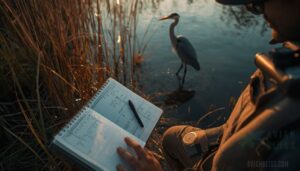
A single observation note, logged precisely and consistently, can turn a casual sighting into a publishable record. Most birders know the feeling—you watched something striking, but by the time you’re home, the details have blurred: was the tail cocked or flat, the call three notes or four?
Field documentation isn’t about bureaucratic record-keeping. It’s the difference between a memory and evidence.
The right gear, the right data points, and a disciplined eye transform your time in the field into something that actually compounds—building a picture of behavior that no single sighting could reveal alone.
Table Of Contents
- Key Takeaways
- Choose Field Recording Gear
- Record Core Observation Details
- Describe Bird Behavior Clearly
- Verify Species With Evidence
- Organize Notes for Analysis
- Protect Sensitive Bird Locations
- Frequently Asked Questions (FAQs)
- When should I document my bird sightings?
- What can I use to document my sightings in eBird?
- What can be used to document a bird sighting?
- How do I document my bird observations in eBird?
- What are the 5 S’s of birding?
- What is the best way to document birds?
- How to correct bird behavior?
- How do I handle disturbances during active observations?
- What clothing minimizes my impact on bird behavior?
- How often should I review and update past records?
- Conclusion
Key Takeaways
- A single, consistently logged observation note — with exact time, GPS coordinates, species name, and behavior — transforms a fleeting sighting into verifiable scientific evidence.
- Your gear setup matters: a weatherproof notebook, H/2H pencils, a fast-shutter camera (1/1000s minimum), and a 32-bit float audio recorder together cover what eyes and memory alone can’t hold.
- Separating observed facts from personal impressions isn’t optional — objective language like "bird probed soil at 08:12" is what makes your notes usable for analysis and peer review.
- Protecting rare species means never publishing exact GPS coordinates publicly; generalize to 10 km resolution for open records and store precise locations behind encrypted, access‑controlled databases.
Choose Field Recording Gear

Your gear is the difference between a complete record and a frustrating gap in your notes. Before you head out, it’s worth knowing which tools actually hold up when conditions get rough.
Here’s what belongs in your field kit.
Weatherproof Notebook or Ring-binder Journal
Your notebook is your field lab — protect it like one. A ring-binder journal with solid Binding Durability withstands rain, mud, and fumbling gloves without complaint. Look for these features:
Pair that with weatherproof paper built for field conditions and your notes stay legible whether you’re caught in a drizzle or knee-deep in a marsh.
Consider using a notebook with polypropylene waterproof paper for full water resistance.
- Cover Material: PVC or Cordura fabric resists abrasion and moisture
- Spine Capacity: 0.5–1 inch rings hold extra pages without bulk
- Page Refills: Swappable packs reduce waste on long projects
- Eco-friendly Options: Recycled polyester covers and FSC-certified paper exist
- Portability: Under 400g keeps your portable notebook for birding pack-light
Pencils, Pens, and Waterproof Paper
Once your journal is sorted, your writing tools matter just as much.
For pencils in the field, lead hardness selection makes a real difference — H or 2H leads resist smearing on water-resistant paper for fieldwork.
Ballpoint ink drying speed runs 2–6 seconds on most synthetic surfaces, keeping notes clean.
Check paper texture compatibility before committing to a pen, and don’t overlook clip attachment durability or eraser performance — both get tested hard outdoors.
Digital Camera With Fast Shutter Speed
Your writing tools carry you this far — now your camera does the heavy lifting.
For sharp photographic documentation of bird behavior, set shutter speed to at least 1/1000s. Fast subjects demand faster: 1/4000s or beyond.
Three settings worth locking in:
- Autofocus Tracking with bird-detection AF for erratic flight
- Burst Mode Optimization at 10–20 FPS for wingbeat sequences
- ISO Management balanced with Lens Stabilization in low light
Portable Audio Recorder for Bird Calls
Your camera freezes the moment — a good recorder captures what eyes miss entirely. The Zoom F3 manages audio recording of bird calls for identification with 32-bit float depth, preserving every pitch shift.
Prioritize microphone sensitivity for distant songs, wind noise reduction with a foam windscreen, and WAV file format selection for lossless quality.
Auto-trigger settings and smart battery management keep you ready when it counts.
Mobile Apps for GPS Tagging and Syncing
Syncing your sightings has never been this smooth. eBird mobile and similar Digital Apps and Online Platforms handle GPS tagging automatically, so integrating GPS data into bird records takes seconds, not hours.
- Offline Data Capture keeps logs running without cellular service
- Geofence Habitat Mapping marks territory boundaries precisely
- Batch Tagging Workflow links multiple birds to one coordinate set
- Real-time Team Sync shares updates instantly across devices
- API Integration Automation pushes records straight to analysis pipelines
Using apps for avian data submission — using Field Guides and Mobile Apps together — sharpens every entry.
Record Core Observation Details
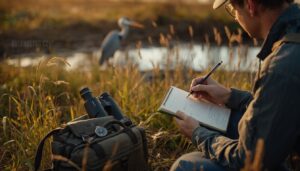
Every solid field record starts with the same foundation: the right details captured at the right moment. Without them, even the most careful behavioral notes lose their scientific value.
Here’s what to log for every observation.
Full Date and Exact Local Time
Every observation starts with a timestamp — and sloppy ones cost you credibility. Log the full date in ISO 8601 formatting (2026-04-30) alongside exact local time to minute level precision, like 07:23.
Precise timestamps matter even more when you’re documenting sightings tied to rare bird habitat protection efforts, where accurate records can directly influence conservation decisions.
If daylight saving documentation applies, note the shift. For timestamp synchronization across multiple observers, everyone references the same clock.
Date time place and weather conditions belong on line one, always.
GPS Coordinates in Decimal Degrees
Pinpoint location data separates a useful record from a vague one. Log GPS coordinates in decimal degrees — format like 48.51234, 13.40872 — and aim for five decimal places, which puts you within roughly 1.1 meters on the ground.
Keep these standards in mind:
- Datum Selection: Always record under WGS 84
- Precision Levels: Five decimals for field use; six for sub-meter accuracy
- Accuracy Estimation: Note your device’s reported positional accuracy or HDOP value
- Coordinate Conversion: Convert DMS to decimal degrees before database entry
- Mapping Integration: Decimal degrees sync directly with eBird, GIS tools, and GPS devices and mapping tools
Capture the exact location at the moment of sighting — GPS location tagging tied to your date and time stamp makes the record analysis-ready.
Weather, Temperature, Wind, and Visibility
Weather shapes everything you see in the field. Log air temperature at 1.5 m screen height, wind speed and direction, and current visibility — fog can drop sightings to under a kilometer.
Don’t overlook microclimate variation: shade versus sun can differ by several degrees within meters. Wind shear near terrain, humidity influence on sound, and visibility constraints all affect bird activity.
Weather logging is core habitat documentation.
Species Common Name and Scientific Name
Naming matters more than most birders realize. Always log both the common name and the scientific name — Binomial Nomenclature Basics — for every sighting:
- Write genus capitalized, species epithet lowercase, and italicized (Setophaga petechia)
- Understand Genus Significance — it groups closely related species sharing key traits
- Recognize Epithet Meaning, since it often describes color, habitat, or a notable person
- Account for Common Name Variability — one bird, multiple regional names
- Follow Naming Conventions aligned with Clements taxonomy for ornithology data standards
Scientific names standardize accurate bird sighting documentation across every platform.
Number of Birds and Age Class
Count every individual you see — don’t round down. Log the exact number of birds, then note age and sex where plumage makes it clear.
Hatch-year birds often show molt limits and fresher feathers than adults, which matters for tracking Juvenile Recruitment Rates and Adult Survival Indicators.
Consistent Age Class Sampling reveals Population Age Structure shifts, and solid estimating bird counts with count verification strengthens your data for Age Ratio Trends analysis.
Describe Bird Behavior Clearly
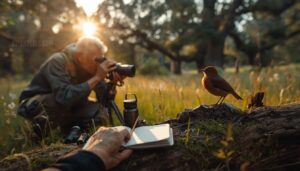
Once you’ve logged the basics, the real work begins: capturing what the bird is actually doing. Behavior tells you far more than a name on a checklist ever could.
Here’s what to watch for and record.
Foraging, Flight, Vocalizing, and Resting
Each behavior tells a story.
Log foraging by noting prey detection strategies—rapid pecking bursts, gleaning patterns, and whether calm morning conditions boosted capture rates.
Capture flight with wingbeat frequency and body tilt.
Document acoustic structure variations in vocalizations and calls by pitch and rhythm.
Habitat influence and temporal activity peaks shape everything, so your behavioral notes on observing and identifying birds in the field must reflect that context.
Movement Patterns and Group Interactions
Movement builds on what you just logged about vocalizations — now watch how the group moves as a unit.
- Flock Alignment happens within a few body lengths: note neighbor influence on direction and pace.
- Evolving Contact Networks shift constantly — track who leads, who follows, and leadership roles mid-flock.
- Synchronization Mechanisms drive cohesion — your behavioral notes and tracking bird counts and flock sizes reveal migration mapping patterns invisible at the individual level.
Posture, Tail Movement, and Feeding Method
Once you’ve logged how the flock moves, zoom in on the individual. Posture tells you a lot.
A crouched feeding posture in small passerines signals active prey pursuit, while tail elevation balance often counterweights the bird during a strike.
Watch for tail flick signaling in finches — it’s a live broadcast to flockmates. Pair beak head coordination with your behavioral notes for reliable posture species identification.
Breeding, Territorial, or Alarm Behaviors
Scale up from individual posture to bigger social signals. A Crest Display or Wing Drumming burst means a boundary dispute — note it fast.
Dawn Singing from sentinel perches marks territory ownership; document species via Audio and Photo Documentation with Recording Date, Time, Location, and Weather Data. Log Species Identification, Common and Scientific Names, and sketch postures using Field sketching techniques and Bird behavior sketching for Nest Fidelity patterns.
Separate Facts From Personal Impressions
Your notes are only as reliable as the line between what you saw and what you felt. That’s where Fact Labeling earns its keep.
- Write "Bird A probed soil at 08:12" — Objective Language, no guesswork
- Move hunches to an Impression Section
- Avoid Subjective Terms like "seemed agitated"
- Run a Fact-Check Workflow against timestamped media
- Apply field note taking techniques to keep personal reflections separate from precise details
Verify Species With Evidence
A gut feeling isn’t enough — solid ID requires actual evidence. Before you call a species confirmed, there are a few key things worth checking off.
Here’s what to look for in the field.
Note Plumage Marks, Bill Shape, and Eye Rings

Three marks together beat one mark alone.
When recording plumage details, note Plumage Contrast first — that bright chest crescent or pale belly is visible even in poor light. Then capture Bill Curvature and Eye Ring Color. Seasonal Molt shifts these visual diagnostic traits, so always record the date.
| Field Mark | What to Note |
|---|---|
| Plumage Contrast | Chest, belly, crown color |
| Bill Curvature | Length, curve, tip shape |
Compare Features With Field Guide Plates

Flip to the right plate and let the illustration do the heavy lifting.
Field guide plates are built for Plumage Pattern Matching — Wing Bar Emphasis, Beak Shape Contrast, and Eye-ring Color Coding are mapped right there.
Use Habitat Cue Integration notes in the margins.
Sketching Plumage and Behavior in the Field alongside Visual Diagnostic Traits sharpens your Species Identification, Common and Scientific Names accuracy, fast.
Record Call Pitch, Rhythm, and Duration

A bird’s voice is a fingerprint.
When you’re Recording Unique Songs or Calls, note three things: pitch, rhythm, and duration.
Pitch Calibration starts with a properly set gain — clipping kills frequency data. Rhythm Quantification means counting inter-onset intervals between notes. Duration Measurement captures each call’s start to finish.
Run Spectrogram Annotation afterward and apply Noise Filtering to confirm what your ear caught.
Use Photos and Audio for Confirmation
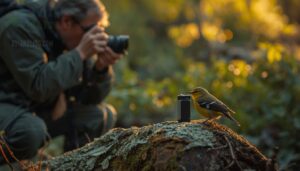
Photos and audio together are your strongest confirmation pair. Shoot at 1/1000 s or faster for Plumage Detail Capture — wing bars and eye rings don’t lie.
Run Call Frequency Analysis on your recorder’s spectrogram to verify pitch. Timestamp Alignment and Metadata Synchronization lock your Audio-Visual Matching to the exact sighting moment, giving reviewers two independent lines of evidence instead of one.
Cross-check Behavior With Species Ethograms
Ethogram Mapping turns raw notes into repeatable science. When you log a foraging bout, match it against Species-Specific Codes before you close your notebook.
- Apply Behavior Coding with Temporal Alignment — note duration and sequence, not just the action.
- Flag behaviors that don’t fit existing categories and document them as ethogram expansions.
- Use Observer Calibration across sessions to keep your labels consistent.
Organize Notes for Analysis

Raw field notes are only useful if you can actually find and use them later. real work happens after you leave the field — turning scattered observations into something structured and searchable.
Here’s how to keep your records tight and analysis-ready.
Use a Consistent Field-note Template
A consistent method matters more than most birders realize.
Standardizing bird sighting entries through Uniform Sections — header, observations, context, and reflections — means you never stare at a blank page mid-session.
Pre-filled Prompts handle Mandatory Fields automatically, and Consistent Formatting facilitates field observation protocols that hold up under review.
| Template Section | Mandatory Fields | Pre-filled Prompts |
|---|---|---|
| Header | Date, time, GPS, observer | "Site name / weather / purpose:" |
| Observations | Species, count, behavior | "Common name (Scientific name):" |
| Review Checklist | Media ID, plumage notes | "Photo ref / audio clip #:" |
Best Practices for Keeping a Field Notebook also mean Managing Abbreviations and Data Consistency across every session.
Label Entries by Date, Species, and Site
Once your template is set, labeling each entry with a Unique Identifier Scheme locks everything together.
Combine Date-Site Coding with a Species Abbreviation — something like "20260429-LKW-AMRO" — and you’ve got instant Version Control without spreadsheet headaches.
Standardized Naming keeps bird sighting entries searchable fast.
Recording Date Time Location and Weather Data alongside Species Identification, Common and Scientific Names, turns raw notes into reliable Field observation protocols with clean Metadata, date time location.
Track Habitat Type and Dominant Vegetation
knowing where a bird matters as much as which bird it was. Log dominant plant communities — Andropogon grasses, willows, cattails — alongside vegetation structure metrics like canopy height and shrub density.
Seasonal vegetation dynamics shift bird use dramatically, so habitat documentation captures that story. Even a quick habitat assessment noting microhabitat features like woody debris or moisture pockets sharpens your analysis considerably.
Transcribe Notes Into a Searchable Database
Raw field notes don’t analyze themselves. Transcribing observations into a structured database — with Full-Text Indexing, Schema Design, and Metadata Tagging for date, time, and location — turns scattered pages into searchable science. Field data management gets serious here.
- Assign unique record IDs per entry
- Index species codes to a taxonomy table
- Set Access Permissions by user role
- Enable Version Control for edited records
Back Up Files Using The 3-2-1 Rule
Lose your field data once, and you’ll never skip this step again.
The 3-2-1 rule keeps your records safe: three copies, two storage media types — like an external drive plus Offsite Cloud — with one copy geographically separated.
Media Diversity protects against wipeout.
Schedule Backup Scheduling quarterly, apply AES-256 Encryption Practices, and run Restore Testing to confirm everything’s actually recoverable.
| Backup Layer | Storage Type | Key Requirement |
|---|---|---|
| Copy 1 | Primary device | Active working copy |
| Copy 2 | External hard drive | Local quick restore |
| Copy 3 | Cloud (offsite) | Encrypted, auto-synced |
| Testing | Restore drill | Quarterly verification |
| Encryption | AES-256 standard | Both media types |
Protect Sensitive Bird Locations

Knowing where a rare bird is can be just as powerful — and just as risky — as the sighting itself. Sharing too much can attract disturbance, poaching, or habitat damage that no one intended.
Knowing where a rare bird nests can be as dangerous to it as any poacher — share wisely
Here’s how to handle location data responsibly.
Limit Exact Coordinates for Rare Species
Rare species detection puts a target on the birds you’re trying to protect. Publishing exact GPS coordinates — even casually in a forum — can trigger poaching or disturbance. Coordinate generalization and data redaction aren’t optional extras; they’re ethical considerations when sharing locations. Follow these privacy thresholds and access permissions to stay on the right side of legal compliance:
- Generalize coordinates to 10 km resolution for public outputs.
- Store exact locations behind access-controlled, encrypted databases.
- Flag sensitive records so automated redaction tools apply before any public release.
Share Only Necessary Location Detail
Not every data point needs to go public. When sharing sightings, think minimum viable detail — enough to support verification, not enough to lead someone straight to a nesting site.
Ethical considerations when sharing locations mean choosing Grid Reference Approximation over pinpoint GPS accuracy in fieldwork. Here’s a practical guide:
| Detail Type | Public Records | Secure Sharing Platforms |
|---|---|---|
| Coordinates | Grid Reference Approximation | Exact decimal degrees |
| Timing | Seasonal Time Frames | Precise timestamps |
| Site | Habitat Descriptors Only | Named location with access notes |
privacy-first metadata protects both species and your credibility in citizen science data collection for ornithology.
Follow Site Access and Ethics Guidelines
Access isn’t just about showing up. Before entering any site, complete your Permit Verification, carry written clearance, and respect seasonal buffer zones around nests.
Stakeholder Communication with landowners keeps doors open for future visits.
Practice Disturbance Minimization — stay quiet, keep distance, never handle birds without approval.
Ethics Training and Data Anonymization round out responsible bird conservation through recorded observations and ethical wildlife data sharing.
Use Reviewer-ready Notes for Unusual Sightings
Unusual sightings demand a different level of care — think of your notes as a legal brief for a skeptical judge. Color‑coding your margin flags (red for urgent, blue for multi‑source corroboration) speeds reviewer communication dramatically. Build every entry around solid Metadata Date Time Location fields, including Time Zone and Altitude Context.
- Flag each entry with a clear color code
- Record exact time in 24‑hour format with Time Zone noted
- Attach Evidence Tagging to every photo, audio clip, or sketch
- Write three independent diagnostic features for Providing Evidence for Rare Bird Observations
- Keep observable facts separate from inferences for stronger Data Quality Assurance
Upload Records to Citizen-science Platforms Carefully
Submitting bird observations to eBird isn’t just clicking upload — it’s the final step in a Verification Workflow that determines whether your data actually counts. Follow Platform Guidelines: include complete Metadata Standards, anonymize coordinates for sensitive species, and flag uncertain records before submission.
Citizen science platforms apply Data Quality Assurance filters automatically, so clean, honest entries move through faster and contribute meaningfully to real conservation science.
Frequently Asked Questions (FAQs)
When should I document my bird sightings?
Document right after the sighting—ideally within 10 minutes. Dawn-dusk windows and rain-post activity are prime moments. Log date, time, and location immediately. Consistent method matters more than perfect conditions.
What can I use to document my sightings in eBird?
The eBird mobile app is your go-to tool.
Use the eBird Checklist Builder to log species, counts, and notes, with Real-time Sync, keeping everything backed up via Cloud Storage Link instantly.
What can be used to document a bird sighting?
You can use traditional field notebooks, smartphone photography, digital voice recorders for bird calls, video footage, printable checklists and templates, hand-drawn sketches, and exact location or GPS coordinates to document a bird sighting effectively.
How do I document my bird observations in eBird?
Think of it as your digital field ledger.
Start a checklist, log the date, time, and location, apply Effort Coding, add species counts, attach media, then submit — Checklist Submission done in minutes.
What are the 5 S’s of birding?
The 5 S’s are Sharp identification, Silhouette cues, Size estimation, Sound analysis, and Surefootedness practice — five instincts that sharpen how quickly you read a bird before it vanishes into the canopy.
What is the best way to document birds?
Like Linnaeus building taxonomy, one specimen at a time, great documentation starts with essential details to record for each sighting — date, location, species, and behavior — are logged consistently using proven field recording methods for birdwatchers.
How to correct bird behavior?
Correcting bird behavior starts with trigger identification. Once you spot the cause, apply redirection strategies and positive reinforcement immediately. Training consistency is what makes it stick.
How do I handle disturbances during active observations?
Disturbances happen. When birds flush or alarm-call, stop immediately, back away along a predictable withdrawal path, and log the event with timestamps in your disturbance log before resuming observation.
What clothing minimizes my impact on bird behavior?
Stick to earth tones — olive, brown, gray. Choose brushed cotton or fleece over stiff shells. Silence metal zippers, layer quietly, and tread softly.
Birds notice contrast and sound before they notice you.
How often should I review and update past records?
Review records quarterly at minimum. Run a monthly reconciliation on active checklists, and do an annual retention check each winter. Consistent method matters — small gaps compound fast.
Conclusion
The less you try to remember, the more you actually retain—because disciplined tips for documenting bird behavior in the field shift the burden from memory to record.
A notebook doesn’t forget.
A timestamped audio clip doesn’t blur.
Every detail you capture today becomes evidence tomorrow, building a body of work no single sighting could carry alone.
The birds keep moving.
Your notes are what make them stay.