This site is supported by our readers. We may earn a commission, at no cost to you, if you purchase through links.
A cage full of smooth dowel perches might look tidy, but it tells a quiet story of boredom and stiff joints. Birds evolved to grip uneven bark, twist along rough edges, and shift their weight across branches that move and flex. When those instincts have nowhere to go, stress builds and muscles weaken.
Natural branches bring that lost landscape indoors—they challenge a bird’s feet, keep the body agile, and feed the mind through touch and motion. The benefits of natural branches in bird cages extend far beyond decoration; they restore what birds were built to do each day.
Table Of Contents
- Key Takeaways
- Key Benefits of Natural Branches in Cages
- Choosing Safe Natural Branches
- Designing a Bird Cage With Branches
- Maintaining and Replacing Natural Perches
- Top Natural Branch Perches for Bird Cages
- Frequently Asked Questions (FAQs)
- Can I put tree branches in my bird cage?
- What branches are safe for parrots?
- Can I use branches from outside for my bird?
- How often should natural branches be inspected for damage?
- Can outdoor branches be safely used indoors?
- What’s the best way to introduce new branches to birds?
- How can branches be arranged for multi-bird cages?
- Conclusion
Key Takeaways
- Natural branches in bird cages improve foot strength, flexibility, and circulation by providing varied diameters and textures that mimic real tree surfaces.
- They reduce boredom and stress by encouraging exploration, problem‑solving, and natural foraging behaviors that keep birds mentally active.
- Safe, non‑toxic woods like apple, birch, and manzanita support healthy chewing and beak conditioning while avoiding harmful resins or toxins.
- Regular cleaning, inspection, and secure placement of branches maintain hygiene, prevent injury, and extend perch life for long‑term bird health.
Key Benefits of Natural Branches in Cages
Natural branches do more than fill space in a cage—they keep your bird active, curious, and comfortable every day. They bring a bit of the outdoors inside, offering real texture and variety.
For tips on choosing safe, enriching options, check out this guide on the best natural bird perches and branch types.
Here’s a closer look at how these branches support your bird’s overall health and happiness.
Enhanced Physical Exercise and Foot Health
Natural branches turn every perch into a built-in workout station. Their uneven diameters keep foot muscles moving, improving bird mobility and natural balance. This perch variety prevents stiffness and pressure sores, supporting long-term bird foot health.
For daily foot care, branch texture matters—it promotes healthy grip, joint flexibility, and overall avian foot health. Additional attention to perch variety for foot health helps prevent issues like bumblefoot, calluses, and nail overgrowth by ensuring birds use different muscles and pressure points.
Mental Enrichment and Reduced Boredom
While varied branch sizes strengthen the feet, they also sharpen the mind. Birds use Cognitive Stimulation and Problem Solving to explore new angles, textures, and pathways—a daily dose of Environmental Enrichment.
These natural perches pair well with DIY bird cage enrichment ideas that encourage foraging, climbing, and exploration.
Effective bird cage enrichment includes:
- Branch clusters for spatial planning
- Uneven forks for bird enrichment
- Rotating layouts for mental stimulation
- Bark textures for Sensory Exploration
- Complex shapes encouraging Behavioral Diversity.
Promotion of Natural Behaviors
Every time your bird hops along rough bark or pecks at a twig, it’s practicing wild instincts. These natural branches invite foraging techniques, climbing strategies, and natural exploration that shape normal bird behavior.
In naturalistic bird habitats, such behavioral enrichment reinforces perch preferences and movement patterns your bird would use in forests every day.
Beak Conditioning and Chewing Benefits
Out in the wild, those same instincts your bird uses to shred bark also keep the beak in shape, and you can copy that inside the bird cage with the right natural branches.
When your bird chews real Wood Texture, you get built‑in Beak Trimming, gentle Natural Abrasion, steady Jaw Exercise, and daily Chewing Therapy that all work together as quiet, reliable beak conditioning for long‑term avian health and balanced chewing behavior.
Social Interaction and Bonding
Flock dynamics thrive when your birds can perch together at different levels, shaping natural group behavior that mimics wild roosting.
These setups encourage gentle social interaction, social learning, and cooperative play while supporting bonding techniques rooted in real bird psychology.
It’s animal enrichment in motion—a quiet form of avian behavioral enrichment that strengthens trust daily.
Choosing Safe Natural Branches
Not every branch is safe for your bird, so choosing the right kind matters. Some woods are harmless and enriching, while others can quietly cause harm over time.
Here’s how to tell which types belong in your cage and which to skip altogether.
Recommended Non-toxic Wood Types
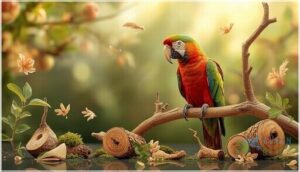
Want simple, bird friendly trees you can trust as Natural Perch Materials and Toxic Wood Alternatives? Look for Non Toxic Branches from safe wood types like apple, pear, mulberry, willow, maple, birch, beech, ash, sycamore, spruce, fir, poplar, manzanita, bamboo, cork oak, palm, and grape vine, which all make sturdy, non-toxic natural wood perches and Safe Hardwoods that keep wood toxicity worries low.
Woods to Avoid for Bird Safety

Toxic Wood Types often hide in plain sight, so your best Bird Safety Tip is to skip Hazardous Tree Species like cherry, plum, cedar, pine, oak, and yew.
Avian Toxicology shows these woods release harmful oils or cyanide when chewed.
Stick to safe wood types, avoid toxic finishes, and prioritize wood toxicity prevention over aesthetics.
Importance of Varied Textures and Diameters
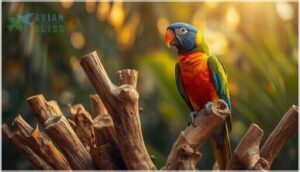
Ever watched your bird shift its feet again and again? That movement keeps joints flexible and blood flowing. Natural branches with varied textures and diameters strengthen grip, improve foot health, and spread weight evenly for better pressure distribution. They turn simple perching into seamless bird foot exercise and support beak conditioning, natural grip, and overall bird comfort.
- Rough bark grips toes lightly
- Smooth wood invites rest
- Knots act as natural footholds
- Tapered ends challenge balance
- Mixed surfaces mimic naturalistic perching
Species-specific Considerations
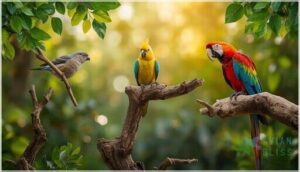
Each bird species interacts with its world differently, so their perches should match those instincts. Natural branches should reflect species-specific perch requirements—thin and springy for finches, sturdy for cockatiels, thick for conures or macaws.
Parrot size variations, bird behavior patterns, and feathered friend psychology all shape ideal textures, supporting avian health and wellness within naturalistic bird environments.
Designing a Bird Cage With Branches
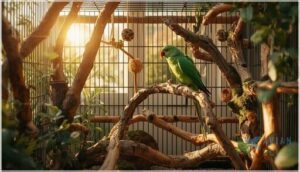
Designing your bird’s cage with natural branches isn’t just about looks—it’s about balance, comfort, and function. Placement and structure matter just as much as the materials you choose.
Here’s how to set up your branches so your bird feels at home and stays active all day.
Strategic Placement and Height Variations
Think of your cage as a mini forest canopy—not a flat playground. Use vertical spacing of 15–30 cm between perch heights to encourage climbing and short flights, not leaps.
Vary branch angles so balance and foot use shift often. This kind of branch placement builds strength, flexibility, and confidence within a naturalistic cage setup.
Creating Zones for Eating, Sleeping, and Play
You’ve spaced your natural branches by height, now use them to carve out clear zones in your cage environment. For Eating Area Design, park food and water on a mid‑level branch with a sturdy perch in front so your bird can stand, eat, and move without sitting there all day.
Sleeping Perch Placement belongs high in a quiet corner with one thick, gently textured branch and no toys underneath, so droppings fall onto a clean liner instead of bowls or bird enrichment items.
For Play Zone Creation, cluster forked natural branches, toys, and foraging cups on the opposite side to keep mess and shredded material contained, using Visual Boundaries in your bird cage design so each activity area feels obvious and promotes Cage Layout Optimization in a naturalistic cage setup.
Mimicking a Natural Habitat in The Cage
Once each zone feels balanced, bring the space to life with a naturalistic cage design. Aim for a canopy design up high, light gradients across the top, and some natural cover using foliage.
Mix branch variety for climbing options, and use a foraging layout so your bird explores its cage environment like a real forest.
Ensuring Stability and Safety of Branches
Once your cage environment looks alive with branches and foliage, make sure every perch can hold its own. Use Secure Mounting with metal washers for firm Branch Attachment, check Weight Limits by pressing down, and tighten loose hardware often.
Weekly Safety Checks and Branch Inspection keep natural branches safe, protecting bird safety and supporting avian health.
Maintaining and Replacing Natural Perches
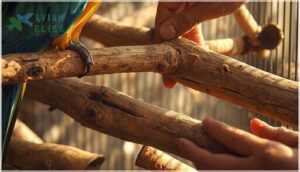
Keeping natural perches in good condition is one of the simplest ways to protect your bird’s feet and overall health. Regular care helps prevent hidden issues like bacteria buildup or loose fittings that can cause injury.
Here’s what to watch for and how to keep each perch safe and sturdy over time.
Cleaning and Sanitizing Natural Branches
A good Branch Preparation routine starts before you ever reach for Cleaning Solutions, because bird safety and toxicity always come first. Inspect natural branches, strip hardware, then scrub under warm water with mild, unscented cleaning products before any Sanitizing Methods like dilute bleach, vinegar, hydrogen peroxide, or UV Treatment in sun or low oven.
Finish with Dry Storage and simple maintenance schedules so preparation and sterilization become easy habits.
Signs a Branch Needs Replacement
Warning lights for Branch Wear are mostly simple Damage Signs you can spot if you look closely. Deep cracks, splinters, missing bark, soft “spongy” spots, or wobbly hardware all break basic Perch Safety and call for immediate replacement.
Pair those visual checks with Bird Behavior—slipping, foot fidgeting, avoiding a once-favorite natural branch perches—and adjust your replacement schedules to protect Bird Foot Health and Perching, Bird Safety and Toxicity, and smart perch selection.
Preventing Bacteria and Mold Buildup
Clean, dry natural branch perches are one of the simplest ways to guard bird safety and health and cut off bacteria and mold before they start. Focus on moisture control, ventilation techniques, disinfectant safety, drying methods, and steady branch sanitation as a core part of your cage maintenance for long-term avian health and toxicity prevention.
- Wipe natural branch perches with a damp cloth at least twice a week to remove fresh droppings and food before heavy biofilm develops, then finish with a dry cloth so moisture control stays in your favor.
- Do a deeper scrub with hot water and mild dish soap about once a month, working stuck-on debris off first so any bird-safe disinfectant you choose can actually touch the germs instead of just the grime.
- Use a dilute vinegar solution, roughly one part white vinegar to three parts water, for targeted branch sanitation, let it sit 15–30 minutes, then rinse well to balance disinfectant safety with your bird’s sensitive airways.
- Lean on ventilation techniques and drying methods together: place washed perches in a warm, well-ventilated room, use indirect airflow, and only return them to the cage once they’re fully dry to the touch to shut down mold growth.
- Avoid keeping baths or misting areas over main perches and skip long-term plastic covers, because constantly damp wood and trapped humidity undo your cage maintenance work and quietly raise infection and respiratory risk.
Installation Tips for Long-lasting Use
For long-lasting natural branch perches, think of Branch Mounting as quiet Cage Reinforcement that starts with smart Hardware Selection and simple Safety Precautions using stainless steel bolts, wide washers, and untreated wood.
Aim for firm Perch Stability with tool-free installation methods that don’t bend cage bars, and keep a few pre-drilled spares ready so you can rotate pieces and refresh your cage setup ideas without starting from scratch.
Top Natural Branch Perches for Bird Cages
If you’re looking for the best natural perches for your bird’s cage, it helps to know which ones hold up well and keep your bird comfortable. Some offer great variety in texture, while others focus on strength or easy setup.
Here are a few reliable options worth considering for your setup.
1. Natural Parrot Perch Bird Stand
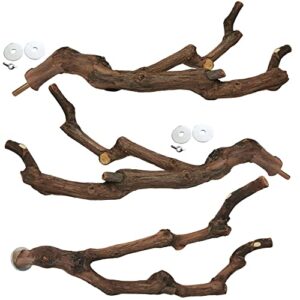
A Natural Parrot Perch Bird Stand made from wild grapevine gives your bird a small slice of “real tree” inside the cage, not just another dowel.
You’re getting a forked, uneven branch that lets feet wrap at different angles, which helps with foot strength, balance, and gentle nail wear as your bird moves.
Lengths around 9 inches with a built‑in bolt and wing nut mean you can anchor it firmly near food or at eye level, turning it into a daily station perch for step‑ups and quiet watching.
| Best For | Bird owners who want a natural, chew‑friendly perch that helps small birds like budgies or cockatiels stay active and keep their feet healthy. |
|---|---|
| Material | Natural grapevine wood |
| Piece Count | 3 pieces |
| Installation | Metal wing nut & bolt |
| Bird Size | Small birds only |
| Chewing Support | Yes |
| Foot Exercise | Yes |
| Additional Features |
|
- Made from real wild grapevine for a natural look and feel.
- Easy to install with built‑in bolt and metal wing nut.
- Encourages exercise, claw care, and natural chewing.
- May have a slight odor or rough texture when new.
- Not ideal for large or heavy birds.
- Can be uneven or a bit wobbly in some cages.
2. Natural Bird Perch Set
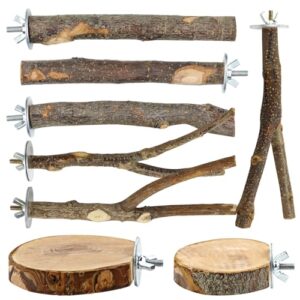
Think of a natural bird perch set as a ready-made mini jungle you bolt straight onto the bars. With an 8‑piece kit like the CZWESTC set, you get round platforms, straight branches, and forked perches in one bundle. This allows your bird to climb, pause, and nap on different levels, all without you having to cut wood yourself.
The set includes natural apple and hardwood pieces with built‑in wing nuts, making them easy to mount and rearrange. They’re sized best for smaller birds like parakeets, cockatiels, and lovebirds.
| Best For | Bird owners who want to create a natural, multi-level play and rest area for small birds like parakeets, cockatiels, and lovebirds. |
|---|---|
| Material | Apple wood & hardwood |
| Piece Count | 8 pieces |
| Installation | Metal wing nuts & washers |
| Bird Size | Small birds only |
| Chewing Support | Yes |
| Foot Exercise | Yes |
| Additional Features |
|
- Made from natural apple wood and hardwood for safe chewing and climbing.
- Variety of branch shapes encourages exercise and play.
- Easy to install with built-in wing nuts and washers.
- Some perches may be smaller than expected.
- Screws and washers can loosen over time.
- May not include enough washers for all pieces.
3. Natural Wooden Bird Perch Stand
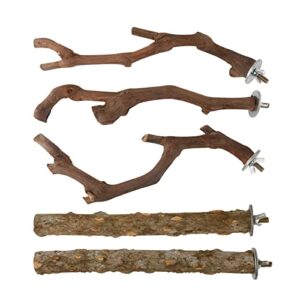
If your bird needs a dedicated out-of-cage spot, the HOSUKKO Grape Wood Stand delivers. This 5-piece set — three perches and two stands — mimics the uneven branch angles birds naturally seek.
The grape wood surface is textured enough to give your bird solid footing without slipping, and the varied diameters keep their feet flexing throughout the day.
Installation is straightforward with included metal washers and screws. It fits parakeets, cockatiels, and conures comfortably, though measure your space first — at 9 x 7 x 9 inches, it takes up room.
| Best For | Bird owners who want a natural, sturdy perch that supports active play and healthy foot movement for small to medium birds. |
|---|---|
| Material | Grape wood |
| Piece Count | 5 pieces |
| Installation | Metal washers & screws |
| Bird Size | Small to medium |
| Chewing Support | Yes |
| Foot Exercise | Yes |
| Additional Features |
|
- Natural grape wood texture offers secure, anti-slip standing surface.
- Easy to assemble with durable metal washers and screws.
- Promotes exercise and mimics real branch angles for natural balance.
- Size may be too bulky for smaller cages.
- Natural variations in wood shape and color can affect look and fit.
- May need boiling or cleaning before first use for safety.
4. Natural Wood Bird Perch Set
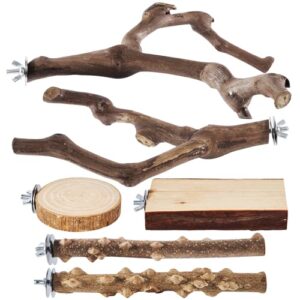
You’ll love how this LIMIO 6-piece set turns your cage into a freedom zone, with 2 grape stick forks, 2 parakeet perches, and round plus square platforms. The non-slip wood grips feet securely, varying shapes flex toes to fend off bumblefoot and arthritis. Bolt it in easily with metal wing nuts — perfect for budgies, cockatiels, conures.
Clean often, as droppings build up, but the natural bark wears nails naturally. Your bird hops freely, just like in the wild.
| Best For | Small to medium-sized parrots like budgies, cockatiels, and conures needing natural perches for exercise and healthy feet. |
|---|---|
| Material | Natural wood |
| Piece Count | 6 pieces |
| Installation | Metal wing nuts & bolts |
| Bird Size | Small to medium |
| Chewing Support | Yes |
| Foot Exercise | Yes |
| Additional Features |
|
- Variety of shapes and textures supports natural movement and foot health.
- Easy to install with built-in bolts and wing nuts.
- Natural wood surface helps keep nails trimmed.
- Needs regular cleaning to prevent buildup.
- May be too small for larger or older birds.
- More expensive than simple DIY options.
5. Bissap Natural Bird Perch Stand
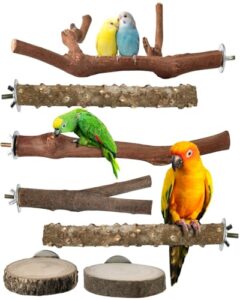
If your bird needs a dedicated space outside the cage, the Bissap Natural Bird Perch Stand gives them exactly that. This freestanding tabletop unit combines a central post with branching arms at different angles and levels — made from untreated hardwood, grapevine, prickly ash, and apple wood.
The compact footprint works well indoors, and the built-in bolt hardware makes setup quick. Your bird gets varied grip points that shift foot pressure constantly, which helps prevent bumblefoot and keeps legs strong.
| Best For | Bird owners who want to give their pets a safe, natural play area outside the cage to climb, perch, and chew. |
|---|---|
| Material | Grapevine, prickly ash, apple wood |
| Piece Count | 7 pieces |
| Installation | Built-in bolts & wing nuts |
| Bird Size | Small birds only |
| Chewing Support | Yes |
| Foot Exercise | Yes |
| Additional Features |
|
- Made from natural, non-toxic wood that’s safe for birds to chew.
- Offers varied grip sizes to keep feet strong and healthy.
- Quick to set up with built-in bolts and wing nuts.
- Wing nuts may be too small or mismatched for some units.
- Natural wood shapes vary, so each set looks different.
- Packaging could be sturdier to prevent damage during shipping.
6. Natural Wood Bird Perch Stand
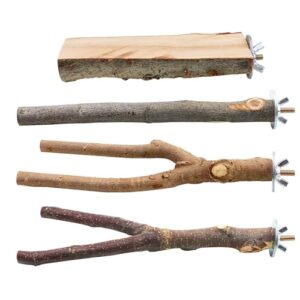
For a similar out-of-cage adventure that keeps your bird climbing freely, check out the Natural Wood Bird Perch Stand. This floor model builds a tree-like setup from dense Java wood or manzanita, with a wide base that won’t tip when your parrot flaps around.
Branches twist naturally, offering grip changes that exercise feet and cut bumblefoot risk. Add toys to branches for extra fun — it’s your bird’s ticket to real freedom and strong health.
| Best For | Bird owners looking to create a natural, enriching perch space inside the cage for small to medium birds like budgies, conures, and cockatiels. |
|---|---|
| Material | Natural wood with bark |
| Piece Count | 4 pieces |
| Installation | Tool-free integrated hardware |
| Bird Size | Small to medium |
| Chewing Support | Yes |
| Foot Exercise | Yes |
| Additional Features |
|
- Made from natural wood that encourages healthy chewing and beak maintenance.
- Easy, tool-free setup with sturdy grip and bark texture for foot exercise.
- Spacious platform ideal for resting, foraging, or playing.
- May not fit all cage sizes or suit larger birds.
- Some users report short perches or incomplete sets.
- Occasional quality inconsistencies like missing parts or uneven finishes.
Frequently Asked Questions (FAQs)
Can I put tree branches in my bird cage?
Yes, you can use tree branches in your bird’s cage, as long as the wood is from a safe species like apple, maple, ash, elm, or manzanita, is pesticide‑free, thoroughly cleaned, disinfected, fully dried, and securely attached.
What branches are safe for parrots?
Safe branch options for parrots include apple, willow, birch, manzanita, grapevine, elm, ash, and untreated bamboo, provided they are sourced from pesticide-free trees and cleaned properly.
Avoid toxic species such as Prunus (cherry, plum, peach, apricot, nectarine), yew, box elder, hemlock, pitch pine, and toxic sumac, as these can release harmful compounds when chewed.
Choose branches with firm, non-sticky bark, no mold, and diameters that allow your parrot’s toes to wrap about two-thirds around the perch. This ensures normal foot flexing and strong, healthy feet.
Can I use branches from outside for my bird?
You can, as long as you’re sure the branch comes from a safe tree like birch or apple, far from roads or pesticides, cut fresh from the tree, and cleaned, dried, and disinfected before use.
How often should natural branches be inspected for damage?
You’ll want to give natural branches a quick visual once‑over every day, then do a hands‑on strength check about once a week.
A deeper remove-and-inspect clean roughly once a month will help catch hidden damage early.
Can outdoor branches be safely used indoors?
Outdoor branches can be used indoors if you treat them like raw ingredients, not ready-made perches.
Choose only clearly non-toxic species, avoid roadside or sprayed areas, then scrub, disinfect, bake or sun-dry, and inspect carefully before mounting.
What’s the best way to introduce new branches to birds?
Bold but bird-friendly works best: let your bird watch the new branch outside the cage for 3–5 days, then move it into a low-traffic spot, pair it with favorite treats or target training, and advance only if body language stays relaxed.
How can branches be arranged for multi-bird cages?
Arrange branches at different heights and angles, leaving open flight paths through the cage.
Offset perches so droppings don’t fall on others, and provide duplicate high spots to reduce competition among birds.
Conclusion
Like swapping a stone tablet for a touchscreen, upgrading your cage perches changes everything your bird does all day.
The benefits of natural branches in bird cages show up in stronger feet, calmer behavior, better balance, and healthier beaks. Start small, add a few safe branches, then watch how your bird chooses to move, rest, and explore.
When the cage works like a living tree, your bird finally gets to act like a bird again.
- https://www.northernparrots.com/blog/safe-branches-for-parrots/
- https://realitypathing.com/how-do-perches-affect-bird-foot-health/
- https://vcacanada.com/know-your-pet/pet-health-articles/beak-and-nail-care-in-birds
- https://www.cedarrun.org/2019/04/perches-and-foot-health-in-raptors/
- https://birdsupplies.com/blogs/news/bird-perch-tips-keep-your-parrot-s-feet-happy