This site is supported by our readers. We may earn a commission, at no cost to you, if you purchase through links.

Each spring, roughly 50 species of warbler cross North America in one of wildlife’s most underappreciated spectacles—tiny birds burning fat reserves to cross the Gulf of Mexico overnight, sometimes arriving so exhausted that they drop into the first tree they find.
Most birders miss the peak by a week or two, showing up either too early or too late. Knowing where to spot migrating warblers matters, but understanding when and why they concentrate in specific places matters more.
A few key sites, some basic weather awareness, and the right timing can turn an average morning walk into something genuinely memorable.
Table Of Contents
- Key Takeaways
- Best Warbler Migration Hotspots
- Follow The Major Flyways
- Search These Warbler Habitats
- Time Your Visit by Region
- Use Weather and Birding Tools
- Frequently Asked Questions (FAQs)
- How to attract migrating warblers?
- What are the 5 S’s of birding?
- How do warblers navigate during nocturnal migration?
- Which warbler species travel the longest distances?
- How can I photograph warblers in dense foliage?
- Do warblers return to the same stopover sites yearly?
- What threats do migrating warblers face along the way?
- Conclusion
Key Takeaways
- A handful of sites — Magee Marsh, Point Pelee, and High Island among them — naturally funnel exhausted warblers into tight, walkable spaces where close encounters happen without much effort on your part.
- Timing beats location: warbler migration ripples north from late March in Texas to late May in the Northeast, and showing up even a week off means missing the peak entirely.
- Free tools like BirdCast and eBird bar charts take the guesswork out of planning — BirdCast tells you when a big push is coming, while eBird shows you exactly when your target species peak at your local patch.
- Weather is the hidden variable most birders ignore: south winds load the skies overnight, post-rain fallouts drop birds into the nearest cover, and cold windy mornings above 15 mph shut activity down fast.
Best Warbler Migration Hotspots

Some spots just put warblers right in front of you — no luck required, just good timing.
Pair those visits with a field guide built for eastern warblers and you’ll spend less time guessing, more time watching.
Across North America, a handful of sites are known for concentrating migrants in numbers that can make any birder’s jaw drop. Here are the hotspots worth putting on your map.
Magee Marsh Wildlife Area, Ohio
Magee Marsh Wildlife Area earns its reputation every May. This 1,150-acre Ohio gem sits on Lake Erie’s western shore, funneling exhausted migrants into lakeshore woods where boardwalk birding offers remarkably close encounters.
Festival Week draws thousands of birders annually. Pair your visit with BirdCast migration intensity maps and Mid-Atlantic/Ohio Valley migration timing windows for optimal results.
The area acts as a critical stopover habitat for warblers during spring migration.
Point Pelee National Park, Ontario
Point Pelee National Park stretches south into Lake Erie like a pointing finger — and in mid-May, that finger is covered in warblers. Canada’s Southernmost Lighthouse marks the Tip, where Lake Erie views open wide and birds concentrate after crossing open water.
Walk the Marsh Boardwalk through cattails, then explore the Carolinian Forest trails. These habitats offer prime opportunities to observe migratory species up close.
Use eBird data, BirdCast, and the Merlin Bird ID app to track bird movements and identify species, ensuring you stay ahead of the migratory wave.
High Island, Texas
From the peninsula tip at Pelee, head southwest to High Island, Texas — a modest coastal town perched atop a salt dome elevation that makes it the highest point on the Gulf between Mobile and the Yucatan.
The Houston Audubon Sanctuaries here protect impressive rookery diversity every spring. Check BirdCast’s migration dashboard before visiting — warbler migration peaks mid-April, and migration forecasting tools simplify timing.
South Padre Island, Texas
South Padre Island rewards early arrivals. Warblers push through from late March, peaking by the first week of May along Coastal Scrub Trails and the Laguna Madre Boardwalk. Check BirdCast migration forecasts the night before — fallouts concentrate birds fast.
Between sightings, catch the Port Isabel Lighthouse or Sea Turtle Rescue nearby.
Tawas Point State Park, Michigan
Tawas Point State Park sits at the tip of a sand spit on Lake Huron, spanning 183 acres where warbler migration funnels birds right to your feet. Time your visit using BirdCast’s Migration Dashboard to hit the second-to-third week of May perfectly.
The Trail Network, Lakefront Beach, and Camping Facilities make extended stays easy.
Don’t miss the Lighthouse Heritage tied to the area’s Indigenous History.
Garret Mountain Reservation, New Jersey
Garret Mountain Reservation rises to 500 feet on New Jersey’s First Watchung Trails corridor, funneling spring migrants straight into the treetops. Woodland warblers concentrate near Barbours Pond Fishing areas and along Lambert Castle Views at peak movement.
Check the BirdCast Migration Dashboard before arriving — Skyline Vista Points reward early risers.
The Equestrian Center Programs and diverse habitats make this spring birding hotspot genuinely worth the detour.
Mount Auburn Cemetery, Massachusetts
Mount Auburn Cemetery sits on 175 acres of rolling hills, ponds, and woodlands — a Victorian Memorial Art landscape that doubles as a foremost spring birding hotspot.
The Garden Cemetery Design strategically channels migratory birds into dense tree corridors, while Washington Tower Views enable observers to scan for canopy movement efficiently.
To locate warblers, utilize BirdCast forecasts alongside habitat cues near Ornamental Shrub Displays and Historic Landscape Features, maximizing observational success.
Follow The Major Flyways
North America’s four major flyways are effectively the highways warblers use every spring—and knowing which one runs through your region changes everything.
Each flyway has its own rhythm, hotspots, and species mix worth learning. Here’s a closer look at what each one offers.
Atlantic Flyway Warbler Routes

The Atlantic Flyway stretches along the eastern seaboard from Florida to Newfoundland and is one of the continent’s richest Coastal Migration Corridors. Birds utilize Wind-Assisted Travel along River Valley Flyways, pausing at spring birding hotspots like Cape May and Delaware Bay.
Observe Rain-Triggered Aggregations following storms. Urban Stopover Threats, driven by habitat loss, underscore the critical need for protected sites to safeguard migratory species.
Leverage tools like BirdCast and migration forecasts to plan birding activities. Analyze eBird data to pinpoint local migration peaks within your timing windows, enhancing observational success.
Mississippi Flyway Stopover Sites

The Mississippi Flyway, stretching from Minnesota to the Gulf, serves as one of spring migration’s most productive corridors. Riverine Floodplains, Agricultural Edge Buffers, and Wildlife Refuges anchor critical stopover sites for migrating birds.
Focus conservation and observation efforts on:
- Water Management Zones near major tributaries
- Urban riparian parks during Seasonal Insect Blooms
- Protected refuges during regional migration peaks
Check bird migration forecasts and regional migration data on BirdCast before heading out.
Central Flyway Migration Corridors

The Central Flyway funnels warblers and neotropical migrants through a broad corridor stretching from the Canadian Prairies to the Gulf. Prairie Pothole Wetlands, the Platte River Corridor, and Missouri Valley Refuges anchor the best stopover action.
Agricultural Edge Habitats along river floodplains add fuel-stop diversity.
Utilizing BirdCast and migration forecasts with real-time bird forecasts helps you hit migration peaks when Central Flyway migration corridors are firing on all cylinders.
Pacific Flyway Warbler Locations

The Pacific Flyway runs a different game than the Central. Here, Coastal Wind Patterns shape where Early Arrival Species like Orange-crowned and Wilson’s Warblers touch down first. Use eBird and BirdCast migration maps to pinpoint Citizen Science Hotspots before you head out.
- Long-distance Stopovers cluster near microhabitat water sources like ponds and stream edges
- Orange-crowned Warblers arrive in April along the California coast
- Wilson’s Warblers peak through May in riparian corridors
- Western Tanagers join warblers at shaded, water-adjacent sites
Gulf Coast Stopovers During Spring Migration

Shift your focus east from the Pacific, and the Gulf Coast opens up a whole different kind of spectacle. Sites like South Padre Island, High Island, and Dauphin Island are prime Migration Stopover Sites, where Fallout Alerts signal overnight arrivals worth chasing.
Habitat Connectivity along coastal forests enhances Insect Flush Timing, fueling rapid refueling for migratory birds. This ecological synergy transforms these regions into critical hubs for avian energy replenishment.
Migration Pulse Modeling via BirdCast helps predict peak windows across both Coastal and Inland Warbler Viewing Sites. By leveraging these tools, enthusiasts can strategically time visits to witness mass migrations at their most dynamic.
Lake Erie and Great Lakes Migration Bottlenecks

Lake Erie works like a funnel. At 30–40 miles wide at its narrowest, its water volume triggers lake-cross fatigue in land birds, causing them to accumulate along the southern shore.
Island stepping-stones like South Bass and Pelee Island act as guides for nocturnal migrants, directing them toward Magee Marsh.
Wind-assist timing is critical here. Utilize radar pulse tracking via BirdCast’s real-time forecasts to optimize visits to these warbler hotspots.
Search These Warbler Habitats

Warblers don’t just show up anywhere — they follow the food, cover, and water that match their needs at each stage of migration. Knowing which habitat types to target cuts hours off your search time.
Warblers follow food, cover, and water — target the right habitat and the search becomes a sure thing
Here are the eight habitat types most likely to put warblers in front of you.
Lakefront Woods and Peninsula Tips
Lakefront wood lots punch well above their weight during migration. Warblers funneling south along Lake Erie, Lake Huron, and Lake Ontario hit the shoreline at dawn and drop into the nearest trees.
Walk boardwalk observation points early. Shoreline water features and drip water stations draw birds quickly. Check cattail microhabitats in quiet inlets.
Wear low-impact footwear—you’ll want to move quietly.
Riparian Corridors With Willows and Cottonwoods
Along stream corridors, willows and cottonwoods do far more than look pretty—they’re warbler magnets. Bank stabilization keeps roots intact, invertebrate production remains high, and microhabitat diversity draws warblers into layered foraging zones.
Water temperature moderation and beaver engineering create quiet pockets where Blackpoll and Wilson’s Warblers refuel, offering essential stopover habitats.
Follow riparian corridors west—they’re critical migration stopover sites for western migrants. Use dense canopy edges as your habitat cues, signaling prime foraging and shelter zones for these species.
Marsh Edges for Common Yellowthroats
Marsh edges are where Common Yellowthroats feel at home—and where you should look first. Vegetation density signals everything: thick cattails, tangled willows, and sedge mats point to prime wetland habitat.
Insect abundance follows hydrological dynamics, so wetter margins hold more prey. Use these habitat clues for sharp field identification:
- Dense low tangles near water
- Humid reed pockets with slow flow
- Willow and alder clumps offering predator concealment
- Mixed sedge and grass understory
- Sites prioritized for edge restoration
Spruce and Fir Forests for Northern Species
If you’re chasing Blackburnian Warblers or Northern Parulas, spruce-fir forests are worth knowing well. Canopy density and deadwood complexity signal rich cold-season invertebrate communities—exactly what exhausted migrants need. Elevation-driven phenology means timing shifts with altitude, so check BirdCast forecasts before heading uphill.
Fire-suppression effects can alter stand structure, but mature, mixed boreal pockets consistently attract the most northern species.
Urban Parks With Mature Trees
Don’t overlook city parks — they punch well above their weight during migration. Mature oaks and maples create a canopy microclimate that lowers temperatures and keeps insects active, turning urban biodiversity corridors into reliable warbler stops.
Check eBird for citizen-science monitoring data on your local patch, use BirdCast forecasts to time visits, and look for tree-based feeding stations where exhausted migrants refuel.
Hilltop Cemeteries and Elevated Parks
Hilltop cemeteries like Garret Mountain Reservation and Mount Auburn Cemetery are underrated warbler traps. Their terraced slopes and scenic overlooks align with nocturnal cruising altitudes, so birds drop in right after dawn.
Pollinator gardens and mature canopies supply quick refueling, while accessibility ramps make early-morning walks easy.
Check eBird data and BirdCast forecasts the night before — elevation effects on migration make timing everything here.
Isolated Tree Patches on Open Plains
A lone grove rising from open plains is not random — it’s a lifeline. These isolated patches act as stepping stone refugia, pulling exhausted warblers down from overnight flights.
Their shaded understories create microclimate refugia, while patch edges function as insect resource hubs. Windbreak benefits concentrate birds in calm pockets, offering critical respite during migration.
Where agroforestry integration preserves scattered trees, migrating warblers follow the green, relying on these fragmented oases for survival.
Native Oak, Maple, and Birch Groves
Native oaks, maples, and birches aren’t just pretty scenery — they’re warbler magnets. Canopy succession shapes understory diversity, creating layered insect habitat that exhausted migrants can’t resist. Soil acidity and sapling regeneration in these groves signal habitat quality worth checking.
Use eBird data to pinpoint which native tree patches hold the highest warbler activity locally, then show up early.
Time Your Visit by Region

Warbler migration doesn’t follow a single calendar — it ripples northward over two months, region by region. Knowing when the wave hits your area is often the difference between an empty morning and a tree full of warblers.
Here’s how timing breaks down across North America.
Deep South: Late March to Early April
If you’re birding the Deep South, late March to early April is prime time. A South Wind Pulse pushes warblers north fast—Black-and-White Warblers and Northern Parulas lead the charge.
Hit Freshwater Stream Edges and Lowland Pine Savannas at dawn for Early Warbler Song and Summer-Season Insect Swarms.
Leverage BirdCast forecasts and habitat cues to pinpoint where birds are concentrated.
Texas Coast: Late March to Mid-April
Move south to north along the Texas Coast, and late March through mid-April opens up quickly. Three spots anchor your itinerary:
- South Padre Island — Coastal Dune Shelters and Barrier Island Refuges concentrate tired migrants
- High Island — Estuarine Insect Swarms fuel quick refueling stops
- Shoreline Water Stations — simple drippers draw warblers into view
Southeasterly Wind Benefits push birds ashore reliably. Leverage BirdCast and migration forecasts to catch peak movement windows.
Mid-Atlantic: Mid-April to Early May
As the Texas coast quiets down, the Mid-Atlantic and Ohio Valley awaken. Yellow-rumped Warblers arrive first in mid-April through early May, followed by Hooded Warblers around the first week of May.
Regional warbler arrival schedules tighten as insect emergence tracks tree bud-out closely.
Use eBird bar charts and BirdCast forecasts to anticipate movement surges before they pass your county.
Ohio Valley: Late April to Early May
Late April shifts the action squarely into the Ohio Valley. After frontal rain events, a Post‑rain Insect Boom pulls warblers into riparian forests hard — Blackburnian, Chestnut-sided, and Tennessee Warblers fuel up fast.
River Island Stopovers along the Ohio concentrate mixed flocks, often with a Gray Catbird Flock Companion in tow.
Foggy Dawn Chorus mornings, shaped by Temperature Shift Activity, reward early risers.
Leverage BirdCast and eBird data to catch peak movement before mid-May.
Northeast: Mid-May to Late May
By mid-May, the Northeast hits its peak season. Blackpoll and Blackburnian Warblers ride the Canopy Insect Surge through oak and maple canopies, while Foggy Coastal Passages concentrate migrants along shorelines.
Elevation Warbler Shifts push Cape May and Blackburnian into higher terrain by late May.
Use BirdCast forecasts, eBird bar charts, and the Early Morning Chorus to pinpoint movement before Heat-Induced Restlessness quiets activity.
Upper Midwest: Mid-May Peak Passage
If there’s one window worth planning around, it’s May 10–25 in the Upper Midwest. Wind Shift Timing drives everything here — southwest winds push Mixed Passerine Flocks north, while Lake Breeze Effects pin birds along shorelines before crossing open water.
Watch for:
- Blackburnian and Magnolia Warblers peaking mid‑May
- Northern Waterthrush and Ovenbird in riparian corridors
- Citizen Data Trends on eBird.org showing county-level surges
- Using BirdCast and migration forecasts for birding precision
- Your Peak Species List building fast around weather influence on bird movement
West Coast: April Through May
The West Coast runs its own calendar. April brings Orange-crowned and Wilson’s Warblers along riparian corridors, while coastal fog affects slow mornings and concentrates birds near urban water features and beach dune habitats. Spring insect pulses peak in late April.
By May, a late-season mix of Yellow and Yellow-rumped Warblers fills coastal parks. Using BirdCast and migration forecasts for birding sharpens your timing considerably.
Rocky Mountains: May Migration Windows
Elevation timing shifts everything in Colorado. Foothill canyons deliver your first warbler arrivals well before the high country thaws.
Watch snowmelt cues—once subalpine zones clear, montane burst passage follows quickly, often compressing warbler movement into days.
Mid-May brings wind-assisted crossings through riparian corridors and aspen stands.
Using BirdCast and migration forecasts for birding helps you catch these brief, high-altitude windows before they close.
Use Weather and Birding Tools
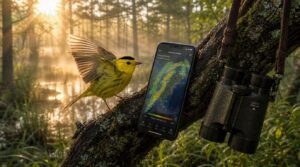
Knowing when warblers might show up is half the battle — the other half is knowing how to check. A handful of free tools can tell you exactly when and where to look, right down to your county.
Here’s what to use and how to work them into your routine.
Check BirdCast Migration Forecasts
BirdCast is your sharpest planning tool before heading out. Its migration intensity dashboards for birding translate radar intensity into color-coded nightly maps, showing exactly where movement is heaviest.
Real-time alerts notify you when a big push is coming, and Species Likelihood lists help you target your watch list.
Wind Forecasts and Historical Playback let you spot repeat corridors — perfect for utilizing BirdCast and migration forecasts for birding smarter.
Watch for Rain and Storm Fallouts
Rain, snow, or a quick shift in wind direction can flip an ordinary morning into something unforgettable. Low-pressure systems trigger cloud-burst fallout events, grounding exhausted warblers in the nearest cover.
Watch for rain-spurred canopy shifts — birds drop from treetops into mid-story shrubs, making them far easier to spot.
Post-rain insect bursts concentrate feeding flocks along marsh edges and shorelines fast.
Use EBird Bar Charts Locally
Once you’ve scanned the sky for fallout birds, pull up eBird.org to sharpen your next move. eBird bar charts transform raw sightings into a visual calendar — instantly revealing when your target warblers peak locally.
- Hotspot Filtering narrows results to your exact site
- Date Range Adjustment isolates your migration timing windows
- Multi-Hotspot Views compare nearby spots side by side
- Local Trend Monitoring tracks year-over-year patterns
- Data Export Options let you plan offline
Analyzing eBird data to predict local migration peaks consistently outperforms guesswork.
Compare County-Level Migration Timing
County-level eBird charts reveal something most birders overlook — migration timing shifts measurably from one county to the next. Think of it as a County Migration Index: coastal counties peak earlier, urban corridors respond to Economic Migration Signals like habitat density, and Climate Timing Shifts push inland counties later.
ACS Flow Analysis confirms these patterns hold year after year.
| County Type | Typical Peak Timing |
|---|---|
| Coastal lowland | Early to mid-April |
| Urban corridor | Mid-April |
| Inland valley | Late April |
| Elevated/rural | Early May |
| Northern border | Mid-May |
Mapping migration peaks by state alongside Demographic Timing Drivers helps you target the right county at the right week.
Listen at Sunrise After Night Flights
Once you’ve mapped your county’s peak window, the next move is simple: get outside before sunrise.
Dawn chorus timing is everything. Warblers that flew overnight begin singing within minutes of first light, making that 30-minute window after civil sunrise your best shot. Set up your acoustic gear near a forest edge or water source, focus on high-frequency chips and trills, and let the birds reveal themselves.
Use Merlin Sound ID for Warblers
While listening at dawn, open Merlin Sound ID—one of the most reliable bird song identification tools available today. Its real-time suggestions dynamically update with each new note, while Offline Song Matching ensures functionality even without a signal.
- Highlights the best match in yellow as songs overlap
- Compares your recording against hundreds of warbler calls instantly
- Works without internet using on-device processing
- Lets you export identifications for later eBird logging via Data Export
Applying these tools in the field is straightforward: stay still, stay close, and let Merlin distinguish species like the Blackpoll from the Bay-breasted Warbler.
Target Sites After Favorable South Winds
After a south wind pushes birds north overnight, immediate post-wind flocks concentrate along canopy edges where insect flush timing peaks at dawn. Head to Magee Marsh or Point Pelee within 6–48 hours of the shift.
Watch for canopy edge foraging near oaks and water source clustering at drippers.
BirdCast’s 3-day forecasts of migration intensity help anticipate when daylight activity lag gives way to peak warbler movement.
Avoid Cold, Windy Low-Activity Mornings
Cold, windy mornings above 15 mph shut warbler activity down fast — fewer songs, fewer sightings.
Plan smarter:
- Check wind chill before leaving
- Wear layered clothing with a wind-resistant shell
- Use windbreak strategies — sit sheltered, face leeward edges
- Bring a thermal beverage for longer stays
- Target sunrise warm windows in microclimate shelters near riparian edges
Frequently Asked Questions (FAQs)
How to attract migrating warblers?
Ironically, the best warbler magnet isn’t a fancy feeder — it’s your yard itself.
Native shrub planting, water feature design, suet feeders, and cat-free zones turn any backyard into a reliable stopover.
What are the 5 S’s of birding?
The 5 S’s — Size, Shape, Sound, Search, and Spotting posture — form a solid scanning strategy for any field birding outing.
Size estimation and shape cues narrow your options fast, while sound identification seals the ID.
How do warblers navigate during nocturnal migration?
Warblers navigate at night using celestial cues, magnetic orientation, olfactory landmarks, and flight call signaling — a layered system that keeps them on course across hundreds of miles of darkness.
Which warbler species travel the longest distances?
The Transatlantic Blackpoll leads the pack — flying 2,000+ miles nonstop over the Atlantic each fall. The Willow Warbler Journey and Reed Warbler Migration span continents too, rivaling the Arctic Warbler Range.
How can I photograph warblers in dense foliage?
Use a 600–800 mm lens for Lens Choice, set a Fast Shutter of 1/2000s, seek Diffuse Lighting, apply Depth Control at f/6–f/8, and practice a Silent Approach.
Do warblers return to the same stopover sites yearly?
Yes, many do. Research using geolocators shows strong site fidelity — birds returning to the same stopover habitat year after year, guided by habitat memory and resource reliability.
What threats do migrating warblers face along the way?
Migration isn’t a walk in the park. Habitat Fragmentation, Light Pollution, Pesticide Exposure, Predation Pressure, and Phenology Mismatch all cut survival odds.
Domestic cats, collisions, and climate shifts compound the impact of habitat loss daily.
Conclusion
Like a lock finally meeting the right key, timing, location, and weather awareness align, and warbler migration clicks into place.
Knowing where to spot migrating warblers is only the entry point—understanding why birds concentrate at Magee Marsh after a south wind, or why a fallout follows overnight rain, separates a good morning from an unforgettable one.
Get those details right, and the birds will do the rest.
- https://www.tpl.org/blog/spring-migration-birding-california-georgia-maine-new-mexico
- https://www.allaboutbirds.org/news/6-warbler-hotspots-to-try-out-this-spring-plus-how-to-find-your-own/
- https://www.audubon.org/magazine/seven-spring-hotspots-warbler-photography
- https://abcbirds.org/news/eight-must-see-spring-birding-sites/
- https://www.bsbo.org/timing-of-spring-migration.html