This site is supported by our readers. We may earn a commission, at no cost to you, if you purchase through links.

A chickadee weighs less than five pennies, yet builds one of the most carefully engineered nests in the bird world. That tiny bird excavates its own cavity, selects materials with surprising precision, and layers them in a specific sequence that insulates eggs through late-spring cold snaps.
Most people spot chickadees at their feeders without ever considering what’s happening just a few trees away.
Chickadee nests reveal a level of instinct and effort that changes how you see these familiar birds. Understanding what they need—and what draws them to certain spots—makes it much easier to support them in your own backyard.
Table Of Contents
- Key Takeaways
- Where Chickadees Build Nests
- Natural Cavities They Prefer
- Chickadee Nest Box Basics
- What Chickadees Use for Nests
- When Chickadees Start Nesting
- Eggs, Incubation, and Nestlings
- How to Protect Chickadee Nests
- Monitoring Chickadee Nests Safely
- Frequently Asked Questions (FAQs)
- What month do chickadees lay eggs?
- Where do chickadees nest at night?
- Where do chickadees make their nests?
- Do chickadees return to the same nest?
- What does a chickadee nest and eggs look like?
- What materials do chickadees use for nesting?
- Do chickadees reuse their old nests?
- Can I safely move a chickadee nest?
- How long do baby chickadees stay hidden?
- Will chickadees abandon their nest if disturbed?
- Conclusion
Key Takeaways
- Chickadees need a cavity with a 1⅛-inch entrance hole, 8–10 inches of depth, and rough wood walls — get those details wrong and the box sits empty.
- They build their nest in layers, starting with moss and bark, then binding it all together with spider silk, and finishing with rabbit fur and feathers for warmth.
- Nesting kicks off earlier than most people expect — males start claiming territory as early as mid-February, with eggs typically laid between April and May.
- A metal baffle on the pole, a hole reducer on the entrance, and weekly 30-second checks are the three things most likely to determine whether a brood succeeds or fails.
Where Chickadees Build Nests

Chickadees aren’t picky in the broad sense — they turn up in forests, parks, and suburban backyards alike. What they do care about is having the right kind of shelter to raise their young.
When it comes to nesting, though, they can be surprisingly selective — dive into Carolina Chickadee nesting habits and egg details to see exactly what they’re looking for.
Here’s a closer look at the specific places they call home.
Forests, Parks, and Backyard Habitats
Black-capped Chickadees thrive wherever trees meet open space.
Mixed and deciduous forests, neighborhood parks, and backyard habitats all work well — especially where tree species diversity gives them foraging options year-round.
- Seasonal insect availability peaks near water feature integration points like ponds or streams.
- Edge habitat benefits include richer food variety and natural escape routes.
- Corridor connectivity links patches, expanding cavity nesting opportunities.
Preferred Trees and Decaying Snags
Chickadees aren’t picky about forests, but they do have favorite trees. Aspen, birch, willow, alder, and oak top their list for tree species preference.
What really draws them, though, is dead or decaying tree trunks — snags at moderate to later snag decay stages. Fungal influence softens the heartwood, beetles move in, and suddenly there’s a cavity with insect prey abundance practically built in.
Fungal decay softens the wood, beetles follow, and suddenly a tree becomes a ready-made chickadee home
These snags also support biodiversity through habitat complexity.
Nest Height Above The Ground
Once you’ve found the right snag, height is the next decision that matters. Most chickadees nest between 5 and 15 feet above ground — roughly eye level to just overhead.
That range reflects a natural predator height gradient: high enough to deter cats and raccoons, low enough for microclimate stability. For nest box placement, aim for 5 to 10 feet.
Natural Cavities Versus Nest Boxes
Natural cavities give chickadees something a nest box can’t fully replicate — thermal insulation from thick walls and deeper chambers that reduce microclimate variation during incubation. They also lower predation risk through irregular, harder-to-reach entrances.
That said, nest boxes fill real gaps where cavities are scarce. Match your nest box specifications for chickadees closely, and proper nest box placement does a solid job.
Natural Cavities They Prefer

Not every hollow in a tree is worth a second look — at least, not to a chickadee. These birds are surprisingly particular about the kind of space they’ll call home.
Here’s what they’re actually looking for when they inspect a natural cavity.
Ideal Entrance Hole Size
Size matters more than you’d think. The entrance hole 1⅛ inches across is the sweet spot for ideal cavity dimensions for chickadee nests. Keep these nest box specifications for chickadees in mind:
- Diameter Tolerance is tight — even ¼‑inch extra invites competitors.
- Edge Rounding prevents beak injuries on entry.
- Wood Expansion from moisture can widen the entrance hole over time.
- Seasonal Adjustments help offset Temperature Effects on the wood.
Cavity Depth and Interior Space
Depth does more work than most people realize. A nest chamber between 8 and 10 inches deep gives chickadees real Depth Driven Insulation — keeping eggs warmer overnight without extra effort. Cup Positioning toward the back manages Draft Reduction naturally. Vertical Space Allocation lets the incubating bird sit comfortably upright. Moisture Buffering happens when porous wood absorbs humidity, protecting the nest interior.
| Cavity Feature | Ideal Measurement | Why It Matters |
|---|---|---|
| Interior depth | 8–10 inches | Insulation and draft protection |
| Floor width | 4 × 4 inches | Stable cup positioning |
| Entrance height above floor | 6–8 inches | Keeps nest hidden from predators |
| Cup depth | 2–3 inches | Holds eggs securely |
| Vertical headroom | 4–6 inches | Allows comfortable incubation posture |
ideal cavity dimensions for chickadee nests apply equally to natural holes and nest box specifications for chickadees — including that entrance hole 1⅛ inches wide you already have covered.
Why Rough Wood Walls Help
Rough wood walls do more than look rustic — they work hard for chickadees in several ways.
Soft materials like rabbit fur and wood shavings grip irregular surfaces easily, improving Fiber Retention throughout nest construction. That texture also enhances Thermal Insulation by trapping warm air, aids Moisture Buffering by absorbing humidity, provides Predator Concealment through visual irregularity, and offers Durability Against Wear over multiple seasons.
Shelter From Wind and Rain
A well-chosen cavity acts like a small house with storm shutters already installed. Chickadees instinctively pick spots that stay dry and calm even on rough days.
- Entrance Overhangs shed rain before it reaches the nest
- Shaded Cavity Orientation and Sealed Entry Gaps block wind chill
- Windbreak Vegetation and Air Pocket Insulation inside walls, combined with rabbit fur and feather lining, deliver reliable thermal insulation in nests
Do Chickadees Reuse Cavities?
Yes, chickadees do reuse cavities — but it depends on quality. If a nest box or natural hole held up well through winter, the same pair often returns.
Keeping the box clean and dry between seasons makes a real difference — here’s a closer look at what birds actually need inside a nesting box to make it worth coming back to.
Strong pair site fidelity means familiar spots win out over fresh excavation. Cavity quality metrics like dry walls, stable structure, and low predator pressure effects all factor into their seasonal reuse trends and nest site selection criteria.
Chickadee Nest Box Basics
A well-built nest box can make a real difference for chickadees, especially where natural cavities are hard to find.
Getting the details right — size, materials, placement — is what separates a box that works from one that sits empty.
Here’s what you need to know.
Best Box Dimensions
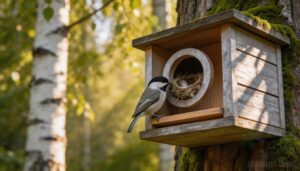
Ever wonder why chickadees thrive in well-designed boxes?
You’ll want an internal clearance of 4×4 inches, floor height of 8–10 inches, and a volume capacity near 1,280 cm³.
Stick to a depth width ratio that matches natural cavities, use sturdy side wall thickness, and follow birdhouse design guidelines for mounting height and nest box specifications for chickadees.
Why 1⅛-inch Entrances Matter
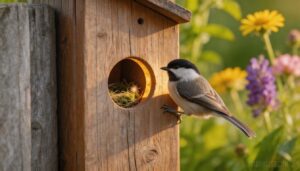
The 1⅛-inch entrance hole is the single most important measurement in any nest box specifications for chickadees. That tight opening delivers real predator exclusion — squirrels and starlings simply can’t get through.
It also limits drafts, supporting thermal retention and egg temperature stability inside the cavity. For a small cavity nesting bird, that extra warmth genuinely boosts chick development from day one.
Safe Wood and Box Materials
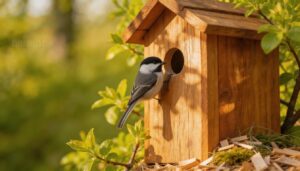
Wood choice matters more than most people realize. Cedar and pine are your best bets — both are eco-friendly wood options that hold up through seasons without treatment.
Skip painted or chemically treated boards. Low-VOC finishes work fine on exterior surfaces only. Avoid fire-retardant treatments and recycled wood composites inside the box.
Untreated, rough-cut softwood keeps things safe and natural for nesting chickadees.
Ventilation, Drainage, and No Perch
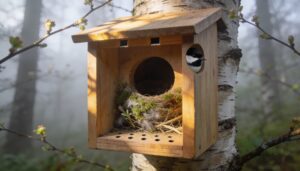
Once you’ve got the right wood, think about airflow design and moisture management. Drill a small drain hole at the box floor — placement away from the nest cup matters. Add vent gaps near the top for draft prevention without cold blasts hitting the nest.
And skip the perch. No perch benefits are real: it removes a predator’s landing platform entirely.
Proper Box Placement and Direction

Where you mount the box matters as much as how you build it. Face the entrance hole east or southeast — that gives the nest morning sun and afternoon shade.
Tilt the box slightly forward for rain drainage tilt, and position it 25 feet from foot traffic as a human disturbance buffer.
Mount a baffle below as your predator guard against snakes and raccoons using any predator access path.
What Chickadees Use for Nests

A chickadee nest is more carefully built than most people realize. Every material has a purpose, from the base all the way up to the soft inner lining.
Here’s what actually goes into one.
Moss, Bark, and Plant Fibers
Building a nest from scratch takes real material know-how. Chickadees start with a sturdy base that relies on three key components:
- Moss — offers moisture retention and light thermal insulation
- Bark strips — provide structural support, keeping the cup from sagging
- Plant fibers — interlock for fiber composition and cushioning
Fiber and material sourcing stay local, so your yard trees genuinely help.
Fur, Feathers, and Soft Lining
Once the base layer is in place, chickadees shift to the soft stuff — and this is where the nest really comes alive.
They line the cup with rabbit fur, feathers, and plant down, creating Fur Insulation Layers that trap air pockets for warmth. Feather Loft adds light, breathable cushioning, while Soft Lining Moisture Control keeps conditions stable.
These nest construction materials and techniques used by chickadees come from naturally shed, ethically available sources.
How The Nest Cup is Formed
The nest cup takes shape slowly, built through a careful Layering Sequence that reflects real engineering instinct. Chickadees press each material deliberately, using spider silk as natural Binding Agents to hold fibers together. The result is a tight Cup Geometry with Stability Features that protect eggs from shifting.
- Coarse moss and bark form the outer walls
- Plant fibers fill gaps for Thermal Insulation
- Spider silk weaves layers into a cohesive structure
- Soft fur and feathers complete the inner pocket
Materials You Should Not Provide
Some well-meaning materials actually cause harm. Avoid synthetic fabrics entirely — shed fibers can cause respiratory problems for nestlings. Skip shredded paper with printed toxic inks, plastic packaging, and chemical paints near the box. Pesticide contamination from treated plants is a real risk too.
Cotton, sawdust, soft wood shavings, and natural moss are safe choices that support healthy nest development without introducing hidden dangers.
When Chickadees Start Nesting
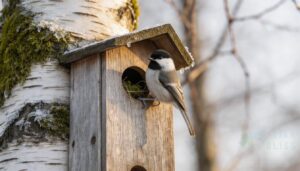
Chickadees don’t wait for a warm day to get started — their nesting season follows a reliable schedule that begins earlier than most people expect. Knowing when each phase kicks off helps you spot activity in your yard and offer support at the right time.
Here’s how their nesting season unfolds, from the first site visit to the first signs of life inside the box.
Early Site Selection and Pair Behavior
Site selection starts earlier than most people expect. As daylength cues lengthen in mid-to-late February, males begin staking claim with territory vocalizations from elevated perches.
Meanwhile, pair bonding displays — synchronized singing, mutual head-poking near cavities — help cement the breeding pair.
They favor microhabitat shelter, like dense canopy, that buffers wind.
Site fidelity patterns emerge quickly once a promising cavity catches their attention.
Excavation and Cavity Preparation
Once a pair commits to a spot, both birds get to work. They chip away at soft or decaying wood using short, precise bill strokes — nature’s version of spoon-shaped tips and double-ended designs built for tight spaces.
This cavity excavation takes 7–10 days.
Watch for tiny wood chips on the ground below. That’s your clearest sign, nest site selection has moved into serious territory.
Spring Nest-building Timeline
Once the cavity is ready, nest construction moves fast — but only when conditions say go.
Here’s how the spring nest-building timeline usually unfold:
- Temperature Thresholds — Nest building kicks off when daily temps hold above 40°F consistently.
- Insect Availability — Rising caterpillar activity in late March through May fuels the whole effort.
- Urban Timing — City areas often see earlier nest building seasons due to faster insect emergence.
- Elevation Delays — Higher terrain can push the nest timeline back by one to three weeks.
- Climate Anomalies — Late frosts shift spring temperature cues and delay female excavation behavior by several days.
Regional Differences in Nesting Season
Where you live shapes when chickadees get started. In boreal regions, egg-laying often waits until late April or May. Coastal areas may see nests as early as late March.
Latitude timing variation is real — northern populations can run four to six weeks behind southern ones. Microclimate heat islands in cities nudge nesting earlier too, sometimes by nearly a week.
Signs a Nest is Active
Once you know the timing for your region, spotting an active nest gets easier. Look for these reliable signs:
- Entrance activity patterns pick up fast — parents make rapid, repeated visits during peak feeding windows
- Parent feeding frequency climbs to several trips per minute when chicks need the most food
- Chick vocalizations — soft, quick cheeps — become audible near the entrance
- Fecal sac removal keeps the nest clean and signals healthy nestlings inside
- Material addition activity early on means the female is still lining the cup
A nest camera removes all guesswork without disturbing parental care.
Eggs, Incubation, and Nestlings

Once the nest is ready, the real work begins. A lot happens inside that little cavity over the next few weeks — from the first egg to the day the chicks take flight.
Here’s what that whole process looks like, step by step.
Clutch Size and Egg Appearance
Most chickadees lay between 4 and 7 eggs per clutch, with 5 or 6 being typical.
Clutch Size Range depends heavily on Habitat Quality — females in better territories tend to lay more. Female Health matters too, since stronger females invest more calcium into Egg Color Variation, producing pale white shells with reddish-brown speckles concentrated near the blunt end.
Urban Edge Effects often push clutch size slightly higher.
How Long Incubation Lasts
Once the last egg is laid, incubation begins — and it usually runs 12 to 14 days.
Temperature Effects play a real role here: warmer nests can shorten that window, while cooler conditions stretch it.
Humidity Influence and Latitude Variation matter too, so northern pairs may wait a day or two longer.
Disturbance Impact is also worth noting — frequent nest checks can interrupt the incubation period and delay hatching.
Which Parent Does The Incubating
So who manages egg incubation? Mostly the female.
She takes the lead during daytime hours, covering the eggs through long, steady bouts.
Sexual role division here isn’t rigid, though — males step in too, especially around dawn and dusk.
Weather influence and food availability shift that balance daily.
When one parent signals it’s time to swap, the other responds quickly, keeping the incubation period on track.
Nestling Feeding and Growth
Once hatching begins, parental investment kicks into high gear. Both parents make feeding visits every 10 to 20 minutes throughout the day — that’s up to 70 trips at peak demand. Prey diversity matters too: caterpillars, spiders, and small insects supply the amino acids nestlings need for rapid growth.
Key nestling development facts:
- Growth rate doubles body mass within the first week
- Temperature effects on insect activity directly shape food provisioning
- Feeding frequency rises when prey is abundant
- Parental care and feeding rates taper as fledging nears
When Young Chickadees Fledge
Young chickadees don’t just "leave" — they launch. Fledging usually happens 16 to 22 days after hatching, with most chicks departing during Morning Departure hours right after sunrise.
That timing isn’t random; early fledging cuts predation risk substantially.
| Fledging Phase | Details |
|---|---|
| Fledging Timing | Days 16–22 post-hatch |
| Morning Departure | Shortly after sunrise |
| Post-Fledge Feeding | 2–3 weeks by parents |
| Habitat Exploration | Nearby trees and shrubs |
| Survival Indicators | Independent foraging, contact calls |
Parental care and feeding rates continue supporting nestling development well beyond the nest.
How to Protect Chickadee Nests
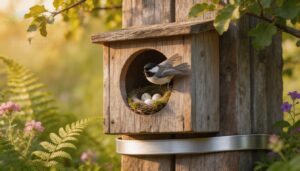
Getting a nest box set up is only half the job.
Chickadees face real threats from the moment they start nesting, and a few simple steps can make a big difference in whether a brood succeeds.
Here’s what you can do to give them a fighting chance.
House Sparrows and Cavity Competitors
House sparrows are relentless. Their sparrow aggression and cavity competition can shut chickadees out of boxes entirely — especially where urban density impact is high.
Sparrow invasion strategies include claiming boxes early and ejecting eggs. Combat this with competition mitigation:
- Use a 1⅛-inch hole reducer
- Space boxes at least 60 feet apart
- Monitor weekly and remove sparrow nests promptly
Cats, Snakes, Squirrels, and Raccoons
Beyond house sparrows, predators like cats, snakes, squirrels, and raccoons all threaten nesting chickadees. Cat hunting peaks in spring and summer — right when nestlings are most vulnerable.
Snake activity zones around woodland edges put cavity nests at risk too.
Raccoon night raids target eggs and chicks, while squirrel predator avoidance behaviors can drive competitive cavity use, displacing your nesting pair entirely.
Guards, Baffles, and Hole Reducers
Three simple tools stop most predators cold.
A guard plate design around the entrance blocks mammals from reaching in to grab eggs or chicks. A stovepipe baffle on your mounting pole stops snakes, raccoons, and squirrels from climbing up at all. And hole reducer installation — shrinking the opening to exactly 1⅛ inches — keeps larger birds and competitors out entirely.
Use a wren guard after the first egg appears.
Habitat Features That Improve Success
Good gear helps, but the habitat around your box matters just as much.
Dense Shrub Cover within 15 meters hides the entrance from predators. Evergreen Windbreaks cut cold air exposure. Morning Sun Exposure warms the nest early without overheating it.
A nearby Water Source within 100 meters promotes insect abundance. Dead wood preservation and native trees and shrubs round out everything chickadees look for.
Common Causes of Nest Failure
Even with a well-placed box, nest failure still happens. The three most common causes are:
- Nest predation from squirrels, snakes, and house sparrows
- Weather extremes like flooding rain or heat waves that spike microclimate stress
- Food scarcity from pesticide use or drought
Human disturbance impact during incubation also raises abandonment risk. Predator avoidance and nest sanitation go hand in hand with long-term success.
Monitoring Chickadee Nests Safely
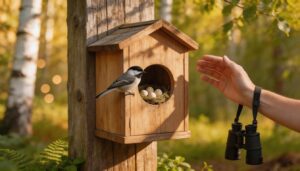
Watching a chickadee nest is rewarding, but how you do it matters. Too much disturbance can stress the birds and even cause them to abandon the nest.
Here’s what safe monitoring actually looks like, from how often to check, to keeping the box ready for next year.
How Often to Check a Nest
Once a week is your sweet spot for nest box monitoring during active nesting. Stick to a Weekly Inspection Schedule and keep each visit under 30 seconds — Minimal Visit Duration matters more than you’d think.
| Stage | Check Frequency | Notes |
|---|---|---|
| Incubation Stage Checks | Weekly | Brief, calm visits only |
| Severe Weather Protocol | Every 3 days | Watch for predator signs |
| Fledging Period Pauses | Stop completely | Avoid spooking fledglings |
| Off-season | Monthly | Responsible observation of nesting birds resumes |
Safe Ways to Inspect Nest Boxes
When you do check, keep it calm and deliberate.
Responsible observation of nesting birds comes down to four simple habits:
- Use Side-Entry Observation — approach from the side, never head-on
- Follow Quiet Approach Timing — move slowly, pause if birds flush
- Stick to Minimal Light Use — a quick glance beats a flashlight
- Practice One-Person Access and Glove Hygiene Protocol — fewer hands, cleaner hands
Close the box promptly and leave.
Using Cameras Without Disturbance
well-placed camera changes everything about monitoring chickadee nests with cameras — no stress, no guessing, just clear footage from a distance.
| Setup Element | Best Practice |
|---|---|
| Camouflage Placement | Match housing to bark color |
| Passive Lighting | Use indirect daylight only |
| Remote Viewing | Stay 15+ meters away |
| Quiet Power | Low-frequency wireless signal |
| Secure Storage | Encrypted local backup drive |
Nest box cameras like a blink camera make responsible observation of nesting birds genuinely hands-free.
When to Stop Close Monitoring
Knowing when to pull back is just as important as knowing when to look. Responsible observation of nesting birds means reading the signs that say "you’re done here."
- Stop nest box monitoring after Seven‑Day Inactivity — no movement, no calls.
- Fledging Completion confirms it’s over when no dependent young remain for 10 days.
- Abandonment Confirmation means two weeks of silence after the pair leaves.
Temperature Stability and a crossed Disturbance Threshold — where chickadees forage calmly without alarm calls — are your final green lights. Monitoring chickadee nests with cameras respects birdwatching ethics by removing you from the equation entirely.
Cleaning and Off-season Maintenance
Once the season ends, give your box a proper reset.
Rinse and dry the interior with lukewarm water, then sanitize gloves before handling any old nesting material. Do a quick ventilation check to clear blocked holes and confirm drainage is open.
Seasonal storage in a dry, shaded spot keeps wood from warping. Finish with predator guard installation before spring returns.
Frequently Asked Questions (FAQs)
What month do chickadees lay eggs?
Most chickadees lay eggs from April through May, though photoperiod triggers and temperature thresholds shift that window.
Urban heat island effects can push egg laying earlier, while phenology shifts tied to historical trends reflect broader breeding season changes.
Where do chickadees nest at night?
At night, small cavity nesters tuck into tree cavities, dead snags, or human-made birdhouses for warmth.
Night roost selection often follows roost rotation patterns, with birds cycling through nearby spots to conserve heat.
Where do chickadees make their nests?
They build in tree cavities, natural cavities, and human-provided cavities like birdhouses.
You’ll find them in forests, edge habitat, urban green spaces, and near water — anywhere dead wood and shelter meet.
Do chickadees return to the same nest?
Funny enough, loyalty has its limits. Yes, they often return to familiar spots, but predator risk, competition, and energy savings all shape that choice.
Nest reuse depends on past success and cavity condition.
What does a chickadee nest and eggs look like?
A chickadee nest is a snug cup of moss, bark, and fur tucked inside a cavity. The eggs are white with reddish-brown speckles, roughly the size of a small grape.
What materials do chickadees use for nesting?
Moss, bark strips, and pine needle insulation form the base.
Then comes spider silk binding, grass straw, lichen lining, and soft materials like rabbit fur.
Animal hair sources and feathers finish the cup.
Do chickadees reuse their old nests?
Rarely. Despite some female site fidelity, reuse frequency stays below 10%. Renovation behavior replaces old lining due to parasite load concerns. Success correlation favors fresh starts over recycled nests.
Can I safely move a chickadee nest?
Moving a nest is like uprooting a home mid-meal — rarely safe, rarely legal. In most cases, don’t.
Legal restrictions protect native birds during breeding season, and the stress impact alone can cause abandonment.
How long do baby chickadees stay hidden?
Baby chickadees stay hidden for about 12 to 18 days after hatching. Food availability, weather influence, and predation pressure all shape this concealment timeline, along with each chick’s growth rate.
Will chickadees abandon their nest if disturbed?
Chickadees don’t abandon their nest at the first sign of disturbance. Brief, calm checks are usually tolerated well.
The real risk comes from repeated or aggressive disruptions, especially during early incubation.
Conclusion
As the seasons change, the chickadee’s impressive nest will keep inspiring. You’ve now gained a deeper understanding of these tiny birds’ impressive engineering skills and specific needs.
By applying this knowledge, you’ll create a welcoming haven for chickadees in your own backyard. Remember, every detail matters – from the trees you plant to the nest boxes you install. Your efforts will be rewarded with a thriving chickadee nests and the joy of observing these delightful creatures up close.