
This site is supported by our readers. We may earn a commission, at no cost to you, if you purchase through links.
Walk through a mature oak‑hickory forest at dawn, and you’ll hear it before you see it—a layered chorus of Ovenbirds, Scarlet Tanagers, and Wood Thrushes each claiming a different vertical slice of the same woodland.
That’s no accident.
Native songbird habitat zones are precisely structured ecological spaces where specific combinations of vegetation, food sources, water, and shelter converge to meet the needs of particular species.
Lose the shrub layer, and you lose the Indigo Bunting.
Drain the riparian corridor, and the Yellow Warbler disappears with it.
Understanding what defines these zones—and what’s quietly dismantling them—is the first step toward keeping those dawn choruses intact.
Table Of Contents
- Key Takeaways
- What Are Native Songbird Habitat Zones?
- Key Types of Songbird Habitats
- Climate Zones and Songbird Distribution
- Vegetation Layers Supporting Songbirds
- Habitat Specialization Among Songbirds
- Migration Patterns and Seasonal Habitat Use
- Threats to Native Songbird Habitat Zones
- Conservation Strategies for Habitat Zones
- Managing and Creating Songbird Habitats
- Monitoring Songbird Populations by Habitat
- Frequently Asked Questions (FAQs)
- Conclusion
Key Takeaways
- Each layer of a forest — canopy, understory, shrub, and ground — serves a distinct ecological role, and losing even one of them can erase entire songbird species from that habitat.
- Habitat fragmentation is one of the most damaging forces at work today, with forest patches under 20 hectares supporting only half the songbird territories of continuous forest and leaving nests far more exposed to predators and cowbird parasitism.
- Specialist songbirds — like the Acadian Flycatcher or Baird’s Sparrow — are built for one specific habitat type, which means even small environmental changes can quietly push them toward local extinction.
- You don’t need a nature reserve to make a difference: planting native shrubs like elderberry, adding a shallow birdbath, and maintaining a layered yard can turn a backyard into functional songbird habitat.
What Are Native Songbird Habitat Zones?
If you’ve ever wondered why certain birds show up in your backyard but never others, habitat zones are your answer.
Each species has specific needs for food, shelter, and nesting, and understanding what makes ideal bird habitat explains a lot about who shows up at your feeder.
These zones are defined stretches of landscape — shaped by climate, vegetation, and geography — that determine where songbirds can actually survive and breed.
Here’s what you need to know about how they work.
Definition and Ecological Importance
Native songbird habitat zones are defined areas where native vegetation, food, water, and shelter align to support specific species — and they’re the foundation of songbird ecology. These zones deliver critical Ecosystem Services:
- Natural pest control through insect predation
- Pollination and seed dispersal supporting Biodiversity Support
- Habitat Connectivity enabling seasonal movement
- Resource Availability sustaining year‑round populations
- Indicator Species data driving biodiversity monitoring and ecological research
Their nutrient recycling services enrich soil and support plant growth.
How Zones Are Determined
Zones don’t appear on a map by accident. Ecologists combine land‑cover classification, climate modeling, and soil‑moisture mapping with remote‑sensing indices to identify where habitat type and habitat quality actually overlap. Elevation bands filter out unsuitable terrain, while species distribution modeling pulls range maps into focus.
The result: a working picture of where songbirds can realistically survive — not just theoretically persist.
effective woodlot planning can improve songbird habitats.
Role in Songbird Distribution
Once zones are mapped, they tell you something directly about songbird distribution: habitat type isn’t background noise — it’s the signal itself. Microhabitat preferences drive where each species actually lands.
- Elevation gradients shape species turnover at timberline
- Riparian corridors concentrate richness within 300 meters of water
- Habitat connectivity determines whether populations persist or collapse
- Seasonal resource peaks pull migrants through specific stopover zones
Habitat fragmentation breaks these patterns fast.
Key Types of Songbird Habitats
Songbirds don’t all live in the same place — and that’s actually the point.
Each species has carved out its niche in a specific type of habitat, shaped by the food, cover, and conditions found there.
Here are the key habitat types that native songbirds depend on.
Forests and Woodlands

Forests are the backbone of songbird ecology in North America. Interior Edge Effects shape which species survive — scarlet tanagers need 200+ acres of mature forest, while wood thrush depends on unbroken canopy microclimate to breed.
Understory Nesting Strategies matter just as much as tree height.
| Species | Forest Zone | Key Requirement |
|---|---|---|
| Scarlet Tanager | Upper Canopy | 200+ acre interior |
| Wood Thrush | Mid-Canopy | Closed mature forest |
| Ovenbird | Forest Floor | Dense understory cover |
Grasslands and Prairies

Open grasslands and prairies host some of North America’s most specialized songbirds — species that won’t settle for anything less than the right conditions. Patch size, litter depth, and grazing regimes all determine who shows up and who doesn’t.
Five habitat factors that drive grassland songbird success:
- Patch Size – Obligate species like Bobolinks need 100+ hectares
- Litter Depth – Baird’s Sparrows peak at 673–785 kg/ha
- Grazing Regimes – Moderate grazing aids Sprague’s Pipit nesting
- Invertebrate Food – Grasshopper Sparrows rely on insect‑rich native plants
- Fire Management – Controlled burns reset vegetation for habitat restoration
Conservation planning must treat these grasslands as precision ecosystems, not open fields.
Wetlands and Riparian Areas

Where land meets water, songbird diversity peaks. Wetlands and riparian areas deliver aquatic insect food rich in fatty acids, making habitat quality superb for species like Prothonotary Warblers. Cattail nesting sites shelter Red-winged Blackbirds; salmon-derived nutrients fuel invertebrate prey chains. Riparian water depth dynamics shape nesting zones precisely.
These rich edge habitats also support resilient desert-adapted species, and the Curve-billed Thrasher’s shrubland nesting habits highlight how quickly birds adapt when development fragments their preferred terrain.
Invasive plant impacts threaten these corridors — habitat restoration here drives meaningful songbird conservation gains.
Urban and Suburban Habitats
Don’t count cities out.
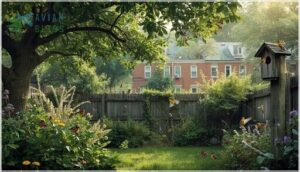
Small urban green spaces — even under two hectares — regularly support 12 or more songbird species, especially where native shrub planting replaces ornamental monocultures.
Noise mitigation matters too: songbirds in loud corridors shift song frequencies to stay audible.
Low-rise density neighborhoods outperform high-rises for resident species.
Backyard nest boxes, green roofs, and native plants turn fragmented habitat into functional bird conservation ground.
Climate Zones and Songbird Distribution

Where a songbird lives isn’t random — climate shapes nearly every aspect of its range, behavior, and survival.
Temperature gradients, seasonal shifts, and even small pockets of local microclimate all influence which species show up where and when.
Here’s how these climate factors play out across songbird distribution.
Temperate Vs. Tropical Regions
Think of it this way: tropical regions are songbird headquarters. Species richness peaks dramatically there — some forests host up to 400 bird species per site, double what temperate zones support.
Tropical songbirds also show stronger Plumage Vibrancy, slower Nestling Growth, longer Breeding Duration, and smaller Clutch Size. These differences aren’t random — they’re ecological logic written in feathers, shaped by habitat fragmentation pressures and the demands of conservation planning.
Influence of Seasonal Variation
Seasons don’t just change the scenery — they rewire how songbirds use every inch of their habitat. Insect Availability peaks in late summer, then collapses, pushing warblers toward Fruit Shifts by early autumn. Canopy Leaf‑out in spring rapidly multiplies nesting space.
Four seasonal forces shape hab type use across climate zones:
- Temperature‑Driven Nesting advances by 1–3 weeks per 1–2°C warming
- Water‑Level Fluctuations shrink riparian strips by 10–30 meters during dry summers
- Fruit Shifts increase berry intake 15–30 percentage points by mid‑winter
- Seasonal movement compresses bird migration patterns when habitat fragmentation cuts corridor access
Impact of Microclimates
Within a single habitat type, temperature can swing 2–3°C over just a few meters — and songbirds track those differences precisely. Dickcissels pick nest sites running 1–2°C cooler than surrounding spots.
Denser vegetation insulation drops extreme heat days by four across a nesting cycle. Topographic cooling on north‑facing slopes stabilizes hermit warbler populations.
Urban heat islands, meanwhile, push climate zones past 39°C thresholds, undermining nest temperature effects and habitat protection.
Vegetation Layers Supporting Songbirds

Think of a healthy songbird habitat like a layered cake — each level provides a different purpose, and removing one throws the whole thing off balance.
The good news is that once you understand what each layer offers, you’ll know exactly where to focus your efforts.
Here’s a closer look at the three key vegetation layers that matter most.
Canopy, Understory, and Shrub Layers
Each layer in forest ecosystems functions like a separate neighborhood.
Canopy Height Variability — trees reaching 20–35 meters — shape which warblers and vireos nest above.
Understory Light Dynamics (10–30 % of full daylight) provide insect‑rich habitat protection zones below.
Shrub Cover Thresholds around 20–30 % matter most for:
- Nesting concealment from predators
- Layered Foraging Patterns across vertical zones
- Vertical Nesting Strategies linking shrub layers to understory
Ground Layer and Leaf Litter
Below that shrub layer, the ground layer does quiet, essential work.
Leaf litter isn’t just dead leaves — it’s a living system.
A single square meter can harbor tens of thousands of invertebrates, directly driving invertebrate abundance for ground‑foragers like Ovenbirds and Hermit Thrushes.
Microclimate buffering keeps prey active through cold snaps.
Nutrient cycling feeds native plants.
Invasive earthworms impact this balance quickly — consuming litter faster than it accumulates, collapsing nest concealment and the food web with it.
Importance of Native Plant Diversity
Native plant diversity is what holds the whole system together.
A single oak can host 500‑plus caterpillar species, feeding directly into the insect food web that drives breeding success.
One oak tree can sustain over 500 caterpillar species, anchoring the entire insect food web songbirds depend on to breed
That variety also delivers seasonal nutrition through staggered fruiting cycles and strengthens microhabitat quality by building stable, layered cover.
It even boosts invasive resistance — diverse native assemblages simply leave fewer gaps for opportunistic exotics to exploit.
Habitat Specialization Among Songbirds
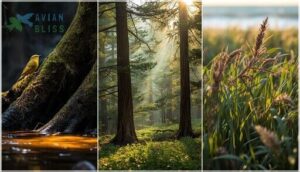
Some species have adapted so tightly to a specific habitat that even small changes can throw off their whole way of life. Here’s a closer look at how that specialization actually works — and which birds show it most clearly.
Species Adaptations to Specific Zones
Every songbird species is fundamentally built for one address. Habitat specialization isn’t accidental — it’s written into anatomy, behavior, and ecology. Species adaptation runs deep: from syrinx specialization enabling precise vocal territory defense to nesting height preference dictated by vegetation structure.
- Wood Thrushes: understory nesters, foraging leaf litter in damp deciduous forests
- Blackburnian Warblers: canopy specialists requiring 80%+ conifer cover
- Prothonotary Warblers: cavity nesters over standing swamp water
- Sprague’s Pipits: grassland ground-nesters selecting vegetation under 49 cm
- Neotropical migrants: dietary shift between breeding and wintering ecological niches
Generalists Vs. Specialists
Think of it as a spectrum. Generalists — robins, starlings, Northern Cardinals — carry wide niche breadth, tolerating urban light, fragmented patches, and mixed land use. Specialists stake everything on one habitat type.
Dispersal distance, functional diversity, even genetic structure diverge between them. In conservation biology and species distribution modeling, this split determines which songbirds survive habitat fragmentation and destruction — and which quietly disappear.
Examples of Specialized Songbirds
Specialists don’t leave much room for error.
The Acadian Flycatcher won’t nest without closed-canopy deciduous forest over 25 hectares — shrink that patch, and it’s gone. Baird’s Sparrow demands native mixed-grass prairie at just the right height. Willow Flycatchers need dense riparian thickets; Cactus Wrens need thorny desert cacti.
Understanding songbird habitat and behavior at this level tells you exactly where each species stands — or falls.
Migration Patterns and Seasonal Habitat Use

Not every songbird stays put when the seasons shift — some travel thousands of miles while others barely leave the county. That movement shapes how and where birds rely on different habitat zones throughout the year.
Here’s a closer look at the key migration patterns and seasonal habits that drive it all.
Neotropical Migrants and Resident Species
birds leave. stay put. That split defines how you read any landscape.
Migratory songbirds like the Wood Thrush travel from the Amazon basin and broader Neotropics each spring, timing their Breeding Timing precisely around peak Insect Food Supply. Resident songbirds — cardinals, chickadees — hold year‑round Territory Defense.
Three things separate these groups:
- Song Complexity peaks during breeding return
- Wintering Grounds shape survival odds
- Neotropics connectivity determines population health
Stopover and Wintering Zones
Migration isn’t just a journey — it’s a survival calculation. Songbirds hit a fuel mass threshold before they depart any stopover, sometimes lingering 1 to 15 days depending on fruit shrub resources and edge habitat value along the route.
Stopover duration stretches longer after crossing major barriers.
Yet two-thirds of these critical sites have no formal protection — a protected hotspot gap that leaves seasonal movement dangerously exposed.
Connectivity Between Habitat Zones
Ecological corridors aren’t optional extras — they’re the connective tissue holding songbird populations together. Without them, fragmentation barriers wider than 1 km block movement entirely, cutting off gene flow and shrinking effective habitat by nearly half.
Riparian linkages let forest specialists cross open pasture safely, while matrix connectivity through native shrubs keeps urban patches linked. Well-connected landscapes raise songbird biodiversity by 25%.
Threats to Native Songbird Habitat Zones

Songbird habitats don’t disappear overnight — they erode through a series of pressures that build quietly until populations start to collapse.
Some threats are slow and structural, others are fast-moving, but all of them chip away at the same foundation: the connected, layered habitats these birds depend on.
Here’s what’s actually driving the decline.
Habitat Fragmentation and Loss
Fragmentation quietly dismantles songbird habitat from the inside out. Small forest patches under 20 hectares support half the songbird territories of continuous forest — and the damage compounds fast:
- Patch Size Effects shrink viable breeding zones, erasing specialist species within five years
- Edge Predation spikes 40–60%, gutting nesting success
- Genetic Isolation cuts diversity by 20% in isolated patches
- Cowbird Parasitism overtakes up to 100% of Wood Thrush nests near edges
Climate Change Impacts
Habitat loss doesn’t act alone. Climate change impacts compound every vulnerability already in the system. Phenological mismatch — when caterpillar peaks outpace nestling demand — cuts food access just when chicks need it most.
Heat-induced mortality spikes during extreme weather events, with tropical populations dropping up to 38%. Drought-driven decline reshapes species distribution modeling across habitat type boundaries, while range edge contraction quietly erases songbird conservation gains decade by decade.
Urbanization and Land Use Changes
Urban sprawl impacts hit hard and fast.
Suburban expansion shrinks nesting habitat by 30% over two decades, while habitat fragmentation splits forest patches into isolated islands where Wood Thrush populations collapse.
Road noise pollution drowns out breeding calls, and invasive species pressure displaces native feeders.
Without green infrastructure solutions and smarter agricultural land management, urban wildlife loses ground, it won’t recover.
Conservation Strategies for Habitat Zones

Knowing the threats is only half the battle — the other half is doing something about them.
Conservation strategies for songbird habitat zones work on a few key fronts, each targeting a different piece of the puzzle.
Here’s what’s actually making a difference.
Protecting Core Breeding Areas
Core breeding areas don’t protect themselves.
Legal Buffer Zones shield nesting sites from disturbance, while Seasonal Access Restrictions keep human activity out during the breeding season.
Predator Exclusion Fences can triple hatching success in vulnerable colonies.
Sagebrush Cover Thresholds matter too — songbird counts double above 40 percent cover.
Pair these tools with Habitat Connectivity Corridors, and you’re giving habitat specialization a real fighting chance.
Restoring Degraded Habitats
Protecting nesting sites buys time — but restoration is how you win ground back.
Prescribed Burning clears invasive shrubs that choke grassland songbirds. Invasive Removal rebuilds native vegetation structure almost immediately. Native Plant Replanting using site‑appropriate Native Plant Species Selection — think oaks, elderberry, willows — restores the insect base nestlings depend on.
Grazing Management and Wetland Rehabilitation round out any serious Songbird Habitat Conservation plan.
Creating Corridors for Migration
Connecting fragmented patches is where songbird conservation gets real.
Design corridors at least 1,000 feet wide — narrow links simply don’t cut it for thrushes and warblers.
Target umbrella species like Golden-winged Warblers to guide your native plant mix and barrier mitigation around roads and fences.
Use Motus stations and banding data as monitoring techniques to confirm migratory songbirds are actually moving through, building genuine ecological connectivity.
Managing and Creating Songbird Habitats

You don’t need acres of wilderness to make a real difference for songbirds — your own backyard can pull serious weight.
A few smart, well-placed choices go a long way toward building habitat that actually gets used.
Here’s where to start.
Native Plant Selection for Backyards
Start with what’s growing in your yard — it sets the stage for everything.
Berry-rich shrubs like elderberry and hawthorn feed over 40 songbird species, while insect-host perennials such as goldenrod and native cherries support hundreds of caterpillar types.
Seasonal nectar plants and multi-layer planting — canopy to ground cover — enhance habitat restoration and creation.
Low-maintenance natives do the heavy lifting for backyard wildlife and bird conservation.
Installing Water Sources and Nest Boxes
Adding water and shelter transforms your yard into a functioning habitat patch.
Keep bird baths shallow — one to two inches deep — positioned in lightly shaded spots for Shade Positioning and predator visibility.
Apply Predator Guards and proper Pole Height on nest boxes, usually five to fifteen feet up.
Seasonal Maintenance every few days keeps both resources viable for songbird conservation.
Sustainable Land Management Practices
Sustainable land management isn’t just good farming — it’s bird conservation in action. Invasive Species Control, like mechanical removal every three years, cuts nest predation rates by up to 50 percent. Hedgerow Buffer Strips with native plants host 25 percent more species.
Forest Stand Improvement, Rotational Grazing, and Soil Health Monitoring all work together, creating the layered habitat management that keeps songbird populations stable across forest ecology and open landscapes.
Monitoring Songbird Populations by Habitat

Knowing where songbirds are — and whether their numbers are holding steady — is the backbone of any real conservation effort.
Tracking populations by habitat gives you a clearer picture than broad estimates ever could.
Here’s how that monitoring actually works, from the tools scientists use to the role everyday people play.
Using Range Maps and Surveys
Range maps are your first window into songbird ecology — and eBird makes them remarkably precise. Through Alpha Hull Modeling and Seasonal Overlap Mapping, distribution boundaries reflect actual habitat use, not guesswork.
Survey Effort Optimization ensures coverage reaches Data-Poor Regions where predictions otherwise fail. Breeding Bird Surveys run standardized routes twice per season, grounding biodiversity monitoring in real field data that directly shapes habitat management decisions.
Citizen Science and Community Involvement
You don’t need a PhD to move the needle on bird conservation. Every day observers are generating some of the most valuable population data available today.
- eBird Data Collection logs over 100 million sightings annually, mapping species across habitat zones
- NestWatch Participation tracks nesting success weekly, revealing climate impacts on breeding cycles
- Dawn Chorus Recording aids biodiversity monitoring through smartphone-captured soundscapes
- Habitat Restoration Volunteering and Community Brigade Training document 221 species across five vegetation types
Guiding Conservation Decisions
All that community data feeds directly into conservation decisions — and that’s where tools like Open Pine make the picture real.
Spatial decision support tools translate raw observations into actionable habitat management strategies.
| Tool/Framework | Conservation Role |
|---|---|
| Prioritization Frameworks | Rank species and zones by extinction risk |
| Adaptive Management | Adjust actions through monitoring cycles |
| Umbrella Species Planning | Cover multiple birds under one target |
| Landscape Corridors | Link habitat zones for bird migration patterns |
Frequently Asked Questions (FAQs)
What is the number one killer of songbirds?
Spoiler: it’s not windows, wind turbines, or even habitat loss. Free‑Roaming Cats kill an estimated 3–4 billion birds annually in the U.S. — the single deadliest direct threat to songbirds.
Where do songbirds go in winter?
It depends on the species.
Neotropical migrants follow bird migration patterns south through the Coastal Flyway toward Mangrove wintering grounds, while residents like cardinals rely on Urban Roosting sites, Snow Burrow Habitats, and Lowland Fruit Sources nearby.
Which pesticides pose the greatest risk to songbirds?
Neonicotinoid toxicity kills outright — a dove can hit a lethal imidacloprid dose from just 7 grams of treated sorghum. Organophosphate exposure, carbamate poisoning, and anticoagulant secondary poisoning follow close behind.
How does wildfire reshape songbird habitat zones over time?
Wildfire rewrites the rulebook fast.
Species richness drops 50% within the first year, but post‑fire succession flips the script — nearly twice as many species increase as decrease across the fire severity gradient within just a few years.
How do predators influence songbird zone selection and density?
Predators shape songbird zone selection more than most people realize.
Nest predation drives predator avoidance behaviors, pushing pairs into safer microhabitats.
Fear-induced fecundity losses and edge risk gradients directly compress viable breeding density across fragmented landscapes.
Conclusion
The quietest forests are often the ones in the most danger—silence where there should be song is its own kind of alarm.
Native songbird habitat zones don’t ask for much: the right plants, intact corridors, a functioning shrub layer. But they give back enormously—biodiversity, ecological balance, and those irreplaceable dawn choruses.
What you protect in your backyard, your watershed, your local woodlands adds up. Small, deliberate choices compound into landscapes where Thrushes still have somewhere to land.
- https://nabci-us.org/resources/bird-conservation-regions-map/
- https://www.birds.cornell.edu/landtrust/bird-conservation-regions/
- https://besjournals.onlinelibrary.wiley.com/doi/full/10.1111/1365-2656.13945
- https://extension.okstate.edu/fact-sheets/songbirds.html
- https://www.ernstseed.com/supporting-native-songbirds/