This site is supported by our readers. We may earn a commission, at no cost to you, if you purchase through links.
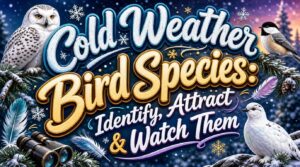
Most birds head south when temperatures drop—but a handful of species do the opposite, thriving precisely where the cold hits hardest. The Rock Ptarmigan turns completely white to vanish into snowfields. The Snowy Owl hunts open tundra in conditions that would ground most raptors. These aren’t just survivors; they’re specialists, finely tuned by evolution to treat winter as home rather than a threat.
Cold weather bird species follow patterns that reveal a lot about where you live, what you plant, and how you set up your feeders. From boreal forest regulars to irruptive visitors blown south by arctic storms, winter birds reward patient, curious watchers with some of the season’s most striking sightings.
Table Of Contents
- Key Takeaways
- Best Cold Weather Bird Species
- Arctic Birds Built for Ice
- Backyard Winter Birds to Watch
- Boreal Forest Winter Birds
- Cold Weather Bird Identification Tips
- How Winter Birds Stay Warm
- Winter Bird Survival Behaviors
- What Cold Weather Birds Eat
- Attracting Cold Weather Birds
- Resident and Migratory Winter Birds
- Frequently Asked Questions (FAQs)
- Conclusion
Key Takeaways
- Cold-weather birds like the Rock Ptarmigan, Snowy Owl, and Black-capped Chickadee don’t just survive winter — they’re built for it, with dense feathers, feathered feet, and countercurrent heat exchange that recycles warmth before it’s lost.
- What you put out matters: sunflower seeds and suet draw the widest variety of winter visitors, while nyjer feeders, heated birdbaths, and fruit-bearing shrubs turn your yard into a reliable winter habitat.
- Not every winter bird is passing through — some are year-round residents, some shift short distances with the cold, and others show up unpredictably during irruption years when northern food crops fail.
- You can identify most cold-weather species by watching just four things: winter plumage color, body size, beak shape, and flight pattern — together, they narrow down almost any confusing silhouette.
Best Cold Weather Bird Species
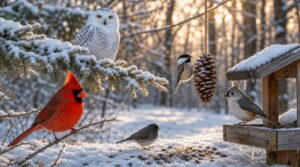
Not every bird heads south when temperatures drop — some are built to thrive in the cold. Knowing which species to look for makes winter birding a lot more rewarding.
If you want to dig deeper, bird migration patterns and cold-weather behavior breaks down exactly why certain species stay put while others flee the frost.
Here are five cold-weather birds worth getting familiar with.
Snow Bunting
The Snow Bunting is one of winter’s most recognizable visitors from tundra ecosystems, arriving in open fields after males spend weeks in cold climates establishing territory before females follow. Watch for flocks displaying tight flock dynamics, swirling like windblown snowflakes across stubble fields.
Their rusty-washed winter plumage, vocal repertoire of metallic chips, and preference for seed mixes make them genuinely rewarding to spot.
Recent southern sightings at Budleigh Salterton highlight how extremely rare their presence is in this region.
Dark-Eyed Junco
Where Snow Buntings drift through open fields, Dark-eyed Juncos claim your backyard.
These compact sparrows show impressive Plumage Variation across subspecies — slate-gray, brownish, or reddish backs — but always flash white outer tail feathers.
Their Ground Foraging Techniques and Seasonal Flock Dynamics make birdwatching in winter genuinely rewarding. Try seed mixes on low platform feeders; smart feeder placement strategies bring them consistently close.
Black-Capped Chickadee
After the junco, shift your eyes to the trees — the Black-capped Chickadee is rarely far behind.
This small bird, measuring just 4–5 inches, thrives in suburban habitats year-round. Its seasonal diet shifts from insects to seeds and suet each winter, making bird feeders essential stops.
- Vocal repertoire includes alarm-coded chickadee-dee-dee calls
- Cavity nesting in tree hollows or nest boxes
- Territory displays intensify near prime feeder placement strategies
- Black-capped Chickadee flocks often signal other species nearby
Snowy Owl
Few birds stop you in your tracks like the Snowy Owl (Bubo scandiacus). This large raptor exhibits exceptional cold tolerance, with dense feathering forming natural insulated foot boots and a yellow-eyed facial disk enabling acoustic prey detection beneath snow.
Native to the Arctic tundra, its survival hinges on lemming population dependence, which periodically triggers irruptions south.
During winter surveys, observe its daylight hunting adaptation and ground nest strategy, behaviors critical to its resilience in harsh environments.
Rock Ptarmigan
Few birds master winter disguise quite like the Rock Ptarmigan (Lagopus muta). Its Alpine Molt Cycle shifts its body to near-total white, achieving impressive Snow Camouflage Efficiency against Arctic slopes.
Toe Feather Adaptation functions like built-in snowshoes, enabling agile movement across icy terrain.
Males perform striking Mating Flight Displays near ridge nest sites, while thick plumage ensures this high Arctic tundra specialist thrives through brutal cold.
Arctic Birds Built for Ice
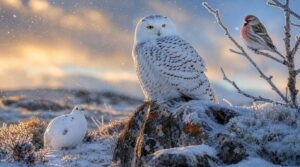
Some birds don’t just survive the cold — they’re engineered for it. These arctic species have physical adaptations that make a blizzard feel like business as usual.
Here are three that truly own the ice.
Emperor Penguin
No bird on Earth pushes cold tolerance further than the Emperor Penguin (Aptenodytes forsteri). Standing up to 130 cm tall, this species defines Antarctic breeding behavior through exceptional colony coordination and ice migration to inland rookeries. What sets it apart:
- Deep diving exceeds 500 meters per hunt
- Egg incubation lasts 40–50 days, by males only
- Huddling and vocal displays sustain colonies through brutal storms
Common Raven
Few cold weather birds match the common raven’s adaptability. Entirely black with shaggy throat feathers and a wedge-shaped tail, it thrives from coastal Alaska to mountain cliffs thanks to pure intelligence. Problem-solving and mimicry skills keep it fed year-round.
| Trait | Detail |
|---|---|
| Mate Bonding | Lifelong pair commitment |
| Cliff Nesting | Reused sites across years |
| Urban Adaptability | Thrives near human activity |
Suet placed in bird feeders can attract them during winter, further showcasing their resourcefulness.
Northern Shrike
The northern shrike is fundamentally a predator wearing songbird clothes. That sturdy hooked bill isn’t for seeds — it’s built for taking small birds and mice.
Specializing in perch hunting from open edge habitat, it spots prey fast and strikes faster.
Impaling prey on thorns is classic food caching behavior, creating a winter larder.
Vocal scolding signals territory.
Don’t confuse it with a finch.
Backyard Winter Birds to Watch
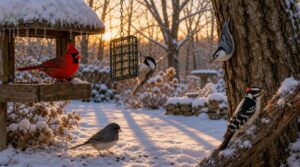
You don’t have to travel far to find fascinating winter birds — some of the best ones show up right outside your window.
A well-stocked backyard can draw in a surprising mix of cold-hardy species throughout the season.
Here are five you’re likely to spot.
Northern Cardinal
Few backyard visitors command attention like the Northern Cardinal — that flash of crimson against fresh snow is genuinely hard to miss. Males display bold Crest Display behaviors year-round, while females show warm brown tones with red accents.
Watch for their Winter Diet Shift toward seed and berry consumption at bird feeders.
Platform feeders with sunflower seeds, placed near dense shrubs, suit Breeding Pair Dynamics perfectly.
Blue Jay
Few winter visitors are as bold and unmistakable as the Blue Jay. Its Acorn Caching behavior and Cognitive Problem Solving make it one of the smartest birds at your feeders.
You’ll notice Territorial Displays and Vocal Mimicry year-round, even in cold weather. Set out high-energy seed varieties like peanuts and sunflower seeds — Family Cooperative Breeding groups often arrive together at winter bird feeding stations.
American Goldfinch
Unlike the bold Blue Jay, the American Goldfinch plays the quiet game in winter — dazzling Summer Plumage replaced by dull olive. Molt timing dramatically alters their appearance, so remain vigilant for these subtle visitors.
Their seed preference leans toward nyjer and sunflower, simplifying feeder placement: hang finch feeders in open areas. High-energy seed varieties ensure consistent returns.
Red-Breasted Nuthatch
Spot the Red-breasted Nuthatch by its rusty-orange belly and bold white eye stripe — it’s hard to miss once you know what to look for. Watch for energetic canopy climbing head-down along conifer trunks; that’s conifer-trunk foraging in action.
Hang suet near conifers and keep a heated bird bath unfrozen to attract these birds. Their territorial vocalizations — a nasal yank-yank — will announce every cold weather visit.
Tufted Titmouse
From the nuthatch’s head-down bark scrambling, shift your eyes upward — the Tufted Titmouse owns the mid-canopy with equal confidence. Its gray crest, rust-flanked profile, and bold dark forehead make it unmistakable at feeders.
- Offer sunflower seeds and suet at varied feeder heights
- Recognize its rich vocal repertoire and sharp territorial calls
- Watch for cavity nesting behavior near mature deciduous trees
- Note its role in mixed-species flocking with chickadees
- Maintain a heated bird bath for reliable winter visits
Predator vigilance benefits every bird sharing your yard.
Boreal Forest Winter Birds
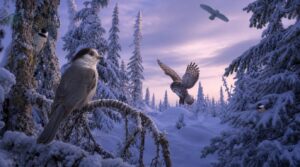
The boreal forest is one of the toughest places a bird can call home in winter, yet a surprising number of species thrive there year-round. Each one has carved out a specific niche — from raiding food caches to hunting through deep snow.
Here are five boreal specialists worth knowing.
Canada Jay
The Canada Jay practically owns the boreal forest in cold weather. These territorial family groups move through conifer stands year-round, their gray plumage blending into conifer bark camouflage like shadows between the branches.
| Trait | Detail |
|---|---|
| Habitat ranges | Boreal and subalpine conifers |
| Seasonal diet shifts | Berries, seeds, carrion, cached stores |
| Food sources | Thousands of bark-crevice caches |
| Vocal cache location | Calls coordinate cache sites |
| Human-feeding boldness | Approaches hands at campsites |
Canada jays don’t migrate — they master winter where they stand.
Common Redpoll
Common Redpolls bring a flash of crimson to the winter boreal, tiny acrobats with a red cap and flushed chest that make bird identification easy at a glance. Their Acrobatic Foraging style — rapid, twisting dives through birch and alder for Boreal Catkin Feeding — is unmistakable.
A specialized Throat Seed Pouch lets them stockpile high-energy seed varieties on the go.
Their Irregular Migration follows seed crop failures, so winter flocks can appear almost anywhere.
Evening Grosbeak
Evening Grosbeaks announce themselves like winter royalty — bold yellow males with a sturdy bill adaptation built for conifer seed foraging. Their nomadic flocking behavior and spruce seed preference drive unpredictable winter movements across boreal regions.
For bird identification, look for striking black-and-white wings. Place sunflower-stocked feeders in open spots — solid feeder placement guidelines pay off when a hungry flock drops in.
Pine Siskin
Small but restless, Pine Siskins follow their cone seed diet wherever boreal forests yield a good harvest — which explains their nomadic migration patterns across North America.
You’ll recognize them by their streaked brown plumage, slender bills, and branch-clinging habit while foraging. Their wheezy trill often arrives before they do.
Social flocking makes them feeder regulars; they frequent areas with abundant resources.
To support these birds during cold weather, stock high-energy seed varieties like nyjer, ensuring a reliable winter diet.
Northern Goshawk
The Northern Goshawk is a master of the winter forest — and one of its most formidable hunters. With a wingspan reaching 125 cm, it weaves through dense canopy with startling precision.
- Nesting Habitat — mature coniferous forests with high canopy cover
- Prey Preferences — grouse, squirrels, and voles during prey scarcity in winter
- Flight Maneuverability — swift pursuit through tight forest gaps
- Territorial Defense — actively guards large forest territories year-round
Habitat selection in winter keeps goshawks deep in boreal forests. Population monitoring reveals stable but sensitive numbers tied directly to forest health.
Cold Weather Bird Identification Tips
Spotting a winter bird takes more than a lucky glance — it’s about knowing what to look for before you even raise your binoculars. A few reliable clues can turn a confusing silhouette into a confident ID.
Here’s what to pay attention to when cold-weather species show up in your yard or field.
Winter Plumage Colors
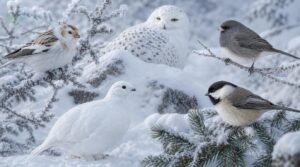
Winter plumage is not just about aesthetics—it’s survival science. Camouflage shifts, driven by melanin reduction, leave species like the Snow Bunting and Snowy Owl noticeably paler against snow. Feather edge whiteness and structural iridescence fade under low winter sun, enhancing concealment. These adaptations highlight the intricate relationship between avian biology and environmental conditions.
Molt timing varies by age and region, making seasonal plumage variation a reliable tool in bird identification techniques. This cyclical transformation ensures species blend into winter landscapes, while subtle differences in coloration and pattern aid observers in distinguishing between similar species.
| Species | Winter Plumage Trait |
|---|---|
| Snow Bunting | Near-white with reddish-brown head |
| Snowy Owl | Pale overall, minimal contrast |
| Dark-eyed Junco | Dull gray with lighter underparts |
| Rock Ptarmigan | Full white plumage via plumage molting |
| Black-capped Chickadee | Muted grays and browns |
Body Size Clues
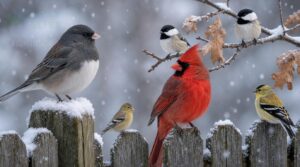
Body size is one of the most underrated bird identification techniques you can master. A bird’s frame reveals how it survives winter: bigger species carry greater thermal inertia, staying warmer longer, while smaller ones have a faster mass‑specific metabolism to compensate.
- Larger birds usually have a wider foraging range and exploit bigger seeds or prey
- Smaller species dominate high‑energy seed varieties through resource partitioning at feeders
- Wing loading shapes how each bird moves across snow‑covered terrain
- Log size observations in your field notebook or eBird app for pattern tracking
Beak Shape Differences
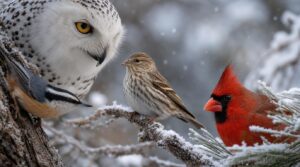
Once you’ve clocked a bird’s size, shift your eyes to its beak — it tells the rest of the story. Beak Length Variations alone separate the Snowy Owl’s hooked, flesh-tearing edge from the Red-breasted Nuthatch’s slender, bark-probing point.
Beak Depth Impact reveals seed-crushing power in the Northern Cardinal, while Beak Curvature Functions, Beak Width Significance, and Beak Edge Texture distinguish seed-based diet specialists from insectivorous birds instantly.
Flight Pattern Clues
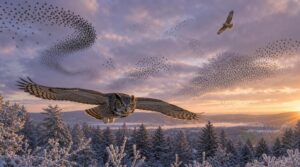
Beak shape narrows your list — flight seals the ID. Wingbeat Rhythm alone separates species: small passerines average 5–8 beats per second, while owls glide on slow, sweeping strokes.
Silent Glide Indicators, V‑Formation Dynamics, Turn Signature Types, and Altitude Shift Patterns all reveal winter bird migration routes, irruptive migration surges, and migration south when food pressures push flocks into unfamiliar ranges.
Feeder Behavior Signs
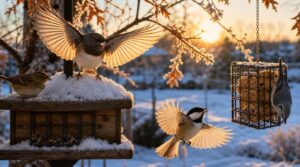
Once you’ve tracked flight patterns, watch what happens at the feeder itself. Dominant species claim prime perches first — that pecking order plays out fast.
Visit timing peaks around sunrise and before sunset. Aggressive displacements, tail bobbing, and preening indicators all signal health and hierarchy.
Birds hitting suet feeders or high-energy seed varieties show real feeder dependence, sometimes revealing food storage behavior and caching food patterns too.
How Winter Birds Stay Warm
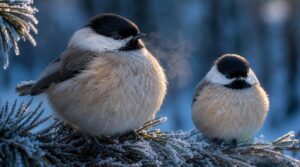
Winter birds don’t just tough it out — they’re built for the cold in ways that are genuinely impressive. Their bodies come equipped with smart, natural solutions that work together to hold heat even when temperatures drop well below freezing.
Here’s a closer look at the key physical features that make it possible.
Dense Down Feathers
Down feathers work like a three-dimensional mesh — each cluster radiates filaments thinner than a human hair, trapping air through cluster microstructure that rivals high-end insulation materials.
Loft efficiency and fill power determine how much warmth you get relative to weight.
Dense feathers maintain compression recovery and moisture resistance, giving thick plumage its reliable thermal insulation mechanisms even in bitter cold.
Subcutaneous Fat Layers
Beneath a winter bird’s skin lies a quiet powerhouse: subcutaneous fat layers that combine insulation thickness with meaningful energy reserves and fat storage. Lobule architecture organizes adipose tissue into compartments, lowering thermal conductivity and slowing heat loss.
Regional fat distribution reflects each species’ physiological cold tolerance, while hormone secretion helps regulate fat reserves dynamically — letting birds endure weeks of brutal cold without missing a beat.
Feathered Feet
Tiny boot-like tufts on birds’ feet aren’t decorative — they’re precision-engineered survival gear. Feathered toes and insulated legs work through smart insulation mechanics: trapped air pockets slow heat loss against frozen ground.
Here’s what makes this foot morphology so effective:
- Genetic Regulation shifts hindlimb skin toward feather production via TBX5 and PITX1 pathways
- Feather density insulation creates layered micro-air barriers that measurably raise foot surface temperatures
- Thermoregulation in birds benefits from reduced ground-contact cooling during overnight roosting
- Cold tolerance in birds improves as seasonal molts adjust coverage when temperatures rise
- Camouflage Role breaks up leg outlines against snow, with mobility trade-offs remaining minimal at walking speeds
Compact Body Shapes
Shape is a cold weather adaptation hiding in plain sight. Species like the Black-capped Chickadee, Tufted Titmouse, Red-breasted Nuthatch, and Common Redpoll share a Low Profile Silhouette with Centralized Mass that limits heat escape.
| Body Feature | Thermal Benefit |
|---|---|
| Tapered Torso & Dense Rib Cage | Reduces surface-area-to-volume ratio |
| Reduced Limb Span | Minimizes exposed, heat-losing extremities |
Counter-Current Heat Exchange
Birds don’t lose heat through their legs — they recycle it. Countercurrent heat exchange is the cold weather adaptation behind this: warm arterial blood flows down into the legs, transferring heat directly to cooler venous blood returning upward. This Leg Vascular Design maintains a Thermal Gradient that drives continuous energy conservation in cold conditions with exceptional Physiological Efficiency.
Winter birds don’t lose heat through their legs — they recycle it through countercurrent exchange
- Arterial and venous vessels run side-by-side, enabling near-complete heat transfer before blood reaches exposed feet
- Heat Transfer Modeling confirms this Evolutionary Adaptation reduces conductive heat loss to the surrounding environment
- The result is thermoregulation without extra energy cost — a built-in heat exchange mechanism running silently all winter
Winter Bird Survival Behaviors
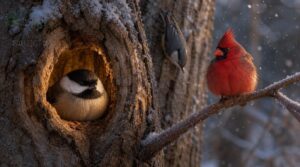
Staying warm is only half the battle — winter birds also need smart strategies to make it through the coldest months. Beyond their physical traits, they’ve developed a fascinating set of behaviors that help them find food, conserve energy, and survive brutal conditions.
Here are five of the most impressive ones.
Snow Burrowing
Some cold-weather birds don’t just endure winter — they dig into it. Rock Ptarmigan and Snow Buntings use snow shelters and tunnel architecture to access the subnivean climate, where temperatures stabilize near 0°C beneath the pack.
| Feature | Detail |
|---|---|
| Burrow Entrance Mounds | Signal recent digging activity |
| Snow Insulation Effects | Buffers extreme surface cold |
| Tunnel Depth | Tens of centimeters deep |
| Seasonal Activity Peaks | Highest during hard freezes |
| Snow Cover Impact | Hides movement from predators |
Snow roosting behavior peaks when above-surface conditions turn brutal.
Feather Fluffing
Watch a chickadee on a bitter morning, and you’ll notice it looks almost round—that’s feather fluffing mechanics at work. By lifting their plumage, winter birds trap warm air against the skin, a masterclass in avian thermoregulation.
Temperature triggers determine how much they puff. Excessive fluffing can also serve as a health indicator, flagging illness.
Seasonal patterns intensify this behavior during hard freezes, regulating body temperature through pure feather insulation.
Group Huddling
Group huddling is one of the most effective winter survival strategies, particularly among Emperor Penguins. This behavior maximizes warmth through collective effort.
Climate triggers like wind chill prompt tighter clusters, where thermal gradients shift heat toward outer members. Such dynamics ensure equitable heat distribution within the group.
Role rotation cycles individuals inward, balancing avian thermoregulation across the huddle. This movement prevents overexposure for any single member.
Communication cues — subtle vocalizations and nudges — maintain coordinated huddle size and movement, adapting to environmental changes in real time.
Food Caching
While huddling shares warmth communally, food caching approaches winter survival from a completely different angle — memory mapping. Species like Black-capped Chickadees and Blue Jays practice careful cache site selection, hiding energy-rich food across hundreds of locations before food scarcity hits.
- Cache content differentiation separates perishables from durable seeds
- Seasonal cache timing aligns retrieval with birds’ peak winter diet demand
- Pilferage defense includes decoy caches to protect real food sources
Daily Torpor
Unlike food caching, daily torpor works from the inside out. When torpor triggers hit — dropping temperatures or a sudden caloric shortfall — some winter birds dial their metabolic rate down to roughly 10–20% of normal. That’s serious metabolic savings.
| Torpor Factor | What It Means |
|---|---|
| Circadian Timing | Onset aligns with nightly rest cycles |
| Energy Budgets | Up to 50% savings on cold nights |
These energy conservation strategies and metabolic rate adjustments keep torpor in birds shallow and brief — just enough to survive, then back to foraging by dawn.
What Cold Weather Birds Eat
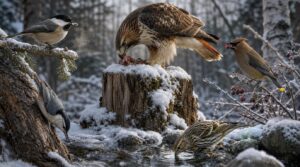
What a bird eats in winter tells you a lot about where to find it and how to bring it closer to your yard.
Diet varies more than most people expect — from tiny seeds to fresh-killed prey, depending on the species.
Here’s a look at the five main food sources that keep cold weather birds going.
Sunflower Seeds
Sunflower seeds are the cornerstone of any seed-based diet for winter birds, offering a nutrient profile that’s hard to beat. High-energy seed varieties packed with healthy fats and vitamin E provide essential fuel for black-capped chickadees during harsh winter nights.
Opt for shelled seeds over shell varieties when using platform feeders to minimize waste. This choice ensures birds access nutrients efficiently while reducing mess and discarded shells.
Preserve freshness by storing extras in airtight containers, adhering to basic storage recommendations. This practice maintains seed quality throughout the season, supporting consistent bird feeding.
Nyjer Seeds
Few seeds pack as much cold-weather value as nyjer. With 35–40% oil content and solid protein benefits, it’s a top high-energy seed variety for finches and siskins enduring winter’s toughest days. Seed size suitability matters here — nyjer’s tiny 1–2mm diameter fits small beaks perfectly.
Keep these in mind:
- Use fresh seed to avoid mold management issues
- Choose mesh feeders for minimal waste
- Source from reputable suppliers prioritizing sustainable harvesting
Suet Blocks
Suet blocks are among the most energy-rich food options for winter birds, offering 25–50% fat content to provide Winter Calorie Density critical for chickadees, nuthatches, and the Downy Woodpecker during extreme cold. Specialized Melt Resistance formulas retain their shape above 70°F, while insect-enriched varieties deliver a Protein Boost essential for avian survival.
| Feature | Standard Block | Insect-Enriched Block |
|---|---|---|
| Fat Content | 25–35% | 30–50% |
| Protein Boost | Low | High |
| Best For | Chickadees, finches | Woodpeckers, nuthatches |
To maximize feeder effectiveness, stock suet feeders with fresh product and adhere to Block Storage Tips by keeping spares in cool, dry conditions. Prioritize Feeder Hygiene through weekly scrubbing of cages to prevent contamination and ensure bird health.
Winter Berries
Berries are a lifeline in the winter diet of birds when seeds run low. Berry nutrient content — especially natural sugars — helps fruit-eating birds maintain body heat through freezing nights.
With smart Berry Plant Selection and Shrub Maintenance, your yard becomes a reliable habitat food source. Focus on native plants like winterberry holly for Late Season Fruit and ideal Winter Fruit Timing through January.
Small Mammal Prey
Not every winter bird lives on seeds. Raptors like Snowy Owls depend almost entirely on small mammals—lemmings, voles, and shrews—as core food sources in their arctic habitat.
Prey Size Preference, Rodent Activity Cycles, and Snow Cover Effects shape hunting patterns, determining what they hunt and when.
The hierarchy of preferred prey includes:
- Lemmings (primary arctic prey)
- Voles (40–120 g, ideal energy return)
- Field Mice (active under snow cover)
- Shrews (backup during Seasonal Prey Shifts)
- Burrowing Rodents (targeted via Burrow Detection Strategies)
Attracting Cold Weather Birds
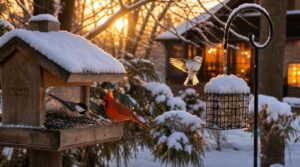
Getting winter birds to visit your yard isn’t complicated — it mostly comes down to giving them what they need to survive the cold.
A few simple setups can make a real difference, whether you’re hoping to spot a Snow Bunting or keep your resident chickadees well-fed.
Here’s what actually works.
Platform Feeders
Platform feeders are one of the most adaptable backyard feeders you can set up for winter birds. Place yours 4–5 feet high for ideal feeder height, and choose metal or wood for material durability in freezing conditions.
Load high-energy seed varieties like sunflower and safflower, and maintain a weekly cleaning routine.
Black-capped Chickadees, Blue Jays, and Northern Cardinals all show up reliably.
Finch Feeders
Finch feeders work best when you match the design to the birds. Small-port tube feeders keep larger species out, while mesh ventilation panels prevent moisture buildup — a key part of sound feeder hygiene. American Goldfinches, Purple Finches, and Redpolls all respond well to smart placement strategy and seed mix optimization.
- Port Size Design: Narrow ports serve nyjer and high-energy seed varieties best
- Placement Strategy: Position 5–10 feet from cover, away from competing platform feeders
- Seed Mix Optimization: Nyjer remains the top seed selection for winter birds
Heated Birdbaths
Beyond feeders, heated birdbaths give winter birds something just as essential — unfrozen water.
Most units run 60–75 watts with automatic thermostat settings that cycle off above freezing, ensuring energy efficiency. Look for UV-resistant bowl materials, built-in safety features like textured landing surfaces, and GFCI-compatible cords.
Ideal placement in a sheltered spot promotes bird health and disease prevention through easier bird bath hygiene.
Evergreen Shelter
Unfrozen water draws birds in, but shelter keeps them. Planting dense evergreen trees near your feeders mimics natural snow shelters, giving winter birds a windbreak when temperatures drop hard.
A well-placed Evergreen Shelter structure extends that protection further:
- Insulated Panels with R-20 ratings hold warmth without trapping moisture
- Snow Guard Design and Wind-Resistant Cladding handle heavy snow cover impact
- Heat Recovery Ventilation and Passive Solar Gain maintain livable interior conditions
Smart habitat conservation starts here.
Fruit-Bearing Shrubs
Shelter and food are key to attracting birds—fruit-bearing shrubs like crabapple, mountain ash, or lingonberry provide reliable food sources through late winter. These plants create a consistent supply that keeps birds returning.
Cedar Waxwing flocks quickly locate hardy berry varieties, making them ideal for wildlife gardens. Pairing these shrubs with native plants enhances their appeal, fostering a thriving ecosystem.
Proper soil pH management (around 4.5–5.5) is critical for plant health, ensuring seasonal feeding benefits that fruit-eating birds find irresistible. This approach combines practicality with ecological harmony.
Resident and Migratory Winter Birds
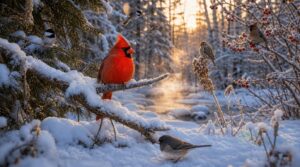
Not every bird you see in winter is just passing through.
Some are year-round neighbors, others drift in from the north, and a few show up only when food gets scarce elsewhere.
Here’s how winter bird patterns actually break down.
Year-Round Residents
Some birds don’t need a change of address when winter hits. In western New York and similar regions, species like the Black-capped Chickadee, Red-breasted Nuthatch, and White-breasted Nuthatch hold their ground year-round, visiting suet feeders consistently through ice and thaw.
These resident winter birds anchor stable backyard ecosystems — reliable as a neighbor who never misses a community meeting.
Short-Distance Migrants
Not every migrant crosses an ocean — some just shift a few counties south. Short-distance migrants make subtle Seasonal Range Adjustments driven by Proximity Migration Triggers like food scarcity and temperature drops. Watch your feeders for these Short-Distance Movement Timing arrivals:
- Black-capped Chickadee — Local Habitat Shifts toward lower elevations
- Tufted Titmouse — Neighborhood Feeder Use peaks mid-winter
- Cedar Waxwing — follows berry crops regionally
- Red-breasted Nuthatch — descends from boreal edges seeking suet
- Short-Distance Movement Timing varies by snow depth and seed availability
Irruptive Winter Visitors
Some winters surprise you. Food driven migrations push species like Evening Grosbeaks, Redpolls, and Cedar Waxwings far outside their usual range when cone crop tracking fails in boreal forests. These bird irruptions aren’t random — they follow patterns driven by food scarcity.
Irruption timing generally peaks December through February, flooding urban hotspots with multi-species flocks. This phenomenon occurs when northern seed crops collapse, forcing birds to seek alternative food sources.
Irruptive species dynamics are directly tied to food availability. Watch your feeders during these periods, as they become critical resources when natural food sources fail.
Regional Winter Patterns
Where you live shapes everything about which birds show up at your feeder. Geographical features such as Coastal Temperature Moderation keep shoreline regions mild, enabling species rarely seen by inland birders in winter to persist, while Mountain Snow Persistence drives Elevation Habitat Shifts, forcing mountain birds to descend to lower valleys when deep snow obscures food sources. Climatic phenomena like Storm Track Shifts and Teleconnection Impacts—including NAO and PNA patterns—directly influence regional bird populations by altering snow cover effects on foraging across entire flyways.
Five regional patterns worth tracking:
- Pacific Coast — mild ocean influence extends winter migration patterns for waterfowl and shorebirds well into February.
- Northern Rockies — persistent snowpack above 3,000 m forces altitudinal descents among finches and sparrows.
- Great Lakes corridor — storm track shifts create unpredictable cold snaps that concentrate irruptive species at feeders.
- Southern Canada/northern U.S. — stable winter habitat food sources support reliable Dark-eyed Junco and chickadee populations year-round.
- Interior highlands — climate change impacts on wildlife are accelerating range contractions for cold-specialist species.
Returning Winter Flocks
Flocks don’t wander randomly — they follow the same Habitat Corridors year after year, guided by Navigation Cues like frost timing and daylight shifts.
Arrival Timing peaks from late October through December, with Flock Size Dynamics ranging from five to fifty birds depending on food availability.
Social Hierarchy within groups positions dominant birds to the best suet feeders and heated birdbaths, making your setup a reliable wintering ground worth watching with good birdwatching equipment.
Frequently Asked Questions (FAQs)
Do cold weather birds communicate differently in winter?
Call simplification, vocal frequency shift, and contact call networks all emerge as winter birds improve the efficiency of communication.
Bird vocalization changes help flocks stay connected across snowy terrain efficiently.
How do bird eggs survive freezing temperatures?
Bird eggs survive freezing temperatures through shell thickness, nest insulation, and egg coloration that absorbs solar heat.
Parental incubation, low pore conductance, and embryo cold hardiness stabilize metabolic rate despite harsh conditions.
Which predators threaten winter birds most often?
Like shadows at the edge of a clearing, predators close in fast.
Domestic cats, raptor predation from red-tailed hawks, and coyote attacks all drive predation risk during winter.
Nighttime owl hunts and corvid opportunism from common ravens further intensify this threat.
Can birds get frostbite on their feet?
Frostbite can occur, but it’s rare. Birds use vascular frost protection — heat exchange mechanisms and vasoconstriction limit toe ice damage.
Wet foot risks rise sharply in icy water, where feathered toes and foot warmth strategies matter most.
How does snow depth affect winter bird populations?
Deeper snow dramatically raises energetic costs for ground foragers, cutting foraging accessibility and shrinking local populations.
Habitat selection shifts as birds chase exposed patches, reshaping bird population distribution and triggering regional population shifts across winter ranges.
Conclusion
Winter is a filter, and cold weather bird species are what pass through it—refined, resilient, and striking.
Stock your feeders with sunflower seeds and suet, add a heated birdbath, and plant dense evergreens for shelter. These steps create a lifeline for winter-hardy birds.
Learn the field marks: beak shape, body size, flight pattern. Observing these details reveals the diversity of species that persist through the cold.
Each one arriving at your yard isn’t just a visitor—it’s proof that nature doesn’t pause for the cold. It doubles down.
- https://www.bing.com/ck/a?!&&p=5043f002b32700d3053e0bdfe5b5aadb615ed51a142037a52d1395da196b4cd5JmltdHM9MTc2ODI2MjQwMA&ptn=3&ver=2&hsh=4&fclid=1c03e36f-f69a-6835-1843-f5f8f7766948&psq=birdcast+400+million+birds+night&u=a1aHR0cHM6Ly93d3cuYmlyZHMuY29ybmVsbC5lZHUvaG9tZS9yZWNvcmQtYnJlYWtpbmctbmlnaHQtb2YtYmlyZC1taWdyYXRpb24v
- https://www.fws.gov/story/how-do-birds-keep-warm-winter
- https://youtu.be/B5tdPDNzHRo?si=-XRs8NIGqNG7IWSR
- https://www.hitchcockcenter.org/earth-matters/behaviors-of-wintering-birds/
- https://asri.org/news-events/articles-2019-02/study-finds-bird-migration-timing-skewed-by-climate-change.html