This site is supported by our readers. We may earn a commission, at no cost to you, if you purchase through links.
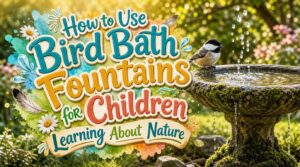
A chickadee lands on the rim, dips its head, and flutters its wings—and suddenly a five-year-old is completely still, watching. That moment of shared attention is rare, and a bird bath fountain can make it happen right in your backyard. Moving water draws birds in ways a still basin simply doesn’t, giving children repeated, close-up chances to observe real animal behavior.
The sounds, the ripples, the preening routines—each one opens a door to a natural conversation about science, hygiene, or habitat. Bird bath fountains for children learning about nature work because the birds do most of the teaching.
Table Of Contents
- Key Takeaways
- Benefits of Bird Bath Fountains
- Choose a Child-Safe Fountain
- Build a DIY Bird Bubbler
- Place It for Bird Watching
- Maintain Water Flow Safely
- Frequently Asked Questions (FAQs)
- Why put a penny in your birdbath?
- What are the benefits of bird fountains?
- Do fountains attract wildlife?
- Why put a tennis ball in your bird bath?
- What bird species visit fountains most frequently?
- Can bird baths attract unwanted wildlife or pests?
- How do I teach water conservation alongside bird bathing?
- Are bird bath fountains safe during thunderstorms?
- Which plants pair best with a bird bath fountain?
- Conclusion
Key Takeaways
- Moving water in a bird bath does more than attract birds — it sparks real curiosity in kids about science, hygiene, and animal behavior, all without a lesson plan.
- A child-safe fountain needs shallow water (under 2 inches), a stable weighted base, hidden pump cords, and non-slip surfaces to keep little hands and curious eyes safe.
- Building your own bird bubbler costs under $30 using a shallow tray, a small aquarium pump, and basic PVC pipe — and kids can help decorate it with sealed stones, tiles, or glass beads.
- Keeping the water fresh daily, the flow gentle, and the basin mosquito-free is what keeps birds coming back and makes the whole setup a lasting outdoor classroom.
Benefits of Bird Bath Fountains
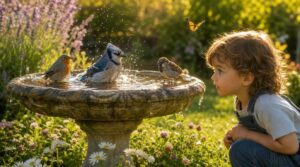
A bird bath fountain does more than look pretty in the yard — it quietly turns your outdoor space into a hands-on classroom.
Kids and adults alike start noticing migration patterns, nesting habits, and species they’d never spotted before — a bird bath fountain naturally draws the wildlife to you.
Kids pick up real science and nature skills just by watching and listening. Here are five ways a simple fountain makes that happen.
Bird Identification Practice
A bird bath transforms your backyard into a natural classroom, offering children an engaging way to observe birds up close. When birds stop by to drink or splash, kids can practice identifying species by focusing on four key visual and behavioral clues.
These identification cues include:
- Size cues — comparing body shapes instantly
- Color patterns — noting wing bars or eye rings
- Behavior clues — watching how each bird moves
- Habitat clues — connecting species to their preferred environments
Children can start by analyzing a bird’s size and shape clues to quickly narrow down options. This foundational step simplifies identification and builds observational skills.
Seasonal bird migration introduces new visitors, ensuring every birdwatching session becomes a fresh discovery. This dynamic cycle keeps the learning experience exciting and ever-changing.
Natural Sound Listening
Once your child starts naming birds by sight, try shifting their focus to sound. A bird bath offers what a field guide cannot: it layers the soft gurgling water of a water feature with real birdsong nearby. This creates an ideal environment for Mindful Listening and Acoustic Localization practice.
Try a Sound Scavenger Hunt by asking, "Where’s that call coming from?" Such activities naturally foster Natural Sound Mapping and Auditory Pattern Recognition, evolving directly from birdwatching at your habitat creation hub.
Water Hygiene Lessons
Watching birds bathe opens a natural door to talking about why we wash up, too. Point out how birds dip, flutter, and preen — that’s their Handwashing Routine.
You can connect this to your own routine: soap, water, scrubbing for 20 seconds. It’s a quiet, real-world hook that makes hygiene feel less like a rule and more like something every living creature understands.
Soap, water, and twenty seconds prove that good hygiene is a habit every living creature understands
Ripples and Wave Motion
Those ripples spreading outward from your bird bath are actually a live physics lesson. Every drop or spray from the water pump creates circular wavefronts — real diffraction patterns, reflection angles, and even capillary wave effects your child can watch in real time.
- Wave speed changes with water depth
- Interference zones appear where ripples overlap and cancel out
- Gurgling water from a water feature keeps patterns constantly shifting
The gurgling water from a water feature ensures these patterns remain in constant motion, offering an ever-changing display of natural physics.
Family Nature Discussions
Something as simple as a bird bath sparks the best family conversations. Ask, "Why do you think that bird keeps coming back?" and watch curiosity take over.
Shared storytelling, observation journaling, and questioning techniques give everyone a role — even little ones. When your family makes collaborative decisions about your bird bubbler fountain or garden wildlife habitat, you’re building nature vocabulary and lasting memories together.
Choose a Child-Safe Fountain
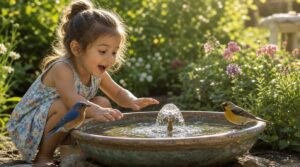
Not every bird bath is built with little hands and curious eyes in mind, so it pays to know what to look for before you buy.
Look for shallow basins, smooth edges, and stable bases — the same thoughtful details covered in this guide to creating a backyard bird habitat that kids and wildlife both love.
A few smart design features can make a real difference in keeping your kids safe while still giving the birds a place they’ll love.
Here’s what to check off your list.
Shallow Basin Depth
The right basin depth makes all the difference. For a child-safe bird bath, keep the water under 2 inches — about as shallow as a shallow baking tray. This enables:
- Clear Depth Perception — kids see the bottom instantly
- Easy Insect Observation — surface creatures stay visible longer
- Low Water Volume — faster, safer refills
- Sediment Settling Speed — debris is easy to spot and remove
- Temperature Moderation — shallow water warms gently, staying bird-friendly
Stable Weighted Base
A fountain that tips over isn’t just frustrating — it’s a safety issue. That’s why base mass distribution matters so much. Look for a fountain with a low center of gravity, a wide footprint, and good footing friction against surfaces like wood or brick. Some models even offer adjustable ballast to boost wind resistance.
A decorative pot base filled with rocks works beautifully too.
Non-slip Bird Surfaces
Birds need a solid grip to feel safe enough to linger. Textured rubber mats, micro-grit coatings, and silicone granule surfaces all reduce slipping on wet basins. Raised edge ridges guide small feet away from deeper spots.
For a DIY build, press sand, substrate grip, rocks, shells, or tiles into tile adhesive inside your shallow baking tray — instant traction, no harm done.
Concealed Pump Cords
Loose cords near a water feature are an accident waiting to happen — especially with curious kids nearby. That’s why a Hidden Wiring Design matters so much. Look for fountains that route plastic tubing and PVC pipe through a Moisture-Proof Conduit inside the base, sealed at the top with a Sealed Entry Grommet to block splashes.
Five features worth checking before you buy:
- Removable Inspection Panel for easy cord checks
- Quick-Connect Access fittings so you don’t need tools
- Weatherproof insulation around every outlet hole and end cap
- Rounded channels shaped by smooth drill bits to prevent snagging
- Low-profile lip that sits flush, keeping surfaces safe underfoot
Safe Viewing Height
Set your DIY bird bubbler fountain so the basin center sits 28–32 inches from the ground — that’s natural eye-level ergonomics for most seated children. Use adjustable stool height to match younger kids or wheelchair accessibility needs.
Glare-free placement, away from midday sun, keeps ripples easy to see. Maintain a 6-inch safety height margin above the water edge.
Build a DIY Bird Bubbler
Building your own bird bubbler is easier than you’d think, and it doesn’t take much money or experience to pull it off. You only need a handful of simple materials — most of which you can find at a hardware store or online for under $30.
Here’s what you’ll need to get started.
Budget-friendly Materials
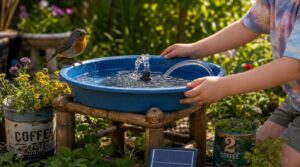
You don’t need to spend much to build a DIY bird bubbler fountain that kids will love. Most materials are already around you or easy to find cheaply.
- Recycled plastic tubs or thrifted containers from secondhand shops make perfect basins
- Bamboo structures work as natural, affordable risers
- Budget pumps — aquarium or solar-powered pump styles — run under $20
- PVC pipe and plastic tubing shape your water channels affordably
Shallow Tray Basin
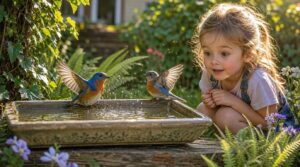
The basin is the heart of the build. A 16 × 24-inch shallow baking tray works beautifully, as its edge lip design prevents water splashing while allowing birds to bathe comfortably.
Choose materials like plastic or unglazed ceramic for durability and heat resistance. Prioritize surface smoothness, which simplifies maintenance and cleaning techniques—making it easy enough for kids to assist.
Aquarium Pump Setup
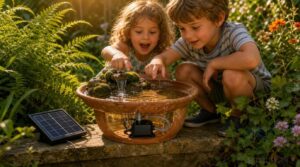
With your tray in place, it’s time to add the water pump. A small aquarium pump — usually $12–$25 — performs this job well. Follow these steps for safe, effective Pump Flow Calibration:
- Connect plastic tubing to your pump for Tubing Length Optimization
- Use a solar powered pump for cord-free Filter Integration
- Apply Noise Dampening with rubber feet under the pump
- Plug into a GFI Electrical Safety outlet, keeping connections dry
These measures ensure safe and effective Pump Flow Calibration.
PVC Spray Holes
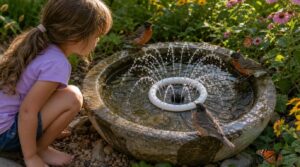
Once your pump is humming, cut evenly spaced holes along your PVC pipe—aim for 2–3 cm Pitch Spacing Design between each one. Hole Diameter Selection is also important: 1.5–3 mm keeps the spray gentle. Drill carefully to ensure clean Spray Pattern Symmetry.
Choose UV-Resistant PVC to prevent sunlight from weakening the material.
Flush the system monthly to prevent mineral buildup and keep water flowing freely.
Waterproof Decorations
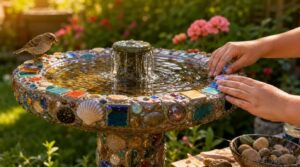
Decorating your bird bubbler is where kids really get creative. Stick to materials that hold up in wet conditions — silicone sealant joints keep everything sealed tight, and UV‑resistant paints won’t fade after a summer in the sun. Non-porous ceramics, smooth river stones, and shells all work beautifully. Hydrophobic finishes make cleanup easy too.
Try these kid-friendly options:
- Glazed ceramic tiles pressed into waterproof adhesive
- Painted rocks sealed with outdoor varnish
- Glass beads around the decorative pot rim
Place It for Bird Watching
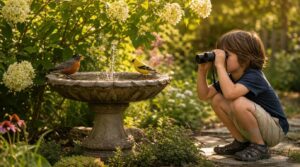
Where you put your bird bath matters just as much as how you build it. A spot chosen with care brings more birds into view and turns every visit into a real learning moment for kids.
Keep these placement ideas in mind as you find the right home for your bird bath.
Window Viewing Spots
Where you set up your indoor viewing spot matters just as much as the fountain itself. Light from a south-facing window gives you the brightest, clearest view, especially in winter.
Keep a 12–18 inch clear glass area free of clutter to avoid reflections.
Add a perch placement nearby, settle into a quiet indoor seating area 6–8 feet back, and watch the magic unfold.
Predator-safe Spacing
Think of your yard like a stage — birds need a clear exit, not a trap. Place your fountain 10–15 feet from dense shrubs, fences, or any predator highway like a shed wall. Keep an open observation perimeter around the basin so nothing can sneak close.
- Maintain a clearance radius of at least 6–8 feet around the bath
- Leave a visible escape flight path with unobstructed airspace in at least one direction
- Use a vegetation buffer — low groundcover only — to avoid hiding spots near the drainage system
Nearby Native Plants
Native plants do more than look pretty — they create a living neighborhood for birds. Surround your solar fountain or water pump setup with Spring Bloomers like wood anemone and oxeye daisy to draw early pollinators.
Add Shade-tolerant Trees and Moist Soil Species nearby, plus Groundcover Food Plants like wild strawberry.
Native landscaping and insect-friendly plants give visiting birds shelter, food, and a reason to stay.
Clear Escape Routes
Birds need a quick getaway — and your setup should make that easy.
Keep unobstructed pathways clear on all sides of the fountain, with adequate clearance of at least a meter around your solar fountain or water pump.
- Remove rocks or decor blocking straight corridors
- Check drain hole monthly during bird bath maintenance
- Install visible signage near play areas
- Conduct monthly safety checks around the basin
- Keep exits free of clutter
Migration Season Support
Migration season turns your backyard into a genuine rest stop for exhausted travelers. Warblers and hummingbirds both rely on clean, moving water to recover mid-journey, so timing the refreshing of water for early morning matters most.
Add species-specific perches nearby, log visits using simple migration data logs, and join community count events with your kids.
Native plants, a bird feeder, and steady weather-adapted flow make your fountain the best outdoor bird attractor on the block.
Maintain Water Flow Safely
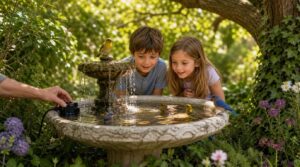
Keeping your bird bath fountain in good shape doesn’t take much, but a few simple habits make a real difference.
Clean water and steady flow are what keep birds coming back — and keep the setup safe for curious kids nearby. Here’s what to stay on top of.
Daily Water Refreshing
Every day, swap out the water in your bird bubble baths — ideally in the morning, when fresh tap water closely matches the outdoor air temperature. This temperature matching makes the bath far more inviting for visitors.
Skipping daily refreshes leads to mineral buildup and algae taking hold fast, turning your outdoor bird attractor murky. Your kids will notice the difference through simple sensory observation: cleaner water, livelier birds.
Gentle Bubbling Pressure
Once the water’s fresh, keeping it gently moving makes all the difference. Your pump’s flow rate through the PVC pipe and plastic tubing should stay under 200 milliliters per minute — just enough to create soft, steady bubbling in bird bubble baths.
A diffuser plate design stabilizes bubble size control between 1–3 millimeters, reducing noise while aeration benefits keep the water oxygenated and inviting.
Solar Versus Electric Pumps
Once your system is dialed in, you’ll need to choose what powers it. Solar pumps excel in eco-friendly gardening, reducing energy costs and environmental impact. Electric pumps provide reliable performance, particularly during cloudy winters. Assess your yard’s sunlight exposure before making a decision.
Key considerations include:
- Solar panels work best when facing south in full sun.
- Battery storage ensures continuous operation after dark.
- Electric pumps provide steady flow control year-round.
- Solar power suits rainwater features or backyard ponds beautifully.
- Hybrid options balance reliability with eco-friendly gardening goals.
Mosquito Prevention
Keeping your fountain mosquito-free is simpler than you’d think. The key habit is to refresh the basin daily during warm months. That gentle bubbling you set up? It’s already doing heavy lifting — moving water disrupts mosquito breeding cycles naturally.
| Prevention Method | Approach | Child-Safe? |
|---|---|---|
| Daily water refresh | Drain and refill basin | Yes |
| Biological barriers | Add BTI dunks to still areas | Yes |
| Chemical larvicides | Use pesticide-free, bird-safe tablets | Yes |
For eco-friendly gardening, skip broad-spectrum sprays near your fountain. Insect-friendly plants like lavender nearby support monitoring routines beautifully.
Winter Freezing Solutions
When temperatures drop, your water garden needs a little winter armor. Use Ice-Safe Basins—shallow, rigid plastic that won’t crack when frost hits.
Heated Mats underneath keep water from locking up overnight, especially with a GFCI outlet nearby.
Add Insulation Windbreaks around the sides, skip Antifreeze Fluids toxic to birds, and use Ice Management Accessories like a plastic scraper to clear overnight freeze quickly.
Frequently Asked Questions (FAQs)
Why put a penny in your birdbath?
An old gardener’s trick still worth knowing: drop a few pre-1982 copper pennies into your birdbath.
This Traditional Garden Hack helps Copper Algae Inhibition and Biofilm Reduction — a simple, Low-Cost Treatment for cleaner water.
What are the benefits of bird fountains?
Moving water draws increased species diversity — even shy visitors like hummingbirds — while providing year-round hydration, algae suppression, and mosquito deterrence.
This dynamic feature also fosters a calming ambiance, transforming your yard into a thriving, wildlife-friendly aquatic habitat.
Do fountains attract wildlife?
Yes, fountains absolutely attract wildlife. Water sound cues draw hummingbirds, songbirds, and butterflies daily. You’ll notice seasonal species influx during migration, plus amphibian presence near deeper edges and insect visitors seeking moisture.
Why put a tennis ball in your bird bath?
Drop a tennis ball in your bird bath for a simple ice melt aid — its movement breaks ice, boosts aeration, and the yellow color contrast gives float visibility so birds spot water fast in winter.
What bird species visit fountains most frequently?
Like a neighborhood café that regulars can’t resist, your fountain draws Chickadee visitors, Robin bathers, and Kinglet frequency risers. Finch presence and Seasonal hummingbirds round out your wildlifefriendly yard beautifully.
Can bird baths attract unwanted wildlife or pests?
Bird baths can attract raccoon intrusions, algae proliferation, and unwanted insect swarms if standing water risks go unmanaged. Refresh water every two days and keep debris harboring clutter cleared away.
How do I teach water conservation alongside bird bathing?
Teach kids to reuse bath water, spot leaks early, and adjust flow rate control on the PVC pipe spray.
Small habits like rainwater harvesting quietly build lifelong eco-friendly gardening values.
Are bird bath fountains safe during thunderstorms?
Unplug electric pumps immediately — lightning risk is real.
Wind tipping can scatter debris, so bring lightweight baths inside and run post-storm cleanup before refilling.
Which plants pair best with a bird bath fountain?
Native plants work best. Sun-loving plants like lavender and salvia attract pollinators, while shade-loving plants like hostas frame the fountain beautifully. Seasonal nectar sources keep birds returning all year.
Conclusion
Picture a quiet morning, dew still on the grass, when a flash of wings breaks the stillness and a child whispers, "Mom, look—it’s drinking." That’s the real reward. Bird bath fountains for children learning about nature don’t just attract birds; they build the habit of paying attention to the living world.
Keep the water moving, keep the basin clean, and let the birds do what they’ve always done—teach anyone willing to watch.