This site is supported by our readers. We may earn a commission, at no cost to you, if you purchase through links.
Fifty-plus warbler species pass through North America each spring, and many of them sound just similar enough to make you question everything you thought you knew.
A Yellow Warbler and a Chestnut-sided can both fill a May morning with high, bright notes—yet their songs carry completely different structural logic once you know what to listen for.
Pitch range, tempo, phrase shape, tonal texture: these aren’t abstract concepts reserved for lab ornithologists. They’re the actual field marks of sound, and learning to distinguish warbler song patterns works the same way as learning plumage—you build a mental image, one detail at a time.
Table Of Contents
- Key Takeaways
- Key Elements of Warbler Song Patterns
- Comparing Similar Warbler Species by Song
- Tools and Techniques for Song Differentiation
- How Song Patterns Reflect Warbler Behavior
- Top 10 Products for Learning Warbler Songs
- 1. Warblers and Songbirds North America Field Guide
- 2. North American Bird Songs Book
- 3. Backyard Birdsong Guide Eastern Central America
- 4. Dejama Singing Bird Box Ambient Sound
- 5. Garden Bird Songs Little Book
- 6. Singing Bird Sound Box with Motion Sensor
- 7. North American Bird Songs Guide
- 8. Usborne Bird Sound Book
- 9. Wild Republic Audubon Bird Plush Set
- 10. Backyard Birdsong Guide Western North America
- Frequently Asked Questions (FAQs)
- Conclusion
Key Takeaways
- Warbler songs are built from four measurable elements—pitch, tempo, phrase structure, and tonal texture—and learning to hear each one separately is what turns a confusing wall of sound into reliable species IDs.
- Species that sound nearly identical in the field, like Cerulean Warbler and Northern Parula, split cleanly once you focus on one or two consistent features, such as whether the song accelerates into a trill or rises like a zipper and drops sharply.
- Tools like spectrograms and apps such as Merlin Sound ID and BirdNET don’t replace your ears—they sharpen them, giving you a visual map of what you’re hearing so patterns stick faster.
- Warbler songs aren’t just background music; they’re doing real behavioral work, signaling territory, attracting mates, and even shifting in pitch or tempo as the breeding season progresses.
Key Elements of Warbler Song Patterns
Every warbler song is built from a handful of measurable ingredients, and once you know what to listen for, the whole soundscape starts to click into place.
Think of it as learning a musical language — warbler song patterns broken down by element can help you recognize each ingredient by ear before you ever step outside.
Pitch, rhythm, phrase structure, and tonal quality are the four building blocks that separate one species from the next.
Here’s what each one actually means in the field.
Pitch and Frequency Range
Pitch is your first handle on warbler song patterns. Most species vocalize between 4 and 9 kHz, but knowing the outliers sharpens your birdsong analysis fast.
Blackpoll Warbler pushes acoustic signals up to 10 kHz — nearly brushing human hearing thresholds — while Yellow Warbler stays fuller around 4–7 kHz.
That frequency bandwidth and spectral overlap is exactly where vocalizations blur, and where careful listening pays off.
Tempo and Rhythm
Once you’ve got pitch locked down, tempo and rhythm become your next layer of birdsong analysis. Warbler song patterns vary wildly — Louisiana Waterthrush lumbers at two to three elements per second, while Cerulean Warbler accelerates from slow opening notes into a rapid trill. These acceleration patterns and rhythmic regularity tell you as much as frequency ever could.
- Tempo variability separates species sharing similar pitch ranges
- Phrase gap timing — those 0.3–2 second silences between phrases — creates each species’ unmistakable rhythmic fingerprint
- Accent stress placement within vocalizations shifts the acoustic signals from blurry to instantly recognizable
spectrogram analysis tools can further clarify subtle differences.
Phrase Structure and Repetition
Rhythm gets you close, but warbler song structure seals the ID. Most species alternate between serial vs repeat modes — either cycling through varied phrase types or hammering the same one repeatedly. Black-throated Blue Warbler stacks short buzzy phrases in sequence; Ovenbird repeats its teacher syllable with almost mechanical consistency.
| Species | Mode | Phrase Count Patterns |
|---|---|---|
| Ovenbird | Repeat | 8–10 identical phrases |
| Black-throated Blue | Serial | 2–3 varied sections |
| Pine Warbler (dawn) | Dawn Serial Mode | Continuous, near-gapless strings |
Section transitions — that shift in pitch or speed mid‑song — are your clearest structural reference point in bird song recognition. Adopting a first/second category system helps clarify song function.
Clear Vs. Buzzy Song Elements
Once you’ve mapped phrase structure, listen for texture. Clear tones — like Hooded Warbler’s smooth slurs — produce thin, distinct lines on a spectrogram, with steady fundamental frequencies and precise harmonic separation.
Buzzy elements, driven by rapid frequency modulation, show thick, fuzzy bands where acoustic energy concentrates on frequency upstrokes. Spectral contrast is one of the sharpest tools in warbler song structure identification.
Comparing Similar Warbler Species by Song
Some warblers are so acoustically close that even experienced birders do a double-take in the field. The difference often comes down to one or two subtle but consistent features in their songs.
Here are four pairings worth studying closely.
Louisiana Waterthrush Vs. Swainson’s Warbler

Two birds, one stream valley — and yet their warbler songs couldn’t sound more different once you train your ear. Habitat acoustics shape everything here. Louisiana Waterthrush (Parkesia motacilla) opens with bold, descending whistles built to cut through rushing water, then tumbles into a choppy, accelerating warble. Swainson’s Warbler (Limnothlypis swainsonii) stays smooth and arched throughout.
Key species identification techniques to lock in:
- Song timing: Louisiana Waterthrush accelerates and gets choppy at the end; Swainson’s keeps a slow, even beat
- Perch height: Swainson’s sings from fixed mid-story spots; Waterthrush moves and shifts constantly
- Tonal quality: Swainson’s stays pure and flute-like; Waterthrush adds rougher chip-like notes
- Vocal learning influence: Swainson’s consistent phrasing reflects tight, locally learned song systems
Cerulean Warbler Vs. Northern Parula

Both species throw buzzy warbler songs from the treetops, but habitat perch differences give you the first clue — Cerulean Warbler (Setophaga cerulea) favors dry ridgetop oaks, while Northern Parula (Setophaga americana) prefers lichen-draped stream edges.
Song timing patterns sharpen the split: Cerulean sounds segmented, "buzz-buzz-buzz-trill," while Parula’s acoustic territory signals roll upward like a zipper, then drop sharply at the end.
Black-throated Blue Warbler Vs. Cape May Warbler
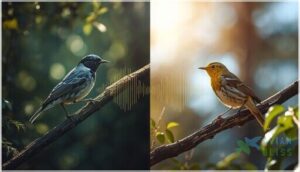
Habitat perch preference splits these two before you even process the sound — Setophaga caerulescens sings from mid-forest shade, while Setophaga tigrina broadcasts its territorial songs from exposed treetops.
That vocal energy distribution shapes entirely.
Black-throated Blue delivers short, mellow, rising phrases; Cape May fires rapid, needle‑thin tsi notes, a classic case of acoustic niche partitioning that makes warbler identification techniques click instantly.
Magnolia Warbler Vs. Bay-breasted Warbler
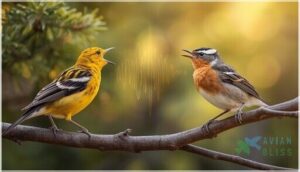
Both sound deceptively alike at first, but your ear will split them quickly once you know what to chase.
- Magnolia Warbler punches out a bright weety-weety-weeteo with an emphatic WETA ending
- Bay-breasted Warbler loops a sibilant teasy pattern — even, soft, flat
- Phrase length contrast: Magnolia wraps up in one second; Bay-breasted chains longer
- Volume dynamics favor Magnolia’s louder finale
- Habitat acoustic cues reinforce the difference
Tools and Techniques for Song Differentiation
Your ears are your first tool in the field, but they don’t have to work alone.
A handful of modern techniques can sharpen your ability to separate one warbler from another, whether you’re standing in a spring thicket or reviewing recordings at home.
Here’s what’s worth having in your kit.
Using Spectrograms for Visual Analysis
Think of a spectrogram as your personal field guide to birdsong — a visual map where frequency contour mapping turns warbler song communication into something you can actually see.
Temporal resolution tuning and variable range adjustment sharpen the image, while spectral texture analysis reveals whether notes are clear or buzzy. Automated element detection even counts song phrases for you, making avian behavior patterns undeniably readable.
Field Recording and Playback Methods
Getting clean birdsong in the field comes down to a few disciplined habits. A shotgun mic like the Sennheiser ME66 manages microphone placement beautifully — aim it directly at your warbler species, keep gain calibration between -12 dB and -30 dB, and layer in wind-noise mitigation with a faux fur windscreen.
- Playback timing matters — dawn sessions trigger the strongest responses
- Data management starts in the field; note date, location, and conditions verbally
- Acoustic ecology improves when you conduct playback in three‑day monthly cycles, avoiding rain
Machine Learning and Song Identification Apps
Once your recordings are clean, apps like Merlin Sound ID take over quickly.
It processes live microphone input into spectrograms instantly, cutting identification time from 89 seconds to 22 seconds. BirdNET’s embedded edge computing runs offline with impressive accuracy — 94.7% top-5 recall in good conditions.
| App | Key Strength | Warbler Accuracy |
|---|---|---|
| Merlin Sound ID | Real-time noise filtering | ~90% excellent |
| BirdNET | Edge computing, offline | 94.7% top-5 |
| Warbler Guide | Interactive song comparison | Species-specific |
Tips for Effective Field Listening
Apps do the heavy lifting, but your ears still need training. Minimize distractions by arriving early — that first hour after sunrise gives you cleaner sound-quality focus with far less human noise.
Build a listening routine around one or two species at a time, using habitat cues and pitch pattern mapping to sharpen identification. Warbler behavior and bird communication reveal themselves when you simply slow down and listen.
How Song Patterns Reflect Warbler Behavior
warbler’s song isn’t just background noise — it’s doing real work. Every phrase carries meaning, from staking out territory to impressing a potential mate, and those functions actually shape how the song sounds.
Every warbler song is purposeful work, carrying meaning from territorial claim to mating call
Here’s a closer look at the key behaviors that warbler songs reflect.
Song Use in Territory Defense
Every dawn, male warblers don’t just sing — they’re staking claims. Dawn chorus timing isn’t random; it peaks mid-breeding season when territorial pressure runs highest.
Mode switching strategies matter too: hooded warblers shift between repeat and mixed patterns depending on whether they’re defending a core zone or a boundary.
Song duration effects and trill performance metrics both signal competitive strength, while female duet roles reinforce shared territories.
Mating and Mate Attraction Signals
While territory defense keeps rivals out, mating calls and courtship songs are what actually win a partner.
Female warblers aren’t passive listeners — they’re evaluating repertoire size, song complexity, and even dawn chorus stamina as honest signals of fitness.
In sedge warblers, males with over 50 unique elements pair noticeably earlier.
Avian communication doesn’t get more direct than that.
Regional Dialects and Variation
Just as human accents shift across regions, warbler dialects reveal how Bird Song evolves through Song Learning and Cultural Evolution of Songs. Geographic Song Boundaries shape what young males copy from local tutors.
Here’s what drives Dialect Learning Processes:
- Young birds mimic nearby adults
- Habitat Influence on Dialects filters which notes carry
- Urban Noise Effects compress local accents
- Immigration seeds new syllable variants
- Territorial Behavior reinforces regional consistency
Seasonal Changes in Song Patterns
As the Breeding Season unfolds, warbler Bird Song transforms in ways that will genuinely surprise you. Early spring brings Territorial Behavior fueled by Testosterone‑Driven Changes — fast tempo, lower pitches, tight Repertoire Expansion.
Then watch for Tempo Deceleration by midsummer, with Seasonal Pitch Shift trending upward as canopy foliage thickens. Dawn Chorus Timing peaks two to three weeks after first arrivals, then quietly fades through Song Learning refinement.
Top 10 Products for Learning Warbler Songs
Getting your ear tuned to warbler songs is easier when you have the right resources backing you up.
Whether you’re a complete beginner or already picking out Northern Parulas by their rising buzz, there’s something on this list for every stage of the learning curve. Here are ten products worth having in your corner.
1. Warblers and Songbirds North America Field Guide
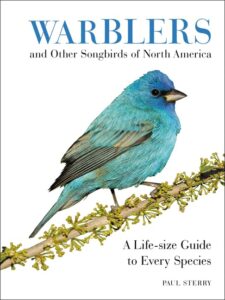
If you want one book that pulls identification together visually, Paul Sterry’s Warblers and Other Songbirds of North America earns a regular spot in your field bag.
It covers 285 species with life-size photographs — so you’re not squinting at tiny illustrations trying to judge scale. Each spread pairs photos with a fact grid, range map, and plain-language voice notes.
It’s especially useful when you need to quickly cross-check a song quality, like "buzzy or clear," against what you’re actually seeing in the canopy.
| Best For | Birdwatchers, naturalists, and nature lovers who want a portable, photo-driven guide for identifying songbirds and warblers across North America. |
|---|---|
| Bird Coverage | 285 North American songbirds |
| Audio Feature | Voice descriptions |
| Target Audience | Experienced birdwatchers |
| Format | Field guide book |
| Educational Value | Species identification |
| Gift Suitability | Yes |
| Additional Features |
|
- Life-size photos make it easy to judge scale at a glance — no more guessing from tiny illustrations
- Each species gets a fact grid, range map, and voice notes all in one place, so cross-referencing is quick
- Compact and light enough to toss in a field bag without thinking twice
- Doesn’t cover every North American songbird species, so you might hit gaps on rarer birds
- The bird anatomy coverage is a bit thin, which could frustrate birders who rely on precise topography terms
- Scope is limited to songbirds and warblers — you’ll need a separate guide for anything outside that
2. North American Bird Songs Book
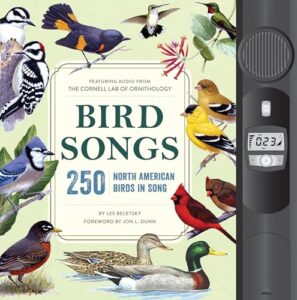
The North American Bird Songs Book takes a different approach — it puts the audio right in your hands.
A built‑in digital audio player holds 250 songs and calls sourced from Cornell’s Macaulay Library, so you’re hearing top‑quality recordings without reaching for your phone.
Each entry focuses on what actually matters: tempo, pitch pattern, phrase structure.
You can press play on the Cerulean Warbler, then immediately hit Northern Parula, and hear the difference yourself.
That kind of direct comparison is hard to beat indoors.
| Best For | Bird lovers, nature enthusiasts, and curious learners of any age who want a hands-on way to learn bird songs without fussing with their phone. |
|---|---|
| Bird Coverage | 250 North American birds |
| Audio Feature | Built-in digital audio player |
| Target Audience | All ages and abilities |
| Format | Book with audio player |
| Educational Value | Bird ID and learning |
| Gift Suitability | Yes |
| Additional Features |
|
- 250 high-quality recordings from Cornell’s Macaulay Library, all built right into the book — no app needed.
- Colorful illustrations and clear, focused descriptions make it easy to connect a bird’s look with its sound.
- Great gift option for anyone into birding, conservation, or spending more time outdoors.
- No number pad means you’re scrolling through all 250 calls to find a specific one — a bit tedious.
- The price point is on the higher side, which might give some buyers pause.
- You’ll need to pull out a small battery tab during setup, which can catch first-time users off guard.
3. Backyard Birdsong Guide Eastern Central America
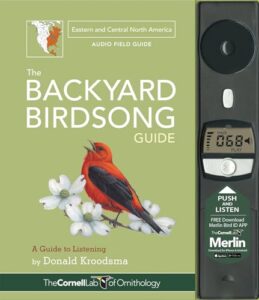
The Backyard Birdsong Guide Eastern & Central North America is built for exactly where most birders start — the window, the yard, the nearby park. It covers 75 species from eastern and central North America, and the touch-button electronic module plays over 130 vocalizations right from the page.
Jon Janosik’s illustrations are crisp and field-accurate, so you’re not guessing at markings. Range maps sit alongside each entry.
It’s compact, hardcover, and honestly a solid first companion before you venture deeper into warblers.
| Best For | Beginner bird watchers of all ages who want a hands-on, interactive guide to identifying birds right in their own backyard or neighborhood. |
|---|---|
| Bird Coverage | 75 bird species |
| Audio Feature | Touch-button electronic module |
| Target Audience | Beginning bird watchers |
| Format | Interactive handbook |
| Educational Value | Bird identification |
| Gift Suitability | Yes |
| Additional Features |
|
- The touch-button audio module lets you hear 130 real bird calls instantly — no app fumbling required
- Illustrations are sharp and scientifically accurate, making it easy to spot the right markings in the field
- Compact and hardcover, so it holds up whether it’s on your shelf or tossed in a bag
- Some users have run into audio module issues that even fresh batteries didn’t fix
- Only covers the most common sounds for each species, so it won’t capture every call you might hear
- The digital display can be tricky to read if you have any trouble with small text
4. Dejama Singing Bird Box Ambient Sound

Sometimes your ears need a break from active study — and that’s where the Dejama Singing Bird Box earns its spot.
This compact, birdhouse-shaped device uses a motion sensor to trigger real nature recordings, including Sedge Wren chirps, Nightingale tunes, and Song Thrush melodies.
Sounds fade naturally after 120 seconds, mimicking actual bird activity pauses. You can adjust the volume to suit any room.
It won’t replace a field guide, but as passive ear training it’s genuinely useful background immersion.
| Best For | Anyone who wants a low-effort, always-on nature soundtrack to help them focus, relax, or just drown out annoying background noise. |
|---|---|
| Bird Coverage | Multiple bird sounds |
| Audio Feature | Motion-activated bird sounds |
| Target Audience | Home and office users |
| Format | Standalone device |
| Educational Value | Ambient atmosphere |
| Gift Suitability | Yes |
| Additional Features |
|
- Motion-activated, so it kicks in automatically — no buttons, no fuss
- Volume adjustable, works whether you want a subtle hint of nature or a fuller soundscape
- Tiny and portable, so it fits on a desk, bathroom shelf, or basically anywhere
- Only one recording, so it can start to feel repetitive pretty quickly
- It’s plastic, not actual wood — the birdhouse look is more decorative than authentic
- No way to control how long the sounds play, 120 seconds is what you get every time
5. Garden Bird Songs Little Book
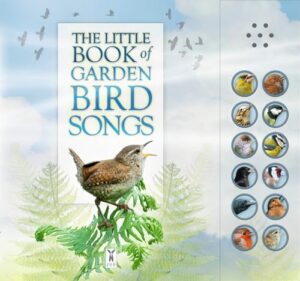
If passive sound immersion builds your ear, the Little Book of Garden Bird Songs sharpens your eye-to-ear connection.
This chunky board book pairs large photographs with real recordings across twelve common species — robin, blackbird, wren, song thrush, and others you’ll genuinely encounter outside.
Each bird gets its own button on the sound panel, so you can replay tricky songs side by side until they stick.
It’s deceptively simple, but that simplicity is exactly what beginners need.
| Best For | Anyone just getting into birdwatching — especially kids and beginners who want a hands-on way to learn garden bird songs without feeling overwhelmed. |
|---|---|
| Bird Coverage | 12 European garden birds |
| Audio Feature | Press-pad sound bar |
| Target Audience | All ages |
| Format | Board book |
| Educational Value | Bird learning and facts |
| Gift Suitability | Yes |
| Additional Features |
|
- Real recordings for 12 common European birds, so what you hear matches what’s actually in your garden
- Simple press-pad design makes it easy to compare songs back to back until they click
- Sturdy board pages hold up well, making it a great pick for young kids and curious adults alike
- Focused on European species, so it’s less useful if you’re based outside that region
- The price point might feel steep for what is, at its core, a board book
- Sound quality may not wow anyone used to high-fidelity nature recordings
6. Singing Bird Sound Box with Motion Sensor
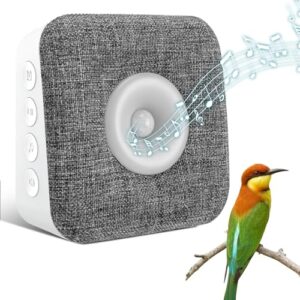
Where the Little Book keeps things visual, this gadget makes birdsong part of your environment without any effort on your part. The Singing Bird Sound Box uses a passive infrared motion sensor to trigger one of nine pre-recorded nature sounds — including bird songs — the moment you walk past.
At up to 105 decibels across five volume levels, it’s surprisingly adaptable. Place it in a hallway or bathroom, and you’ll start absorbing those pitch and rhythm patterns almost subconsciously throughout the day.
| Best For | Anyone who wants effortless, ambient nature sounds at home — especially light sleepers, stressed-out adults, or parents trying to calm a baby. |
|---|---|
| Bird Coverage | 9 ambient sound types |
| Audio Feature | Motion sensor activation |
| Target Audience | Home and travel users |
| Format | Standalone device |
| Educational Value | Stress reduction |
| Gift Suitability | Yes |
| Additional Features |
|
- Nine nature sounds give you real variety, and the motion sensor means it just works without you thinking about it
- Flexible power options (USB-C or batteries) make it easy to use anywhere, including travel
- Wide volume range (up to 105db) means it works in bigger rooms or noisy environments
- Some users have had the sound cut out after 10-30 seconds, which could get frustrating fast
- It might actually attract real birds if placed near a window
- No batteries included, so you’ll need to grab those before you can even try it out
7. North American Bird Songs Guide
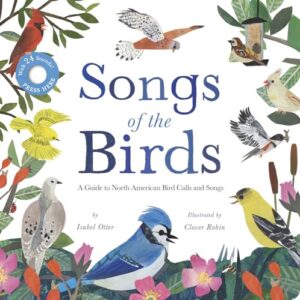
If ambient sound prepares your ear passively, a dedicated field guide sharpens it deliberately. The North American Bird Songs Guide takes a different approach — it pairs spectrograms with actual species accounts, so you’re not just hearing a song but reading its shape.
For warbler identification specifically, seeing how a Cerulean Warbler‘s accelerating buzzes differ visually from a Bay-breasted Warbler‘s steady phrases builds pattern recognition that sticks. It covers eastern species with enough depth to feel like a real reference, not a novelty.
| Best For | Kids and families who love the outdoors and want a fun, hands-on way to learn about North American birds and their songs. |
|---|---|
| Bird Coverage | 24 North American birds |
| Audio Feature | 24 sound buttons |
| Target Audience | Children and families |
| Format | Sound picture book |
| Educational Value | Habitat exploration |
| Gift Suitability | Yes |
| Additional Features |
|
- 24 real bird sounds bring the book to life — great for learning to recognize birds by ear
- Beautiful paper-cut artwork makes it visually engaging, not just educational
- Covers seven North American habitats, so kids get a real sense of where different birds live
- Sound buttons have been reported to malfunction or stop working after just a few days
- The book can be fragile — not ideal for rough handling or wet conditions
- Some copies arrive with defects, so quality control seems inconsistent
8. Usborne Bird Sound Book
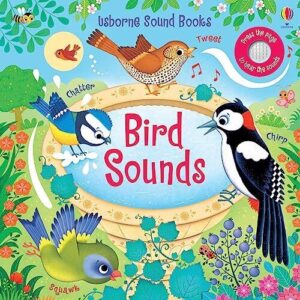
Not every birding resource is built for adults.
The Usborne Bird Sounds book targets toddlers, but don’t dismiss it too quickly — if you’re introducing a young child to warblers and backyard birds, it’s a genuinely clever starting point.
It plays realistic recordings, not electronic beeps, which matters more than you’d think.
Kids who hear actual blackbird and cuckoo calls early start building real sound-image associations.
Think of it as planting the seed before the field guide arrives.
| Best For | Parents and caregivers of toddlers who want a fun, hands-on way to introduce kids to birds and the sounds they make. |
|---|---|
| Bird Coverage | Multiple bird species |
| Audio Feature | Embedded sound buttons |
| Target Audience | Toddlers and young children |
| Format | Sound picture book |
| Educational Value | Nature exploration |
| Gift Suitability | Yes |
| Additional Features |
|
- Plays real bird recordings — actual blackbird and cuckoo calls, not cheap electronic beeps
- Interactive buttons, die-cut holes, and finger trails keep little hands busy and engaged
- Doubles as an early nature education tool, helping kids connect sounds to real birds
- A bit pricey for just 10 pages and a limited number of sounds
- Repetitive sounds may frustrate kids who want more variety
- Durability can be hit or miss depending on how rough your toddler is with books
9. Wild Republic Audubon Bird Plush Set
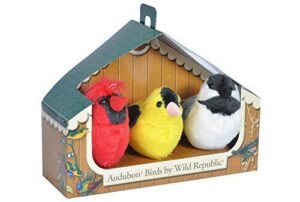
Wild Republic Audubon Bird Plush Set takes a hands-on approach to song learning that’s hard to beat for young birders.
Squeeze the Black-throated Blue Warbler plush and you’ll hear its actual buzzy phrase — sourced from Cornell Lab of Ornithology recordings.
That 2–4 second clip, repeatable on demand, makes drill-and-memory practice genuinely effective.
Pairing these plushes with printed spectrograms turns a tactile toy into a real teaching moment.
It’s surprisingly useful for adults introducing kids to warbler identification.
| Best For | Bird watchers, parents with curious kids, and anyone who wants a fun, hands-on way to learn about backyard birds. |
|---|---|
| Bird Coverage | 3 bird species |
| Audio Feature | Squeeze-activated bird calls |
| Target Audience | Kids and adults |
| Format | Plush toy set |
| Educational Value | Wildlife learning |
| Gift Suitability | Yes |
| Additional Features |
|
- Authentic bird calls sourced straight from Cornell Lab of Ornithology — these aren’t cheap, generic sounds
- Three well-loved backyard species (Northern Cardinal, American Goldfinch, and Chickadee) make it instantly relatable
- Works great for both sensory play with little ones and as a collectible for serious birders
- Batteries can’t be swapped out without cutting the bird open and re-sewing it — not ideal long-term
- Some birds arrive not making sound right away, which can be frustrating out of the box
- Packaging sometimes shows up damaged, so it’s not the most reliable choice if you’re gifting it
10. Backyard Birdsong Guide Western North America
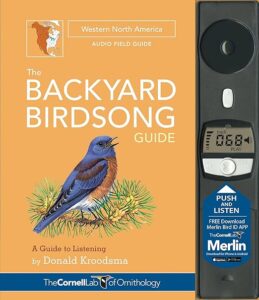
If you’re working the Pacific slope — from the Rockies west to the coast — this guide belongs on your shelf.
Donald Kroodsma’s Backyard Birdsong Guide Western North America pairs scientifically accurate illustrations and range maps with a built‑in touch‑button audio module covering 75 species, including western warblers like Townsend’s and MacGillivray’s.
No internet needed.
Each track plays a clean, single‑species recording straight from the Macaulay Library.
Press the button, step outside, and listen.
That direct feedback loop genuinely accelerates ear training.
| Best For | Beginner bird watchers and families in Western North America who want a hands-on, screen-free way to learn birds by sound. |
|---|---|
| Bird Coverage | 75 Western North American birds |
| Audio Feature | Touch-button electronic module |
| Target Audience | Beginning bird watchers |
| Format | Interactive handbook |
| Educational Value | Bird identification via song |
| Gift Suitability | Yes |
| Additional Features |
|
- The built-in audio module lets you hear 75 species instantly — no app, no Wi-Fi, just press and listen
- Illustrations and range maps are sharp and accurate, so you always know what you’re looking at and where to find it
- Works great for kids and grandparents alike — simple enough for anyone to pick up and use outside
- The battery drains faster than you’d hope, so keep spares handy or pull them when you’re not using it
- It only covers Western North America, so if you travel east of the Rockies, you’ll need a second guide
- The price is on the higher side for a field guide, which might give budget-conscious buyers pause
Frequently Asked Questions (FAQs)
How do juvenile warblers develop their songs?
Juvenile warblers start by listening — storing mental templates of adult songs within their first few weeks.
Then comes subssong, that soft, rambling babble where they practice pitch and rhythm until everything clicks into place.
Can female warblers sing distinct recognizable songs?
Yes — female warblers absolutely can sing, and some do it with startling complexity. Female Cerulean Warblers, for instance, produce distinct "zeet" song sequences right from the nest during incubation.
Do warblers sing differently at night?
Some warblers absolutely do sing at night. Sedge warblers and Connecticut warblers are notable examples, often singing continuously after dark, especially when unpaired males are actively trying to attract mates.
How does habitat loss affect warbler song frequency?
Habitat loss forces warblers into noisier environments, pushing their songs to higher frequencies — sometimes above 6,000 Hz — to cut through urban rumble and stay audible to potential mates and rivals.
Which warbler species have the most complex songs?
Sedge warblers win handily — each male produces over 200 distinct songs, built partly through mimicry.
Aquatic warblers follow closely, mixing rattles and whistles into endlessly varied phrase combinations that genuinely impress even seasoned listeners.
Conclusion
Test this theory on your next May morning out: stand still, close your eyes, and let one song fully register before reaching for your phone. You’ll notice something shift.
When you learn to distinguish warbler song patterns the way you learned faces—by structure, not just impression—the forest stops being noise and starts being conversation.
Each phrase becomes a signature.
And once you’ve heard a Chestnut-sided’s emphatic finish or a Parula’s rising buzz, you won’t unhear it.
- https://www.allaboutbirds.org/news/do-bird-songs-have-frequencies-higher-than-humans-can-hear/
- https://pjdeye.blogspot.com/2014/01/warbler-song-nomenclature-need-for.html
- https://www.audubon.org/magazine/10-common-bird-songs-made-less-confusing
- http://www.mpnature.com/essays/wcyoung/warbler_song.html
- https://soundapproach.co.uk/blogs/news/song-and-call-identification-of-the-first-green-warbler-for-the-netherlands