This site is supported by our readers. We may earn a commission, at no cost to you, if you purchase through links.
A flash of red lands on your fence post, holds still for two seconds, then vanishes into the shrubs—and you’re left wondering what just visited your yard. That split-second encounter is exactly where most backyard birdwatchers get stuck. You saw something, but the details blur fast: Was the breast streaked or solid? Did it have a crest? What was that song it made?
A songbird identification chart cuts through that confusion by pairing what you see with what you hear, giving you a reliable reference you can actually use in the moment. Once you know how to read the signs, your yard transforms from background noise into a living field guide.
Table Of Contents
- Key Takeaways
- What is a Backyard Songbird Identification Chart?
- Key Songbird Species Found in Backyards
- Visual and Audio Clues for Songbird ID
- Essential Tools for Songbird Identification
- Enhancing Your Backyard for Songbird Diversity
- Frequently Asked Questions (FAQs)
- How do I find out what kind of bird is in my yard?
- How do songbirds navigate during nighttime migration?
- Which songbird species form large winter murmurations?
- Can songbirds indicate local environmental pollution levels?
- What ecological roles do songbirds play beyond singing?
- How does daylight change affect songbird vocal behavior?
- Conclusion
Key Takeaways
- songbird identification chart pairs visual field marks with audio cues like spectrograms and QR‑linked calls, giving you a fast, reliable way to name a bird before it disappears into the shrubs.
- Learning a handful of key species — Northern Cardinal, American Robin, House Finch, Eastern Bluebird — builds a recognition baseline that makes every new yard visitor easier to place.
- Tools like Merlin Bird ID and BirdNET bring AI‑powered song matching to your pocket, while a durable field guide with range maps and color plates keeps your skills sharp away from a screen.
- Planting natives, layering habitat, and keeping feeders and birdbaths clean and seasonal turn your yard into a year‑round magnet for diverse songbird species.
What is a Backyard Songbird Identification Chart?
backyard songbird identification chart is a simple visual guide that links each bird’s picture, name, and basic traits to the sounds you’re most likely to hear around your home. Its main job is to help you quickly match the birds at your feeder or in your trees to their songs, so you can put a name and story to each voice.
Pair the chart with this bird identification guide for backyard songbirds to deepen your understanding of each species’ habits, habitat, and voice.
Next, we’ll look at the specific chart elements and options, so you know how to use each one in the list that follows.
Definition and Purpose of Identification Charts
identification chart is your map for Backyard Bird Watching, turning Bird Identification into a habit. You scan key traits at a glance because Chart Design Principles and User Accessibility Features keep photos, markings, and calls organized.
For broader wildlife context, see the quick reference cards([https://www.pathsoflearning.net/2516/best-animal-identification-charts-for-outdoor-exploration/).
| Focus | Example | Purpose |
|---|---|---|
| Visual | Standardized Color Coding | Rapid Species Matching |
| Audio | Birdsong Identification | Bird Species Identification |
| Learning | Bird Identification Techniques | Educational Outreach Value |
Benefits for Birdwatchers and Homeowners
Because chart keeps markings and calls organized, the benefits show up in your yard.
Regular use with a Backyard Songbird Sound Guide and simple Birdwatching Tips brings stress reduction, natural pest control with up to 30 percent fewer insects, and even a property value boost.
It provides family education, community engagement, bird‑friendly gardening, and habitat creation through bird species identification.
How Charts Aid Songbird Recognition
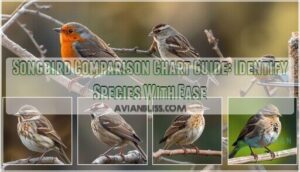
Once you’ve seen those benefits firsthand, it’s worth understanding exactly how a well-designed chart does the heavy lifting. Spectrogram Patterns turn sound into a visual shape you can actually study. Color-Coded Legends decode complex plumage in seconds. QR Audio Links let you hear the call right there in your yard. Seasonal Chart Layouts and Quick Reference Tabs keep backyard songbird identification fast and frustration‑free.
For deeper insight, consult the visual identification techniques guide.
| Chart Feature | What It Shows | How It Helps |
|---|---|---|
| Spectrogram Patterns | Frequency and trill shape | Matches songs visually |
| Color-Coded Legends | Plumage field marks | Speeds up Bird ID |
| QR Audio Links | Live call recordings | Confirms species by ear |
Key Songbird Species Found in Backyards
Before you start learning songs and calls, it helps to know which birds are most likely to show up in your yard.
A bird songs and calls identification guide can help you quickly match the pitches and rhythms you’re hearing to the species most likely visiting your yard.
This next section points you to the core backyard songbird species featured on your chart, so you know who you’re looking for and listening for. Use it as a simple roadmap as you move into the individual entries that follow.
Northern Cardinal Identification
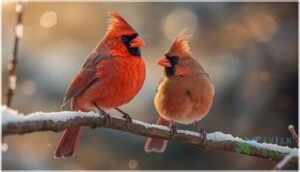
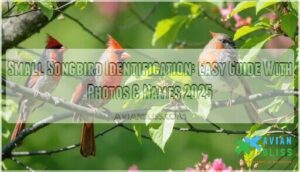
Few birds announce themselves quite like the Northern Cardinal. The male’s all-red plumage, distinctive crest shape, and bold mask contrast make bird identification almost easy. His orange-red bill stays vivid year-round, and watch how he holds that long tail upright while perched.
Females show subtler seasonal plumage — warm brown with red accents.
Both sexes reward close attention and reward your backyard songbird sound guide efforts richly.
American Robin Characteristics
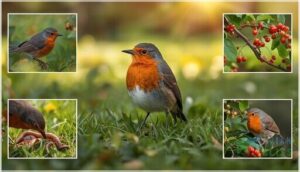
American Robin is a backyard staple worth knowing well. That bright reddish-orange breast, white facial markings near the eye, and dark gray back make bird identification surprisingly straightforward.
Adults reach 9–11 inches, with an upright, confident posture you’ll recognize instantly.
They forage lawns for earthworms, shift to berries in fall, and belt out a cheerful "cheer-up, cheerily" — a vocal pitch perfect for birdsong identification techniques.
House Finch and Song Sparrow Features
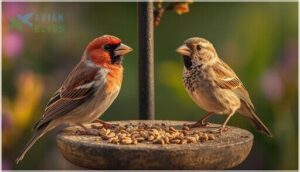
On your feeder, House Finch and Song Sparrow turn into a quick lesson in Plumage Patterns, Beak Morphology, and Habitat Preferences.
Red‑washed finches versus streaked sparrows give you contrast, and when you add Song Structure, Seasonal Behavior, and Birdsong Identification Techniques with a Backyard Songbird Sound Guide, plus Bird Friendly Gardening to keep them visiting, identification practice happens without effort.
Eastern Bluebird and Other Common Species
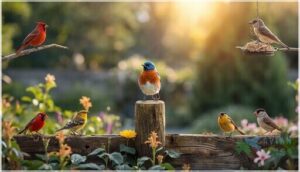
How does one small Eastern Bluebird teach you so much about Backyard Songbird life?
Its rusty chest and bright blue back make Bird Identification feel easy, while soft whistles anchor your Songbird Identification practice.
Watching Territory Defense Behaviors, Mating Display Patterns, Winter Feeding Strategies, Migration Timing, and Predator Avoidance Tactics turns simple Bird Friendly Gardening into real field study sessions.
Visual and Audio Clues for Songbird ID
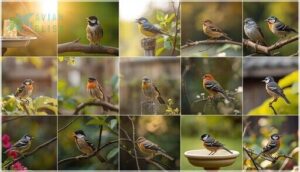
Spotting backyard songbirds gets much easier once you know what to look for and listen for.
In the next few points, you’ll see the main visual patterns and sound clues that birders rely on every day.
Use this list as a quick guide to match what you see and hear to the species in your own yard.
Distinctive Plumage and Markings
Think of plumage as each bird’s name tag, essential for Bird Identification in your yard.
Eye Ring Patterns, Crown Stripe Variations, and cheek patches frame the face.
Wing Bar Contrast, Tail Spot Patterns, and rump flashes separate similar Bird Species.
Underparts Color Streaks on breast and belly push your Songbirds Identification skills into real Ornithology with Backyard Songbirds all around.
Common Songs and Calls Explained
Out in the yard, you hear sound before you spot shapes.
For Bird Identification, you listen closely for Rhythm Patterns, Pitch Shifts, and Motif Repetition that separate Song Sparrows from Northern Cardinal whistles, and you notice Call vs Song behavior and Seasonal Vocal Timing.
Use Spectrograms and Bioacoustics ideas to guide you:
- Hear motifs.
- Track rising pitch.
- Note dawn peaks.
Using Mnemonic Phrases for Birdsong Memory
Ever wish your brain could “subtitle” Songbirds automatically?
Mnemonic phrases subtitle birdsong automatically, turning sounds into memorable words your brain recalls instantly
Mnemonic Phrase Construction does that by Rhythm Matching what you hear to short sayings and strong Visual Imagery.
Use a Backyard Songbird Sound Guide or apps rooted in Bioacoustics, add Birdwatching tips on your card, set gentle Practice Scheduling, and try Community Sharing to sharpen Bird Identification skills, patience, curiosity and joy.
Seasonal Variations in Appearance and Song
Just like your mnemonics, seasons reshape how Backyard Birds look and sound, which matters for Bird Identification.
Watch these patterns in Songbirds:
- Plumage Molt Timing brightens males before breeding.
- Song Frequency Shifts and Migration Vocal Adjustments follow light and noise.
- Breeding Display Behaviors and Seasonal Habitat Influences guide smart Birdwatching tips and Bird Friendly Gardening for more satisfying backyard listening.
Essential Tools for Songbird Identification
Once you’ve got your eye trained, the next step is putting the right tools in your hands.
A few well-chosen resources can make the difference between a frustrating guess and a confident ID.
Here’s what’s worth having.
Bird Identification Apps and Digital Guides
Although nothing replaces listening outdoors, apps such as Merlin Bird ID and BirdNET give you AI-powered identification in your pocket. You get Offline species packs, Confidence scoring on each Bird ID, and even an Interactive spectrogram view of songs.
Behind the scenes, Crowdsourced data integration from Cornell Lab of Ornithology powers smart, local Birdwatching tips for beginners and curious families.
Field Guidebooks and Chart Selection Tips
Apps get you started, but a good field guide keeps you sharp.
Look for durable binding and water‑resistant pages that survive a rainy morning outside.
Color plate design is used by quality guides to compare similar backyard birds side by side, plus range map integration so you know which songbirds actually live near you.
Quick reference tabs and QR audio links make species identification surprisingly fast.
Enhancing Your Backyard for Songbird Diversity
Getting more songbirds into your backyard is less about luck and more about setting the right stage.
A few deliberate choices — what you plant, what you put out, and how safe you make the space — can make a real difference.
Here’s what to focus on.
Bird-Friendly Gardening Practices
Your backyard is a living ecosystem — and a few smart choices make it magnetic for backyard birds.
- Native Plant Selection draws species‑specific insects that fuel nestlings.
- Habitat Layering — trees, shrubs, groundcovers — creates foraging zones at every level.
- Water Feature Design with moving water attracts warblers and thrushes reliably.
- Pesticide‑Free Management protects the insect prey songbirds depend on.
- Seasonal Food Planting ensures continuous resources for attracting songbirds year‑round.
Choosing Feeders, Birdbaths, and Houses
Getting the right setup pays off fast. Match feeders to birds: tube feeders suit small songbirds, platform feeders welcome cardinals, and peanut feeders draw blue jays.
Squirrel-Proof Feeder Designs with weighted perches keep seed where it belongs.
| Feature | What It Does | Best For |
|---|---|---|
| Tube Feeder | Multiple ports, less spillage | Finches, chickadees |
| Birdbath Depth Guidelines (1–2 in.) | Safe splashing zone | Robins, warblers |
| Hopper Feeder | Long-term seed storage | Mixed backyard species |
Keep water fresh — that’s your #1 Water Feature Maintenance Tip.
Creating Safe Habitats for Songbirds
Designing safe habitat starts with smart Predator Guard Design on feeder poles and thoughtful Backyard Bird Feeding locations away from glass.
You add Window Collision Prevention using decals, Light Pollution Management with motion‑sensor lights, and Water Hygiene Practices through shaded, scrubbed birdbaths.
Layer Native Plant Buffer and Native Plants, Bird Friendly Gardening Tips, and Habitat Creation Methods, powering Songbird Conservation.
Encouraging Year-Round Songbird Visits
Keeping birds coming back all year isn’t complicated — it just takes consistency.
Rotate feeders seasonally using Seasonal Food Strategies: black oil sunflower seeds in winter, nectar in spring.
Smart Water Feature Design with a heated birdbath prevents freezing.
Layer native plantings for Habitat Microclimate Creation, apply Predator Deterrence Techniques on poles, and dim outdoor lights.
Year-round songbird visits follow naturally.
Frequently Asked Questions (FAQs)
How do I find out what kind of bird is in my yard?
Watch backyard birds and record calls with Acoustic Apps.
Combine Spectrogram Training, Citizen Science Platforms, songbird identification, Bird Species Classification, Seasonal Migration patterns, feeder placement, and practical birdwatching tips to narrow each bird species seen.
How do songbirds navigate during nighttime migration?
Long after sunset, songbirds become tiny living compasses.
They read star patterns, sense Earth’s magnetic field, and catch olfactory cues on the wind — traversing thousands of miles with stunning precision through pure instinct.
Which songbird species form large winter murmurations?
European Starling and Red‑winged Blackbird are North American birds that form large winter murmurations.
They let Songbirds identification reveal Murmuration Dynamics, Seasonal Triggers, Habitat Requirements, Bird migration patterns, Avian behavior and habitat, and enrich Bird Watching.
Can songbirds indicate local environmental pollution levels?
Over time, you’ll notice songbirds quietly signaling pollution via Feather Metal Levels, Dawn Chorus Shifts, Stress Hormone Markers, Migration Timing Changes, Habitat Contaminant Mapping, Bioacoustics, Environmental Education, Wildlife Conservation, Bird Species, Avian Behavior, and Habitat.
What ecological roles do songbirds play beyond singing?
Songbirds hold ecosystems: they deliver Insect pest control, drive Seed dispersal, assist Bird pollination, and support Nutrient cycling.
Predator‑prey dynamics and bird behavior shape avian ecology, biodiversity and ecosystems, habitat preservation, and wildlife conservation.
How does daylight change affect songbird vocal behavior?
As days grow longer, photoperiod timing triggers hormonal regulation that drives dawn chorus shifts.
Rising testosterone sharpens song complexity, while artificial light influence can advance singing by minutes — pure seasonal song plasticity at work.
Conclusion
quick flash of feathers at your feeder can feel like the most exciting mystery on Earth.
With patient practice, you’re not just naming birds; you’re noticing patterns, behaviors, and seasons unfolding in your own yard.
Your backyard songbird identification chart becomes a trusted field partner, not just a poster on the wall.
Keep it nearby.
Use it often.
Listen a little longer.
Look a little closer.
Soon, your yard will feel unmistakably vibrantly alive.