This site is supported by our readers. We may earn a commission, at no cost to you, if you purchase through links.

Two birds land at your feeder, and for a moment you’re certain they’re the same species—until something feels off. One sits a little taller, the bill curves differently, and the red on its head stops where the other bird’s red bleeds all the way down its breast.
Split-second confusion is something every birder knows well, from the first‑timer squinting through a window to the seasoned watcher with binoculars in hand.
Songbird identification sharpens the moment you know what to look for and where.
Solid common songbird visual comparison cuts through the guesswork by turning vague impressions into concrete, repeatable checkpoints you can trust every time a mystery bird touches down.
Table Of Contents
- Key Takeaways
- Size and Silhouette Comparisons
- Plumage Patterns and Field Marks
- Bills, Wings, and Tail Shapes
- Common Look-Alike Songbird Pairs
- Backyard Songbird ID Checklist
- Frequently Asked Questions (FAQs)
- What American songbird mimics others?
- How do juvenile songbirds differ from adults visually?
- Which songbirds change appearance when wet or ruffled?
- How does molt timing affect mid-season identification?
- Can habitat location alone narrow down songbird species?
- How do regional subspecies complicate visual comparisons?
- Conclusion
Key Takeaways
- size and silhouette do the heaviest lifting — a bird’s shape alone can tell you which family you’re looking at before it even turns around.
- Plumage clues like wing bars, eye rings, and breast streaks are most reliable when you read them in order: shape first, proportions second, color last.
- Look-alike pairs like House Finch vs. Purple Finch or Song Sparrow vs. House Sparrow come apart quickly once you know the one or two physical details that actually differ.
- Lighting, distance, and seasonal molt can quietly erase your best field marks, so anchoring your ID to size and shape keeps you accurate when color fails you.
Size and Silhouette Comparisons
Before you chase color or markings, size and shape will do the heavy lifting. A bird’s silhouette can tell you which family you’re dealing with before it even turns around.
Brushing up on bird silhouettes and body proportions makes it much easier to sort a hawk from a falcon at a glance.
Here’s what to look for when you’re working through your first visual comparison.
Sparrow-sized Vs Robin-sized Songbirds
Size is your fastest visual cue in bird identification.
Sparrows run 4.5–6 inches — compact, quick, and low to the ground in their feeding behavior. Robins stretch to 9–11 inches, with deeper bodies and longer legs.
Use these benchmarks, because size matters for identification. Use this table as your size reference before chasing field marks or vocal distinctions.
| Feature | Sparrow-sized | Robin-sized |
|---|---|---|
| Length | 4.5–6 inches | 9–11 inches |
| Body build | Compact, short-necked | Fuller, upright |
| Wingbeat | Fast, darting | Broader, steadier |
| Tail length | Short relative to body | Noticeably longer |
| Common example | Song Sparrow | American Robin |
Upright Perchers Vs Horizontal Perchers
once you’ve nailed size, watch how a bird holds itself on a perch.
upright perchers — think Red-winged Blackbirds on cattails — show a steep body tilt with tail dropped low and legs centered for balance. horizontal perchers, like American Robins on branches, sit flatter with wings tucked tight along the body.
| Visual Cue | Upright Percher | Horizontal Percher |
|---|---|---|
| Body Tilt | 45–60° vertical | Low, flat angle |
| Tail Position | Angled downward | Aligned with body |
| Leg Placement | Near center of gravity | Spread across perch |
| Wing Tuck | Slightly outward | Folded flat |
bird morphology clues work fast — no color needed.
Rounded Bodies, Slim Bodies, and Long-tailed Shapes
Body shape tells you just as much as color.
Rounded bodies — think sparrows and finches — look like compact little bundles, wide-chested and full-bellied.
Slim bodies, like warblers, sit tall and lean.
Long-tail shapes stretch the silhouette dramatically.
| Body Form | Example |
|---|---|
| Rounded bodies | Song Sparrow |
| Slim bodies | Common Yellowthroat |
| Long tail | Scissor-tailed Flycatcher |
| Mixed ratio | American Robin |
Quick Silhouette Cues for Fast Backyard ID
Once you’ve read the body shape, silhouette analysis for rapid ID gets even faster. A few quick checks do the heavy lifting. Remember that size comparison for quick ID can narrow possibilities dramatically.
| Silhouette Cue | What to Check | Example Species |
|---|---|---|
| Tail Visibility | Does tail extend past body? | Mockingbird vs. Sparrow |
| Wing Edge | Pointed or rounded tip? | Warbler vs. Robin |
| Body Proportion | Wide chest or slim waist? | Finch vs. Wren |
| Perch Angle | Upright or horizontal posture? | Thrush vs. Chickadee |
| Silhouette Contrast | Head size vs. body depth? | Grosbeak vs. Towhee |
Plumage Patterns and Field Marks

Once you move past size and shape, plumage is where identification really starts to click.
Color patterns, streaks, and wing markings each tell their own story, much like the subtle clues covered in this bird identification guide for beginners.
Songbirds carry a surprising number of visual clues — from bold streaks to subtle eyebrow stripes — and knowing where to look makes all the difference. Here are the key plumage patterns and field marks that will sharpen your eye.
Solid-color Birds Vs Heavily Streaked Birds
Think of plumage as your first clue in visual identification.
Solid-color birds — like the Northern Cardinal — show smooth, uniform tones across their back and breast, with no interruptions. Heavily streaked birds, such as the Song Sparrow, display bold broken lines down the chest.
Contrast in bird plumage characteristics alone can help you start identifying similar species before checking size and shape or listening for vocal differences.
Crest, Eye Ring, Eyebrow, and Bib Markings
Facial markings are tiny details that carry serious weight. prominent crest rising above the crown, like the Cardinal’s, signals identity instantly.
Eye ring visibility helps when two birds share similar body color. Eyebrow shape variation — broad versus thin — reshapes the entire facial silhouette.
bib seasonal intensity too, since breeding season deepens contrast. These facial marking combinations together make any field mark unmistakable.
Wing Bars, Tail Spots, and Breast Patterns
Small markings do more heavy lifting than you’d think. Wing bars, tail spots, and breast patterns are where visual identification gets precise — and rewarding.
- Bar contrast variability shifts with lighting, so note bar-color pairings against the wing’s base color
- Spot positioning near tail tips reveals species even when color fades
- Breast marking seasonality means streaks sharpen in spring
- White wing bar edges often glow in shadow
- Spot brightness changes signal feather age
Male Vs Female Plumage Differences
Sexual color dimorphism is your secret weapon here. Males usually wear bright, bold plumage for display; females favor muted camouflage tones for safe nesting.
| Feature | Male |
|---|---|
| Color intensity | Bright, vivid |
| Crest size | Often larger |
| Throat patch | Bold or iridescent |
| Overall tone | High breeding plumage contrast |
Recognizing these differences sharpens visual identification instantly.
Seasonal Plumage Changes That Affect Comparison
A bird that looks familiar in June might stop you cold in November.
Seasonal plumage changes flip the script on visual identification.
Molt timing drives this — species swap vivid breeding colors for muted camouflage through pigment variation and feather wear.
Seasonal dimorphism means your reliable color shift and field marks can disappear.
Track these cycles, and subtle visual cues like wing bars become your anchors.
Bills, Wings, and Tail Shapes

Once you move past color and pattern, bird’s shape starts doing a lot of the work.
The way a bill curves, how long a tail extends, and how wings are built all point toward who you’re looking at. Here are the key structural features worth checking next time you’re puzzling over a look‑alike.
Conical Seed-eater Bills Vs Thin Insect-eater Bills
Think of a bird’s bill as a built-in toolbox — it tells you exactly what’s on the menu.
A bird’s bill is a built-in toolbox that tells you exactly what’s on the menu
Seed eaters carry short, chunky conical bills with serious bill strength and muscle investment behind every crack.
Insect eaters sport slender, precise tips with thinner keratin tip thickness for delicate probing.
Identifying birds by bill shape is one of the sharpest field marks you’ll find.
Short Tails Vs Long Rounded Tails
Tail shape is just as revealing as bill shape.
A short tail — often 20 to 30 percent shorter than similar-sized birds — signals habitat preference for dense undergrowth, where tail flick behavior helps you spot wrens and finches in thick brush.
Long rounded tails suit open perchers, improving flight maneuverability during quick turns.
Perching posture confirms it: short-tailed birds sit upright, long-tailed ones rest horizontally.
Pointed Wings Vs Broader Rounded Wings
Wing shape is another quick field guide shortcut worth learning. Pointed wings — think swallows or waxwings — signal flight speed, long migration distance, and open-habitat foraging strategy.
Broader, rounded wings suit birds weaving through dense brush, where energy efficiency and tight maneuvering matter more than raw speed. In silhouette analysis, pointed wings extend visibly past the tail; rounded wings don’t.
Head, Neck, and Body Proportion Clues
Proportion clues work just like silhouette analysis for wings. A round head with a short neck signals a compact finch; an oval head with a longer neck hints at robins or thrushes.
Body proportion index — how head length compares to torso depth — shifts your eye quickly.
Mantle-back alignment, neck length ratios, and eye ring contrast all sharpen your read of bird morphology before color even registers.
Using Body-part Ratios to Separate Look-alikes
Ratios turn shape into a reliable field tool. Your eye already tracks them — now name them.
- Head‑to‑Bill Ratio and Crest‑Height Metric instantly separate a Cardinal from a Waxwing at a glance.
- Leg‑to‑Wing Proportion reveals stance before color registers.
- Tail‑Length Ratio and Shoulder‑Chest Width confirm look-alikes when lighting hides plumage.
Bird part ratios in field identification make bird morphology your most reliable identification tool.
Common Look-Alike Songbird Pairs
Some birds are just built to confuse you, and a few backyard pairs trip up even experienced birders. The difference often comes down to one or two small details you’d miss at a casual glance.
Here are the most common look-alike pairs worth knowing.
House Finch Vs Purple Finch

These two look so similar that even experienced birders do a double-take. The House Finch is slightly smaller, with red concentrated on the face and chest. The Purple Finch wears a rosy wash across the whole head.
Habitat preference and song structure differ too — House Finches favor suburban feeders year‑round, while Purple Finches prefer forested edges seasonally.
| Feature | House Finch | Purple Finch |
|---|---|---|
| Red Coverage | Face and chest only | Head and breast evenly |
| Feeding Behavior | Feeder‑hopping, urban | Higher in conifers |
| Seasonal Distribution | Year‑round resident | Winter visitor |
| Visual Identification | Streaky flanks, slender | Stockier, less streaking |
Watch both carefully — hybridization potential makes some individuals genuinely tricky to separate.
Song Sparrow Vs House Sparrow

Both share the same 5.5-inch length, but silhouette analysis reveals a lot.
The Song Sparrow carries a slender, longer-tailed profile; the House Sparrow looks blocky and compact.
Visual identification gets easier when you study field marks — the Song Sparrow’s streaked breast spot versus the House Sparrow’s plain gray chest.
Habitat preference, nesting sites, and migration patterns differ sharply too.
American Goldfinch Vs Pine Siskin
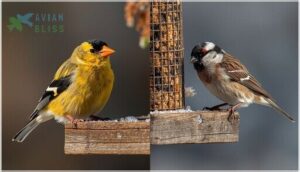
At a glance, American Goldfinch and Pine Siskin can fool even experienced birders. Here’s what separates them:
- Size and shape: Goldfinches look stockier; siskins appear slimmer with sharper wingtips.
- Plumage: Goldfinches show bold yellow; siskins wear heavy brown streaking with subtle yellow wing flashes.
- Bill: Goldfinch bills are thick and conical; siskin bills are finer and more pointed.
- Habitat preference and feeding behavior: Goldfinches dominate open feeders year-round; siskins irrupt into backyards during seasonal migration winters.
- Flock dynamics: Mixed flocks reveal vocal differences instantly — siskins call sharp and buzzy, goldfinches sound softer and musical.
Black-capped Chickadee Vs Tufted Titmouse

These two backyard favorites fool a lot of people, but your field guide will confirm they’re easy to separate once you know where to look.
The Blackcapped Chickadee is noticeably smaller, rounder, and bolder at feeders, while the Tufted Titmouse stands taller with a signature crest.
bird silhouettes, vocalization differences, caching behaviors, and winter flocking patterns all point you toward a confident visual identification.
Eastern Bluebird Vs American Robin
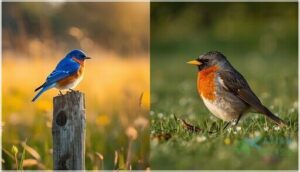
Both sport a rust-colored chest, but bird size alone settles it fast. Robins run about 10 inches — chunky, ground-hopping thrushes with dark heads and slender yellow bills built for worm-hunting. Bluebirds measure closer to 6.5 inches, with vivid blue upperparts, a compact silhouette, and short stout bills.
Habitat preference and nesting sites confirm it: bluebirds favor open fields and nest boxes; robins claim your lawn.
Northern Mockingbird Vs Gray Catbird

Both are gray — but that’s where the similarity ends.
Northern Mockingbird runs 10–11 inches with white wing patches and white outer tail feathers visible in flight.
Gray Catbird sits slimmer at 8–9 inches, uniformly slate gray with rufous undertail coverts.
Habitat preference tells the rest: mockingbirds own open yards; catbirds hide in dense thickets.
Their vocal repertoire and territory behavior seal it — repeated phrases versus raspy mews.
Backyard Songbird ID Checklist

Knowing what to look for makes all the difference between a confident ID and a frustrating guess.
simple, consistent checklist helps you work through each bird methodically — so nothing obvious slips past you.
exactly what to focus on, in the order that works best in the field.
What to Notice First in a Side-by-side Comparison
When two birds land side by side, what do you clock first?
Start with size and shape — silhouette analysis tells you more than color ever could.
Then scan for field marks using this order:
- Overall body proportion
- Behavioral stance and posture
- Habitat context clues
- Seasonal timing of plumage
- Background contrast and lighting effects
These anchors keep your eye honest before bird parts distract you.
Best Order for Comparing Size, Shape, and Color
Once you’ve clocked overall size, work through the rest in order: silhouette, then proportions, then color. Think of it as Silhouette Sequencing — shape always comes before shade. Color Gradient Prioritization means bold markings only matter after size and shape confirm your candidate.
| Step | What to Compare | Why It Matters |
|---|---|---|
| 1 | Size and shape | Narrows family instantly |
| 2 | Proportional Ratios | Separates look-alikes |
| 3 | Field Mark Hierarchy | Confirms final ID |
Common Visual Identification Mistakes
Even with the right order locked in, a few identification mistakes catch almost everyone.
Misleading size cues trip you up when a puffed bird looks bulkier than it really is.
Angle bias distorts bird shape entirely — a sideways perch can fool you about overall size.
Seasonal molt quietly erases field marks.
And behavioral context, like a bird pecking at the ground, shifts your visual cues versus field marks completely.
How Lighting and Distance Change Appearance
Lighting reshapes what you see almost as much as the bird itself does.
Front lighting washout flattens color, stealing contrast. Side lighting texture reveals feather edges you’d otherwise miss. Backlighting silhouette hides field marks entirely, pushing you toward field guide shortcuts using shape and size.
Golden hour warmth makes reds pop but dulls blues.
Distance blur effect collapses fine details — lean on size and shape instead.
Building Confidence With Repeat Observation
Confidence grows the same way any skill does — through repetition. Routine Scheduling matters here: revisit the same spot at the same time each day.
Observation Journaling sharpens your recall faster than memory alone.
Try Side‑by‑Side Practice whenever two birds share a branch — compare size and shape comparison methods in real time.
Mental Mnemonics lock in visual cues versus field marks so identification feels instinctive, not accidental.
Creating a Personal Comparison Chart for Common Birds
Building your own comparison chart is one of the smartest field guide shortcuts you can make. Sketch or print each bird silhouette side by side, then apply consistent annotation standards — label the crown, bill, and wing bars clearly.
Use reference scaling so size comparison stays accurate across entries. Add visual cues versus field marks in separate columns, note bird part ratios, and refresh with a weekly update routine using digital tools.
Frequently Asked Questions (FAQs)
What American songbird mimics others?
northern mockingbird masters territory defense by mimicking hundreds of sounds — warblers, jays, even car alarms.
Its repertoire growth never stops, making urban soundscape mastery and female preference its greatest evolutionary gifts.
How do juvenile songbirds differ from adults visually?
Juvenile songbirds look chunkier, duller, and less defined than adults.
eye rings, crests, and bill proportions develop gradually through feather molt timing, making sexual dimorphism nearly invisible until full adult plumage emerges.
Which songbirds change appearance when wet or ruffled?
Wet plumage shifts catch many birders off guard. A puffed silhouette cue, crest visibility boost, wing-bar enhancement, or tail-spot contrast can make a familiar bird look like a complete stranger.
How does molt timing affect mid-season identification?
Molt timing reshapes your familiar field marks mid-season.
Fresh feather contrast and partial molt patterns can temporarily erase streaks, alter tail length variability, and shift seasonal color — making confident identification genuinely tricky.
Can habitat location alone narrow down songbird species?
Habitat filtering can narrow your options fast — but it won’t hand you a name.
A Song Sparrow in a marsh and a House Sparrow near buildings share a continent, not a habit.
How do regional subspecies complicate visual comparisons?
Regional subspecies throw you off because morphological variation is real — color hue shifts, postural differences, and tail proportion changes vary by location.
Seasonal molt timing adds another layer, turning reliable visual cues into identification mistakes waiting to happen.
Conclusion
Before these checkpoints, two similar birds meant frustration. Now they mean opportunity.
Every curved bill, streaked breast, and bold eye ring becomes a clue you actually know how to read. That shift—from confusion to clarity is exactly what solid common songbird visual comparison gives you.
The birds haven’t changed. Your eyes have. Keep a comparison chart close, return to the feeder often, and trust what careful observation has already taught you.