This site is supported by our readers. We may earn a commission, at no cost to you, if you purchase through links.

Spot a warbler darting through dense hedgerows and you’ll understand the problem instantly—by the time you raise your binoculars and find it through a narrow field of view, it’s gone. That split second costs you the bird.
Experienced birders know this frustration well, which is why so many quietly switched to wide-angle binoculars years ago and never looked back. A wider field of view doesn’t just show you more landscape per glance—it keeps fast-moving targets in frame long enough to actually identify them.
The difference between an 8° and 6° field of view sounds small on paper, but in the field it translates to roughly 100 extra feet of visible width at 1,000 yards—and that’s where birds live and disappear. Understanding why birders prefer wide-angle binoculars starts with what happens in those first critical seconds of a sighting, and it goes deeper than most buying guides ever explain.
Table Of Contents
Key Takeaways
- A wider field of view — ideally 8° or more — lets you keep fast‑moving birds like warblers in frame long enough to actually identify them, something a narrow 6° view simply can’t do.
- 8x magnification beats 10x for most birding situations because it gives you a broader field, less handshake, and brighter images at dawn and dusk when birds are most active.
- Small comfort details like eye relief (17mm+ if you wear glasses), adjustable eyecups, and close focus distance directly affect how much of your wide‑angle view you can actually use in the field.
- You don’t need to spend a fortune to get solid wide‑angle optics — mid‑range models around $600, like the Vortex Diamondback HD 8×42, deliver ED glass, multi‑coated lenses, and weatherproof build quality that serious birders rely on.
Wide Views Find Birds Faster

A wide field of view is one of the biggest reasons birders upgrade their optics — and for good reason. When you can scan more habitat in a single glance, you spot birds before they vanish into the brush. Here’s how a wider view gives you a real edge in the field.
Pairing wide-optic binoculars with sharp knowledge of bird habitat and location patterns means you’re not just seeing more — you’re seeing the right places first.
More Habitat Per Glance
Wide-angle binoculars give you something narrow optics simply can’t — instant landscape coverage. With a broad field of view, you take in open clearings, water edges, and hedgerows in a single glance.
That wide panorama means less scanning, less time searching, and more time actually watching birds move naturally through their habitat.
Easier First Target Lock
Finding a bird fast comes down to one thing: how quickly you can center it. A wide field of view gives you natural angular tolerance, so even a slightly off‑aim raise still catches the target.
That instant lock happens because there’s simply more visual coverage to work with — less correction needed before the bird fills your frame.
Better Foliage Scanning
Once you’ve locked onto a target, the real work begins — scanning layer by layer through dense foliage. A wide field of view lets you cover more canopy in a single sweep, so quick silhouette recognition happens before the bird disappears.
That adaptive canopy tracking ability, paired with contrast edge detection between sunlit and shaded patches, makes foliage scanning dramatically faster.
Peripheral Movement Cues
Your brain actually spots movement before your eyes fully focus on it. That flash of a wing at the edge of your view? Peripheral motion detection kicks in instantly, signaling your brain before you’ve consciously registered anything.
Wide-angle binoculars augment this by expanding your angular field, so those edge view alerts trigger faster and more reliably. Research shows that peripheral optic flow cues contribute to accurate motion parsing during self‑movement.
Beginner Aiming Forgiveness
When you’re new to birding, just lifting binoculars to your eyes feels like threading a needle. Wide-angle binoculars fix this by giving you natural off-center tolerance — even slightly mis-aimed, the broader angular field keeps the bird in frame. That built-in forgiveness is everything when you’re starting out:
- You retain the target even when your aim drifts slightly
- Quick target acquisition becomes instinct, not struggle
- Less re-aiming means more time reading markings
- Beginner-friendly framing reduces beginner frustration fast
- Wider views reward sweeping, relaxed technique over rigid precision
Field of View Matters Most
Field of view is the single number that shapes everything about how you find and follow birds. It’s measured in degrees or feet, and those numbers tell you far more than they might seem at first. Here’s what each measurement actually means for your time in the field.
Paired with magnification and prism type, field of view is just one piece of the puzzle covered in this guide to key binocular features for birders.
Degrees Versus Feet

Binocular manufacturers measure field of view in two ways: degrees of arc, or feet at 1,000 yards. These aren’t separate specs — they’re the same measurement expressed differently. A degree-to-foot conversion uses arc length math: s = r × (π/180). At 1,000 yards, every degree of FOV equals roughly 52 feet of visible width.nn| FOV (Degrees) | Feet at 1,000 yd | Arc Length Formula |n|—|—|—|n| 6° | ~315 ft | 1,000 yd × 6 × π/180 |n| 7° | ~367 ft | 1,000 yd × 7 × π/180 |n| 8° | ~419 ft | 1,000 yd × 8 × π/180 |nnRadius scaling explains why this matters for binocular performance. Your viewing distance is the radius. Change that distance — say, from 1,000 yards to 500 yards — and the feet value halves. That’s why manufacturers anchor the spec at 1,000 yards: it gives every buyer a consistent, comparable reference point for wide-angle binoculars.
Wider View, Larger Area

Going from a 6° to an 8° FOV doesn’t just add a sliver of extra scene — it delivers 33% wider angular width and nearly 76% more observable area. That’s a massive habitat coverage increase from a two-degree difference.
A two-degree FOV increase delivers 33% more width and nearly 76% more observable habitat in a single glance
For bird flight tracking, that extra space means a flushed warbler stays in your frame long enough to actually identify it.
Close Bird Framing
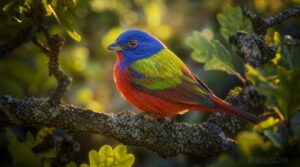
Wide-angle binoculars shine at near distance framing, where a bird 20 feet away can fill your view with plumage detail. A generous field of view keeps surrounding branches and foliage visible too, so you never lose habitat context.
That combination of close focus and image width makes bird identification noticeably faster and more reliable.
Practical FOV Benchmarks
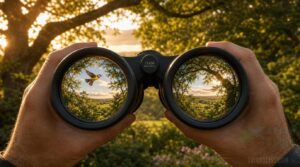
Most birdwatching binoculars fall between 5.5° and 8.5° FOV — measured in degrees or feet at 1,000 yards. That range translates to roughly 290–470 ft of coverage per glance. An 8° FOV gives you about 420 ft of visible habitat, which means a flushed warbler stays in frame far longer than with a narrower 6° view.
Magnification Changes The View
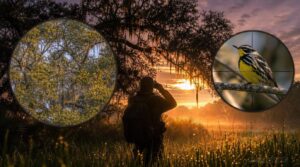
Magnification isn’t just about how close a bird looks — it shapes everything from how steady your hands need to be to how well you can spot birds at dawn. Choosing between 8x and 10x isn’t splitting hairs; it’s a decision that ripples through your whole birding experience. Here’s what changes when you dial up the power.
8x Versus 10x
The choice between 8x and 10x magnification comes down to one practical question: where do you bird most? An 8×42 gives you a field of view exceeding 340 feet at 1,000 yards, while a typical 10×42 narrows that to around 300 feet — a real difference when a warbler is darting through branches.
Less Hand Shake
Lower magnification means less hand shake — it’s that simple. 8x binoculars produce roughly 25% less image wobble than 10x models because hand tremors get amplified less.
Pair that with a firm, relaxed grip and elbows tucked close to your body, and your wide-angle field of view stays locked on the bird instead of bouncing around.
Brighter Low-light Views
That stability benefit pairs nicely with another 8× advantage: brighter low-light views.
8×42 wide-angle binoculars produce a 5.25 mm exit pupil — the circle of light your eye actually receives. Larger exit pupils mean more light reaches your eye at dawn and dusk, when most birds are most active.
What helps that brightness hold up:
- Large 42 mm objective lenses gather considerably more ambient light than smaller 25–28 mm alternatives
- Anti-reflection coatings transmit roughly 95% of available light across lens surfaces
- Phase correction coatings on roof prisms maintain contrast and true color through the optical path
- ED glass reduces chromatic fringing, keeping edges sharp without washing out subtle tones
- Weather sealing keeps moisture off optics, preserving brightness when conditions turn damp
10× models narrow the exit pupil, which visibly dims the image in shaded woodland or overcast skies. At 8×, your low light performance stays consistent — no tripod, no guessing, just a clear, bright field of view when the light drops.
Distant Bird Tradeoffs
So when does 10× actually make sense? Distant, stationary birds — a hawk perched on a far ridge — reward the extra detail.
But spotting birds in flight at that power is genuinely harder. The narrower field of view and amplified handshake mean a fast-moving warbler exits your frame before you’ve confirmed a single marking.
Tripod Needs Above 12x
Push past 12× magnification and a tripod isn’t optional — it’s the only way to keep the image steady. Hand tremor at that power turns detail into blur. Here’s what your setup needs:
- Tripod load capacity rated for at least 15 pounds
- Carbon fiber stability to reduce sag at full height
- Leg spread adjustment for soft or uneven ground
- Weight hook balance and a center column lock to stop drift in wind
Comfort Preserves The Full View

Even the best optics won’t help if the binoculars fight you every time you raise them. Comfort isn’t a bonus feature — it’s what lets you stay on a bird long enough to actually see it. A few design details make the difference between a frustrating outing and a smooth one.
Eye Relief for Glasses
If you wear glasses, eye relief is everything. It’s the distance between your eye and the ocular lens where the full field of view stays visible. Too little relief and you’ll see dark edges — that’s vignetting cutting off your wide-angle view before you’ve even found the bird.
Most birders with glasses need at least 17 mm of eye relief. Anything less and thick frames push your eye too far back, shrinking the image. Here’s a quick reference:
| Eye Relief | Glasses Compatibility |
|---|---|
| Under 15 mm | Poor — noticeable blackout |
| 15–17 mm | Marginal — depends on frame thickness |
| 17 mm+ | Reliable — full field preserved |
Proper alignment with the exit pupil matters just as much as the spec sheet number. Even generous relief won’t help if your eye sits off-center. Test any binoculars with your glasses on before committing.
Adjustable Eyecup Settings
Twisting your eyecups up or down sounds minor, but eyecup position control directly determines how much of your wide-angle view you actually see.
For eyeglass wearers, rolling them down brings your eye closer to the lens. Without glasses, extend them fully.
Soft rubber or plastomer eyecup material ensures comfort during long walks, and locking detents keep your chosen position secure.
Diopter Sharpness Balance
Even a perfectly wide field of view won’t help if the image looks soft. That’s where diopter adjustment comes in — it fine-tunes each eyepiece independently to match your eyesight.
Key things to know:
- Diopter Alignment corrects differences between your two eyes
- Most binoculars offer a ±2 to ±4 diopter range
- Set it using a high-contrast target like a distant silhouette
- Sharpness Matching ensures your wide-angle view stays crisp edge to edge
- Lock the setting to prevent accidental shifts during long walks
Close Focus Distance
Close focus distance is easy to overlook — until a warbler lands three feet in front of you. Minimum focus distance tells you how near a subject can be while still appearing sharp. Most wide-angle binoculars for birding hit around 5–6 feet, but specialized models get down to 3 feet or less, boosting your near field performance considerably.
That close focus range changes how you bird. You can study feather texture, leg color, or bill shape without backing away or disturbing the bird. A tight close focus spec pairs naturally with a wide field of view — you get the big picture and the fine detail, switching between them just by turning the focus wheel.
Weight During Long Walks
Binoculars add up fast on a long walk. Wide-angle 8×42 models weigh around 650–750 grams — manageable until mile three.
Use a chest support instead of a neck strap to spread that load and cut neck strain by up to 15 percent.
Stay hydrated every 20–30 minutes, and your focus stays sharp alongside your field of view.
Choosing Wide-Angle Birding Binoculars

Picking the right wide-angle binoculars comes down to a few key factors — budget, build quality, and how you plan to use them. The good news is there’s a solid option at just about every price point. Here’s what to know before you buy.
Beginner Budget Options
Starting out doesn’t mean settling for bad optics.
Budget wide-angle binoculars in the 70–120 euro range — commonly 8×25 compacts — give beginners a solid entry point. They’re lightweight, often under 400 grams, and most come splash-proof with rubber armoring.
Many bundles include a case, strap, and cleaning cloth. That’s a decent kit for your first season in the field.
Mid-range Optical Value
Once you’re ready to move beyond basics, mid-range birding optics open up a noticeably different experience.
Models around $600 offer fully multi-coated lenses with light transmission near 95%, ED glass for sharper color accuracy, and nitrogen sealing against fogging.
A wide 8° field of view through quality roof prism glass means you’re actually seeing more — clearly.
Vortex Diamondback HD 8×42
The Vortex Diamondback HD 8×42 is one of the most recommended mid-range options in birding circles — and for good reason. Its roof prism design with dielectric coatings, ED glass elements, and fully multi-coated lenses deliver sharp, color-accurate images.
At roughly 618 grams, argon-purged optics and ArmorTek lens coating round out a remarkably capable package at its price point.
Weatherproof Birding Features
Weather can change fast in the field. That’s why weatherproof construction matters more than most beginners expect.
Wide-angle binoculars built with O-ring seals and argon gas purging block moisture and prevent internal fogging when temperatures shift. Hydrophobic lens coatings shed raindrops instantly, while IPX-rated housings handle sudden showers without hesitation — keeping your view clear no matter what the sky decides.
Fixed Versus Zoom Designs
Most serious birders stick with fixed-design binoculars. Fixed optics deliver sharper edge-to-edge clarity, a wider maximum aperture for better low‑light brightness, and a lighter build — all without the extra lens groups that zoom designs require.
Zoom binoculars offer framing flexibility, but they add weight and can soften detail across the zoom range, which matters when a warbler won’t sit still.
Frequently Asked Questions (FAQs)
How do coatings affect wide-angle light transmission?
Coatings are the unsung heroes of clear optics. Multilayer AR coatings push light transmission to around 95%, while nanostructured surface layers keep reflectance below 5% even at wide angles — delivering sharper, brighter birding views.
Conclusion
Miss a single degree of field of view, and you might as well be watching birds through a rolled‑up newspaper.
That’s how much framing matters when a warbler vanishes in under a second.
Understanding why birders prefer wide angle binoculars isn’t about chasing specs—it’s about keeping real birds in real view long enough to actually see them.
Choose wider optics, and the field stops feeling like a guessing game and starts feeling like your territory.
- https://www.bestbinocularsreviews.com/birdwatching-binoculars.php/night-vision/documents/wide-angle-binoculars.php
- https://www.allaboutbirds.org/news/choosing-binoculars-field-of-view-and-close-focus
- https://www.birdcollective.com/blogs/news/why-binoculars-matter-and-how-to-choose-the-right-pair
- https://en.wikipedia.org/wiki/Binoculars