This site is supported by our readers. We may earn a commission, at no cost to you, if you purchase through links.
blue tit nest weighs less than a teaspoon of sugar, yet it holds together through frost, wind, and the constant traffic of hungry chicks. That’s not luck—it’s precision engineering, built from materials the bird selected, tested, and wove into place over several days.
walk past dozens of nests each year without recognising what they’re looking at. Once you start identifying bird nesting materials, a nest stops being a tangle of twigs and becomes a readable record: which species built it, when, and exactly what your local habitat offers them.
Table Of Contents
Key Takeaways
- A nest’s materials — twigs, mud, silk, feathers — act as a fingerprint that tells you exactly which species built it and what your local habitat can support.
- Each nest has three functional layers: a twig-and-mud outer frame, a fiber-bound rim, and a soft inner lining, and understanding that structure lets you read any nest you find.
- Urban birds increasingly swap natural fibers for synthetic materials like string and fabric scraps, but some human-left items — tinsel, dryer lint, treated yarn — can trap or poison chicks.
- UK law protects active nests from March through August, so check shrubs carefully before any garden trimming and offer only dry, untreated natural materials if you want to help.
What Bird Nesting Materials Reveal
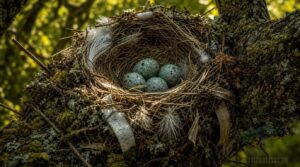
A bird’s nest is basically a field note written in twigs, mud, and feathers. Once you know how to read it, the materials tell you almost as much as the bird itself. Here’s what to look for.
Each clue builds on the last, and a solid guide to identifying bird nests by location, shape, and materials can sharpen your eye before you even step outside.
A bird’s nest is a field note written in twigs, mud, and feathers — learn to read it
Structure, Lining, and Binding
Every nest is built in three distinct layers. The twig base framework forms the outer shell — sticks arranged to distribute weight and resist wind.
Inside, mud adhesive properties lock that frame together.
Then come soft lining materials: moss, feathers, hair.
Fiber binding techniques using spider silk or plant threads hold the rim tight, letting the structure flex without failing.
Natural Versus Added Materials
Once you know how a nest is built, the next question is what it’s built from — and that split between natural versus added materials tells you a lot. Natural materials are things birds collect from their territory: twigs, leaves, dry grasses, feathers. Added materials are human-sourced — string, fabric scraps, paper fibres.
- Natural binding agents like spider silk and plant threads offer flexibility and odourless grip
- Urban birds increasingly rely on synthetic nest materials as natural fibre availability drops in built-up areas
- Seasonal material trends shift too, with greener renewables dominating spring and dry or synthetic debris appearing more in late summer
Material selection criteria come down to what’s available, workable, and safe. In gardens near sheds or construction debris, you’ll spot string or cotton tucked into a cup nest. That’s not laziness — it’s adaptation. Added material benefits include gap-filling, extra insulation, and structural volume, especially useful in cooler climates. Just note that some materials to avoid — tinsel, dryer lint, chemically treated yarn — can trap or poison birds, so what humans leave out matters. Many synthetic items are non‑biodegradable and persist in waste streams.
Material Clues by Species
Each species leaves a material fingerprint. Robins build with dry grass and rootlets, often pressing mud pellets into the base for form. Goldfinches favour spider silk and plant fibres to create a delicate, flexible cup. Woodpigeons stack large twigs into flat platforms. Tits weave fine moss and hair through cavity linings for warmth.
| Species | Key Materials | Placement |
|---|---|---|
| Robin | Grass, rootlets, mud | Low shrubs, ledges |
| Goldfinch | Spider silk, plant fibres | Tree forks |
| Woodpigeon | Large twigs, leaves | High branches |
| Blue Tit | Moss, hair, spider silk | Cavities, nest boxes |
Fresh Versus Old Materials
Once you’ve matched a species to its materials, look closer at the materials themselves. Fresh versus aged tells its own story.
Green, pliable moss signals recent construction. Faded, brittle fibers suggest an older or reused nest.
Fresh materials offer better moisture retention and tensile strength. Aged ones run drier but often add firmer insulation — a trade-off birds manage instinctively.
Common UK Nest Materials
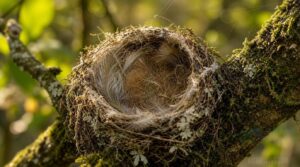
Walk up to almost any UK garden nest and the materials practically introduce themselves. Each one — from a scrap of mud to a twist of spider silk — has a job to do and a story to tell. Here’s what you’re likely to find, and what it means.
Many birds, in fact, build fresh nests two or three times each breeding season — so those carefully chosen materials get put to work again and again.
Twigs and Small Sticks
Twigs are the skeleton of almost every garden nest. Birds select small sticks between 1–8mm thick — thin enough to weave, stiff enough to hold shape.
Fresh twigs bend without snapping, making them ideal for the outer frame. Dry, fallen twigs add rigidity.
Most birds collect from nearby shrubs, keeping energy costs low. Mixed twig sizes create a stronger, more stable structure overall.
Moss, Grass, and Straw
Once the twig frame is in place, birds layer the softer nest construction materials that make a nest genuinely livable. Moss soft cushion sits at the base, cushioning eggs from uneven surfaces and holding just enough moisture to keep materials pliable. Its green colour also helps camouflage the structure.
Grass blade weave binds everything together — fine blades interlaced around the rim create a surprisingly sturdy frame. Small pieces of straw add the finishing touch, their hollow stalks acting as a natural straw air trap that locks in warmth.
Mud and Clay Binding
Mud is the unsung hero of nest construction. Birds like robins and magpies mix clay-rich soil with water, hitting that ideal water content sweet spot where the mud holds its shape without crumpling. Here’s what makes it work:
- Clay plasticity effects let birds mold a smooth, solid cup
- Calcium binding strength locks particles together as it dries
- Surface adhesion mechanisms grip twigs and moss fibers firmly
Slow drying reduces cracking and yields a stronger final bond.
Feathers, Hair, and Fluff
The soft interior of a nest is where warmth actually lives. Birds line their cups with feather insulation, hair, and plant down — materials that trap air and hold heat around eggs and chicks.
| Material | Benefit |
|---|---|
| Feathers | Downy padding, heat retention |
| Human hair | Flexible, dense hair lining |
| Plant down | Lightweight fluff benefits |
Soft linings are the final, most deliberate layer.
Spider Silk and Plant Fibres
Few nest materials work as hard as spider silk. Birds like goldfinches weave it between plant fibres to create a structure that’s both firm and flexible — it stretches as chicks grow without losing shape.
Plant fibre stiffness provides the frame; silk supplies the give. Together, they form a hybrid composite toughness that no single material alone could match.
Identifying Nests by Material
Once you know what materials birds commonly use, you can start reading nests like field notes. Each species leaves a kind of signature — a mix of structure, lining, and binding that’s surprisingly consistent. Here’s what to look for in five of the most common UK garden nesters.
Robin Nesting Materials
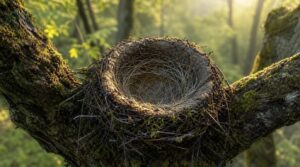
Robin (Erithacus rubecula) nests are compact, precise structures. The twig frame construction forms a circular cup roughly 7–9 cm wide. A foundation mud mix binds those twigs into a stable base.
Inside, an insulation grass layer cushions eggs and holds warmth. Elastic silk threads secure the lining.
Seasonal material choices shift with spring moisture, favoring more moss and damp‑gathered mud early on.
Blackbird Nesting Materials
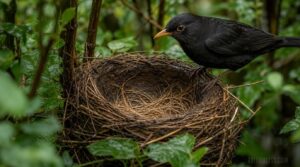
Where the robin builds tidy and tight, the Blackbird (Turdus merula) takes a rougher, roomier approach. The female builds alone, weaving twigs and grasses into a broad cup, then pressing in mud as a binding layer to stiffen and seal it. A soft inner lining of fine grass cushions the eggs.
Five things to know about blackbird nests:
- Twigs and dry grass form the outer cup walls
- Mud seals the interior, adding weatherproofing
- A leafy base layer often anchors the structure
- Fine grass provides egg cushioning materials inside
- Material availability shapes the final composition — urban birds use garden shrub twigs; wetland birds incorporate reeds
The female can build three to four nests per season, rarely reusing the same one.
Goldfinch Nesting Materials
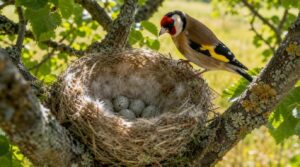
The goldfinch (Carduelis carduelis) builds one of the most finely crafted nests in the UK garden.
Thistle down and seed fluff form the soft inner lining, while plant fibers and twigs shape the outer cup. Spider silk binds everything to the branch fork, keeping it stable through wind.
Timing matters — goldfinches build when thistles are seeding.
Woodpigeon Nesting Materials
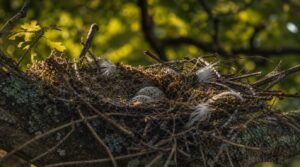
Where the goldfinch weaves silk and thistle fluff, the Woodpigeon (Columba palumbus) takes a rougher approach.
Twig gathering is the foundation — loose sticks and small branches stacked into a flat platform nest, often thin enough to see eggs through from below.
- Moss padding cushions the inner cup
- Fine rootlets bind the structure
- Feathers and hair add warmth
- Spider silk secures lighter materials
- Seasonal grasses complete the lining
Tit and Cavity Nests
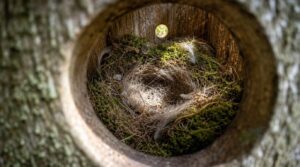
Tits take a different approach entirely. Cavity and hole nests trade exposed architecture for concealment — a natural hollow, old woodpecker hole, or nest box becomes the frame.
Inside, blue tit behavior leans practical: moss first, then fine grasses woven into a tight cup, finished with feathers and fur for warmth.
Cavity entrance size and nest box height shape everything.
Nest Shape and Placement Clues
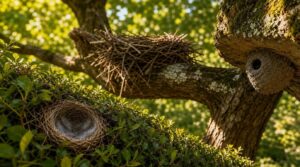
Once you know what a nest is made of, the next clue is where it sits and what shape it takes. Different birds have very distinct habits — a cup tucked into a hedge tells a different story than a stick platform high in an oak. Here are the main nest types you’re likely to spot.
Cup Nests in Shrubs
A cup nest in a shrub is built from the outside in. Birds start with twigs and small sticks, then layer moss and grass inward, finishing with spider silk and soft feathers.
Most take three to six days to complete. Dense foliage hides them well — camouflage is the point, not convenience.
Platform Nests in Trees
Unlike cup nests tucked into shrubs, platform nests sit high up in tree branches — broad, flat, and built to last. Birds choose forked branches and strong branch junctions first. That structural support matters.
Twigs form the base, with moss and even spider silk woven through to bind it. In spring, birds add fresh green material for camouflage.
Elevated platforms naturally deter ground predators.
Cavity and Hole Nests
Cavity nests are built inside enclosed spaces — tree hollows, woodpecker excavations, or bird houses. Entrance hole size matters a lot. Tits use openings around 1.0 to 1.1 inches; bluebirds need closer to 1.5 inches. That tight fit keeps larger predators out.
Cavity reuse patterns are common. One hollow might house tits one year, then sparrows the next. Inside, you’ll find feathers, hair, and moss creating a thermal microclimate that buffers chicks from temperature swings. Artificial nest boxes with a predator guard installation extend these benefits into managed gardens.
Ground Nests and Scrapes
Some nests don’t climb — they stay put on the ground. Scrape and ground nests are shallow depressions scratched into bare soil, lined with little more than fine grass, shell fragments, or feathers.
Scrape site selection often favors open, sunlit patches where adults can spot threats early. Eggs rely on ground nest camouflage — mottled browns that vanish against soil and debris.
Artificial Structure Nests
Man-made nest boxes are where engineering meets ecology. Cedar wood construction resists rot through UK winters without chemical treatment.
Blue tits need a 28mm entrance hole; great tits want a 32mm.
Face boxes east, mount them 1.5–3 metres up, and add drainage holes. Clean them out each winter — old nesting material harbors parasites that hurt the next season’s brood.
Safe Nest Spotting in Gardens
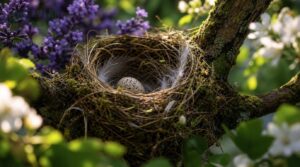
Spotting a nest in your garden is genuinely exciting, but there’s a right way to do it. A few simple habits protect both the birds and you from running into legal trouble. Here’s what you need to know before you go looking.
UK Nesting Season Timing
The UK breeding season runs roughly March to August, but some birds jump the gun. Robins and a handful of other species start as early as February in milder southern areas.
Southern England usually beats Scotland and upland regions by four to six weeks.
Weather matters too — a cold snap can delay laying, while a warm spring pushes everything forward.
Signs of Active Nests
Once you know the season is underway, the next step is learning to read what’s right in front of you.
- Fresh material additions — new moss, mud, or grass appearing on the rim overnight
- Adult feeding visits — parents arriving repeatedly with insects or spiders
- Vocal activity patterns — nestling begging calls during daylight hours
- Nest temperature rise — warmth from constant brooding
These signs confirm an active nest.
Legal Protection Basics
Once you’ve confirmed a nest is active, the law steps in. Under the Wildlife & Countryside Act 1981, it’s an offence to intentionally damage or destroy any active nest while it’s in use or being built. That protection kicks in before eggs even appear. Disturb a nesting bird and you risk real wildlife act offences — not just a warning.
Garden Maintenance Precautions
The law protects active nests, but your garden habits matter just as much. Avoid hedge trimming from March through August — that’s when most UK birds are actively nesting.
A single pass with powered shears can destroy a nest in seconds.
Before any cutting, check shrubs and hedgerows carefully by eye first.
Safe Materials to Offer
Once you’ve sorted your garden maintenance habits, you can go further by supporting birds actively.
Natural fiber lining materials — dried grass, moss, and clean feathers — are your safest options. Keep everything untreated.
Untreated twigs offer solid structure without chemical risk.
Avoid dryer lint, tinsel, or yarn entirely.
Synthetic materials tangle and harm chicks.
Frequently Asked Questions (FAQs)
Can birds reuse nests from previous seasons?
Yes, some birds do reuse nests. Seasonal reuse is more common in urban areas where stable sites and fewer predators make it worthwhile. Many species simply add fresh material on top.
How do weather conditions affect nest material choices?
Weather shapes every material choice. Cold nights push birds toward thicker feather and wool linings. Heat prompts lighter, sometimes reflective, natural materials.
Rain triggers heavy mud and clay binding. Wind drives tighter, woven construction.
Which nesting materials attract parasites or pests?
A dirty nest is a dangerous nest." Wet materials breed mold fast, pulling in mites and fleas. Old nest debris transfers parasites between seasons. Synthetic fibers trap moisture. Offer only dry, natural, nontoxic supplies.
How long does it take birds to build a nest?
Most birds wrap up nest construction in 2 to 14 days. Sparrows finish in two to four. Robins take about five or six. Eagles need weeks.
Conclusion
Every nest is a field notebook written in moss, silk, and feather—patient, precise, and completely honest about the world around it. Once you start identifying bird nesting materials, you stop seeing a garden and start reading it. Each cup of woven grass or mud‑sealed rim tells you what’s living nearby and what your habitat can sustain.
That knowledge changes how you look after your outdoor space—and it makes every walk genuinely worth slowing down for.
- https://www.woodlandtrust.org.uk/blog/2026/01/bird-nest-identification
- https://sharonsflorida.com/wildlife/how-to-provide-nesting-materials-for-birds
- https://www.schlitzaudubon.org/2024/04/29/a-diversity-of-bird-nests
- https://centerofthewest.org/2023/04/06/bird-nests-types-material-how-you-can-help
- https://www.allaboutbirds.org/news/providing-nest-material-for-birds-dos-donts