This site is supported by our readers. We may earn a commission, at no cost to you, if you purchase through links.

A bird standing in too-deep water looks exactly like a bird about to drown—wings spread, body tilted, scrambling for footing that isn’t there. It’s uncomfortable to watch, and it happens more often than most backyard birders realize.
The difference between a bath birds love and one they avoid often comes down to a single inch of water.
Get the depth right, and you’ll see cardinals splashing, finches drinking, and robins doing that full-body shake that means they’ve found exactly what they needed.
The following guidelines break down safe depths by bird size, show you how to fix a bath that’s too deep, and help you keep the water in the right range all year.
Table Of Contents
- Key Takeaways
- Why Birdbath Depth Matters
- How Deep Should a Birdbath Be?
- Best Depths by Bird Size
- Make a Deep Birdbath Safer
- Signs The Depth is Right
- Maintain Safe Depth Year-Round
- Frequently Asked Questions (FAQs)
- How deep should a bird bath be?
- Should a bird bath be shallow?
- How to keep birds safe in a bird bath?
- Why is water depth important in a bird bath?
- Do birds like deep or shallow bird baths?
- Where not to put a bird bath?
- Can moving water help attract more birds?
- Where is the best spot to place a birdbath?
- How often should birdbath water be replaced?
- Do birdbath materials affect bird safety?
- Conclusion
Key Takeaways
- Most backyard birds thrive in just 1–2 inches of water, where they can stand flat-footed, bathe safely, and escape quickly if startled.
- A gradual slope from rim to center — shallow at the edges, slightly deeper in the middle — makes your bath work for small finches and larger robins at the same time.
- Adding flat rocks or a shallow dish inside a too-deep basin is a quick, low-cost fix that gives birds solid footing and raises the water to a safe level.
- Depth only stays safe if you maintain it — refill daily in heat, check after rain, and clean every 2–5 days, so birds keep coming back.
Why Birdbath Depth Matters
The depth of your birdbath does more than you might think — it shapes which birds visit, how safely they bathe, and whether they come back at all.
Getting the depth right matters more than most people realize — this guide on bird bath depth for different bird species breaks down exactly what works for everyone from tiny finches to larger backyard visitors.
Get it wrong in either direction and you’ll notice fewer birds using it. Here’s why depth is the first thing worth getting right.
Why Shallow Water Attracts More Birds
shallow water are drawn to shallow water the same way you’d gravitate toward a clear, calm stream — it feels safe. Water sitting at 1 to 2 inches gives small birds an easy landing, solid footing, and room for feather cleaning without feeling overwhelmed.
quick predator visibility benefits species that depend on quick predator visibility and social interaction, letting multiple birds bathe comfortably side by side. Keeping the depth at 1–2 inches is the recommended water depth(https://chillwithbirds.com/how-deep-should-my-bird-bath-be/) for most species.
How Proper Depth Reduces Drowning Risk
Shallow water isn’t just inviting — it’s a lifeline.
When the water sits at 1 to 2 inches, birds keep solid footing stability and a clear escape pathway if something startles them. Wet feathers are heavy, so drowning prevention depends on species-specific depth that lets small birds touch the basin floor.
Daily water level monitoring keeps that safe water depth consistent and every visitor protected. Avoid the danger of big‑box bird baths death traps by ensuring a gentle slope.
Why Steep Sides Discourage Bathing
Even the safest water depth won’t help if your bath has steep, straight walls.
A gradual slope — shallow at the edges, gradually deeper toward the center — creates the natural depth gradient small birds trust.
Without it, limited entry points and reduced perching options leave finches and chickadees stranded on the rim.
Steep sides also mean increased escape effort, which raises predator exposure during that vulnerable split-second exit.
Drinking Depth Versus Bathing Depth
Depth does double duty in any birdbath — but drinking and bathing don’t ask for the same thing.
The Drinking Zone Depth works best around 1 inch at the rim. Birds sip from the edge, feet dry, quick exit ready. The Bathing Zone Depth runs slightly deeper — 1.5 to 2 inches toward the center suits most visitors.
- Small finches trust safe water depth under 1 inch.
- Cardinals wade comfortably at species-specific depth needs near 1.5 inches.
- Robins splash freely where water depth guidelines allow up to 2 inches.
- Clear bottoms act as natural water level indicators — birds won’t enter what they can’t see through.
How Deep Should a Birdbath Be?
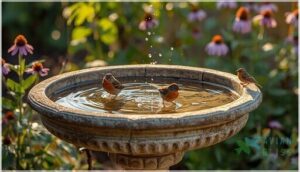
Most backyard birds are happy with just 1 to 2 inches of water — that sweet spot covers drinking, bathing, and safe footing all at once.
But depth at the rim, the center, and for different bird sizes each deserves a closer look.
Here’s what works best for every part of the bath.
Best Depth for Most Backyard Birds: 1–2 Inches
For most backyard birds, the sweet spot is 1 to 2 inches deep — that’s your best bird bath water depth recommendations in short. It’s the ideal depth of water for everything from cardinals to sparrows.
Safe water depth for small birds stays closer to 1 inch.
Factor in bath placement, water temperature, seasonal temperature effects, material choice, and predator visibility to keep visits consistent and bird bath safety solid.
Ideal Rim Depth: About 1 Inch
water level on the edges should be about 1 inch — that single measurement does a lot of quiet work. At the rim, birds can stand flat-footed and reach the water without tipping forward.
- Rim Color Contrast helps birds spot safe depth instantly
- Wind Shielding keeps water calm so the level stays steady
- Installation Height affects how birds approach the edge
- Maintenance Accessibility makes daily depth checks easy
A shallow dish placed inside a too-deep basin brings the rim to that ideal depth of water quickly, protecting every bird that visits your bath.
Ideal Center Depth: Up to 2 Inches
Move toward the center of the basin, and you’ll notice the sweet spot for most backyard visitors: a maximum of 2 inches deep in the middle.
This Center Depth Measurement keeps the ideal bird bath water depth recommendations within a safe depth for small birds while giving larger ones room to splash.
Depth Consistency Tips and Seasonal Depth Adjustments help maintain Bird Preference Zones, supporting Preening Depth Benefits year‑round.
When a Slightly Deeper Center Can Work
Sometimes a center nudging toward 2.5 inches actually works — if your yard hosts medium to large songbirds like robins or jays. A slightly deeper middle enhances better water visibility, longer bathing duration, and temperature stability on hot afternoons.
Keep these safety conditions in mind:
- Surround it with a shallow dish or gradual water depth gradient at the edges
- Prioritize bird bath safety with rocks for footing and predator deterrence
- Stick to a maximum of 2 inches deep in the middle as your maintenance focus
Why Depths Over 2–2.5 Inches Can Be Risky
Once depth creeps past 2 to 2.5 inches, real dangers stack up fast. Small birds face limited escape routes if startled, reduced footing grip on slippery surfaces, and increased energy expenditure just staying upright.
Thermal shock risk rises in deep cold water, and higher predator visibility puts nervous bathers at a disadvantage.
For bird bath safety, ideal bird bath water depth recommendations exist for a reason — don’t ignore them.
Best Depths by Bird Size
Not every bird that visits your yard is the same size, and the water depth that’s perfect for a chickadee can feel like a swimming pool to a crow. Getting the depth right for the birds you actually see makes a real difference in how often they’ll use the bath.
The right water depth for a chickadee can feel like a swimming pool to a crow
Here’s a quick look at what works best for different sizes.
Small Birds Like Finches and Chickadees

Tiny birds like finches and chickadees are primarily wading, not swimming — so keeping your bird bath depth at 1 to 2 inches deep is the sweet spot to prevent bird drowning.
Here’s what helps:
- Use Shade Positioning to keep Water Temperature cool and inviting
- Add pebbles for safe depth for small birds
- Place near Predator Cover like shrubs
- Follow guidelines for water depth based on bird species size
- Consider Feeding Proximity and Seasonal Color to attract more visitors
Medium Birds Like Sparrows and Cardinals
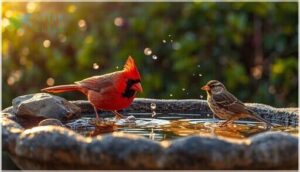
Cardinals and sparrows sit in the medium range — roughly 6 to 9 inches tall — and they bathe comfortably in 1.5 to 2 inches of water.
Follow bird bath depth recommendations that account for bird species size range, and these visitors will come back daily.
| Feature | Recommendation | Why It Helps |
|---|---|---|
| Medium birdbath depth | 1.5–2 inches | Safe footing for both species |
| Perch Placement | Rocks near rim | Easy entry and exit |
| Predator Cover | 3–6 ft from shrubs | Quick escape if startled |
Larger Birds Like Robins, Jays, and Doves
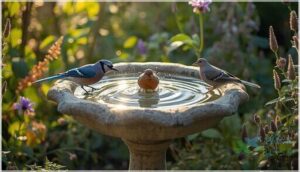
Robins, jays, and doves are larger than sparrows — generally 8 to 13 inches tall — and they handle a bit more water. Still, 1 to 2 inches is the sweet spot for best bird bath water depth recommendations across all three.
- American Robin: The American Robin’s perching edge behavior means they test the rim first, then wade in
- Bluejay: The jay’s splash area works best at 2–2.5 inches across a wide basin
- Mourning Dove: A dove’s shallow entry is key — they prefer a gradual slope, not a sudden drop
- Species size adaptation: Bigger birds still need easy footing, not deep water
Using The Half-height Rule Safely
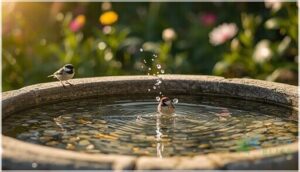
The half-height rule keeps things simple: the bird bath depth should never exceed half the bird’s height. A chickadee standing 5 inches tall—keep water under 2.5 inches.
That height ratio calculation works across species.
For safety margin adjustments, stay a little below that maximum — rocks and shallow dishes help you dial in the right depth without guesswork.
Creating One Bath for Mixed Species

One bath really can work for finches and jays together — you just need zoned depth design. Keep the rim at 1 inch for small birds, and let the center slope to 2 inches for larger species.
Adjustable platforms, modular inserts, and multi-level perches create species-specific zones. That gradual slope is the key to balancing water depth for mixed species without compromise.
Make a Deep Birdbath Safer

A birdbath that’s a little too deep doesn’t have to stay that way.
A few simple fixes can bring the water level into a safe range without replacing the whole basin. Here’s what works.
Add Rocks or Pebbles to Raise The Floor
A handful of rocks can quietly transform a bird bath that’s too deep into one that small birds will actually use. Drop some smooth, flat stones in — here’s what that does:
- Rock Ramp Design guides birds in gradually instead of forcing them into deep water.
- Pebble Traction gives wet feet something to grip on slippery basin floors.
- Layered Stone Floors raise the overall basin bottom, keeping a safe bird bath depth for small birds around 1–2 inches.
- Rock Island Creation gives hesitant birds a dry landing spot before they wade in.
Use flat stones for Stone Stability Tips — they won’t wobble when a bird lands.
Use a Shallow Dish Inside The Basin
If your basin runs too deep, a shallow dish dropped inside it can fix that in minutes. Set a wide, flat tray or terra-cotta saucer in the center — DIY Installation doesn’t get much simpler.
Mind Stability Concerns by choosing a dish that sits flat without rocking. The shallow basin keeps water at 1–2 inches, and the lighter water volume improves Water Visibility, so you can check depth at a glance.
Build a Gentle Slope From Edge to Center
Shaping a gentle slope from edge to center is one of the most effective fixes for a too-deep bath. Think of it as Gradual Incline Design in action — your Edge-to-Center Gradient keeps edge depth near 1 inch while the center depth reaches about 2 inches.
These Depth Change Zones let birds choose their comfort level, making the safe depth accessible to every visitor.
Add Flat Stones for Landing and Footing
Flat stones pull double duty in a birdbath — they give birds a place to land and something to grip. Stone Placement matters: choose broad, rough-surfaced rocks for Size Selection, then arrange them as a Stepping Path from rim to center. Stability Assurance is key; wobbly stones send birds elsewhere.
- Use flat stones just above the waterline as landing pads.
- Rough Surface Texture beats smooth ceramic for wet-foot grip.
- Position rocks to create clear shallow zones within safe depth.
- Adding rocks and pebbles raises the floor in deep basins.
Choose Rough, Non-slip Bath Surfaces
The surface under a bird’s feet matters as much as the water depth. Slippery surfaces make even a perfectly shallow bath feel unsafe.
Rough surfaces — like a Textured Concrete Finish or Unglazed Terracotta Surface — give birds solid footing.
You can also apply a Non-toxic Grip Coating or Sand Paint to smoother bowls.
These Easy-Clean Rough Surface options support safe depth and bird bath safety guidelines without extra fuss.
Signs The Depth is Right
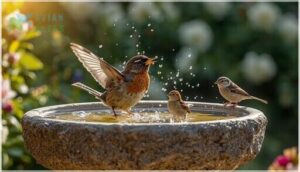
Once your birdbath is set up, the birds themselves will tell you if something’s off — or if you got it just right. You don’t need fancy equipment to read those signs.
Here’s what to look for.
Birds Can Stand Comfortably on The Bottom
One reliable sign you’ve got the bird bath depth right: birds wade in and just stand there, feet flat on the bottom. That’s a bird that feels safe.
A rough bottom — textured stone or concrete — gives them grip without slipping.
Add stone platforms at varied heights to support weight distribution across sizes.
Shallow depth keeps water temperature stable and welcoming, a key bird bath design consideration.
Small Birds Enter and Exit With Ease
Watch a chickadee or goldfinch, and you’ll see exactly what easy looks like.
They hop to the rim, test the water with one foot, then step right in — no hesitation.
That smooth entry happens because the depth range of 1 to 2 inches matches their short legs perfectly.
A gradual edge incline, non-slip flooring, and stable placement give them quick escape routes whenever they need one.
Birds Bathe Instead of Only Perching
When the depth is right, birds do more than sip — they actually bathe. If birds only perch on the rim and leave, the water is probably too deep. Correct depth brings them in fully, supporting thermal regulation and natural bathing frequency patterns.
You’ll notice the wing splash technique: a quick dip, a shake, repeated dunks. That’s feather cleaning behavior in action, not casual visiting.
The Water Line Stays in The Safe Range
A safe water line tells its own story. Regular level checks keep the edges near 1 inch and the middle at a maximum of 2 inches deep.
After rain, Rainwater Overflow Management matters — check immediately, since overflow can push depths too high.
Seasonal Depth Adjustments and Automatic Refilling Systems help you monitor the bath and adjust water depth consistently throughout the year.
How to Measure Depth With a Ruler
A simple ruler takes the guesswork out of determining safe bird bath depth. Start with proper Ruler Placement — set it at the basin bottom so the zero reference sits at the floor, not above it. Read at eye level for Parallax Avoidance, then take Center Edge Readings in both spots using Consistent Units.
- Place the ruler straight down to the basin floor, zero reference at the bottom
- Check the edges first — water level on the edges should be about 1 inch
- Move to the center; maximum of 2 inches deep in the middle keeps most birds safe
- Use visual depth markers like pebbles or pencil lines for quick daily checks
- Always read at eye level to avoid a false low reading
Maintain Safe Depth Year-Round

Getting the depth right once is a great start, but keeping it right through every season takes a little more attention. Weather changes fast, and your birdbath needs to keep up.
Here’s what to stay on top of throughout the year.
Refill Often During Heat and Evaporation
Hot summer days can drain a birdbath faster than you’d expect. Daily water top-off keeps the basin usable and facilitates water quality monitoring by making it easy to spot cloudiness or buildup.
Shade placement slows the evaporation rate considerably, so position your bath near shrubs when possible. Avoid metal bowls — heat‑resistant materials like ceramic or concrete stay cooler and keep water fresher in dry conditions.
Check Depth After Heavy Rain
heavy downpour can quietly push your birdbath well past the safe 1–2 inch range. Make Rainfall Overflow Inspection part of your post-storm routine — grab a ruler for quick Post-Storm Measurement and check for debris clogging drainage.
Debris Removal Check matters too, since leaves and soil cloud the water fast.
Adjust the level, reset any shifted stones, and you’re done.
Keep Winter Water Shallow and Usable
Winter turns birdbath into a lifeline — but only if the water stays liquid and low. Stick to 1–2 inches, even in freezing weather. Heated shallow basins warm faster and need less energy to keep unfrozen. Wind protection placement also helps slow ice formation.
- Use a bird bath heater to prevent ice buildup
- Practice seasonal depth monitoring after every cold snap
- Apply ice prevention methods like sheltered positioning and shallow fills
Clean Regularly So Birds Keep Visiting
Fresh water is the single biggest reason birds return day after day. Clean your birdbath every 2–5 days using the vinegar cleaning method — one part vinegar to nine parts water — then rinse thoroughly.
Position it away from feeders to reduce debris and water contamination.
| Task | Frequency |
|---|---|
| Full scrub + vinegar | Every 2–5 days |
| Water refill | Every 1–2 days |
| Debris removal | Daily |
Regular cleaning also provides mosquito prevention naturally.
Monitor Depth Daily During Peak Use
Birds visit twice daily in predictable waves — early morning and late afternoon. A quick Morning Depth Snapshot at sunrise and an Afternoon Level Log before dusk give you a daily water level monitoring routine.
Track your Evaporation Rate Tracking patterns over time using a Simple Depth Gauge — a marked stick works fine. Strong Bird Visit Correlation follows consistent depth: birds return when the water stays reliably at 1–2 inches.
Frequently Asked Questions (FAQs)
How deep should a bird bath be?
Perfectly placed, purposeful water depth makes all the difference. Keep your bird bath between 1 and 2 inches deep — shallow enough for small birds to stand safely and bathe with confidence.
Should a bird bath be shallow?
Yes, a shallow birdbath is safest. Aim for 1 to 2 inches of water — shallow enough for small birds to stand, bathe, and escape quickly if needed.
How to keep birds safe in a bird bath?
Keep the water at 1–2 inches, add textured rocks for footing, and place the bath near shrubs for predator shielding. Fresh water every two days prevents algae and keeps birds safe.
Why is water depth important in a bird bath?
Water depth shapes every visit a bird makes — from whether it drinks to how safely it bathes. Get it wrong, and even a beautifully placed bath sits empty.
Do birds like deep or shallow bird baths?
Birds strongly prefer shallow basins. Most species choose water that lets them stand, splash, and escape quickly — usually 1 to 2 inches deep.
Where not to put a bird bath?
Avoid direct sun, dense shrubs, windows, high traffic zones, and feeders.
Clutter dirties water fast.
Partial shade near cover gives birds predator protection while keeping your bird bath placement guidelines simple and safe.
Can moving water help attract more birds?
Yes. Moving water draws birds quickly.
The drip sound and rippling visual cue trigger their instincts.
A simple bubbler attraction or solar fountain creates water motion appeal that still water simply can’t match.
Where is the best spot to place a birdbath?
Place your birdbath in morning sun with afternoon shade, near trees or shrubs within 10–20 feet for quick cover, on stable level ground, and at least 15 feet from busy foot traffic.
How often should birdbath water be replaced?
Change the water every 1–2 days in summer heat, every 2–3 days otherwise. Cloudy water, algae, or bad smells mean change it immediately. Fresh water keeps birds coming back.
Do birdbath materials affect bird safety?
Materials matter more than most people realize. The wrong choice — slippery surfaces, toxic metals, heat-trapping finishes — can quietly make your birdbath unsafe, no matter how perfectly you’ve set the depth.
Conclusion
Who knew a puddle could be so dramatic? We fret over garden aesthetics while birds just want a quick splash without a swim lesson.
Yet the answer is disarmingly simple: how deep should a birdbath be for birds? Mostly 1–2 inches. Get it right, and your yard becomes a spa.
Too deep? A risky moat. Too shallow? Ignored.
Add rocks, check depths, and suddenly cardinals are doing cannonballs (okay, gentle shakes).
This small effort turns your space into a lifeline—where wings dry, feathers gleam, and trust takes root, one safe sip at a time.
- https://www.wildlifedepartment.com/outdoorok/ooj/birdbath-tips
- https://waterfountainonline.com/blogs/tips/can-bird-baths-be-too-deep
- https://www.allaboutbirds.org/news/attract-birds-with-birdbaths/
- https://www.audubon.org/news/how-make-birdbath
- https://lyricbirdfood.com/birding-hub/habitat/how-to-attract-birds-to-a-bird-bath-a-guide-for-backyard-birders/