This site is supported by our readers. We may earn a commission, at no cost to you, if you purchase through links.
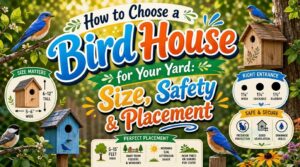
Most bird houses sold at garden centers go home, get mounted on a fence post, and sit empty all season. The birds aren’t being picky—they’re being precise.
A chickadee won’t squeeze through an entrance hole sized for a bluebird, and a bluebird won’t nest in a box that faces into the afternoon wind. Wild birds select cavities the way an architect reviews a blueprint: entrance diameter, interior depth, wall thickness, orientation.
Get the specs right, and you’ll watch a pair move in within days. Get them wrong, and you’ll hand that real estate straight to house sparrows. Choosing a bird house for your yard comes down to matching five measurable factors to the species you want to attract.
Table Of Contents
- Key Takeaways
- Choose Birds You Want to Attract
- Match Birdhouse Size to Species
- Select Safe, Durable Materials
- Place The Birdhouse Correctly
- Check Safety and Maintenance Features
- Frequently Asked Questions (FAQs)
- Where not to put a bird house?
- What are the common mistakes when building a birdhouse?
- How long does a birdhouse typically last outdoors?
- Can I paint or decorate my birdhouse exterior?
- When is the best time to put up a birdhouse?
- Should I add nesting material inside the birdhouse?
- How do I keep bees from taking over the birdhouse?
- Conclusion
Key Takeaways
- Entrance hole diameter is the single most critical measurement — even a quarter-inch error locks out your target species or invites invasive birds like house sparrows to take over.
- Untreated cedar or redwood at least ¾‑inch thick gives nesting birds natural insulation, moisture resistance, and a chemical-free environment that plastic and metal simply can’t match.
- Mounting your birdhouse 5–9 feet high on a pole with a baffle, entrance facing east or southeast, keeps it safe from predators and warm enough to draw early spring nesters.
- Cleaning the box twice a year — once in early spring and once in fall — prevents mold, mites, and bacteria buildup that quietly drive birds away season after season.
Choose Birds You Want to Attract
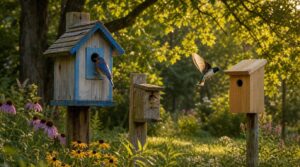
Before you buy a birdhouse, it helps to know exactly which birds you’re hoping to welcome. Different species have very different needs, and a house built for a bluebird won’t suit a wren. Here’s what to think about when narrowing down your target species.
Once you’ve narrowed down your target species, a good bird house installation guide can walk you through the placement details that make the difference between a house that sits empty and one that gets claimed.
Identify Local Cavity Nesters
Knowing which birds already visit your yard is the best place to start. Common local cavity nesters include bluebirds, chickadees, wrens, nuthatches, and woodpeckers — each with specific box requirements.
Bluebirds need a 1½-inch entrance hole, while wrens do fine with just 1 inch. Check community science platforms like Cornell’s NestWatch to confirm which species are active in your region.
The loss of natural cavities due to dead‑tree removal, known as natural cavity decline, has intensified competition for nesting sites.
Match Habitat to Species
Once you know which cavity nesters visit your area, the next step is asking whether your yard can actually support them.
Habitat matching matters more than most people realize. Bluebirds need open, grassy areas. Wrens thrive near dense shrubs and woodland edges. Chickadees favor mixed-age vegetation with scattered cover.
- Check for nearby water sources
- Look for vegetation layers — shrubs, trees, and ground cover
- Note predator presence like cats or corvids
- Assess habitat connectivity to larger green spaces
- Watch how seasonal shifts change insect availability
These factors directly influence which species will actually use a box you put up.
Consider Yard Size
Your yard’s size shapes nearly every placement decision you’ll make.
Small yards favor focused placement — a single box near shrubs or a woodland edge, with clear flight corridors of at least 6–10 feet. Larger yards support habitat diversity and multiple boxes, but require careful spacing to prevent territorial conflicts between competing cavity nesters.
Avoid Invasive Bird Use
Yard size tells you where to place a box — but choosing the right bird matters just as much as choosing the right spot.
Not every bird that shows interest in your birdhouse is one you want nesting there. House sparrows and European starlings are invasive non-native species that aggressively displace bluebirds, chickadees, and tree swallows from boxes they’d otherwise use.
Here’s what you can do to keep invasives out and natives in:
- Use species-specific entrance holes — a 1½-inch diameter blocks starlings but welcomes bluebirds.
- Build or buy invasive deterrent designs with no perches, since native cavity nesters don’t need them.
- Plant a native plant garden to attract insects that local species feed on, without drawing opportunistic invaders.
- Remove food sources like spilled seed that attract house sparrows to the area.
- Monitor invasive nests weekly and remove them promptly to protect resident native pairs.
Selective feeder use also helps — targeted seed mixes and tube feeders favor local bird species over invasives. Combine that with proper placement away from dense artificial structures, and your yard becomes a genuinely hospitable space for the birds that belong there.
Pairing the right feeder setup with a well-sized cedar birdhouse designed for cavity-nesting species gives bluebirds and wrens exactly the shelter they’re looking for.
Match Birdhouse Size to Species
Getting the size right is probably the single most important thing you can do when choosing a birdhouse. A box that’s too big or too small won’t just go unused — it can actually put nesting birds at risk. Here’s what to look for across five key sizing factors.
Entrance Hole Diameter
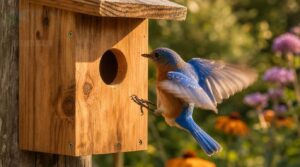
The entrance hole is the single most critical dimension on any birdhouse. Get it wrong by even a quarter inch, and you’ll either lock out your target species or roll out the welcome mat for nest competitors and predators.
A quarter-inch entrance hole error can lock out your target species or invite predators in
Bluebirds need exactly 1½ inches. Chickadees do best with a 1-inch hole, while wrens accept 1⅛ to 1¼ inches. Tree swallows, like bluebirds, prefer 1½ inches. Purple martins require a larger 2¼-inch opening to accommodate their size and colony traffic. Always smooth the hole’s edge — rough or splintered wood causes wing injuries during repeated daily entries.
A properly sized hole also acts as natural microclimate regulation, limiting cold drafts and heat intrusion, which directly enhances healthy chick development.
Interior Floor Dimensions
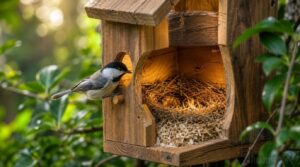
Every birdhouse lives or dies by its floor. Interior floor dimensions determine whether your target species can actually nest comfortably — or whether the space feels too cramped or exposed to raise chicks successfully.
Small species like chickadees and wrens do best on a 4 × 4-inch floor, giving just enough room without excess space that chills a brood.
Proper Box Depth
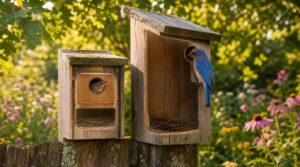
Depth is one of the most overlooked dimensions in nest box design, yet it directly shapes whether birds feel secure enough to raise a brood.
Small songbirds like wrens do well in shallower cavities of 4 to 6 inches, while bluebirds need 8 to 12 inches to accommodate their longer nests comfortably.
No Perches Needed
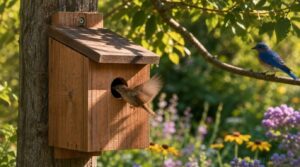
Most birders assume a perch makes entry easier — it doesn’t. Cavity nesters like wrens and bluebirds evolved to grip rough wood and launch straight into a hole without a landing platform.
Here’s why no perch is smarter:
- Reduced aggression — dominant birds can’t guard a ledge they don’t have
- Safer entryways — smaller species enter and exit without interference
- Less competition — eliminating a resting spot discourages territorial standoffs
- Predator guards work better — no foothold means fewer attack angles
Simple is best: fewer parts, cleaner design, safer nest.
Species-specific Sizing
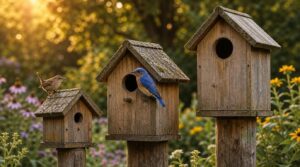
Getting the sizing right isn’t guesswork — it’s biology. Before you buy a box, identify which cavity nesters actually live in your area.
Local species guidelines exist for a reason: a bluebird needs a 1½-inch entrance hole and a 5×5-inch floor, while wrens and chickadees fit comfortably through 1⅛-inch.
Matching dimensions correctly also blocks invasive house sparrows naturally.
Select Safe, Durable Materials
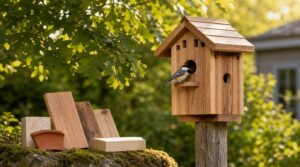
The material you choose makes a bigger difference than most people expect. Birds are sensitive to heat, chemicals, and moisture — and the wrong housing can do more harm than good. Here’s what actually works.
Untreated Natural Wood
Wood is the best material for birdhouses — full stop. Cedar, pine, redwood, and cypress are your best choices because they carry natural wood preservatives built right into their grain. Cedar’s oils offer solid insect resistance, and all four species handle moisture far better than hardwoods like oak, which adds unnecessary weight and makes mounting a headache.
That said, durability isn’t guaranteed without smart choices. Aging and repeated wet-dry cycles cause warping, surface checks, and moisture ingress — real factors that shorten a birdhouse’s lifespan. Here’s what to prioritize:
- Untreated, unpainted wood — nontoxic finishes are fine, but chemicals harm nesting birds
- Naturally rot-resistant species — cedar and redwood outperform pine in prolonged wet conditions
- Sustainably sourced materials — eco-friendly birdhouse builds support conservation from the ground up
Porosity also plays a role. Softwoods absorb moisture unevenly, so choose thicker stock and let natural aging develop a weathered patina rather than fighting it.
Thick Insulated Walls
Wall thickness matters more than most people realize. A 3/4-inch minimum wall keeps interior temperatures stable enough to protect eggs and nestlings from dangerous heat spikes.
Double-wall construction takes this further, reducing temperature swings by up to 30%.
That’s real climate control — no chemicals, no gadgets, just smart woodworking that mimics what a tree hollow naturally provides.
Sloped Overhanging Roof
A well-designed roof does more than keep rain out.
A sloped overhanging roof — extending 2–4 inches over the entrance — deflects rain, blocks afternoon sun, and shields nesting birds from predators’ reach. That overhang also allows natural air exchange beneath the eave, working alongside your ventilation holes to keep interior conditions stable and healthy.
Avoid Metal and Plastic
That roof overhang protects your birds from above — but the walls around them matter just as much.
Metal and plastic housings are two materials you’ll want to skip entirely. Metal conducts heat rapidly, turning the interior into a dangerous oven on warm days. Plastic birdhouses can warp, crack, and offgas chemicals over time. Wood is the ideal material — naturally insulating, breathable, and safe.
Natural Colors and Finishes
The material matters, but so does what you put on it. Untreated wood is your safest bet — no stains, no paint, no varnishes that could offgas chemicals into a nesting space. If you want some protection from the elements, nontoxic water-based finishes are a sound choice. They seal the surface without putting birds at risk.
Place The Birdhouse Correctly
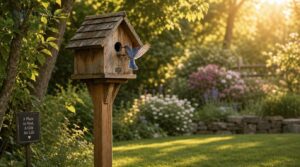
Even the best birdhouse won’t attract a single tenant if it’s hung in the wrong spot. Location shapes everything — how safe birds feel, how well chicks survive, and whether the house gets used at all. Here’s what you need to know about placement.
Best Mounting Height
Getting the height right might be the single most overlooked step in birdhouse placement. Mount too low and predators move in; mount too high and maintenance becomes a hassle.
Species-appropriate heights vary more than most people expect:
- Bluebirds: 4–6 feet on an open pole
- Chickadees and wrens: 5–8 feet in trees or shrubs
- Woodpeckers: 6–12 feet for predator clearance
For most small songbirds, 7–9 feet balances predator height protection, moisture clearance, and easy monitoring access without needing a ladder.
East-facing Entrance
Face your birdhouse entrance east or southeast for best results.
Morning sun gently warms the interior, encouraging birds to settle in earlier during spring nesting season. It also helps dry overnight moisture before midday heat builds.
Most cavity nesters, from bluebirds to chickadees, thrive with this orientation because it balances warmth and comfort naturally.
Shelter From Harsh Weather
Even a perfectly oriented birdhouse can fail if harsh weather batters it from the wrong side. Position your box so the entrance faces away from prevailing winds, and tuck it near natural windbreaks like shrubs or tree lines when possible.
Consider these weatherproofing essentials:
- A sloped roof sheds 60–80% more rain than a flat surface, reducing water intrusion substantially
- Double-wall construction buffers interior temperatures against cold winds and heat spikes
- Moisture barriers on exterior surfaces prevent water from wicking into the wood
- A reflective outer finish cuts solar heat gain by up to 20% during summer
Snow load is worth thinking about, too. Sturdy hardware and wind-resistant fasteners keep the house stable in gusts exceeding 60 mph, and a curved or dome-shaped roof naturally sheds snow before it accumulates.
Thermal buffering isn’t just a winter concern — proper insulation keeps the interior 8–12°F warmer in cold snaps and measurably cooler on hot afternoons, giving nesting birds the stable climate they need to raise healthy chicks.
Safe Spacing Between Houses
Spacing your birdhouses correctly can make or break whether birds actually settle in. Most cavity nesters are fiercely territorial — bluebirds, for instance, need houses at least 100 yards apart.
Crowding boxes invites constant fighting, abandoned nests, and even disease spread between broods. Give each species the breathing room it needs, and you’ll see far more successful nesting seasons.
Where Not to Place It
Location can quietly make or break your nesting success. Avoid placing boxes within 50 feet of active feeders, near ground cover where snakes lurk, or on walls that bake in afternoon sun.
Stay 100 feet from patios and playgrounds — disturbance causes abandonment. Skip flood‑prone spots, exposed ridgelines, and dense hedges that block the maintenance access your birds depend on.
Check Safety and Maintenance Features
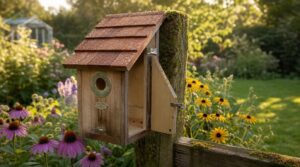
A good birdhouse doesn’t stop working once it’s mounted — it needs to hold up through seasons, weather, and the occasional curious raccoon. The details that make a house truly safe and long-lasting are worth knowing before you buy. Here’s what to look for.
Ventilation and Drainage
A birdhouse without proper ventilation and drainage is basically a damp trap.
Drill two 5/8-inch ventilation holes near the top of each side wall to keep air circulating and humidity low.
On the floor, four drainage holes — about 3/8 to 1/2 inch wide — prevent standing water and mold from taking hold.
Predator Guards and Baffles
Good drainage keeps the box dry — but it won’t stop a raccoon at midnight.
Predator guards and baffles form your nest box’s physical defense. Key options to know:
- Stovepipe or cone baffles block climbing mammals on mounting poles
- Metal collars create smooth, grip-free barriers below the box
- Entrance hole guards stop raccoon paws from reaching inside
- Baffles should sit at least 5 feet off the ground
- Inspect monthly for rust, dents, and loose screws
Easy Cleaning Access
Once predators are blocked, your next job is making sure the box stays clean — and that starts with how easy it is to open.
Hinged side panels or a lifting roof let you access the interior without fumbling. A removable tray catches debris for quick disposal. Cleaning ports sized for a standard brush make scrubbing fast, even in deep boxes.
Seasonal Cleaning Schedule
A clean birdhouse is a safe one.
Spring cleaning comes first — remove all old nesting material, rinse the interior with warm water, and let it dry fully before birds arrive.
Each fall, repeat the process after fledglings leave. Together, these twice-yearly deep cleans keep mites, mold, and bacteria from building up between seasons.
Regular Nest Monitoring
Keeping a clean birdhouse annually is only half the job — you also need to watch what’s happening inside during the season.
Check nest boxes every 3 to 4 days while birds are actively breeding. Keep visits brief, quiet, and calm. When you monitor its nest consistently, you catch problems early and contribute valuable data to the NestWatch program, Cornell Lab’s citizen science bird monitoring platform.
Frequently Asked Questions (FAQs)
Where not to put a bird house?
Avoid mounting a birdhouse on a tree trunk — raccoons and squirrels climb straight to it. Also skip direct southwest sun, high-traffic patios, and spots under low branches where debris and moisture collect.
What are the common mistakes when building a birdhouse?
The most common mistakes include using pressure-treated wood, wrong entrance hole diameter, skipping predator guards, poor roof pitch, and ignoring a maintenance routine — each one quietly costing birds a safe home.
How long does a birdhouse typically last outdoors?
A well-built cedar birdhouse usually lasts 10–15 years outdoors. With annual cleaning and re-sealing every few years, you can push that closer to
Can I paint or decorate my birdhouse exterior?
Yes, you can — but keep it safe. Use zero-VOC exterior latex paint in light, neutral tones. Never paint the interior. Let it fully cure before mounting so no fumes linger near nesting birds.
When is the best time to put up a birdhouse?
Late winter is ideal. Put your birdhouse up in January or February so early nesters like bluebirds and chickadees can find it before the nesting season begins.
Should I add nesting material inside the birdhouse?
Skip adding nesting material inside the birdhouse. Birds bring their own materials, and filling the cavity can trap moisture, grow mold, and attract predators — all serious risks to nestling survival.
How do I keep bees from taking over the birdhouse?
Bees love an empty birdhouse. Clean it every fall, removing any wax comb and residual scent. Use the correct entrance hole size — tight fits block bee entry and keep cavity nesters safe.
Conclusion
Precise planning pays off when you know how to choose a bird house for your yard. Match the entrance hole to your target species, mount the box at the right height, face it east, and clean it every season.
Birds don’t reward guesswork—they reward the yard that fits their needs exactly.
Get the details right once, and you won’t just attract birds. You’ll keep them coming back, year after year.
- https://thebackyardnaturalist.com/wordpress/resources/how-to-choose-bird-houses
- https://www.birdfy.com/blogs/blogs/birdhouse-hole-size-chart-by-species
- https://dev.welcomewildlife.com/birdhouse-dimensions
- https://afs.mgcafe.uky.edu/poultry/chapter-7-natural-ventilation-systems
- https://www.birdsandblooms.com/birding/attracting-birds/bird-nesting/attracting-nesting-birds-better-birdhouses