This site is supported by our readers. We may earn a commission, at no cost to you, if you purchase through links.
Most birdhouse cameras capture blurry wings and blown-out backgrounds—frustrating when a bluebird finally shows up at your setup. The difference between a forgettable snapshot and a frame-worthy shot often comes down to the gear holding the camera, not the camera itself.
Birdhouses for nature photographers have evolved fast: today’s smart models combine 2K sensors, AI species recognition, solar power, and predator guards into a single weatherproof unit. Knowing which features actually matter—and which are just marketing noise—saves you money and gets you sharper footage from day one.
Table Of Contents
- Key Takeaways
- Top 9 Birdhouses for Nature Photographers
- 1. HEAPETS Solar Smart Bird Feeder Camera
- 2. Birdfy Smart Solar Bird House Camera
- 3. Harymor Smart Bird Feeder Camera
- 4. Homiefans Smart Solar Bird Feeder Camera
- 5. Solar Powered Smart Birdhouse Camera
- 6. Wansview Smart Solar Bird Feeder Camera
- 7. Aprilmin Smart Solar Bird Feeder
- 8. Birdsnap Smart Bird Feeder Camera
- 9. PeckCam Solar Bird Feeder Camera
- Must-Have Camera Features
- Bird-Safe Design and Materials
- Placement for Better Wildlife Shots
- How to Choose The Right Model
- Frequently Asked Questions (FAQs)
- How to attract birds for photography?
- What are the 5 S’s of birding?
- What do nature photographers use?
- How much do bird photographers make?
- Do smart birdhouses attract more birds than traditional ones?
- How do nesting birds react to infrared LED light?
- Can birdhouse cameras integrate with photography editing software?
- Conclusion
Key Takeaways
- Upgrading from 1080p to 2K resolution makes a real difference for birdhouse cameras — you’ll see sharper feather detail, cleaner zoomed crops, and truer colors in your footage.
- Solar-powered models with 4,000–5,200 mAh batteries strike the best balance between low maintenance and reliable uptime, but shady spots or cloudy winters can still drain them faster than expected.
- Where you mount your birdhouse matters as much as which model you pick — east-facing placement at species-correct heights (3–6 ft for bluebirds, 5–15 ft for chickadees) gives you better light and sharper shots.
- Most AI bird ID and cloud storage features sit behind a paid subscription, so factor in ongoing costs — Birdfy runs $4.99/month while Harymor charges just $2.99/month — before you commit to a model.
Top 9 Birdhouses for Nature Photographers
If you want better bird photos at home, the right birdhouse can make a big difference. Some models focus on clear video, while others make setup, power, and daily use much easier in the yard.
Picking the right model gets a lot easier once you browse a curated breakdown of bird houses with built-in cameras that covers video quality, mounting options, and power setups side by side.
Here are nine birdhouses worth a close look before you choose one for your space.
1. HEAPETS Solar Smart Bird Feeder Camera
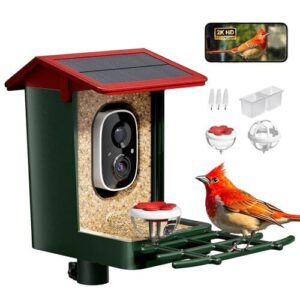
A solid starting pick, the HEAPETS Solar Smart Bird Feeder Camera gives you sharp 2K video, a wide 160° lens, and color night vision, so feather detail stays clear from dawn to dusk.
The built-in solar panel keeps the rechargeable battery topped up with about four hours of sun, and wired charging is there as backup.
You also get live app viewing, instant motion alerts, local microSD storage, and AI bird ID for 10,000 species, though the subscription adds cost.
| Best For | Backyard bird lovers who want easy, solar-powered live viewing and bird ID without dealing with a complicated setup. |
|---|---|
| Camera | 2K |
| Power | Solar + optional AC |
| Connectivity | 2.4 GHz only |
| Storage | microSD + optional cloud |
| Material | ABS |
| App Control | Live stream + alerts |
| Additional Features |
|
- Sharp 2K video with a wide view, color night vision, live app streaming, and instant motion alerts.
- Built-in solar panel helps keep it running with less maintenance, and wired charging is available as backup.
- AI bird identification, dual-user viewing, local microSD recording, and easy multi-mount installation add a lot of convenience.
- AI bird ID requires a paid subscription after the free first month, and cloud storage costs extra too.
- It only works on 2.4 GHz Wi-Fi, so some users may need to adjust their router settings.
- Solar charging and day-to-day reliability can vary, especially in shady spots or if the camera needs an occasional reboot.
2. Birdfy Smart Solar Bird House Camera
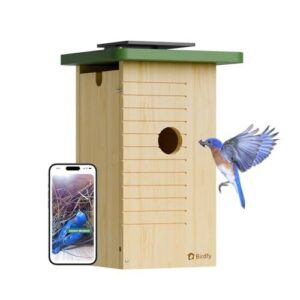
If HEAPETS works like a feeder-first camera, Birdfy feels more like a front-row nest hide.
You get two 1080p cameras, one outside and one inside, so you can watch arrivals, feeding, and chick growth without opening the house.
You also get a 5W solar panel and 9000mAh battery, keeping it running with little fuss, while the app sends alerts for nesting activity.
Four entrance options, predator guards, vents, and easy clean-out access make it especially appealing for careful backyard photographers.
| Best For | Backyard bird lovers, families, and classrooms that want an easy way to watch nesting behavior up close with live video, smart alerts, and solar-powered convenience. |
|---|---|
| Camera | 1080p |
| Power | Solar + battery backup |
| Connectivity | Wi-Fi required |
| Storage | Free nesting cloud |
| Material | Sealed fir wood |
| App Control | Live view + audio |
| Additional Features |
|
- 1080p live streaming with infrared night vision lets you watch nesting activity day and night without disturbing the birds.
- Built-in solar power, battery backup, and tool-free mounting make setup and everyday use simple for most homeowners.
- AI species recognition, nesting-stage alerts, and free cloud storage during the breeding cycle add strong educational and recording value.
- It needs solid Wi‑Fi at the install spot, so weak signal can affect live viewing and cloud uploads.
- Solar charging depends on sunlight, which means long cloudy stretches may reduce runtime.
- Free cloud storage is limited after the nesting cycle ends, with footage only kept for 30 days unless downloaded.
3. Harymor Smart Bird Feeder Camera
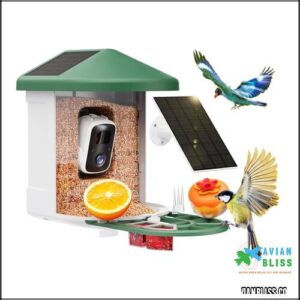
Where Birdfy leans toward nesting, the Harymor is more about action at the feeder.
You get 2K live viewing, a 120° lens, and 3x magnification, so feather patterns show up clearly on your phone.
The 2-liter seed bin and dual 3W solar setup help it stay ready outdoors, and the 5200mAh battery covers dim days.
Just know the best bird ID tools need a Vicohome subscription, and night viewing stays fairly tight around the tray once the light fades away.
| Best For | Backyard birdwatchers who want sharp live feeder footage, instant alerts, and solar-powered convenience more than advanced night monitoring or fully free bird identification. |
|---|---|
| Camera | 2K |
| Power | Dual solar + battery |
| Connectivity | 2.4 GHz only |
| Storage | Cloud + microSD |
| Material | ABS + PC |
| App Control | Vicohome + sharing |
| Additional Features |
|
- Sharp 2K video, a 120° wide-angle lens, and 3× magnification make it easy to catch fine feather detail at the feeder.
- The 2 L feeder, dual 3 W solar setup, and 5200 mAh battery help it stay running with less hands-on maintenance.
- Real-time phone alerts, app sharing, and cloud plus micro-SD storage make it easy for families to watch and save visits.
- Full AI bird identification features require a Vicohome subscription.
- Night vision is limited and works best only close to the seed tray.
- The app can be inconsistent, with reported SD card issues, lag, and occasional audio-video sync problems.
4. Homiefans Smart Solar Bird Feeder Camera
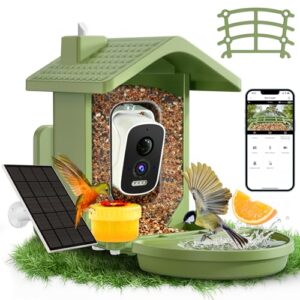
If you like the feeder-first idea but want a little more range, the Homiefans is an easy step over. Its 2.5K, 5MP camera and 130-degree lens give you sharp, close views of birds at the tray, perch, and water area.
The 1.6-liter reservoir cuts refill trips, and the built-in solar panel helps the 4000mAh battery stay topped up.
You also get motion alerts, live app viewing, and bird ID features, though local recording needs your own microSD card for storage.
| Best For | Backyard bird-watchers who want a feeder-first setup with a sharper camera, a bigger seed reservoir, and app-based bird alerts without moving into a more expensive premium model. |
|---|---|
| Camera | 2.5K |
| Power | Solar + 4000 mAh |
| Connectivity | 2.4 GHz only |
| Storage | microSD + cloud trial |
| Material | Plastic |
| App Control | Live stream + control |
| Additional Features |
|
- Sharp 2.5K, 5 MP camera with a 130° wide-angle lens gives clear views around the feeder, perch, and bath area.
- The 1.6 L food reservoir and built-in solar charging help cut down on refill trips and reduce charging hassle.
- Useful smart features like live viewing, motion alerts, night vision, and bird ID make it fun for remote watching and sharing clips.
- It works on 2.4 GHz Wi‑Fi only, so it will not connect to a 5 GHz-only network.
- Local recording requires a microSD card, and that card is not included.
- Reported downsides include privacy/connectivity concerns with the cloud service, occasional offline issues, and battery performance that can dip in poor sunlight.
5. Solar Powered Smart Birdhouse Camera
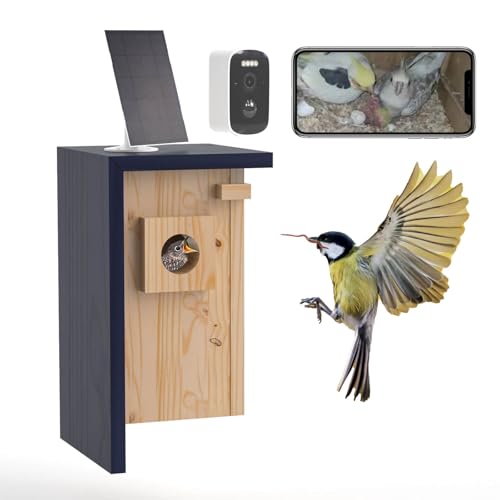
Because it watches the nest without getting in the birds’ way, this solar powered smart birdhouse camera feels made for patient nature photographers. You get 1080p video, night vision, motion alerts, and live viewing over 2.4 GHz Wi‑Fi, so it’s easy to check egg‑laying or hatch day from your phone.
The pine housing has a waterproof finish and a 1.3‑inch entry hole for small songbirds. Just give the solar panel good sun and expect the setup to take some patience.
| Best For | Patient bird lovers, families, and backyard nature watchers who want to remotely watch small songbirds nest, lay eggs, and hatch without disturbing them. |
|---|---|
| Camera | 1080p |
| Power | Solar + rechargeable battery |
| Connectivity | 2.4 GHz only |
| Storage | Included microSD |
| Material | Pine wood |
| App Control | Live view + alerts |
| Additional Features |
|
- Solar-powered design helps keep the camera charged without running power cords or swapping batteries often.
- 1080p video, night vision, motion alerts, and live viewing make it easy to check on nest activity from your phone.
- Pine wood housing with a waterproof finish gives small songbirds a more natural-looking, weather-resistant nesting spot.
- Works only on 2.4 GHz Wi‑Fi, and some users have reported trouble with newer router security settings.
- Setup can be frustrating because the camera gives limited feedback during pairing and reset.
- Solar charging depends on good sunlight, so performance may drop in winter or in shady spots.
6. Wansview Smart Solar Bird Feeder Camera
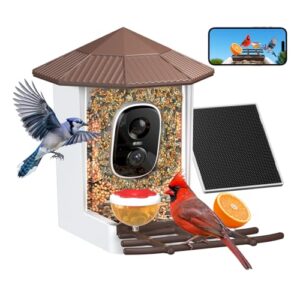
A solid middle-ground pick, the Wansview Smart Solar Bird Feeder Camera gives you sharp 2K video, a 135-degree lens, and motion alerts that land quickly in the mobile app.
To keep that 2K image crisp through rain or morning dew, bird photography tips for wet and foggy weather walk you through using microfiber cloths and silica packets to protect your lens.
You can check live footage at 30 fps, save clips to a micro-SD card up to 128 GB, and use color night vision when dusk settles in.
The IP65 body withstands rough weather, but full AI bird ID, cloud replay, and deterrent sounds all sit behind a paid app subscription tier.
| Best For | Backyard birdwatchers who want clear 2K live video, easy motion alerts, and solar-powered convenience without paying top-tier prices. |
|---|---|
| Camera | 2K |
| Power | Solar + rechargeable battery |
| Connectivity | 2.4 GHz only |
| Storage | microSD + optional cloud |
| Material | ABS + PC |
| App Control | Sharing + pest controls |
| Additional Features |
|
- Sharp 2K video with a wide 135-degree lens gives you clear, detailed views of visiting birds.
- Solar charging, a rechargeable battery, and IP65 weather sealing make it easy to run year-round outdoors.
- Real-time alerts, local micro-SD storage, live viewing, and color night vision add a lot of everyday usefulness.
- Some of the most appealing features, including AI bird ID, cloud replay, and deterrent sounds, require a paid subscription.
- A micro-SD card is needed for local storage, but it is not included.
- Placement depends on steady sunlight and reliable 2.4 GHz Wi‑Fi, which can limit where it works best.
7. Aprilmin Smart Solar Bird Feeder
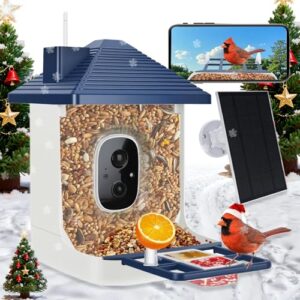
The Aprilmin Smart Solar Bird Feeder suits photographers who want sharp detail without spending much. Its 2K camera and broad 160-degree lens catch feather texture and wing movement well, and the 1.8-liter seed bin cuts down refill trips.
You get instant phone alerts, 2.4 GHz Wi‑Fi, cloud storage with a 30-day trial, and micro‑SD support up to 128 GB.
The 5200 mAh battery and 3 W solar panel help, though cloudy weeks may still call for cable charging at times.
| Best For | Budget-conscious bird lovers, casual backyard birdwatchers, and beginners who want clear 2K footage, app alerts, and easy remote viewing without paying a premium. |
|---|---|
| Camera | 2K |
| Power | Solar + 5200 mAh |
| Connectivity | 2.4 GHz only |
| Storage | microSD + cloud trial |
| Material | ABS + PC |
| App Control | Sharing + social posting |
| Additional Features |
|
- Sharp 2K camera and a 160° wide-angle lens give you clear, detailed views of visiting birds.
- The 1.8 L seed capacity, 5200 mAh battery, and built-in 3 W solar panel help cut down on refills and charging.
- Instant phone alerts, cloud or micro-SD storage, and bird ID features make it fun and easy to watch, save, and share clips.
- The full AI bird recognition library requires a paid subscription.
- It only works on 2.4 GHz Wi‑Fi, which can be inconvenient for some home networks.
- Solar charging may be inconsistent in cloudy weather, and some users report connection issues or squirrel-related wire damage.
8. Birdsnap Smart Bird Feeder Camera
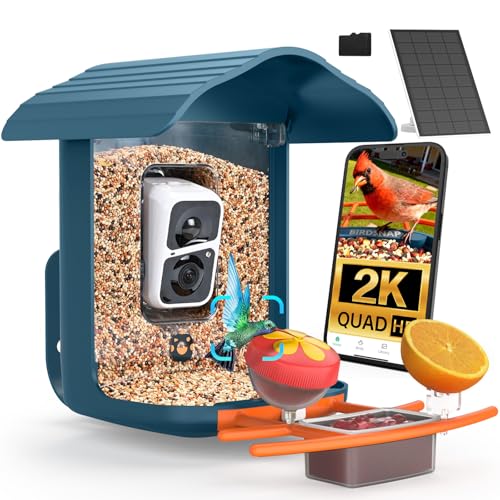
one feeder that does a bit of everything?
Birdsnap gives you a 3MP camera, a very wide 160-degree view, and 940 nm night vision, so you can catch visits in daylight and after dusk.
The 5200 mAh battery and adjustable solar panel help it stay running, and the 64 GB microSD card stores plenty of short clips.
You also get AI species alerts, live viewing, and five feeder attachments, though Wi‑Fi drops and subscription costs are worth noting too.
| Best For | Backyard bird-watchers who want one feeder that can attract different species, stream video to their phone, and help identify birds without much day-to-day effort. |
|---|---|
| Camera | 2K |
| Power | Solar + 5200 mAh |
| Connectivity | 2.4 GHz only |
| Storage | 64 GB microSD + cloud |
| Material | ABS + PC |
| App Control | Live stream + playback |
| Additional Features |
|
- Wide feature set with a sharp 2K camera, 160-degree view, night vision, live streaming, and AI bird alerts in one feeder.
- Flexible feeding setup thanks to five interchangeable attachments, making it useful for seed-eaters, hummingbirds, and fruit- or suet-loving birds.
- Good everyday convenience with solar-assisted power, included 64 GB microSD storage, motion-triggered clips, and support for up to four users.
- Ongoing costs can add up since the AI species database is only free for 30 days and cloud storage also requires a subscription.
- Wi‑Fi performance can be inconsistent, especially if your 2.4 GHz signal is weak or the feeder is far from your router.
- Some parts feel less durable, and squirrel deterrence plus solar charging may not work well enough on their own in every yard.
9. PeckCam Solar Bird Feeder Camera
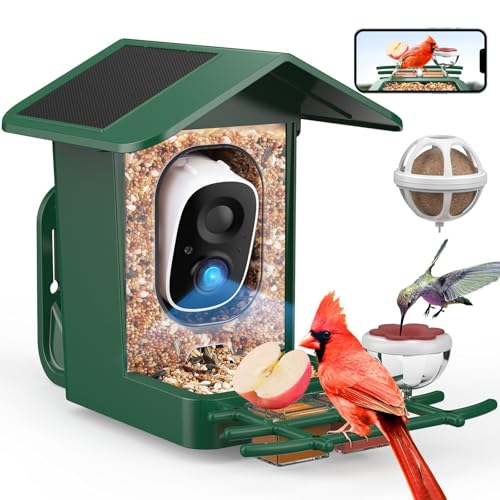
Need a feeder that keeps rolling through long stretches of sun and shade? PeckCam stands out with 2K UHD video, a 165-degree view, and both infrared and color night vision, so you can track birds at any hour.
Its three-panel solar setup, 5200 mAh battery, and USB-C backup make power less stressful.
You also get motion clips, 3X zoom, 128 GB card support, and AI recognition for 10,000 species, though the best app features sit behind a low-cost subscription tier.
| Best For | Birdwatchers, families, and educators who want a solar-powered feeder camera for easy remote viewing, local recording, and sharing live bird activity with multiple users. |
|---|---|
| Camera | 1080p |
| Power | Solar + 5200 mAh |
| Connectivity | 2.4 GHz only |
| Storage | 32 GB microSD + free cloud |
| Material | Charred pine wood |
| App Control | Alerts + live monitoring |
| Additional Features |
|
- Sharp 2K video with full-color night vision makes it easy to watch birds clearly day or night.
- Dual 2 W solar panels, internal battery, and included 32 GB microSD card help keep it running with less hands-on maintenance.
- Modular accessories, weatherproof IP65 build, and support for up to four live-view users make it flexible for different setups and households.
- AI species identification and better cloud features require a paid subscription, adding ongoing cost.
- It only works on 2.4 GHz Wi-Fi, so setup and connection quality may be limiting for some homes.
- Some users report missed recordings, freezes, and weaker battery performance in very cold weather.
Must-Have Camera Features
A good birdhouse camera does more than record a nest. The right mix of sharp video, steady alerts, and a reliable connection helps you catch the moments that matter without bothering the birds.
Here are the camera features worth checking before you choose a model.
1080p Vs 2K Video Quality for Feather Detail
2K HD changes everything. In this camera resolution comparison—1080p, 2K, 4K—1080p Full HD shows less pixel density, softer feather texture, weaker zoom retention, and lower color fidelity.
2K HD gives high-definition imaging for:
- feather barbs
- clean zoomed crops
- truer plumage tones
Trade-off: more data bandwidth for high-resolution video streaming for birdhouses when you study subtle shimmer and pattern.
A fast shutter speed of 1/1000 s is essential for freezing rapid wing movement.
Wide-angle Lenses for Full Nest Coverage
Resolution gets you detail, but field of view gets you the whole story.
A wide-angle lens covers the full nest chamber — floor, walls, and entrance — from just centimeters away.
Smart Focal Length Selection and Sensor Size Matching prevent missed action.
Rectilinear lenses handle Barrel Distortion Mitigation and Edge Stretch Control naturally, keeping nest walls straight.
Close Focusing Distance under 15 cm keeps hatchlings sharp.
Infrared Night Vision for Low-light Activity
Even the best wide-angle lens can’t help you if the nest goes dark. That’s where infrared night vision earns its place.
Most camera birdhouses use Low-Glow 850nm or invisible 940nm LEDs — LED Wavelength Selection matters here. Bird-Friendly Infrared with Auto IR-Cut Switching delivers Uniform Nest Illumination and sharp black-and-white footage, so you never miss late-night feeding activity.
AI Bird Species Identification Accuracy
AI bird recognition sounds impressive, but accuracy varies. Systems using Species-specific Thresholds outperform single universal cutoffs — F1 scores swing from 0.46 to 0.84 depending on settings.
Image Cropping around the bird before classification meaningfully sharpens results. Regional Species Lists reduce false matches better than global databases.
And when Confidence Thresholds return uncertain results, Human Review still wins.
Motion Alerts and Real-time Mobile Viewing
AI accuracy matters, but so does knowing when birds show up.
Motion alerts notify you the moment something lands, so you’re not endlessly scrubbing footage. With Zone-based Motion Detection, you set exactly where the camera reacts.
Alert Sensitivity Tuning cuts false triggers from wind or shadows.
Push Notification Settings deliver instant snapshots to your phone.
Live Stream Latency stays low enough for real-time reaction, and Two-way Audio Integration lets you monitor without stepping outside.
Cloud Vs Local Storage for Wildlife Footage
Where you store your footage shapes everything — from cost to convenience.
Cloud storage keeps clips safe off-device, uses Data Encryption, and simplifies your Retrieval Workflow from anywhere. But Internet Dependence is real in remote yards. Local storage records through outages instantly.
- Data Encryption protects uploads automatically.
- Cost Structure — local avoids cloud storage subscription fees.
- Retention Management — cards overwrite; cloud storage holds rare moments longer.
- Data storage limits vary by plan.
WiFi Range, Signal Strength, and App Access
Your camera’s WiFi connectivity hinges on one thing: the 2.4 GHz Band. It travels farther and punches through walls better than 5 GHz ever will.
Aim for Signal Strength Thresholds between -50 and -67 dBm for smooth live viewing. Smart Router Placement Tips and a WiFi Extender Setup help close the gap.
The App Pairing Process is straightforward — just follow mobile app integration prompts carefully.
Bird-Safe Design and Materials
A great photo is only half the story — the other half is making sure the birds actually feel safe enough to stick around. The right birdhouse does that through smart design choices you might not think twice about, like hole size, wood type, and where the camera sits.
The right birdhouse earns great photos through quiet details: hole size, wood type, and camera placement
what to look for.
Species-specific Entrance Hole Sizes
The entrance hole isn’t just a doorway — it’s a species-size chart built into the wood.
Exact fit matters enormously for cavity nesters: bluebirds need 1½ inches, chickadees prefer 1⅛ inches, and wrens work with 1 to 1½ inches.
For birdwatching and nature photography, choosing the right birdhouse for specific species means accounting for regional variation too, since body size shifts between climates.
Predator Guards for Nest Protection
A good predator guard is your nest’s first line of defense.
Stovepipe diameter matters — 8 inches keeps raccoons and cats from getting a grip. Noel guard mesh extends the entrance so predators can’t reach inside.
Conical baffle size determines coverage on open poles. Combined guard systems cover multiple threats at once.
Check predator guard maintenance seasonally — bent or loose guards lose their stopping power fast.
Ventilation and Drainage for Healthy Nesting
Fresh air and dry floors make or break a nesting season.
Two 5/8-inch Side-wall Ventilation holes near the roof line establish Cross Ventilation Pathways that pull heat out naturally. Pair those air vents with Floor Drainage Configuration — four 3/8-inch holes plus corner cuts — and rainwater drainage happens fast.
Roof Overhang Design angled 15–30 degrees, with Material Gap Ventilation and ventilation slots, keeps your nest box design genuinely weather-resistant.
Cedar, Cypress, and Other Durable Woods
Wood choice matters more than most photographers realize.
Cedar construction brings Natural Rot Resistance and Thermal Insulation through its natural oils — no chemical treatment needed. Cypress adds Lightweight Structural Strength with barely any warping season‑to‑season.
Both woods offer Aesthetic Grain Patterns that blend into natural settings, quietly improving your photography opportunities without spooking birds. Look for Sustainable Harvest Practices on the label too.
Non-toxic Finishes for Long-term Bird Safety
Natural cedar is already a head start, but the finish you add outside seals the deal.
Keep interiors bare — always. Outside, your options include:
- Linseed Oil Protection and Tung Oil Durability for deep moisture resistance
- Milk Paint Application in earthy tones for eco‑friendly construction and camouflage
- ECOS Paint System — zero-VOC, bonds strongly, won’t flake
Exterior Only Sealing keeps bird‑friendly materials safe long‑term.
Camera Placement That Avoids Stress and Obstruction
Where you place the camera inside the box matters just as much as the finish outside. Follow Quiet Installation principles — set it up before nesting begins and leave it alone.
Stable Mounting keeps your field of view locked without cramping the interior.
Aim for Clear Viewing of the entrance, use Gentle Lighting via infrared, and you’ll capture every moment without disturbing a single feather.
Weatherproof Construction for Year-round Use
Once the camera is quietly in place, the box itself needs to hold up through everything the sky throws at it. Cedar resists rot naturally, while sloped metal roofs shed rain fast.
Solar Panel Integration keeps power flowing even after a storm. Wind-Resistant Mounts lock the house steady.
Anti-Fungal Treatments, UV-Blocking Glass, and a Modular Frame Design make weatherproof, weather-resistant electronics built for year-round use.
Placement for Better Wildlife Shots
Where you put your birdhouse matters just as much as which one you buy. The right placement can mean the difference between blurry distant shots and frame-filling, perfectly lit photos.
Here’s what to think about before you drive that first mounting screw.
Best Mounting Height by Bird Species
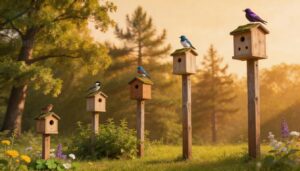
Getting the height right is half the battle for sharp, stress‑free shots. Each species has a sweet spot:
- Bluebirds thrive at 3–6 feet — the ideal Bluebird Height Range for easy monitoring.
- Chickadees prefer 5–15 feet, matching Chickadee Ideal Elevation near wooded edges.
- Tree Swallows settle at 5–6 feet (Tree Swallow Level), while Wren Mounting Guidelines suggest 4–8 feet.
- Purple Martins demand 10–15 feet Purple Martin Height on open poles.
Match these cavity nesters’ natural preferences, and your birdhouse placement doubles as a prime photography opportunity.
East-facing Placement for Balanced Light
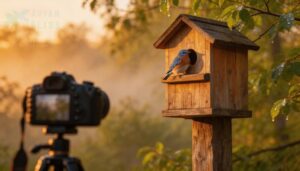
East-facing birdhouse placement is a quite significant advantage for your shots. Morning Light Warmth from Sunrise Illumination Balance delivers soft, golden-hour detail between 6–9 AM — your Photographer’s Golden Hour window.
Wind Buffering Benefits from westerly gusts keep footage steady, while Temperature Regulation holds interiors 10–15 °C cooler than south-facing boxes.
For high-resolution bird photography, this single birdhouse placement decision makes everything easier.
Positioning for Clear Flight Paths
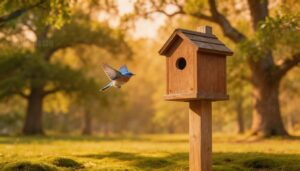
Think of your birdhouse entrance as a runway — birds need a clear, straight shot to land safely. An Obstacle-Free Approach and Open Entrance Zone mean no branches crowding the front.
Branch Clearance of at least a few feet keeps predators from hiding nearby. Clear Landing Space below the opening helps adults exit fast.
Your ideal angle and field of view capture every arrival cleanly.
Pole, Wall, and Tree Mounting Options
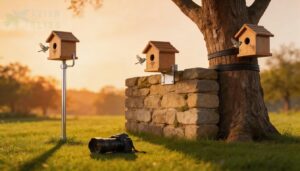
Each mounting option shapes what you’ll capture.
Poles give you adjustable height — usually 5 to 10 feet — with easy ground-level access for lens cleaning. For permanent pole setups, foundation depth of 18 to 36 inches ensures stability through every season.
Wall brackets with corrosion resistance and solid bracket materials handle coastal humidity well.
Tree straps need regular strap tension checks as trunks grow.
Reducing Glare, Shadows, and Camera Blind Spots
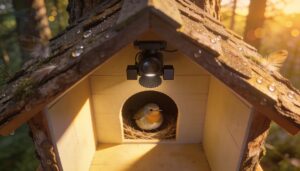
Glare and blind spots can quietly ruin your best footage. A small Lens Shade Placement between the entrance and lens blocks direct sun without interrupting birds. Pair that with Camera Angle Control — mount it top-down using a wide-angle lens with 100°–120° field of view — and corners stay visible.
Matte Interior Finish absorbs bounce light, while Light Diffusion Techniques keep infrared night vision clean and shadow-free.
Keeping Distance From People and Feeders
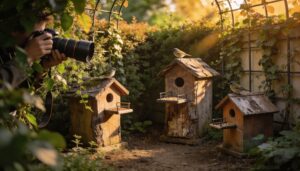
Where you place your birdhouse shapes every shot you’ll capture. Birds flush fast near busy doors, play areas, or heavily used walkways — a Human Traffic Buffer of at least 10 feet makes a real difference. Quiet Yard Zones in corners consistently draw more visits.
- Use Screening Plantings like shrubs or trellises to soften human presence
- Maintain a Predator Visibility Buffer with open sightlines around the feeder
- Apply Window Collision Prevention by staying within 3 feet or beyond 10 feet of glass
- Keep remote video streaming stable by meeting basic WiFi network requirements at your chosen spot
- Position away from other feeders to reduce competition and disturbance
Improving Solar Exposure and Power Reliability
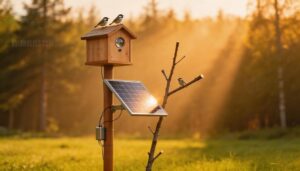
Your solar-powered birdhouse only works as hard as its setup allows.
Facing panels toward True South Orientation (not magnetic south) maximizes daily sun exposure. Apply Shade Mitigation Strategies by trimming nearby branches that block peak hours. Use MPPT Charge Control and Battery Storage Management to stay online through cloudy nights.
| Solar Factor | Best Practice |
|---|---|
| Panel Tilt Optimization | Match tilt to your site’s latitude |
| True South Orientation | Face panels true south, not magnetic |
| Shade Mitigation Strategies | Clear branches during peak sun hours |
| Battery Storage Management | Use 4,000–5,200 mAh backup for overnight |
How to Choose The Right Model
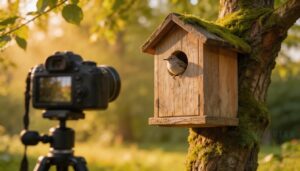
Picking the right birdhouse camera comes down to a few key decisions — species, power source, and how much you want to spend. Each model below sits at a different spot on that spectrum, so knowing your priorities makes the choice a lot easier.
Here’s what to look for before you buy.
Matching Birdhouse Style to Target Species
Think of your birdhouse as a species-specific invitation. Cavity nesters like bluebirds, wrens, and chickadees each respond to different cues:
- Entrance hole size — 1.5" for bluebirds, 1.125" for wrens
- Habitat-inspired architecture — natural cedar with roof pitch design blends into woodland edges
- Color camouflage and seasonal color schemes — earthy tones with predator guard placement deter intruders naturally
Solar, Battery, AC, and PoE Power Options
Once your birdhouse suits your target species, powering it reliably becomes the next decision. Solar panel power works beautifully when your mount gets strong, direct sun — proper Solar Panel Angle maximizes daily harvest. Battery Capacity Planning keeps footage running overnight.
AC Outlet Safety suits fixed garden installs.
PoE Injector Selection simplifies wired setups, while Hybrid Power Management, combining battery backup with Power over Ethernet, gives you the most consistent uptime.
Budget Vs Premium Camera Birdhouses
Budget camera bird houses keep costs low but often trade away Build Quality, Battery Life, and camera resolution — most cap at 1080p.
Premium models jump to 2K or higher, closing that Price Gap with sharper feather detail, stronger night vision, and a cleaner User Interface.
For serious nature photography, the upgrade usually pays for itself quickly.
Subscription Costs for AI and Cloud Features
Most smart birdhouses bundle AI bird recognition and cloud-based video archiving into software subscription models for AI features. Pricing tiers vary: Birdfy runs $4.99 monthly or $49.99 annually, while Harymor charges just $2.99 monthly.
Some models offer lifetime access with no recurring fees. Cloud storage limits differ too — free tiers often cap at 24 hours, so weigh your AI feature bundles carefully.
Seasonal Maintenance and Lens Cleaning Needs
Once nesting season wraps up, your Autumn Cleanout is the perfect reset — scrub old nesting material, rinse with a 10% bleach solution, and let everything dry completely.
Before birds return, a quick Spring Inspection catches loose mounts and blocked vents early.
Use a Microfiber Lens Wipe for lenses, add a Desiccant Pack to fight condensation, and apply Fog Resistant Coatings in humid climates.
Durability in Rain, Heat, and Winter Weather
Cedar and cypress walls with Thermal Insulation Layers keep interiors stable when temperatures swing hard. UV-Resistant Coatings slow sun damage, while IP66 Enclosure Rating electronics handle heavy rain and snow without skipping a frame. Freeze-Thaw Joint Design prevents cracking through brutal winters. Look for weatherproof Solar Panel Sealing, too.
- Cedar boards (¾–1 inch) hold heat and resist moisture
- IP66-rated weatherresistant electronics survive heavy rain and dust
- UV-resistant coatings protect weatherresistant outdoor surveillance components from sun degradation
- Freeze-thaw joints prevent seasonal cracking in cold climates
Best Value Birdhouses for Photography Goals
You don’t need to spend a fortune to get sharp footage and reliable AI features. Models with 1080p high resolution video streaming for birdhouses hit the sweet spot for Cost Efficiency without sacrificing Affordable Lens Quality.
Budget Solar Power keeps things running off-grid, while Economical AI Features still identify hundreds of species.
Add night vision and weather-resistant, eco-friendly design, and you’ve got serious value for your photography goals.
Frequently Asked Questions (FAQs)
How to attract birds for photography?
Plant native shrubs, add a water source, and keep the area quiet. A predator-free zone with seasonal feeding draws birds close — perfect for high-resolution bird photography in your backyard.
What are the 5 S’s of birding?
The 5 S’s of birding are Shape Analysis, Shade patterns, Size Comparison, Sound Identification, and Space Habitat — five quick checks that sharpen your Sight Identification skills and open up better photography opportunities in any environment.
What do nature photographers use?
Nature photographers rely on mirrorless cameras with telephoto lenses, tripod types ranging from carbon fiber to gimbal heads, lens filters, remote triggers, camouflage clothing, and smart battery management for high-resolution bird photography in backyard and field settings.
How much do bird photographers make?
Bird photographers earn between $20,000 and $81,000 annually, with salary ranges shifting by experience. Freelance rates, workshop earnings, and licensing commissions from stock photos round out most income streams.
Do smart birdhouses attract more birds than traditional ones?
Smart birdhouses won’t magically fill your yard with birds. Species-specific attraction still comes down to habitat influence, hole size, and predator guard effectiveness — not the camera inside.
How do nesting birds react to infrared LED light?
Most nesting birds don’t react to infrared night vision at all — as long as there’s no visible glow.
Stick with 940 nm LEDs, and you won’t cause sleep pattern disruption or nighttime activity shifts.
Can birdhouse cameras integrate with photography editing software?
Not directly, but it’s closer than you’d think.
Export file formats like MP4 and JPEG work in most editors. Metadata preservation stays intact, so batch editing workflow stays clean after download.
Conclusion
Ironically, the best birdhouses for nature photographers often go unnoticed—until you capture that perfect shot. With the right gear, like top-rated birdhouses for nature photographers, you’ll be well on your way.
Consider your target species, power needs, and budget to make an informed choice.
By investing in a quality birdhouse, you’ll enjoy sharper footage, reduced frustration, and a deeper connection with nature. Your perfect shot awaits—equip yourself with the best tools today.