This site is supported by our readers. We may earn a commission, at no cost to you, if you purchase through links.
bird’s perch isn’t just a stick in a cage—it’s where your feathered companion sleeps, eats, plays, and feels safe.
When children get involved in choosing and caring for perches, something shifts: bird care stops feeling like a chore and starts feeling like a relationship.
But without the right guidance, even well-meaning kids can accidentally pick the wrong size, place perches in unsafe spots, or skip cleaning steps that protect their bird’s feet.
Bird perches for children learning bird care deserve more attention than most pet guides give them—because the details matter, and kids can absolutely handle them with the right tools.
Table Of Contents
Key Takeaways
- right perch material, size, and texture isn’t optional — it directly shapes your bird’s foot health and daily comfort.
- Where you place perches matters just as much as which ones you choose, so keep them away from food bowls, drafts, and tight corners.
- Kids can be real contributors to bird care when given simple routines like daily perch checks, gentle handling rules, and treat-based training.
- Introducing new perches slowly, watching for stress signals, and cleaning consistently are the habits that keep your bird healthy long-term.
Choosing The Right Perch

Picking the right perch makes a bigger difference than most people expect.
A perch that’s too wide or too narrow can stress your bird out, so it’s worth checking out this beginner’s guide to choosing the right bird perches before you buy.
The material, size, and texture all shape how comfortable and healthy your bird feels every day.
Here’s what to look at before you buy.
Material Matters
The material of a perch matters more than most people think. Natural wood perches with tight wood grain density are great — they grip well and feel natural underfoot. Always check for non-toxic finishes before buying.
- Hardwoods like oak, maple and sustainable bamboo hold up to chewing
- Metal edge rounding prevents feather snags and injuries
- Silicone grip safety makes synthetic perches easy to clean
- Rope perches and plastic perches need frequent inspection
Size and Shape
Size and shape work together, just like material does. A round perch creates less foot contact than a square or cross shape, which spreads weight more evenly. Think of it like wearing flat shoes versus heels.
Profile variety — mixing lengths, curves, and widths — gives your bird different grip points all day.
Perch size and shape guidelines exist for good reason: foot enclosure and comfort depend on getting both right. Following the the 2/3 grip rule helps guarantee proper foot support and reduces the risk of pododermatitis.
Matching Perch Diameter to Bird Size
Once you’ve matched shape, diameter is next. Species-specific diameters matter more than most people realize. A finch needs just 3/8 to 7/8 inches, while a large macaw needs 2 to 3½ inches.
Foot wrap ratio — toes covering about two-thirds around — guides every choice. Pressure distribution stays healthier when diameter range guidelines match your bird’s actual size.
Safe Wood, Metal, and Synthetic Options
Now that diameter is sorted, material matters just as much.
Natural wood perches offer great grip, but stick to hardwoods like birch or maple with non-toxic finishes only.
Stainless steel durability makes metal a smart, rust-free pick.
For easy cleanup, BPA-free plastics and silicone rubber grip perches work well.
Always skip lead-free coatings that aren’t verified safe.
Perch Textures That Support Healthy Grip
Texture is where comfort meets safety.
Natural wood perches with rough bark grooves give your bird’s toes something real to grip. Fiber rope nubs distribute pressure evenly across small feet.
Sandpaper finish perches gently wear down overgrown nails, while stone grit surfaces add traction without causing sores.
Rubberized traction helps larger birds stay steady. Providing variety of perch textures for foot health makes a real difference.
Setting Up Perches Safely
Once you’ve picked the right perch, where you put it matters just as much. A poorly placed perch can stress your bird out, even if the perch itself is perfect.
Here’s what to keep in mind when setting everything up.
Low, Mid, and High Perch Placement
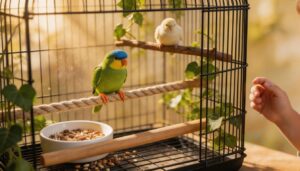
Think of your bird’s cage like a tiny apartment with floors. Low, mid, and high perches create vertical movement pathways that keep your bird active and engaged throughout the day.
This height-based enrichment enhances cage space optimization by giving birds dedicated zones for feeding, playing, and resting.
Smart activity zone zoning and thoughtful perch placement help with bird safety and cage enrichment.
Sleep Perch at The Highest Safe Spot
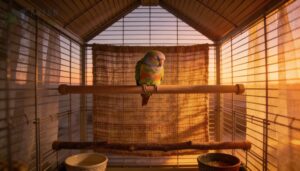
Birds sleep best up high — it’s instinct. Place the sleep perch at the highest safe spot, leaving a clear Height Safety Gap above active perches. Keep it within the cage’s Central Vertical Plane, away from corners and doors.
- Use a Sheltered Backing to block drafts
- Maintain a Door Proximity Buffer for calm rest
- Add a Ventilation Shield without sealing airflow
- Never position it above food bowls
Keeping Perches Away From Food and Water
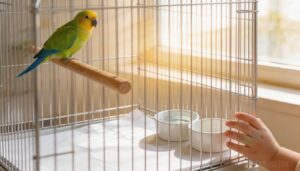
A perch placed directly above a bowl is a contamination waiting to happen. Droppings direction matters — waste falls down, not sideways. Practice food zone isolation and water safety buffer by keeping no perch overhead above any dish.
| Placement Tips | Why It Matters |
|---|---|
| Bowl Clearance below perches | Stops droppings contamination |
| Open space above water | Maintains water safety buffer |
| Corner dish placement | Promotes bird cage hygiene |
| Regular perch cleaning routine | Reduces bacteria buildup |
Allowing Wing and Tail Clearance
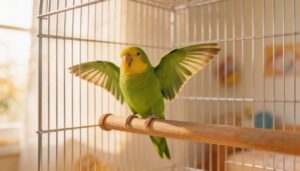
Your bird needs room to stretch. Keep at least three inches of wing tip space between each wingtip and the nearest bar or object.
A tail clearance margin behind the perch prevents bent feathers. Use perch end rounding to avoid feather snag prevention issues.
Arrange obstacle-free corridors so wing exercise stays safe, and always match perch diameter to your bird’s size.
Avoiding Drafts, Heat, and Harsh Sun

Your cage placement choice matters more than you’d think. Hot perches, sneaky drafts, and harsh rays can all stress your bird quickly.
Keep these placement rules in mind:
- Use Shade Placement near east-facing windows for Sunlight Filtering without heat buildup
- Practice Draft Prevention by staying clear of vents, fans, and leaky windows
- Support Airflow Management with breathable cage covers on sunny sides
- Use Temperature Monitoring with a room thermometer for consistent bird welfare
Teaching Children Perch Care
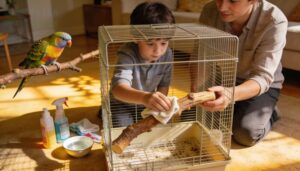
Kids can learn a lot by helping care for a bird’s perch — and it starts with understanding why it matters. Few simple habits go a long way in keeping your bird safe and happy.
Children can do, with a little guidance from a trusted adult.
Explaining Why Birds Need Perches
Think of a perch the way you’d think of a gym, a bedroom, and a lookout tower — all in one spot.
Your bird grips and releases constantly, which drives Foot Muscle Exercise and Balance Development. That daily movement helps bird foot health and satisfies their Natural Roosting Instinct.
It also provides Cognitive Enrichment and Stress Reduction, keeping your feathered friend calm and curious.
Safe Rules for Kids Around Pet Birds
Now that you know why perches matter, rules make bird time safer for everyone.
- Always use a Quiet Voice — loud sounds startle birds fast
- Supervised Handling only — no solo bird time for kids
- Practice Hand Hygiene and Germ Prevention after every touch
- No Face Contact — keep beaks away from eyes and skin
Simple Perch Checks Children Can Help With
Kids can spot problems before adults notice. After setting those safety rules, put your child in charge of a simple perch check routine.
| Check Name | What to Look For |
|---|---|
| Hardware Tightness Check | Loose bolts or wobbling |
| Mold Inspection | Dark spots or musty smell |
| Rope Fraying Check | Loose threads or unraveling |
| Foot Pad Check | Rough or cracked surfaces |
| Temperature Comfort Test | Too hot or too cold to touch |
Daily spot cleaning and weekly deep cleaning start here.
Building Gentle Bird Care Habits
Once kids master the perch checklist, real habits begin to grow. Soft Voice Training and a Calm Approach matter every single day.
Teach your child to whisper near the bird, move slowly, and pause before reaching in.
Reading Bird Signals takes practice, but Daily Care Routines make it easier.
Treat Reinforcement during short sessions builds trust fast — Building trust with a new bird starts here.
Adult Supervision During All Bird Interactions
Every session runs smoother when adults stay present from start to finish. Use clear Safety Commands before your child reaches in, and agree on Supervision Signals if the bird shows stress.
Role Assignment helps too — one adult watches, one guides. Keep Interaction Timing short.
Run quick Health Checks before handling. Good Safety precautions for bird perches and Monitoring bird comfort protect everyone involved.
Introducing New Perches Slowly

Birds don’t always warm up to something new right away, and that’s completely normal.
Rushing a new perch into the cage can stress your bird out more than you’d expect.
Here are a few simple ways to make the switch feel safe and easy for your feathered friend.
Starting With Stable, Familiar Perch Types
Start simple — straight dowels, rounded loops, and simple bar perches are your best first choices. Natural wood perches give birds a familiar, secure grip, while plastic perches with non-toxic finishes are easy to clean.
Secure anchor points prevent wobble, so your bird feels confident right away. appropriate perch materials and placement of perches in the cage sets a safe, steady foundation from the start.
Adding One New Perch at a Time
When your bird seems settled, add just one new perch — never two at once. Try Visual Perch Pairing by placing the new option near a familiar one.
A Gradual Height Increase of two to three inches weekly prevents stress.
Watch for Monitoring Vocal Changes, like unusual silence or loud calls.
Stepwise Diameter Shift and Safety Cue Reinforcement keep the process calm and bird-friendly.
Using Treats for Positive Reinforcement
Treats make bird training click. Using treats for positive reinforcement works best when your timing is sharp — reward the moment your bird steps onto the new perch.
Keep treat size tiny so your bird stays focused. Seeds or pine nuts work well as healthy treats.
Short session lengths under 20 minutes prevent fatigue. Positive reinforcement builds real trust, one small step at a time.
Watching Bird Body Language for Stress
Your bird tells you everything — if you know what to watch. During perch introductions, observing bird behavior closely helps you catch stress early.
Look for these signs:
- Feather Ruffling – signals discomfort or anxiety
- Eye Darting – shows the bird is scanning for danger
- Tail Fanning – indicates rising fear
- Perch Shifting – rapid movement between perches means unsettled stress
Vocal tone changes and monitoring bird’s comfort level guide your next move.
Creating Short, Consistent Training Sessions
Consistency is key when teaching your bird anything new. Keep sessions to 2–5 minutes — short enough to end while your bird still wants more.
| Session Element | What to Do |
|---|---|
| Session Timing | Same time daily, low distraction |
| Reward Timing | Treat immediately after success |
| Step Breakdown | One small behavior per session |
Patience and positive reinforcement, paired with a calm environment, make the step-by-step perching process feel safe for your bird.
Cleaning and Maintaining Perches

Keeping perches clean is one of the most important habits your child can build early. A dirty perch can make a bird sick faster than you might think.
Here’s what good perch care looks like, step by step.
Daily Droppings and Food Residue Removal
Every good spot cleaning routine starts with warm water. Moisten dried droppings first — they wipe off much more easily that way. For cleaning and maintaining perches, grab a microfiber cloth to lift residue without smearing it around.
Check these spots daily:
- Top and underside of each perch
- Edges where grease removal techniques matter most
- Areas near food bowls for cross-contamination prevention
Bird hygiene stays simple when you’re consistent.
Weekly Deep Cleaning Steps
once a week, go deeper than the daily wipe-down. Remove all perches and soak them in hot water — around 120°F works well for loosening stuck gunk.
Follow soak temperature guidelines, then choose the right brush type: stiff nylon for wood, a toothbrush for tight spots.
rinse thoroughly, check for cracks, and dry completely before reinstalling. weekly cage cleanings keep hygiene practices for avian environments on track.
Bird-safe Disinfecting Methods
After scrubbing, disinfecting is your next move. Always start with a pre‑cleaning procedure first, since grime blocks disinfectants. Keep proper ventilation going.
Diluted hydrogen peroxide is gentle and effective — just wet the surface fully and let it sit. Quaternary ammonium products work too, but follow the bleach rinsing protocol carefully: rinse every trace off.
Safe cleaning products make regular cleaning and disinfection of bird perches simple and safe.
Drying Perches Fully Before Reuse
Once disinfecting is done, don’t rush to put perches back. A damp perch can grow mold fast — especially wood.
Use a wire rack for rack placement so air reaches every side. Run a fan nearby for airflow optimization and humidity control.
Do a simple touch test: if it feels cool or clammy, wait longer. Rotating schedule checks every 30 minutes help too.
Replacing Cracked, Frayed, or Worn Perches
Once a perch shows cracks, frays, or worn spots, it’s time to act fast. Use this Damage Inspection Checklist before each cleaning:
- Check wood for splinters using a Material Compatibility Test
- Apply a Safe Removal Procedure — no tools needed for most mounts
- Use a Swap Perch Strategy to keep one stable perch in place
- Try Tool-Free Replacement methods for quick swaps
- Install bird-safe materials matched to your bird’s size
Protecting Bird Feet and Comfort
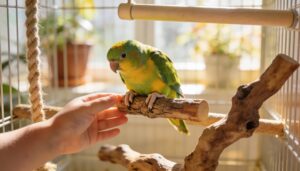
Your bird’s feet work hard every single day. The right perch setup can prevent soreness, improve grip, and keep those little toes healthy for years.
Here’s what to know about protecting foot comfort.
Why Mixed Diameters Support Foot Health
Think of your bird’s feet like hands that never get a break. When you offer mixed diameters, you naturally support Toe Joint Mobility and Pressure Distribution — toes curl differently on each width, so no single spot takes constant strain.
Offering mixed diameters gives bird feet a break, spreading strain across toes so no single spot suffers constant pressure
This Circulation Enhancement and Callus Prevention approach, combined with providing a variety of perch textures for foot health, keeps every step comfortable and strong.
Preventing Strain From Poor Perch Sizing
When a perch is too thin or too wide, your bird’s feet pay the price. Poor sizing throws off pressure distribution analysis — toes either clench too hard or can’t grip at all.
That’s why ensuring correct perch size for different species matters so much.
Follow perch diameter and texture guidelines, and build a phased schedule planning approach to prevent foot injuries through proper perch selection.
Spotting Sores, Slipping, and Weak Grip
Watch your bird’s feet closely — early foot signs can be easy to miss. Pad redness detection starts with spotting shine or swelling on the foot pad.
Claw pressure patterns shift when a perch is slippery or the wrong size. If your bird raises one foot often or grips poorly, that’s a balance test worth noticing.
Catching these changes early helps long-term foot health and foot abscess prevention.
Choosing Perch Variety for Enrichment
Variety is the secret to happy, healthy feet. Different perch types keep your bird’s muscles working in different ways — and that’s a good thing.
- Rope Stretch Perches encourage soft gripping and gentle stretching
- Edible Foraging Perches combine beak exercise with mental engagement
- Plastic Hygiene Perches stay clean and resist moisture easily
- Cement Nail Maintenance perches naturally trim nails over time
Rotate textures regularly for real enrichment benefits.
Knowing When a Perch Needs Replacement
Even small warning signs matter. Check for visible cracks, fraying, or deep chew marks — these create sharp edges that hurt feet. A perch losing surface smoothness can cause slipping and pressure sores.
Watch for foot swelling or redness, which signal real discomfort. Loose hardware, mold growth, or material that won’t clean properly mean it’s time to replace it.
Top 8 Kids Bird Books
Good books make bird care feel exciting and real for kids. These eight picks cover everything from backyard birds to big migration journeys.
Here are the ones worth adding to your shelf.
1. Nesting Robin Picture Book for Kids
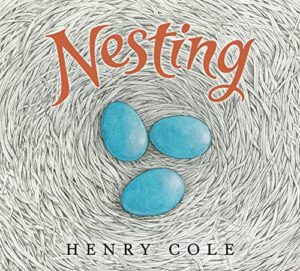
Henry Cole’s Nesting Robin is a quiet, beautiful book that takes kids right into the sphere of bird life. Through black-and-white illustrations with robin-egg blue accents, it follows a robin pair from nest building to fledging.
Your child sees how birds gather twigs, lay eggs, and care for hatchlings — all in simple, clear text.
At 40 pages, it’s perfect for read-aloud time. Ages 4–8 will find it calming, educational, and genuinely lovely to look at.
| Best For | Kids ages 4–8 who love nature, especially budding little bird watchers or anyone who enjoys calm, story-time reads with a gentle educational twist. |
|---|---|
| Price | $14.39 |
| Page Count | 40 pages |
| Publisher | HarperCollins |
| Language | English |
| Target Age | 4–8 years |
| Publication Year | 2020 |
| Additional Features |
|
- The robin-egg blue accents are a smart touch — subtle but charming, and they make the illustrations feel cohesive and special
- Short, clear text makes it easy to read aloud without losing younger kids’ attention
- Covers a full life cycle (nest building all the way to fledging), so it naturally sparks curiosity and good questions
- The minimal color palette might disappoint kids who are used to bright, full-color picture books
- At just 40 pages, the story moves quickly — you may want to pause and dig deeper with extra conversation
- Thin pages mean it probably won’t survive rough handling from very young kids
2. Robert Louis Stevenson Garden of Verses
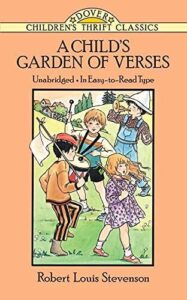
From quiet nests to open gardens — Robert Louis Stevenson’s A Child’s Garden of Verses is a natural next step. First published in 1885, this collection holds 64 poems written warmly from a child’s point of view.
Your child will find birds, seasons, moonlight, and imaginative play woven throughout.
The Dover edition features large type and gentle illustrations by Thea Kliros, making it perfect for read-aloud sessions.
At just $7.99, it’s an easy, meaningful addition to any young bird lover’s bookshelf.
| Best For | Parents, grandparents, and early childhood educators looking for a timeless poetry collection to read aloud with young children. |
|---|---|
| Price | $7.99 |
| Page Count | 96 pages |
| Publisher | Dover Publications |
| Language | English |
| Target Age | 3–8 years |
| Publication Year | 1992 |
| Additional Features |
|
- 64 classic poems written from a child’s perspective, perfect for sparking imagination during bedtime or quiet time
- Large, easy-to-read type and Thea Kliros’s gentle illustrations make it great for shared reading
- Lightweight and compact — easy for little hands to hold and simple to toss in a bag for travel
- Thin pages (0.24 in) may not hold up well with very young or rough-handed readers
- Some poems reference 19th-century experiences that might feel distant to modern kids
- Only available in English, so it won’t work for multilingual households looking for translated editions
3. Early Birdy Worm Adventure Picture Book
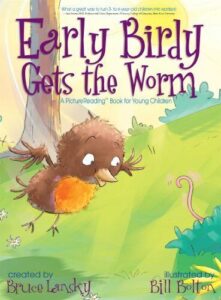
If poetry speaks to the heart, pictures speak straight to a child’s imagination. Early Birdy Worm Adventure Picture Book by Bill Bolton does exactly that — no words needed.
Your child follows Early Birdy through a springtime forest, watching him stumble, try again, and learn.
That mix of perseverance and humor clicks naturally with kids aged three to six.
At $15.99, it’s a gentle, visual story that sparks real conversations about birds, effort, and emotions.
| Best For | Parents of toddlers and preschoolers (ages 3–6) who want a fun, wordless book that sparks storytelling and conversation. |
|---|---|
| Price | $15.99 |
| Page Count | 24 pages |
| Publisher | Meadowbrook |
| Language | English (pictures only) |
| Target Age | 3–6 years |
| Publication Year | 2014 |
| Additional Features |
|
- No text means kids of any reading level can "read" it on their own — great for building confidence.
- The springtime story of Early Birdy naturally opens up talks about nature, emotions, and not giving up.
- Works just as well on the tenth read as the first, so it earns its shelf space.
- At only 24 pages, the story wraps up pretty quickly — don’t expect a long bedtime read.
- No words at all means it won’t help with phonics or early reading skills.
- The paperback format might not hold up well if your little one is rough with books.
4. Feathers For Lunch Kids Book
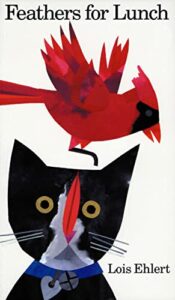
From pictures without words, let’s move to a story that pairs rhyme with real bird facts.
Feathers for Lunch by Lois Ehlert follows a house cat chasing twelve backyard birds — and catching nothing but feathers.
The playful "jingle, jingle" rhythm makes it easy to read aloud together.
It’s great for kids aged 0–8 and includes a bird guide at the back with species names and fun facts.
At $6.99, it’s an affordable way to spark genuine bird curiosity.
| Best For | Families with young kids (ages 0–8) who want a fun, read-aloud way to learn about backyard birds. |
|---|---|
| Price | $6.99 |
| Page Count | 36 pages |
| Publisher | Clarion Books |
| Language | English |
| Target Age | 0–8 years |
| Publication Year | 1996 |
| Additional Features |
|
- The rhyming text and "jingle, jingle" rhythm makes it a joy to read aloud — kids stay hooked.
- Doubles as a real learning tool with a bird identification guide tucked right in the back.
- At $6.99, it’s an easy, affordable pick for parents, grandparents, or classroom shelves.
- The tall, slim shape can be a bit awkward to store on a standard bookshelf.
- Published in 1996, so some bird facts or taxonomy may not reflect current science.
- Only covers common backyard birds — not much help if you’re looking for something more regional or advanced.
5. Jerry Pallotta Bird Alphabet Book
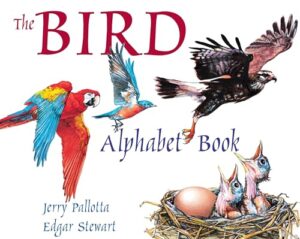
Next up is the Jerry Pallotta Bird Alphabet Book — a clever two-in-one that teaches letters and bird facts at the same time. Each page pairs a bold letter with a full-color bird illustration and a short, memorable fact.
Your child gets alphabet practice without it feeling like a lesson.
The bat entry under "B" always gets a laugh and a great teachable moment.
At $8.99, it’s a smart pick for ages four to eight.
| Best For | Parents, teachers, and librarians looking for a fun way to teach letters and spark an early love of birds in kids ages four to eight. |
|---|---|
| Price | $8.99 |
| Page Count | 32 pages |
| Publisher | Charlesbridge |
| Language | English |
| Target Age | 3–7 years |
| Publication Year | 1989 |
| Additional Features |
|
- Doubles as both an alphabet book and a nature guide — two lessons in one sitting
- Full-color gouache illustrations are vibrant and genuinely engaging for young kids
- The bat page under "B" is a fun surprise that sparks curiosity and good conversation
- The bat entry might genuinely confuse very young toddlers who expect every page to show a bird
- Heavy on bird facts, so it’s not the best pick if you just want a straightforward ABC book
- At 32 thin pages, it may not hold up well to repeated rough handling by little hands
6. Birds Enchanting Story for Preschoolers
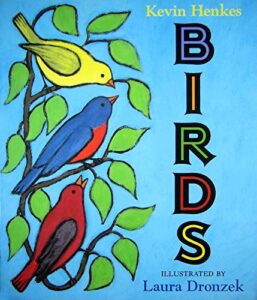
If your little one already loves watching birds from the window, Birds by Kevin Henkes and Laura Dronzek will feel like it was written just for them.
This preschool gem follows a girl who notices birds everywhere — their sizes, colors, and movements — and dreams she can fly too.
The lyrical text stays simple and short, perfect for read-aloud time.
It earned the ALA Notable Children’s Book honor for good reason.
At $14.99 used, it’s a gentle, imaginative pick.
| Best For | Parents and caregivers of toddlers and preschoolers who want a gentle, imaginative read-aloud that sparks curiosity about the natural world. |
|---|---|
| Price | $14.99 |
| Page Count | 32 pages |
| Publisher | Greenwillow Books |
| Language | English |
| Target Age | 3–6 years |
| Publication Year | 2009 |
| Additional Features |
|
- Lyrical, simple text makes it easy to read aloud — great for short attention spans
- Vibrant illustrations bring birds to life and naturally spark color, size, and shape conversations
- Encourages imaginative thinking in a way that feels effortless, not educational
- Used condition means some wear is possible, even if minor
- No bird names or facts included, so it won’t satisfy kids looking for real nature info
- At 32 pages, it’s a quick read — don’t expect it to stretch into a long storytime session
7. Are You My Mother Book
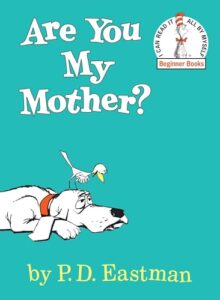
Ever wonder what a baby bird thinks when it hatches alone?
*Are You My Mother?
- by P.D. Eastman answers that in the sweetest way.
Your child follows a determined little bird asking everyone — a kitten, a cow, even a steam shovel — if they’re its mother. The repetitive questions make it perfect for early readers ages 3–7.
At just $3.59, it’s one of the best beginner reads you’ll find, ranked #2 in Children’s Bird Books.
| Best For | Parents and caregivers of toddlers and early readers (ages 3–7) who want a simple, engaging book to build reading confidence and spark a love of storytelling. |
|---|---|
| Price | $3.59 |
| Page Count | 72 pages |
| Publisher | Random House |
| Language | English |
| Target Age | 3–7 years |
| Publication Year | 1960 |
| Additional Features |
|
- Repetitive, simple text makes it easy for little ones to follow along and start recognizing words on their own.
- At $3.59, it’s a great value — a classic story that’s been loved for decades without breaking the bank.
- The sturdy board book format holds up well to small (and rough) hands, making it great for on-the-go reading.
- Only available in English, so it’s not an option for families looking for bilingual or translated editions.
- The illustrations and style are from 1960, which might feel a little old-fashioned compared to modern picture books.
- It’s really only a fit for the preschool crowd — older kids will likely outgrow it pretty quickly.
8. Bird Butterfly Eel Migration Book
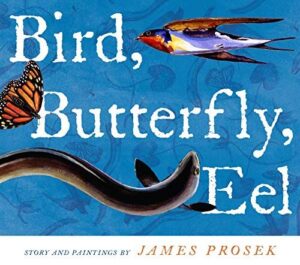
Three animals, one farm, three completely different journeys — that’s the quiet magic of Bird Butterfly Eel by James Prosek. Your child follows a barn swallow to Argentina, a monarch butterfly to Mexico, and an eel all the way to the Sargasso Sea.
The watercolor illustrations make each migration feel real and beautiful.
Back-matter facts give you easy talking points for science or geography lessons.
At $15.83, it’s a calm, rich read for ages 6–10.
| Best For | Parents and teachers of kids ages 3–6 who want a gentle, visually rich introduction to animal migration and the natural world. |
|---|---|
| Price | $15.83 |
| Page Count | 32 pages |
| Publisher | Simon & Schuster |
| Language | English |
| Target Age | 3–6 years |
| Publication Year | 2009 |
| Additional Features |
|
- James Prosek’s watercolor illustrations are genuinely stunning — they make each animal’s journey feel alive and worth lingering over.
- The back-of-book facts and migration map give parents and teachers easy hooks for science or geography conversations.
- Simple, rhythmic language makes it a great read-aloud for bedtime or classroom storytime.
- The story can feel a bit thin — older or more curious kids may want more depth than the narrative offers.
- Migration details stay pretty surface-level, and the butterfly’s metamorphosis isn’t really explained, so you may need extra resources.
- There’s no mention of dangers or mortality in nature, which leaves some gaps if you’re trying to teach a full picture of animal life cycles.
Frequently Asked Questions (FAQs)
Can children build simple bird perches at home?
Yes — and no hammer required.
With adult help, kids can craft simple perches using safe, untreated wood and basic hardware.
It’s a hands-on way to learn what birds actually need underfoot.
What backyard birds benefit from outdoor perch stands?
Backyard birds like finches, chickadees, and sparrows love outdoor perch stands. Woodpeckers and robins use them too.
A good stand gives birds a safe spot to rest, watch for food, and feel secure.
How do perch swings help a bird exercise?
Like a tightrope walker finding balance mid-step, a perch swing keeps your bird constantly adjusting.
Every sway triggers gripping, stepping, and wing steadying — turning simple perching into a full-body workout without leaving the cage.
Which bird species are best for young caretakers?
Budgies, cockatiels, canaries, and ringneck doves are great starter birds for kids. They’re gentle, manageable, and easy to bond with.
Each one fits a different comfort level, from hands-on to observation-only.
How often should perch positions be rearranged?
Every one to two weeks is the sweet spot. Swapping perch spots keeps your bird curious and active. If boredom shows up sooner, rearrange within three to seven days.
Conclusion
As you nurture your child’s love for birds, remember that bird perches for children learning bird care are more than just sticks— they’re bridges to connection and compassion.
By choosing wisely, setting up safely, and teaching gently, you’re not just caring for a pet; you’re cultivating kindness.
Your child’s small hands can make a big difference. With every step, you’re helping them grow into a responsible, caring companion for their feathered friend and a more empathetic person.