This site is supported by our readers. We may earn a commission, at no cost to you, if you purchase through links.
Most parrots living in captivity die earlier than they should—not from disease, but from a seed bowl that looks perfectly fine. Seeds are calorie-dense and easy to eat, which is exactly why parrots love them and exactly why a seed-only diet quietly creates vitamin A, calcium, and amino acid deficiencies over months or years. By the time symptoms show up, the damage is already done.
Pellets change that equation by delivering consistent, complete nutrition in every bite, leaving nothing to selective eating.
Choosing the right parrot pellet foods involves matching formulation, size, and ingredients to your specific bird—and the options below make that decision straightforward.
Table Of Contents
- Key Takeaways
- Best Parrot Pellets for Indoor Birds
- What Makes Pellets Healthy
- Pellets Versus Seed Diets
- Choose Pellets by Parrot Species
- Check Ingredients and Labels
- Pick The Right Pellet Size
- Feed Proper Daily Portions
- Transition Birds to Pellets
- Combine Pellets With Fresh Foods
- Store Pellets Safely Indoors
- Frequently Asked Questions (FAQs)
- Conclusion
Key Takeaways
- A seed-only diet quietly causes vitamin A, calcium, and protein deficiencies over months before symptoms ever appear, making pellets the most reliable way to ensure your parrot gets complete nutrition every day.
- Matching pellet size, formulation, and ingredients to your bird’s specific species isn’t optional — a macaw’s caloric needs, an Eclectus’s low-iron requirement, and a budgie’s 4–6mm pellet size are all non-negotiable for long-term health.
- Transitioning your bird to pellets works best as a gradual 7–14 day process, blending pellets into familiar seeds and using crumbling or warm water to lower the barrier for picky eaters.
- Even the best pellets degrade quickly once opened, so storing them in airtight containers at 60–75°F with humidity below 60% is just as important as choosing a quality formula in the first place.
Best Parrot Pellets for Indoor Birds
Finding the right pellet for your parrot doesn’t have to feel overwhelming.
A solid starting point is this guide to healthy diet options for pet birds, which breaks down what nutrients actually matter.
Each pellet on this list was chosen with indoor living, picky eaters, and everyday convenience in mind.
Here are six options worth a closer look.
1. ZuPreem True Harvest Bird Pellets
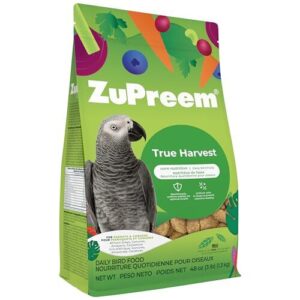
ZuPreem True Harvest Bird Pellets bring something a little different to the bowl — real vegetable pieces mixed right in with the pellets, offering texture variety alongside consistent nutrition.
The multigrain base (corn, millet, oat groats, barley, wheat) delivers steady energy, while added vitamins A, D3, E, and B-complex cover daily health essentials.
With no artificial colors or synthetic preservatives, the formula minimizes unknowns in your bird’s diet. At roughly $15 for 3 lbs, it’s a solid everyday staple.
| Best For | Medium to large parrot owners — think African Greys, conures, Eclectus, and cockatiels — who want a nutritionally complete daily pellet without relying on seed-only diets. |
|---|---|
| Net Weight | 3 lb |
| Life Stage | All life stages |
| Artificial Additives | None |
| Nut Allergen Risk | Yes |
| Primary Bird Size | Medium to large |
| Country of Origin | USA |
| Additional Features |
|
- Clean ingredient list with no artificial colors or synthetic preservatives, so you know exactly what’s going into your bird.
- Multigrain base plus real fruits and veggies (carrots, blueberries, cranberries) means solid nutrition and a little natural variety in every serving.
- Works across species and all life stages, so it’s a reliable staple whether you have a cockatiel or a macaw.
- Sugar sits pretty high on the ingredient list, which could be a problem for birds prone to carb sensitivity.
- Contains peanuts and tree nuts, so it’s not a safe pick if your bird has nut allergies.
- Some owners have noticed a stale oil smell as the bag nears its expiration date, which is worth watching for.
2. ZuPreem FruitBlend Bird Pellets
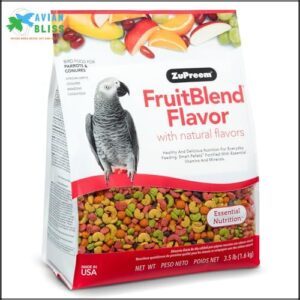
If your bird is more motivated by color and scent than plain textures, FruitBlend might be the better fit. These pellets come shaped and tinted to mimic real fruit — banana, apple, orange, grape — which naturally triggers foraging curiosity in medium to large parrots.
The formula guarantees 14% crude protein and 4% fat, hitting solid baseline targets. Nutritionally complete, it provides essential balance for your bird’s diet.
Artificial dyes can turn droppings bright colors, which surprises first-time owners. This is a harmless side effect but worth noting for those unfamiliar with such additives.
While nutritionally sound, FruitBlend is best suited for birds who eat with their eyes first — those that respond strongly to visual and sensory stimulation during mealtime.
| Best For | Medium to large parrots (African Grey, Amazon, Cockatoo, Caique) that are visually motivated eaters or birds you’re trying to transition off an all-seed diet. |
|---|---|
| Net Weight | 3.5 lb |
| Life Stage | All life stages |
| Artificial Additives | Artificial dyes included |
| Nut Allergen Risk | Yes |
| Primary Bird Size | Medium to large |
| Country of Origin | USA |
| Additional Features |
|
- Fruit-shaped, colorful pellets tap into natural foraging instincts, making mealtime more engaging for curious birds
- Nutritionally complete with a solid vitamin and mineral blend to support feathers, immunity, and overall health
- A practical option for converting picky seed eaters to a higher-protein, more balanced daily diet
- Artificial dyes can cause brightly colored droppings that stain fabrics and may catch first-time owners off guard
- Contains soy, corn, and peanut traces, which could be a concern for birds with sensitivities or allergies
- Some birds fixate on one pellet color and ignore the rest, leading to uneven eating and wasted food
3. Tops Organic Parrot Hookbills Pellets
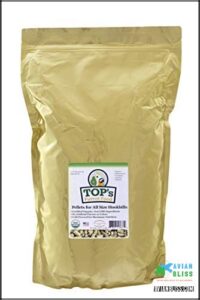
For owners who want to skip artificial additives entirely, Tops Organic Parrot Hookbills Pellets take a different approach. These are USDA Organic, non-GMO, and free from corn, soy, BHA, BHT, and ethoxyquin — preserved instead with rosemary, rose hips, and citrus peel.
The cold-pressed process helps retain heat-sensitive nutrients that extruded pellets often lose.
At roughly ¼ inch, they suit medium to large parrots well. The higher price reflects that certification, but for sensitive species like Eclectus or macaws, it’s often worth it.
| Best For | Medium to large parrot owners — especially those with sensitive species like Eclectus, macaws, or cockatoos — who want a clean, additive-free diet. |
|---|---|
| Net Weight | 4 lb |
| Life Stage | All life stages |
| Artificial Additives | None |
| Nut Allergen Risk | No |
| Primary Bird Size | Medium to large |
| Country of Origin | USA |
| Additional Features |
|
- USDA Organic, non-GMO, and free from corn, soy, and synthetic preservatives — about as clean as pellets get
- Cold-pressed to protect heat-sensitive nutrients that extruded pellets often destroy
- Works for all life stages, from weaning chicks to adult birds
- Pricier than most conventional pellet brands, which adds up fast for larger flocks
- The ¼-inch pellet size can crumble or feel too big for smaller birds
- Birds used to sugary or heavily flavored pellets may take weeks — or months — to fully accept them
4. ZuPreem Pure Fun Seed Pellet Blend
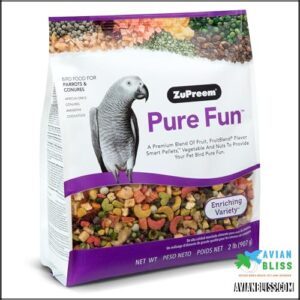
Not every bird takes to plain pellets right away — and that’s where the ZuPreem Pure Fun Seed Pellet Blend earns its place. It combines seeds, dried fruits, vegetables, nuts, and FruitBlend pellets in one mix, which helps picky eaters accept pellets more naturally.
Think of it as a bridge food. Just keep it to 30% of your bird’s weekly intake, since it contains artificial colorants and isn’t a complete diet on its own.
| Best For | Bird owners with picky parrots, conures, caiques, African Greys, Eclectus, or small cockatoos who need a little coaxing to eat their pellets. |
|---|---|
| Net Weight | 2 lb |
| Life Stage | All life stages |
| Artificial Additives | Artificial dyes included |
| Nut Allergen Risk | Yes |
| Primary Bird Size | Medium to large |
| Country of Origin | USA |
| Additional Features |
|
- Mixes seeds, fruits, veggies, nuts, and FruitBlend pellets together — great for getting reluctant birds interested in pellets
- Keeps mealtime stimulating, which helps cut down on boredom and behavior problems
- Delivers a solid range of vitamins, minerals, and antioxidants to support feather health, digestion, and immunity
- Contains artificial colorants (Yellow 5, Red 40, Blue 1) and preservatives, which some owners prefer to skip
- Not a complete diet — needs to stay at 30% or less of weekly food intake
- Has peanuts and tree nuts, so it’s not ideal for birds with sensitivities or strict dietary needs
5. Lafebers Premium Bird Food Pellets
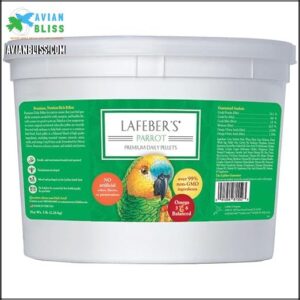
Lafeber’s Premium Daily Diet Pellets stand out for one key reason: they’re formulated by avian veterinarians using non-GMO, human-grade ingredients — no artificial colors, flavors, or preservatives included.
The blend delivers balanced omega-3 and omega-6 fatty acids alongside vitamins A, D3, E, and B-complex, supporting feather quality and immune health.
Produced in small batches on a single family farm in Cornell, Illinois, you’re getting consistent quality batch to batch.
The 5 lb bag works well for single-bird households, though large flocks may need frequent restocking.
| Best For | Parrot owners who want a vet-formulated, clean-ingredient daily diet and are ready to transition their bird away from seeds. |
|---|---|
| Net Weight | 5 lb |
| Life Stage | All life stages |
| Artificial Additives | None |
| Nut Allergen Risk | No |
| Primary Bird Size | All parrots |
| Country of Origin | USA |
| Additional Features |
|
- Made with non-GMO, human-grade ingredients — no artificial anything, formulated by actual avian vets
- Supports feather health, skin, and immunity with balanced omegas and key vitamins
- Less messy than seeds since pellets don’t get dunked in water as easily
- Pricier per pound than your average seed mix
- Birds used to seeds may take a few weeks to warm up to pellets
- The 5 lb bag runs out fast if you have multiple birds or a larger species
6. ZuPreem FruitBlend Large Bird Pellets
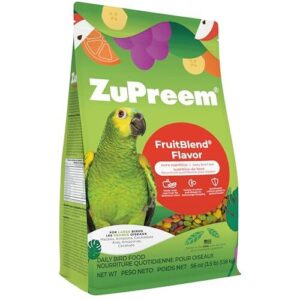
ZuPreem FruitBlend Large Bird Pellets offer fruit-shaped, multicolored pieces tailored for macaws, Amazons, and cockatoos. Their varied shapes encourage natural foraging behavior, keeping large parrots mentally engaged during feeding.
Each pellet provides a complete vitamin and mineral complex, including vitamins A, D3, E, K, and B-complex, alongside balanced calcium-to-phosphorus ratios for strong bones.
However, the formula contains artificial colorants and added sugars, so birds with sensitivities may require an alternative option.
| Best For | Large parrot owners—macaws, Amazons, and cockatoos—looking to replace seed-heavy diets with a nutritionally complete, foraging-friendly pellet. |
|---|---|
| Net Weight | 3.5 lb |
| Life Stage | All life stages |
| Artificial Additives | Artificial dyes included |
| Nut Allergen Risk | Yes |
| Primary Bird Size | Large parrots |
| Country of Origin | USA |
| Additional Features |
|
- Fruit shapes and bright colors keep big parrots mentally engaged while they eat
- Fully balanced formula covers vitamins, minerals, and the right calcium-to-phosphorus ratio for bone health
- Cuts out the excess fat from seed mixes, making it easier to manage your bird’s overall diet
- Contains artificial colorants and added sugars, which could be a problem for sensitive birds
- Pellet size runs on the smaller side, so it may not work well for larger cockatoos or birds with weak beaks
- Higher carb content compared to plain, no-frills formulations
What Makes Pellets Healthy
Not all pellets are created equal, and knowing what to look for makes a real difference in your bird’s long-term health. A quality formulation covers more ground than most owners expect — from macronutrients down to trace minerals and gut-supporting additives.
What separates a genuinely healthy pellet from one that just looks the part? The inclusion of these critical components ensures comprehensive nutritional support, moving beyond superficial appearances to deliver tangible health benefits.
Balanced Protein, Fat, Fiber, and Carbohydrates
Think of a pellet as your bird’s daily foundation — and macronutrient ratios are what hold it together. A well-formulated pellet delivers:
To keep those nutrients intact after opening, follow proper parrot pellet storage and freshness tips so every serving delivers what it promises.
- Protein level of 12–20% supporting feather growth and tissue repair
- Fat content of 6–12% from quality fat sources like flaxseed oil
- Fiber intake of 6–15% promoting healthy gut motility
- Complex carbohydrates providing steady energy density without spikes
- Protein quality from peas, lentils, and balanced plant blends
That nutrient balance keeps your parrot active and healthy daily.
Essential Vitamins A, D3, E, K, and B-complex
Vitamins aren’t extras — they’re the engine behind your parrot’s daily health.
Vitamin A deficiency weakens immunity and vision support almost immediately.
Vitamin D3 drives calcium regulation, keeping bones dense and strong.
Vitamin E provides oxidative protection at the cellular level, while Vitamin K ensures proper blood clotting.
B-complex vitamins handle energy metabolism, fueling every preening session, vocalization, and flight your bird takes.
Key Minerals Including Calcium, Zinc, and Selenium
Minerals quietly run the show beneath every healthy feather and strong bone your parrot has.
- Calcium supports bone health, starting with fortified pellets — deficiency leads to fractures and egg binding in hens
- Zinc supports immune function, aiding keratin formation during molts to keep feathers tight and vibrant
- Selenium’s antioxidant role shields cells from oxidative damage, with birds requiring roughly 0.1–0.2 mg per 100 g of body weight
- Chelated mineral benefits improve absorption over inorganic forms, boosting nutrient bioavailability in extruded pellet processing
Watch for mineral deficiency signs like feather picking or lethargy — they’re early warnings worth taking seriously.
Why Calcium-to-phosphorus Balance Matters
Getting the calcium-to-phosphorus ratio right isn’t optional — it’s the foundation of bone strength and long-term health. Most quality pellets target a ratio near 2:1, and for good reason.
Too much phosphorus pulls calcium away from bones, undermining growth development and eggshell quality in breeding hens. This imbalance directly threatens skeletal integrity and reproductive health.
Vitamin D synergy makes calcium supplementation effective, but only when that balance holds. Hormonal control then ensures optimal utilization, completing the cycle of skeletal and metabolic regulation.
Added Omega-3s, Prebiotics, and Probiotics
Beyond minerals, the best parrot pellet reviews of 2026 highlight omega-3 fatty acids from algae or fish oil — key for feather condition and cell membranes. Omega-3 stability depends on antioxidants added during manufacturing.
Prebiotic fiber benefits gut microbiome support by feeding beneficial bacteria, while probiotic viability ensures live cultures actually reach your bird.
Together, these synergistic nutrient effects make probiotic use in parrot pellet formulations genuinely worthwhile.
Pellets Versus Seed Diets
Seeds might seem like the obvious choice — they’re familiar, affordable, and parrots love them. But the comparison with pellets goes deeper than convenience, and what you find might change how you think about your bird’s daily meals.
Here’s a closer look at five key areas where the two diets part ways.
Why Seed-only Diets Can Cause Deficiencies
A seed-only diet might look colorful in the bowl, but nutritional deficiencies are hiding in plain sight. Seeds fall short in critical areas your parrot needs daily:
- Calcium deficiency weakens bones and triggers egg binding
- Vitamin A gaps impair vision and immunity
- Protein variability disrupts feather growth and recovery
- Omega-3 shortfall increases cardiovascular stress
Seed vs. pellet feeding isn’t even close on consistency.
How Pellets Reduce Selective Eating
Selective eating is basically your parrot voting ‘no’ on anything unfamiliar. Unlike seeds, where birds pick their favorites and leave the rest, pellets eliminate food competition entirely.
Their uniform texture promotes beak health and steady mechanical wear, while behavioral conditioning through routine servings builds meal predictability.
Appetite regulation follows naturally—same shape, same size—reducing opportunities to cherry-pick.
Nutritional Consistency in Daily Feeding
That predictability pays off at feeding time, too. Pellets deliver the same nutritional balance in every bite — no gaps, no guessing.
Stick to a consistent feeding schedule and follow your pellet portion guideline by weight, because Portion Accuracy matters more than most owners realize.
Pair that with consistent storage and moisture control, and your bird’s daily diet stays reliable, meal after meal.
When Seeds Can Still Be Used Safely
Seeds aren’t the enemy — they just need guardrails. Portion-controlled seeds work well as a reward-based offering after your bird finishes its measured pellet portion.
Stick to low-fat seed blends, respect the 10 percent seed limit within your overall seed vs. pellet feeding balance, and always practice moisture-free storage to prevent mold.
A smart seed mix complements pellets without displacing them.
Common Pellet Diet Misconceptions
A few common misconceptions about parrot nutrition can quietly put your bird at risk.
The complete nutrition myth leads owners to skip fresh foods entirely, while the calcium adequacy myth overlooks species-specific needs.
Vitamin variability and fiber deficiency misconceptions are equally real.
Even preservative safety isn’t guaranteed across brands. Understanding these gaps in seed vs. pellet feeding keeps your approach genuinely balanced.
Choose Pellets by Parrot Species
Not every parrot thrives on the same pellet, and species differences go deeper than just size. A macaw’s caloric needs look nothing like a budgie’s, and feeding the wrong formula can quietly cause problems over time.
Here’s how to match the right pellet to your specific bird.
Small Parrots: Budgies and Parrotlets
Budgies and parrotlets may be small, but their nutritional needs are precise. Small parrot pellets — ideally 4–6 mm — prevent waste and choking, and pellet size directly affects how comfortably your bird feeds. TOP Organic Mini Bird Pellets are a strong fit here.
- Daily portion: 1–2 tablespoons (15–30 g)
- Promotes beak maintenance and cage enrichment routines
- Feeding guidelines for beginner parrot owners recommend starting with crumbled pellets
Feeding guidelines for beginner parrot owners emphasize starting with crumbled pellets to ease the transition for both bird and owner.
Medium Parrots: Cockatiels and Conures
Cockatiels and conures occupy a sweet spot—active enough to require real nutritional support, yet small enough that overfeeding sneaks up on caregivers. Choosing the right parrot pellet food for medium parrots involves selecting 6–9 mm pellets and providing roughly 2–4 tablespoons daily.
Watch for crest communication as a key indicator of stress, manage noise levels through enrichment toys, and prioritize beak maintenance to ensure overall well-being. These practices help maintain a balanced environment for these energetic birds.
Top Parrot Pellet Reviews 2026 consistently highlight ZuPreem Medium as a reliable fit for both conures and cockatiels, emphasizing its suitability for their dietary needs.
Large Parrots: African Greys and Amazons
African Greys and Amazons aren’t just large parrots — they’re long-term companions with very specific species dietary needs. Choosing the right parrot pellet food means prioritizing elevated calcium and vitamin D3 for Greys, and higher fat content for Amazons’ faster metabolism.
- Omega-3s support feather molting, cognitive enrichment, and vocal training readiness
- Adequate joint health nutrients matter across their 40–60 year lifespan
- Poor air quality and nutritional gaps accelerate feather and immune decline
Macaws and Higher-calorie Pellet Needs
Macaws are built differently — and their pellets should reflect that. A mature macaw weighing 900–1,200 grams needs roughly 140–190 daily calories, so calorie density and fat enrichment matter here more than with any other species.
Look for large parrot pellets with 6–12% fat and around 450–550 kcal per 100g.
During breeding energy demands or molt periods, bump portions up 10–20% and keep weight monitoring consistent.
Eclectus Parrots and Low-iron Considerations
Eclectus parrots exhibit a unique physiological trait: they are prone to hemochromatosis, a condition where iron accumulates faster than their bodies can safely process it. This necessitates a diet specifically formulated to minimize iron intake, contrasting with species like macaws that require calorie-dense nutritional profiles.
Eclectus parrots are uniquely prone to hemochromatosis, requiring a low-iron diet to prevent dangerous iron accumulation
Unlike macaws, which thrive on high-calorie diets, Eclectus parrots demand pellets with low iron content to prevent toxic buildup. Their dietary management hinges on avoiding iron-rich ingredients and strategically pairing nutrients to regulate absorption.
Watch for these species-specific dietary needs:
- Avoid iron-rich seeds like certain millet and linseed varieties
- Pair dark greens with vitamin C to manage mineral absorption
- Understand phytic acid effects from excess grains, which can disrupt iron uptake
- Schedule regular blood ferritin monitoring, especially during breeding calcium balance adjustments
- Choose certified low-iron pellets — your parrot pellet buyer’s guide should prioritize this when selecting the best pellet food for parrots
Juvenile, Adult, and Senior Formulas
Just as Eclectus parrots need iron-controlled pellets, every parrot benefits from stage-specific protein matched to their life phase.
Juvenile prebiotic blends support gut development with 14–18% protein.
Adult calorie optimization keeps indoor birds lean.
Senior formulas shift toward kidney-friendly phosphorus levels and a senior antioxidant boost — vitamins C, E, and carotenoids — protecting aging birds from the inside out.
Check Ingredients and Labels
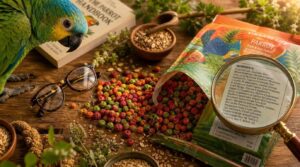
The ingredient list on a pellet bag tells you more than you might expect. Knowing what to look for — and what to avoid makes it easier to filter out the brands that cut corners.
Here’s what to check before you buy.
Whole Vegetables, Fruits, and Herbs
When a pellet label lists whole vegetables, fruits, and herbs in the top three ingredients, you’re looking at genuinely minimal processing — and that matters for nutrient bioavailability. Fresh vegetable and fruit supplementation promotes the integration of fresh foods with pellets effectively.
- Bell peppers and kale — deliver vitamins A, C, and K
- Blueberries and papaya — offer probiotic benefits and antioxidants
- Oxalate management — limit spinach; prioritize kale or carrots
- Herb flavor pairings — parsley and cilantro add calcium and variety
Seasonal produce rotation keeps nutrition diverse.
Organic and Non-GMO Pellet Options
Organic and non-GMO bird food options like TOPs Organic Parrot Food Pellets and Harrisons Organic Pepper Lifetime Coarse Bird Pellets go further than just clean ingredients.
They require third-party audits, non-GMO DNA testing, and synthetic pesticide exclusion throughout the supply chain.
Traceability lot numbers and verified organic seed varieties mean you can actually confirm what’s in every bag — not just trust the label.
Avoiding Artificial Colors and Preservatives
Artificial colors and preservatives deserve real scrutiny on any label. Synthetic dyes like tartrazine carry allergy risks and concerns—some birds show hypersensitivity or behavioral shifts.
Better formulas use beet-based pigmentation or paprika instead, avoiding synthetic alternatives. For preservation, rosemary antioxidants effectively manage shelf life without relying on BHA or BHT.
Transparent sourcing on packaging confirms these choices, meaningfully reducing the impact of artificial additives on avian health.
Fillers Such as Wheat Middlings
Wheat middlings — a common filler in budget pellets — quietly affects ingredient quality more than most owners realize. They bulk up texture and improve shelf stability, but their low nutrient density dilates the nutritional profile overall.
Consider what middlings actually bring:
- Fiber Impact: moderate gut motility support, though excess softens stools
- Mineral Balance: contributes phosphorus but minimal calcium, requiring careful formulation
- Cost Efficiency: reduces production costs, often at the expense of premium protein sources
Ultimately, while wheat middlings offer functional and economic advantages, their nutritional trade-offs demand careful consideration in formulation.
Spotting BHA, BHT, and Ethoxyquin
Three synthetic preservatives — BHA, BHT, and ethoxyquin — appear in lower-quality pellets to slow fat rancidity. Detecting these additives begins with analyzing food labels: scan the bottom of the ingredient list, where chemical preservatives often hide.
Vendor transparency is crucial. Reputable brands provide certificates of analysis confirming safety thresholds are met. The table below highlights key additives and their label indicators:
| Additive | What to Look For |
|---|---|
| BHA | Listed near fats or oils |
| BHT | Often paired with BHA |
| Ethoxyquin | May appear as "E324" |
| Safe Alternative | Mixed tocopherols (Vitamin E) |
Certification clues like "ethoxyquin-free" or "BHA/BHT-free" signal a preservative-free diet commitment. Certified organic lines reliably exclude synthetic preservatives, offering a shortcut when label scrutiny feels overwhelming.
Pick The Right Pellet Size
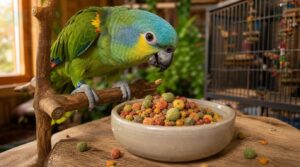
Size matters more than most people realize regarding pellets. A pellet that’s too big becomes a wrestling match, and one that’s too small just gets flung across the cage floor.
Here is what you need to know to match the right size to your bird.
Small Pellets for Small Parrots
Small parrots like budgies and parrotlets need pellets measuring 4–6 mm — anything larger risks waste or choking.
When choosing the best pellet food for parrots this size, prioritize eco-friendly packaging and flavor variety to engage picky eaters.
A consistent feeding schedule helps ensure better intake, while pellet shelf life is key for smart pet owner budgeting.
Medium Pellets for Conures and Cockatiels
Medium parrots like cockatiels and conures thrive on pellets measuring 6–9 mm — the sweet spot for comfortable chewing and natural beak wear. Pellet size directly shapes species-specific dietary needs, palatability enhancement, and behavioral impacts like reduced selective eating.
Brands such as Kaytee Exact Rainbow Parrot Conure Food and TOPs Parrot Food Pellets offer digestive benefits and meet veterinary recommendations.
Aim for consistent feeding timing daily to support their health and well-being.
Large Pellets for Greys, Amazons, and Macaws
Large parrots have serious nutritional demands, and pellet size is where it starts. African Greys, Amazons, and Macaws need roughly 1-inch pellets — firm enough to match their beak strength and bulk density requirements.
Species-specific pellet requirements and formulations for these birds prioritize protein stability, omega-3 enrichment, and energy density.
For Eclectus owners, iron-reduced formulation options are worth seeking out specifically.
How Pellet Size Affects Waste
Pellet size has a direct impact on how much food actually gets eaten versus scattered across the cage floor. Choosing appropriate pellet size for parrots promotes reduced food scatter, uniform droppings, and lower dust production — all signs of enhanced digestion efficiency.
Correctly sized pellets can cut waste by up to 15 percent, making cleaner cages a realistic daily outcome.
Choking Risks and Feeding Comfort
Size matters more than most owners realize. A pellet that’s too large strains swallowing coordination, while one that’s too small can be inhaled during a rushed grab.
Competitive feeding environments or sudden disruptions break a bird’s natural feeding pace, increasing risk.
Minimize airborne crumbs by serving pellets gently on a stable dish, and keep pellet moisture consistent—dry crumbs are harder to swallow safely.
Matching Pellet Texture to Beak Strength
Texture works hand-in-hand with size. A pellet’s hardness grading, surface grip, and friability collectively determine whether a bird eats confidently or gives up. Bite-force matching involves selecting age-adjusted textures suited to the species.
- Soft pellets help senior birds with weakened beaks maintain consistent intake.
- Textured surfaces improve grip, reducing frustrating slippage during biting.
- Moderate friability supports foraging enrichment, encouraging pellet intake without excessive crumbling.
Feed Proper Daily Portions
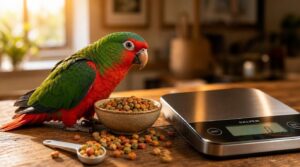
Getting portions right makes a bigger difference than most owners expect. Too much food leads to waste and weight gain, while too little can quietly cause deficiencies over time.
Here’s what your parrot actually needs each day, broken down by size and activity level.
Pellet Intake by Body Weight
Think of your parrot’s daily pellet amount as a living formula, not a fixed scoop. Weight-based formulas start at roughly 2–6% of body weight per day, but metabolic rate adjustments matter — active birds may need 15% more.
Evolving feeding curves and Caloric Percentile Guidelines help fine-tune portions over time. Weight monitoring and weekly weighing protocols remain your most reliable tool for ensuring optimal nutrition.
Portion Ranges for Small Parrots
For small parrots like budgies and parrotlets, gram-based allocation is more reliable than guesswork every time. Feeding guidelines typically recommend 15–30 grams daily, but activity-adjusted portions and seasonal energy needs can shift this range. During molting, a molting portion boost of around 10–15% supports feather regrowth without excess calories.
Keep these portion control and feeding schedule anchors in mind:
- Budgerigars: ½–1 teaspoon of small parrot pellets daily
- Parrotlets: 1–2 teaspoons, adjusted by body condition weekly
- Both species: use calorie count guides and a gram scale to ensure accuracy
Portion Ranges for Medium Parrots
Medium parrots like cockatiels and conures do best on 1.5 to 2.5 tablespoons of medium parrot pellets daily, making up roughly 60–70% of their daily diet. Caloric targeting around 100–120 kcal keeps weight steady.
Use a Daily Feeding Log to catch Portion Slip Prevention early — stress impact can quietly drop intake by 20%.
Weight-Goal Tuning every two weeks keeps pellet portion ratios within daily diet on track.
Portion Ranges for Large Parrots
Large parrots — African Greys, Amazons, and macaws — generally need ¼ to ½ cup of pellets daily, roughly 60–120 g depending on body mass and metabolic factors.
Calorie density varies by brand, so weight tracking every two weeks keeps pellet portion ratios within daily diet on target.
Veterinary guidelines recommend seasonal tweaks when your bird’s activity or feather-growth cycle shift occurs.
Adjusting Portions for Indoor Activity Levels
Indoor birds do not burn the same calories every day — and your feeding schedule should reflect that. Applying the matching energy intake principle ensures your bird’s diet stays aligned with activity levels.
Activity scaling is straightforward: on low-playtime days, trim the pellet portion slightly and execute a treat reduction plan to keep energy density in check.
Weekend feeding shifts happen naturally with routine changes.
Track weight weekly to confirm your daily diet adjustments are actually working.
Preventing Obesity in Indoor Pet Parrots
Obesity sneaks up quietly — a gram here, a gram there, until your bird can barely climb its cage. Weigh your parrot weekly using accurate weight scales and log results consistently through calorie logging to catch trends early.
Combine treat management with activity rotation and enrichment play to keep metabolism active. This approach helps prevent weight gain while ensuring your parrot remains engaged and healthy.
Nutrient-dense pellets anchor a balanced diet, but portion control and feeding schedules for parrots seal the deal when managing obesity and weight in pet parrots. Consistency in these practices is key to long-term success.
Transition Birds to Pellets
Most birds come around with the right approach and a little patience.
Here’s a step-by-step breakdown of what actually works.
Seven-to-fourteen-day Conversion Plan
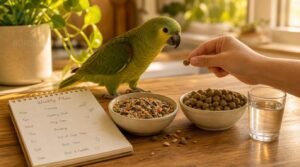
Think of this as a slow handshake — not a sudden swap. A 7–14 day pellet changeover timeline gives your bird time to adjust without stress. Your Ratio Adjustment Schedule matters here:
- Cut seeds by 10–20% daily during week one
- Watch for Stress Monitoring signs like feather fluffing
- Keep a Consistent Feeding Environment at set times
- Use Positive Reinforcement when your bird accepts pellets
Hydration management and a steady feeding routine make switching parrots to pellet diets smoother.
Mixing Pellets With Familiar Seeds
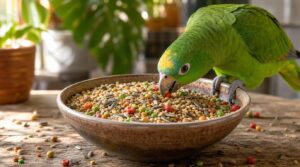
Once your bird is comfortable with the slow handshake approach, start blending pellets directly into their seed mix. Aim for a 50/50 texture ratio at first — seeds retain their familiar crunch while parrot pellet foods stay visible and separate. This maintains the bird’s natural foraging behavior.
Seed compatibility ensures the transition feels intuitive. Keep seeds fresh to enhance flavor and appeal during this shift.
Boost acceptance by tracking which flavors your bird prefers. Use these insights to refine the mix, supporting a smoother transition to a pellet-based diet.
Crumbling Pellets for Picky Birds
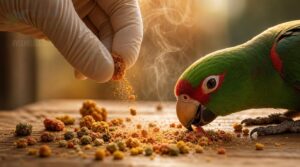
Some parrots won’t touch a whole pellet at first — and that’s where crumbling helps. Gently crushing pellets to around 2–4 mm releases aroma enhancement that draws curious birds in.
Texture gradation lets you scale piece size gradually, building acceptance through behavioral strategies for pellet acceptance.
Freshness tracking guarantees crumbles stay sealed, preventing moisture loss and mold.
Moistening Pellets With Warm Water
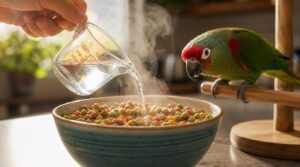
Warm water works the same way crumbling does — it lowers the barrier between "unfamiliar" and "worth trying." Here’s how to do it right:
- Use a 1:2 pellet-to-water ratio for a creamy pellet texture
- Keep water between 37–38°C for temperature safety
- Stir thoroughly to eliminate dry pockets
- Discard moistened mix after two hours — spoilage prevention matters
- Offer at consistent feeding times to reinforce behavioral strategies for pellet acceptance
Tracking Weight During Diet Changes

Once your bird starts accepting the new mix, weight monitoring becomes your most reliable feedback tool. A Consistent Weighing Routine — same scale, same time, same method daily — cuts through the noise.
| Tracking Element | Best Practice |
|---|---|
| Weigh timing | Before morning feeding |
| Baseline period | 1–3 days before changing portions |
| Multi-Day Averages | Average last 3–7 weigh-ins |
| Feeding Log Integration | Record portions offered and leftovers |
| Environmental Impact | Note temperature, molting, or stress events |
Stress-Free Handling during each session keeps readings honest.
When to Contact an Avian Veterinarian
Even with careful weight monitoring, some symptoms can’t wait. Contact an avian veterinarian immediately if you notice:
- Respiratory distress — open-mouth breathing, wheezing, or tail bobbing
- Sudden anorexia or unexplained weakness lasting more than a day
- Abnormal droppings, regurgitation, or abdominal swelling
- Traumatic injuries, seizures, or loss of balance
Rapid disease signs escalate fast in birds. Don’t wait.
Combine Pellets With Fresh Foods
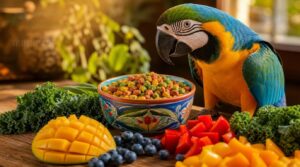
Pellets do the heavy lifting nutritionally, but fresh foods can make your parrot’s diet more interesting and well-rounded.
The key is knowing which foods actually belong in the bowl — and which ones don’t. Here’s what to keep in mind as you build a balanced daily menu.
Keeping Pellets Nutritionally Dominant
Think of pellets as the foundation — fresh food is the finishing touch, not the main course. Keeping nutrient-dense pellets at 80% of your bird’s daily intake ensures balanced diet consistency without sacrificing variety.
Use Pellet Palatability Boosters like warm mashing to maintain Feeding Schedule Consistency. This approach helps birds accept pellets reliably while preserving nutritional integrity.
Adjusting Micronutrient Ratios remains easier when pellets anchor every meal. Their standardized formulation provides a stable baseline for fine-tuning additional dietary components.
| Food Type | Ideal Proportion | Nutritional Importance |
|---|---|---|
| Nutrient-dense pellets | 80% | Complete balanced diet |
| Fresh fruits & vegetables | 15% | Vitamins, enrichment |
| Nuts & treats | 5% | Healthy fats only |
Safe Fruits for Indoor Parrots
A handful of fresh fruits can do wonders for your bird’s enrichment without disrupting pellet-based nutrition. Safe and toxic foods for parrots differ more than most owners expect — avocado is always off-limits, while apples, berries, and mango work well as fresh food supplementation.
Follow Fruit Portion Guidelines (roughly one to two tablespoons daily), apply Citrus Moderation Tips to limit acidity, and practice Allergy Monitoring when introducing anything new.
Safe Vegetables for Daily Variety
Vegetables add real nutritional depth to your parrot’s pellet routine. A colorful veggie mix — think bell peppers for vitamin-C boosts, carrots for beta carotene, and zucchini for fiber — keeps fresh produce for birds varied and engaging.
Practice leafy green rotation with kale, dandelion greens, and spinach, but monitor oxalate levels in spinach closely.
Seasonal vegetable selection ensures your parrot’s intake remains fresh and diverse year-round.
Using Nuts as Occasional Treats
Nuts make excellent healthy bird snacks, but their nut calorie count adds up fast. Safe nut preparation means offering only plain, unsalted, hulled pieces, such as walnuts, almonds, or pecans, chopped small enough for comfortable chewing.
Treat frequency guidelines keep nuts rare, not routine. Integrating nuts as occasional treats alongside nutrient-dense pellets protects your pet bird’s diet.
Always discard anything that smells rancid; mold risk awareness is non-negotiable.
Avoiding Overfeeding Fresh Extras
Fresh extras are easy to overfeed when your bird gobbles them up eagerly. Keep supplementing pellets with fresh vegetables and fruits within the 10–20% limit — calorie density varies widely, and fruit adds up fast.
Snack timing matters too; offer fresh foods at set meals rather than free-feeding. Portion limits protect nutrient balance.
Track monitoring droppings and weekly weighing protocols to catch weight creep early.
Foods Indoor Parrots Should Never Eat
Some foods aren’t just unhealthy — they’re genuinely dangerous. No matter how much your bird begs, keep these off the menu entirely:
- Avocado toxicity can trigger respiratory distress and heart failure within hours.
- Chocolate poisoning causes seizures from theobromine buildup.
- Caffeine effects include dangerous heart arrhythmias even in small amounts.
Alcohol danger, stone fruit kernels, and artificial colors round out the list of safe and toxic foods for parrots every owner must memorize.
Store Pellets Safely Indoors
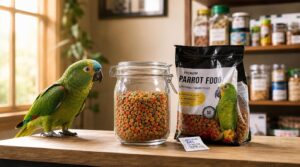
Good pellets don’t stay good on their own — how you store them matters just as much as what’s inside the bag.
Once you open a package, the clock starts ticking on freshness, and a few simple habits can make a real difference.
Here’s what to keep in mind to protect every pellet you buy.
Airtight Containers After Opening
Once you open a pellet bag, the clock starts ticking. Transferring your supply to a BPA-free airtight container with a gasket seal is one of the best practices for storing parrot pellets — it actively slows oxidation and moisture contact.
| Feature | Why It Matters | Practical Tip |
|---|---|---|
| Gasket Longevity | Maintains reliable vacuum-like seal through repeated use | Inspect monthly; replace if cracked |
| UV Protection | Prevents vitamin degradation from light exposure | Choose opaque or UV-resistant lids |
| Moisture Control | Reduces humidity that accelerates spoilage | Add a desiccant pack if recommended |
| Stackable Organization | Keeps multiple pellet types accessible | Label each container with open date |
| Cleaning Routine | Prevents residue buildup affecting palatability | Hand-wash, air-dry fully before refilling |
Proper storage and shelf life of parrot pellets depend on these small, consistent habits.
Ideal Room-temperature Storage Range
Your airtight container is doing its job — but where you place it matters just as much as the seal itself. Pellet storage hinges on staying within the right temperature thresholds: 60–75°F (15–24°C). Outside that window, heat degradation breaks down vitamins and fats, while cold damage from damp areas causes clumping.
- Keep pellets away from ovens, radiators, or appliances generating ambient heat
- Avoid windowsills where thermal fluctuations occur throughout the day
- Store in an interior cabinet, not an exterior wall shelf prone to cold seeping in
- Use a small thermometer for basic temperature monitoring in your storage area
- Humidity below 60% is non-negotiable for proper storage and shelf life of parrot pellets
Storing and handling parrot pellet foods at stable temperatures directly shapes pellet shelf life and your ability to accurately evaluate pellet freshness and expiration dates.
Freezing Pellets for Longer Freshness
When room temperature isn’t enough, the freezer earns its place. Proper storage and shelf life of parrot pellets improves dramatically when you freeze portioning packs at 0°F (-18°C) or below.
This slows lipid oxidation and bacterial growth for up to six months.
Thaw packs in the refrigerator overnight — never microwave.
Evaluating pellet freshness and expiration dates still matters; discard anything smelling rancid or showing freezer burn.
First-in, First-out Rotation
Think of your pellet storage like a grocery shelf — oldest stock always moves first. First-in, First-out rotation prevents flavor fatigue and nutritional decline before your bird ever notices.
Keep it simple with three habits:
- Write Batch Date Labels on every container
- Log dispensing order in a Rotation Logbook
- Use a Color-Coded System to flag aging stock visually
Checking Best-by Dates
Every pellet bag carries a best-by date — and knowing how to read it matters more than most owners realize. That date signals peak quality, not a safety deadline, so your pellets don’t automatically become harmful the day after.
| Date Label | What It Means |
|---|---|
| Best-by | Quality peak; safe if stored properly |
| Use-by | Strict safety cutoff; don’t exceed |
| Sell-by | Retailer guide; not a consumer limit |
Temperature swings accelerate nutritional decline, so consistent storage at 50–70°F helps extend pellet shelf life well past the printed date.
Signs Pellets Have Spoiled or Gone Stale
Your nose is usually the first alarm — a sour odor coming from the bag almost always means moisture got in. From there, check texture: fresh pellets hold firm, while spoiled ones crumble at a touch. Mold growth, excessive dust, or bag inflation is a clear stop.
Rotating pellet brands also promotes ingredient quality and prevents flavor fatigue over time.
Frequently Asked Questions (FAQs)
What are the healthiest pellets for parrots?
The healthiest pellets combine nutrient-dense ingredients, third-party testing, and veterinarian-endorsed formulations. Look for organic bird food with non-GMO certification, strong nutrient bioavailability, and sustainable sourcing.
High-quality brands like Harrison’s consistently deliver the best cost-performance ratio.
Can pellets replace veterinary nutritional supplements entirely?
Pellets act like a nutritional safety net, but they cannot always replace veterinary supplements entirely.
Species-specific gaps, malabsorption, or illness may still require clinical monitoring and targeted supplementation despite a complete-balanced diet.
How do stress and molting affect pellet consumption?
Both stress and molting trigger a feeding pattern shift in parrots. Hormone appetite shifts reduce intake, while molt’s energy demand increase raises protein requirements.
Watch for a molt intake dip and adjust vitamin supplementation accordingly.
Does water quality affect how pellets should be moistened?
Just like brewing tea, water quality shapes the result. Hard water impact, pH balance, and mineral content all affect pellet texture and hydration.
Use fresh, room-temperature water for consistent pellet formulation and rehydration.
Conclusion
What’s really standing between your parrot and a longer, healthier life? Often, it’s just the bowl you fill each morning. Choosing the right parrot pellet foods for indoor pet owners isn’t about ideal—it’s about consistency.
Match the pellet to your bird’s size, species, and nutritional needs, shift gradually, and pair it with fresh foods thoughtfully. Do that reliably, and you’re not just feeding your parrot.
You’re actively building the foundation for a thriving life together.
- https://www.petshopdirect.com.au/blog/whats-in-your-birds-bowl-a-complete-guide-to-the-best-premium-bird-pellets
- https://www.semanticscholar.org/paper/00230b7e554a20a28fd60e80e7a09e95e9dda881
- https://www.msdvetmanual.com/management-and-nutrition/nutrition-exotic-and-zoo-animals/nutrition-in-psittacines
- https://parrotessentials.co.uk/blog/best-parrot-pellets-in-the-uk-a-comprehensive-guide
- https://pmc.ncbi.nlm.nih.gov/articles/PMC3367951/