This site is supported by our readers. We may earn a commission, at no cost to you, if you purchase through links.
A blue tit can weave spider silk into its nest walls so precisely that the structure stretches as the chicks grow — no engineer has matched that ratio of strength to flexibility at that scale.
Most people walk past dozens of active nests each spring without recognizing a single one. The signs are there: a female robin slipping behind the same shrub every twenty minutes, a chickadee carrying moss in its bill, a sudden silence when you step too close.
Learning how to watch nesting birds means training your eye to read those signals without becoming part of the disturbance. Done right, you get an unfiltered view of one of nature’s most precise operations — and the birds never know you were watching.
Table Of Contents
Key Takeaways
- Distance is your best tool — staying at least 15–30 meters back and using binoculars protects nesting birds from stress, abandonment, and legal trouble.
- Reading behavioral cues, like a robin slipping behind the same shrub or a chickadee carrying moss, tells you a nest is active without you ever needing to get close.
- Varying your approach route each visit and limiting sessions to 15 minutes prevents you from accidentally drawing predators to the nest.
- Logging your observations through NestWatch turns backyard watching into real conservation data, contributing to 60 years of North American nesting research.
Choose Safe Nest Viewing Locations

Where you choose to watch makes all the difference. Some spots naturally put you closer to nesting activity without causing harm, while others come with rules you’ll want to know before you go. Here are the best places to start.
For a deeper dive into reading bird behavior before you arrive, observing bird nesting habits without disturbing them is a solid place to build that foundation.
Natural Nests
When you spot a natural nest, your first instinct might be to get closer — but the best thing you can do is stay still and observe from where you are.
Natural nests vary widely: robins build mud-lined cups in shrubs, while hawks construct large twig platforms high in trees.
Each design reflects the bird’s need for insulation, shelter, and protection.
The strength of spider silk support helps many songbirds secure their nests.
Nest Boxes
Nest boxes give you a front-row seat to nesting activity that natural nests rarely allow.
Cedar or pine wood works best — untreated, so no chemicals reach the birds.
Size the entrance hole to your target species: 25 mm for blue tits or chickadees, 28 mm for great tits.
Mount boxes 1.5 to 3 meters high, entrance facing away from prevailing winds.
Backyard Habitats
Your own backyard can be just as rewarding as any nest box, sometimes more so.
When you layer native plants — shrubs, wildflowers, ground cover, and a few mature trees — you create the kind of habitat that draws birds in naturally and keeps them there through the season.
- Native flowering plants supply nectar and berries from spring through autumn
- A shallow bird bath or small fountain gives birds safe drinking and bathing water
- Dense shrubs and snags provide shelter from predators and nesting cover
- Berry-producing shrubs carry food through winter when other sources run dry
- Log and brush piles support the insects that parent birds feed their chicks
Register with NestWatch, and your yard becomes a monitoring site where every visit counts.
Public Trail Rules
Public trails bring you close to nature, but they come with rules worth knowing.
Many trail managers designate viewing pullouts with signage — use them. These spots keep you at a safe distance without pushing you off the trail entirely.
When seasonal closures appear, respect them; they exist because eggs or nestlings are nearby, and even quiet foot traffic causes real harm.
Breeding Season Timing
Timing your visits around breeding season makes all the difference. In North America, nesting generally runs March through July, though warmer springs can push birds to start earlier, while cold spells or drought delay things.
Higher latitudes compress this window dramatically.
Watch for rising temperatures and longer days — those are nature’s starting pistol for most songbirds.
Watch From a Safe Distance
Getting close to a nest doesn’t mean getting close enough to touch it. A little distance, paired with the right habits, protects the birds and keeps you in the clear legally. Here’s what that looks like in practice.
Use Binoculars
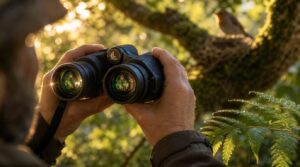
A good pair of binoculars is one of the best things you can bring to a nest observation. They let you watch from a distance without stepping close enough to cause stress. Common magnifications like 8x or 10x give you a clear, steady image without the hand shake that comes with stronger lenses.
- Adjust your IPD (the distance between the two eyepieces) to match your eyes — wrong spacing causes blurry edges or double vision
- Eye relief matters if you wear glasses; short eye relief cuts off the image at the sides
- A larger exit pupil helps in lower light, so you can still see detail on overcast mornings
- Image stabilization reduces shake, especially useful if you’re standing on uneven ground near a wooded edge
- Wipe lenses with a microfiber cloth only — finger smudges and rough fabrics scratch coatings and reduce clarity
Once your binoculars are properly set up, you can stay well back from the nest and still catch every detail — a sitting adult, a newly hatched chick, even the slight movement of eggs being turned.
Avoid Touching Nests
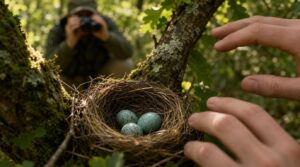
Touching a nest — even briefly — can set off a chain of consequences you can’t undo. It’s actually illegal to touch breeding birds or manipulate nest contents in most jurisdictions, and NestWatch protocols strictly enforce this rule.
| Action | Why It’s Harmful | What to Do Instead |
|---|---|---|
| Touching eggs | Transfers scent, attracting predators | Observe only with binoculars |
| Moving nest material | Breaks camouflage, exposes chicks | Preserve nest integrity from a distance |
| Peeking into cavities | Disrupts incubation temperature | Use camera zoom or a nest-box camera |
| Handling nestlings | Elevates stress hormones in adults | Practice hands-off observation always |
| Approaching too closely | Can trigger nest abandonment | Stay at least 30 meters away |
Avoid physical contact whether eggs are present or nestlings have hatched — both stages are equally vulnerable. If you follow ethical bird watching and nest monitoring protocols, you protect the nest without sacrificing the experience.
Stay Quiet
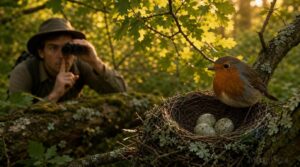
Sound travels — and birds hear more than you’d think. Stay at least 15 meters away and keep your voice low or silent entirely. Turn off phone notifications before you arrive. Move slowly and smoothly to avoid ground vibrations.
- Speak softly or not at all near any active nest
- Silence all devices before approaching
- Avoid whistling — it carries far in open areas
- Pause and wait if a parent bird reacts to your presence
Quiet behavior also reduces predator attraction, protecting the nest beyond just the moment you’re there.
Limit Visit Time
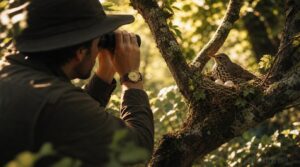
Even a brief visit can feel like an eternity to a bird sitting on eggs. Keep each session to 15 minutes or less — and if you sense any agitation, leave sooner.
Avoid visits at early morning or dusk, when birds are most vulnerable. Space sessions at least an hour apart so the nest returns to calm between checks.
Respect Parent Birds
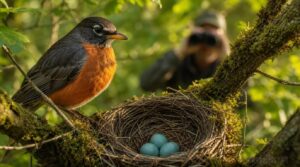
Parent birds are always watching — even when you can’t see them. If an adult is perched nearby, wait for it to leave naturally before moving closer. Alarm calls mean you’re too close, so step back immediately. Remember:
- Maintain distance to keep feeding routines undisturbed
- Never linger near nests when eggs are laid
- Quiet approach reduces stress on both parents and chicks
Know What Nesting Signs Mean
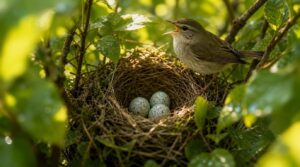
Every nest tells a story, and once you learn to read the signs, you’ll know exactly what’s unfolding before your eyes. Birds move through distinct stages — from the first twig placed to the day a fledgling takes flight — and each one looks and sounds a little different. Here’s what to watch for at each stage.
Nest Building
Watch for a flurry of activity when a bird begins collecting nest materials — twigs, grasses, moss, and feathers gathered in quick trips back and forth. This is nest building in motion.
| Material | Purpose | Example Species |
|---|---|---|
| Twigs and straw | Main framework | Robins, sparrows |
| Moss and soft fibers | Interior cushioning | Chickadees, wrens |
| Spider silk | Binds structure together | Hummingbirds, warblers |
Keeping your distance here matters most — disturbance at this early stage can cause complete abandonment.
Egg Laying
Once the nest is complete, the hen settles into a quieter rhythm — one egg per day, usually laid in the morning hours. Eggs range from about 50 to 70 grams and come in colors shaped by the species, from speckled to plain blue.
Stay well back during this stage, because even brief disturbance can prompt abandonment before the clutch is complete.
Incubation Behavior
Once the last egg is laid, incubation begins — and this is where the nest really comes alive.
- Temperature regulation keeps eggs within a narrow warmth range for healthy development
- Parental trade-offs mean parents must balance warming eggs against their own feeding needs
- Nest attendance often drops slightly as incubation progresses toward hatching
- Onset timing shifts with food availability and seasonal conditions
Hatchling Activity
From the quiet stillness of incubation, hatching shifts everything into motion.
Hatchling emergence timing peaks within the first two hours after sunset, when cooler temperatures and low light reduce predator activity. Once out, hatchlings orient toward the brightest horizon using visual light contrast, instinctively moving away from darker, cluttered surroundings that slow or disorient them.
Energy expenditure is intense during this window — every second counts.
Fledgling Readiness
By the time a fledgling leaves the nest, it’s already in the middle of its most critical learning window. Flight muscle development kicks in fast — within 7 to 14 days, most small songbirds can manage short, controlled lifts. Watch for:
- Feathers filling in sleekly as plumage maturation completes
- Wobbly but deliberate hops between branches
- Parents nearby, guiding foraging skill acquisition
Disturb this stage, and you risk triggering premature departure before a chick can survive alone.
Follow Ethical Nest Monitoring Steps
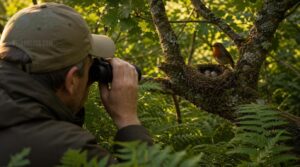
Watching nests is only half the equation — how you watch matters just as much. A few simple habits can mean the difference between a nest that thrives and one that doesn’t. Here’s what ethical monitoring actually looks like in practice.
Visit Midday
Midday is your best window for a nest visit. Around solar noon, the sun sits high, shadows shrink, and your binoculars or camera lens work at their clearest.
Most songbirds are actively foraging then, so parents leave the nest more freely. Aim for a one- to two-hour window centered on noon for the least disruptive, most productive observation.
Avoid Bad Weather
Bad weather doesn’t just make your visit uncomfortable — it puts real stress on nesting birds. Cold rain chills eggs fast, and wind speeds above 20 mph can trigger alarm calls that disturb the whole nest.
Always do a weather forecast check 24 hours ahead, and skip your visit if storms, sleet, or heavy rain are in the picture.
Vary Approach Routes
Every time you walk the same path to a nest, you’re quietly drawing a map — one that predators are very good at reading.
Every path you repeat to a nest quietly becomes a map that predators know how to read
That’s why varying your approach route matters as much as keeping your distance. Rotating your starting angle by 15 to 40 degrees each visit breaks any pattern that might attract foxes or corvids.
Try these simple route shifts:
- Alternate between low ground and slightly elevated vantage points
- Switch between shaded, leaf-litter paths to soften your footsteps
- Use multiple converging trails that never pass directly over the nest zone
Even small changes disrupt predictability and keep the nest safer.
Prevent Predator Trails
Varying your route only solves half the problem. If predators still find a clear path to the nest, your visits may be doing more harm than good.
Keep a 2-meter clear radius around any nest site — remove dense brush, fallen debris, and low cover that gives foxes or weasels a place to crouch and stalk.
Install barriers and use fencing with buried hardware cloth to block ground predators from digging under. Inspect these regularly for gaps.
Monitor predators by placing a small camera away from the nest to track activity without disturbing the site.
Skip Fledging Disturbance
The fledgling stage is the riskiest time to be nearby. When chicks are nearly ready to leave the nest, any sudden disturbance can trigger early departure before they’re strong enough to survive.
Stay out of the area during your fledging window, planned during early-season scheduling, and use a remote camera to monitor progress without setting foot near the nest.
Record and Support Nesting Birds
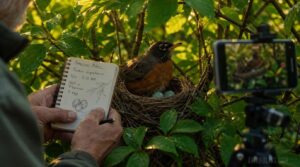
Watching nesting birds is rewarding on its own, but recording what you see turns your observations into something that actually helps science. Tools like NestWatch make it easy to contribute real data, and a few habitat tweaks can make your yard a safer place for birds to raise their young. Here’s how to do both.
Use NestWatch
If you’ve ever wished your backyard observations could matter beyond your own notes, NestWatch makes that possible. Run by the Cornell Lab of Ornithology, it’s a citizen science program that has tracked bird nesting across North America for 60 years — and your data becomes part of that record.
Getting started is straightforward. Volunteer training takes about 15 minutes online and covers safe observation practices before you ever approach a nest. Once registered, you can submit observations through the mobile app or website, with GPS tagging added automatically.
Here’s what the data entry process captures at each visit:
- Number of eggs present
- Number of nestlings or hatchlings
- Key dates such as first egg and hatch day
- Any notable parental or disturbance behavior
The app also uses AI species detection to identify over 200 North American birds with at least 90% accuracy, so you don’t need expert-level knowledge to contribute meaningfully. All submitted data feeds into an open data repository that researchers use to study nesting trends across species and regions — your visits genuinely advance conservation science.
Log Eggs and Chicks
Once your data is logged in NestWatch, what exactly should you be recording? Start with the basics: egg count and measurements. Most backyard bird eggs run one to two inches long, and clutches usually hold three to six eggs. Note the incubation start date too — hatching usually follows within 10 to 14 days.
When chicks appear, track their growth. Healthy nestlings triple their weight within the first week, and parents usually return to feed them every 15 to 30 minutes. If visits slow down or chicks seem lethargic, log that as well — those details matter to researchers monitoring local breeding success.
Take Careful Photos
Photos add a visual layer to your nest records that numbers alone can’t capture. But getting a good shot means putting the bird’s comfort first.
Here’s how to photograph nests without causing harm:
- Stay at least 5 meters away and use a 300mm or longer lens to close the distance optically, not physically.
- Shoot in natural light during mid-morning or late afternoon — soft, directional light reduces harsh shadows without needing flash, which can startle adults.
- Keep your camera on a tripod to eliminate sudden movements that might alarm a perched parent.
- Never share images that reveal nest locations — even well-meaning posts can attract predators or curious visitors.
Install Safe Nest Boxes
A well-placed nest box can quietly transform your yard into a reliable breeding site. Box placement height matters more than most people realize — mounting boxes 6 to 12 feet above ground keeps ground predators at bay. Pair that with a metal or PVC baffle on the pole, and climbing threats like raccoons and snakes lose their advantage entirely.
Entrance hole size is equally worth getting right. A 1.5-inch opening suits bluebirds; chickadees need a smaller 1⅛-inch hole that larger, competing birds simply can’t squeeze through. Smooth the edges carefully — rough wood around the opening can nick a bird’s wings on every trip in and out.
For materials and insulation, untreated cedar or pine with ¾-inch-thick walls regulates interior temperature far better than thin plywood. Drill small vent holes near the top and drainage holes at the bottom so the interior stays dry and breathable through spring rains.
| Feature | Recommendation | Why It Matters |
|---|---|---|
| Mounting height | 6–12 feet above ground | Reduces ground predator access |
| Entrance hole | 1.5" bluebird / 1⅛" chickadee | Excludes larger competing species |
| Wall thickness | ¾ to 1 inch untreated wood | Regulates temperature and durability |
Maintenance and cleaning close the loop. Clear out old nest material each fall — leftover debris harbors parasites that harm the next occupants. Don’t open the box mid-season when eggs or nestlings are present, and plan to replace aging boxes every 5 to 10 years as wood weathers and gaps form. Thoughtful nest box construction, done once and maintained well, offers seasons of reliable shelter to birds that genuinely need it.
Improve Bird Habitat
Think of your yard as a layered system — each addition stacks value for the birds using it.
Native trees and shrubs attract the insects that nestlings depend on most.
Add a shallow water source nearby, tucked close to protective cover, so birds drink without feeling exposed.
Fallen logs and varied plant heights round out the shelter, giving every species something worth staying for.
Frequently Asked Questions (FAQs)
Which bird species nest in urban areas?
Some birds have quietly made cities their home. House sparrows, robins, great tits, pigeons, warblers, and even tree swallows all nest in urban gardens, street trees, building ledges, and nest boxes.
How do I identify eggs by appearance?
Eggs vary in size, shape, and color by species. Look for smooth shells, speckles, or solid tones ranging from white to blue-green. A slightly pointed oval shape is most common.
Can weather delay the nesting season start?
Yes — cold snaps, heavy rain, and unsettled springs can all push nesting back by days or even weeks, as birds wait for the warmer, insect-rich conditions their chicks need to survive.
What predators most commonly raid bird nests?
The most common nest raiders include raccoons, snakes, jays, crows, foxes, and rats. Raccoons climb for eggs; snakes slip into boxes; jays strike by day; rats raid at night.
How long does a typical nest last?
Most songbird nests last just 4–6 weeks — built, used once, and left behind. Nest boxes, though, can endure 5 to 15 years, while raptors reuse platforms for decades.
Conclusion
The field glass never lies. Every time you learn how to watch nesting birds with patience and care, you’re doing something that matters far beyond a single morning in the meadow — you’re building a practice that sharpens your eye, steadies your presence, and deepens your respect for creatures that ask nothing of you except distance.
The nest will empty soon enough. What you carry away from watching, it’s entirely yours to keep.