This site is supported by our readers. We may earn a commission, at no cost to you, if you purchase through links.

A bird lands three feet away. You raise your binoculars, catch a glimpse of streaked brown and white, and it’s gone before you’ve named it.
Every birder knows that moment—the one that turns casual watching into an obsession with getting it right.
North America hosts over 900 bird species, and even experienced observers misidentify them regularly.
The difference between guessing and knowing comes down to a handful of sharp skills: reading size, field marks, behavior, sound, and using the right tools.
Master those, and the birds start telling you exactly who they are.
Table Of Contents
Key Takeaways
- Size and shape are your first filter — knowing whether a bird is sparrow-sized or crow-sized cuts your options quickly before you ever reach for a field guide.
- Field marks like breast streaks, wing bars, and eye rings aren’t decorations — they’re the bird’s ID card, and reading them correctly separates a guess from a confirmed species.
- Behavior and habitat reveal as much as feathers do — a bird’s foraging style, flight pattern, and the habitat it occupies can name a species before you even see its markings clearly.
- Tools like Merlin Sound ID, 8×42 binoculars, and eBird don’t replace your eye — they sharpen it, turning ambiguous sightings into confident, logged identifications.
Start With Size and Shape

Before anything else, size and shape are your fastest shortcut to narrowing down a species. You don’t need a name yet — just a rough read on the bird in front of you. Here’s what to look at first.
Pay attention to whether it’s sparrow-sized or crow-sized — Nevada backyard bird identification guide shows exactly how size and silhouette separate common species at a glance.
Compare Familiar Bird Sizes
When you’re out birding, start by comparing familiar bird sizes. Judge a bird’s length and mass against common species—think sparrow, robin, or crow. Use visual scale comparisons, estimating relative mass and body proportions in real time. Watch for silhouette size distortion from distance or lighting. Here’s a practical list:
- Sparrow-sized
- Robin-sized
- Crow-sized
- Goose-sized
Understanding the bird size categories guide helps improve these comparisons.
Notice Body Silhouette
Once you’ve gauged size, focus on the body silhouette. Study the outline for clues—tail shape profiles (square, forked, rounded) and wing tip projection beyond the tail hint at species.
Notice head neck contours and any crest that adds a peak. Body girth—slender or bulky—also helps.
These visual field marks sharpen your species determination in the field.
Study Beak Shape
The beak is fundamentally a bird’s toolkit.
A cardinal’s thick, conical beak drives enough force to crack hard seeds. A warbler’s thin, pointed beak probes for insects in tight spaces. Downward-curved beaks signal mud or water foragers. Wider beaks handle fruit and bulk.
Once you know the shape, the feeding strategy — and often the species — practically names itself.
Check Tail Length
Tail length is easy to overlook, but it’s one of the fastest sizing clues you have.
A long tail relative to body size suggests open-country species like American Kestrels. Shorter tails belong to forest specialists.
In flight, longer tails create a steadier glide; shorter ones mean tighter, quicker turns.
During molt, tails temporarily shorten — always factor in the season.
Watch Wing Structure
Wings tell a story before a bird moves a muscle.
Broad, rounded wings signal forest birds built for quick, tight turns — think Red-tailed Hawks or Barred Owls. Long, narrow wings belong to aerial specialists like swallows, built for sustained, efficient gliding.
Watch the wingtips too: pointed tips mean speed; slotted, finger-like tips mean soaring.
Read Key Field Marks
Once you’ve got size and shape locked in, it’s time to look closer. Birds carry a set of visual clues — wing bars, breast patterns, head markings — that narrow your ID fast. Here’s what to focus on.
Keeping a bird watching journal for seniors alongside your field sketches helps you connect those wing bars and markings to the date, weather, and location where you spotted them.
Wing Bars and Patches
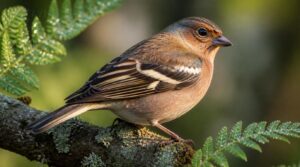
Wing bars are like a bird’s fingerprint — small details that reveal a confident ID. Look for pale covert feather edges running parallel to the wing, forming one or two distinct lines.
- Note bar width and spacing
- Check diagonal bar orientation when the wing folds
- Watch how light reflection shifts patch visibility
- Compare juvenile versus adult markings carefully
Breast Streaks and Spots
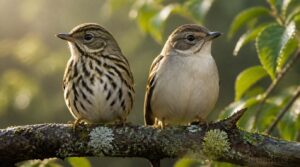
Breast streaks and spots are some of the most reliable species differentiation marks you’ll find. A heavily streaked breast points to species like the Song Sparrow, while a clean, unstreaked chest suggests a House Sparrow.
Coloration consistency matters — uniform spots tend to be benign pigmentation, but bold, contrasting streaks carry real ID weight. Trust the pattern.
Head Stripes and Eye Rings
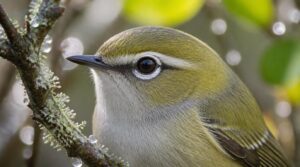
Head stripes and eye rings are small details that carry big identification weight. A bold white eye ring on a Nashville Warbler separates it instantly from similar species. Check the superciliary line too — that stripe above the eye often extends toward the bill, narrowing your options fast.
Lores contrast, iris color, and age class all sharpen your final call.
Plumage Color Patterns

Plumage tells a story before the bird moves a muscle. Melanin-based patterns — blacks, browns, and grays — form bars, spots, and scalloped edges across feathers. Carotenoid pigments produce yellows and reds, but only if the bird’s diet delivers them. Here’s what to scan for:
- Melanin bar or spot patterns on wings and tails
- Carotenoid brightness signaling diet quality
- Iridescent blues and greens that shift with light angle
- Scalloped or mottled feather edges adding texture clues
- Seasonal molt dulling fading vivid breeding colors
Structural colors — like a hummingbird’s gorget — rely on feather microstructure, not pigment. Tilt your binoculars slightly; iridescence shifts fast.
Male Versus Female Markings
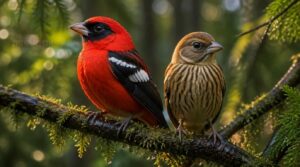
Sex matters more than you’d think in field ID. Sexual dimorphism is often your fastest shortcut — males usually flash bolder wing bars, heavier breast streaks, and more saturated body tones.
Females lean toward cryptic coloration, built for nesting concealment. During breeding season, watch for intensified male markings from seasonal molt.
A dull bird nearby often confirms the bright one’s species.
Use Behavior and Habitat Clues

Plumage only tells part of the story. A bird’s behavior and the habitat it calls home can be just as revealing as any field mark. Here are five clues to watch for.
Foraging Style
Watch how a bird feeds — it tells you almost as much as its feathers do. Ground foraging motions like leaf-flicking or low-stance scratching point to thrushes or towhees. Aerial insect capture — fast, snapping mid-flight grabs — signals flycatchers or swallows.
- Watch for leaf-flicking near fallen logs
- Notice beak snaps during flight
- Look for probing in mud or bark crevices
- Track seasonal diet shifts from seeds to insects
Flight Pattern
Flight tells you what feathers can’t. A woodpecker’s undulating dip-and-rise arc differs sharply from a hawk’s steady thermal glide. Small passerines beat their wings 8–12 times per second, producing quick, tight turns through woodland.
Falcons power-dive, then level fast. Vultures barely flap, riding thermals upward. Match that flight shape to your field marks, and confirmation comes quickly.
Perching Posture
Next, pay close attention to perching posture. Birds align their pelvis forward, tuck their feet beneath, and flex their knees for balance.
You’ll notice consistent toe tension gripping the branch, a slightly spread tail for stabilization, and wings folded tightly.
Watch for core engagement—they stay upright, adjust posture with wind, and shift subtly to scan surroundings.
These cues sharpen your behavioral analysis.
Flock or Solitary Habits
From perching posture, shift your eyes to how birds move socially. A bird’s choice to flock or go solo is one of the most telling behavioral signals you can read.
Flocking species like starlings and Cedar Waxwings use collective vigilance — more eyes mean faster predator detection. A hawk approaching a tight flock gets confused by the swirling mass. That’s predator dilution working in real time.
Flocking birds survive not by fighting predators, but by overwhelming them with numbers
Solitary birds — think Red-tailed Hawks — rely on stealth and early detection instead. They’d lose their competitive edge sharing a territory.
Seasonally, watch for shifts. Many species flock during winter or migration but split apart come breeding season. Mixed-species flocks are especially worth noting; chickadees often anchor them, and where chickadees go, warblers and nuthatches follow.
Match Birds to Habitats
In every habitat, birds reveal their secrets. Forest edges bring mixed flocks and nesters. Wetlands hold specialist waders and ducks, each tied to water. Grasslands reward ground-nesting larks and meadowlarks. Urban parks shelter adaptable species like hummingbirds and kestrels. If you know these zones, you’ll pinpoint species faster.
- Forest edge diversity
- Wetland niche specialization
- Grassland nesting strategies
- Urban habitat adaptation
Identify Birds by Sound

Sound is one of the most reliable tools in your birding kit. A bird you can’t see can still tell you exactly who it is. Here’s how to sharpen your ear and start identifying birds by their calls.
Listen During Dawn Chorus
The dawn chorus peaks 20–60 minutes before sunrise — step outside then and you’ll hear more birds than any other time of day. Sound travels farther at dawn because the air is still and cool.
Robins often lead, with warblers and sparrows joining fast. Urban dawns shift timing slightly, but that pre-sunrise window still delivers the richest listening opportunity.
Note Pitch and Rhythm
Pitch and rhythm are your two fastest clues once you’ve heard a bird. Pitch — how high or low a call sits — often reflects size. Smaller birds like warblers ring bright and high. Larger birds land lower.
Rhythm is the pattern: quick clipped notes versus long-drawn-out phrases. Tap along mentally to lock in the tempo.
Compare Calls Carefully
Two songs can sound almost identical until you listen closer. Start by comparing pitch contour variations — does the call rise, fall, or stay flat across its arc? A Song Sparrow drops toward the end; a Lincoln’s Sparrow stays mid-range.
- Compare trill rate differences between similar species
- Check call segment structure for intro notes or tail phrases
- Verify vocalization consistency across multiple bouts
Habitat acoustic adaptation shapes calls too — open-field birds project sharper, more piercing tones than woodland species.
Use Merlin Sound ID
Merlin Bird ID‘s Sound ID feature is one of the sharpest tools in your kit. Open the app, hit listen, and it analyzes live audio in real-time — converting sound into spectrogram representations that the model reads instantly.
It covers hundreds of species across North America.
Record somewhere quiet to reduce background noise and sharpen prediction accuracy.
Confirm With Visual Clues
Sound gets you close — visual clues seal the deal.
Once Merlin flags a species, scan quickly for silhouette and beak curvature to confirm. Check eye ring details, facial patterning, and breast streaks against what you see.
Seasonal plumage shifts color patterns, so size and shape matter most. Field marks don’t lie.
Improve Accuracy With Birding Tools
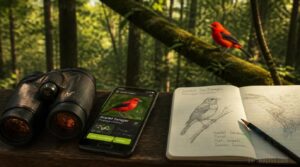
The right tools can make or break your time in the field. From optics to apps, each one sharpens how quickly and accurately you spot a species. Here’s what experienced birders actually rely on.
Choose 8×42 Binoculars
One piece of birdwatching equipment defines your early success: a quality pair of 8×42 binoculars.
- Lens brightness at dawn makes the difference between a mystery bird and a confirmed ID
- Roof prism, Bak4 glass delivers sharp feather detail even on fast-moving targets
- Weatherproof build keeps optics clear through fog, rain, and heavy humidity
Look for 15–20 mm eye relief and a field of view near 400 feet per 1,000 yards.
Carry Peterson Bird Guide
Good binoculars get you close — but the Peterson Field Guide tells you what you’re actually looking at. Its watercolor plates render plumage with striking accuracy, and comparative species thumbnails let you rule out lookalikes fast.
Grab the regional edition that matches your area. Use the range maps to confirm seasonal presence before committing to an ID.
Record Sightings in EBird
Every sighting you log in eBird does double duty — it sharpens your own records and feeds a global database used by real scientists. Start a checklist, enter each species with a count, and attach field notes on behavior or habitat.
Link your session to a local hotspot so location data is precise.
Regional editors may review flagged entries, so accuracy matters.
Use a Checklist Journal
eBird manages your digital trail, but a checklist journal keeps you grounded in the field.
Write down the date, location, and weather before anything else — context shapes every sighting.
Add a confidence rating per bird and track your daily streak.
That habit builds honest, reliable records over time.
Avoid Common ID Mistakes
Misidentification happens to every birder — even experienced ones.
- Lighting shifts can wash out breast streaks, making a Song Sparrow look plain
- Subtle wing bar gaps separate similar warblers that share nearly identical coloring
- Regional plumage variation means a Western House Finch may look unlike its Eastern counterpart
- Silhouette confusion between a Sharp-shinned and Cooper’s Hawk trips up many beginners
Always confirm with behavior, not color alone.
Frequently Asked Questions (FAQs)
What are common bird ID mistakes?
Bird ID mistakes are surprisingly common. Silhouette distortion, plumage variation, mimicry confusion, and background noise all trip up even experienced birders. Habitat anomalies can also place unexpected species in your path.
What clothing colors help you blend into nature?
Think of yourself as part of the landscape. Earth tones — greens, browns, grays — break your silhouette against foliage. Matte fabrics kill glare. Low-saturation hues stay invisible at distance.
When is the best time of day to birdwatch?
Early morning wins every time. The two hours after sunrise — roughly 6 to 8 AM — deliver peak bird activity. That’s when the dawn chorus is loudest and foragers are most visible.
How do weather conditions affect bird activity levels?
Weather shapes bird activity more than most beginners expect. Cold temperatures push small passerines to feed aggressively, while heavy rain silences them entirely. Wind drives birds into sheltered spots, reducing visible movement across open ground.
Can beginners join local birding clubs or groups?
Absolutely — most local birding clubs welcome beginners with zero experience. Many offer free guest walks, mentorship from seasoned birders, and beginner-friendly outing schedules. You’ll find a ready birding community waiting.
How does habitat fragmentation impact bird population diversity?
Habitat fragmentation breaks continuous forest into isolated patches, driving interior species decline and genetic diversity loss. Edge effect predation spikes, while generalists dominate.
Habitat corridors restore movement, slowing biotic homogenization and supporting long-term species richness.
Conclusion
identify species correctly about 90% of the time — new birders often hover much closer to 30%. These five tips for identifying birds while watching are exactly what close that gap over time.
Size, field marks, behavior, sound, and the right tools each sharpen a different edge of your eye. One skill builds naturally on the next.
The bird that vanished before you named it — next time, you’ll have it before it even moves.
- https://www.pennington.com/all-products/wild-bird/resources/bird-identification-skills
- https://birdschoice.com/blogs/news/how-to-identify-birds-in-your-backyard
- https://www.flockingaround.com/post/how-to-identify-a-bird
- https://www.allaboutbirds.org/news/build-your-bird-id-skills-size-shape
- https://www.thelookoutaz.com/weekly-articles/birding-using-habitat-to-help-identify-wild-birds