This site is supported by our readers. We may earn a commission, at no cost to you, if you purchase through links.
A backyard sparrow landed on a fence post, and your kid froze—binoculars raised, completely locked in.
That moment of pure focus tells you something: birds make irresistible teachers.
They’re everywhere, they move, they have jobs to do, and curious kids notice all of it.
The challenge isn’t sparking the interest—it’s building the skills to turn a sighting into real knowledge.
The right bird identification guides for homeschooling give that curiosity somewhere to go, pairing field tools with anatomy worksheets, apps, and hands‑on activities that make science feel less like a subject and more like an adventure waiting outside your door.
Table Of Contents
Key Takeaways
- A few well‑chosen tools—binoculars, a solid field guide, and anatomy worksheets—are all you need to turn backyard curiosity into real bird ID skills.
- Free apps like Merlin Bird ID and eBird let kids identify birds by photo or sound and contribute their sightings to real conservation science.
- Bird study naturally stretches across multiple subjects—sketch anatomy for art, map migrations for geography, and tally species for math.
- Starting simple and consistent works best: one daily observation, a short journal entry, and the right guide build a lifelong birder.
Essential Bird Identification Tools for Homeschooling
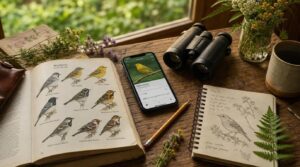
Getting started with bird ID doesn’t have to mean expensive gear or complicated setups. A few well-chosen tools can make all the difference for your homeschool lessons. Here’s what’s worth having on hand.
A solid bird field guide picked for classroom learning gives kids a tangible reference that bridges backyard sightings with real identification skills.
Kid-friendly Binoculars for Beginners
Good binoculars can make or break a first birding session. Here’s what to look for in kid-friendly binoculars:
Parents should include breakaway neck straps for added safety.
- 6x to 8x magnification reduces shake and makes bird identification easier
- Wide field of view — around 350 feet at 1,000 yards — helps track fast movers
- Under 300 grams for comfortable, prolonged outdoor use
- Rubberized, non-slip grip prevents accidental drops
- Adjustable interpupillary distance fits a range of young faces
Printable Bird Anatomy Worksheets
Once your young birder can spot a bird through binoculars, the next step is knowing what they’re actually looking at.
Printable Bird Anatomy Worksheets make that click happen. They cover beak shape labels, feather types, wing bone charts, and foot morphology — giving kids a clear, structured way to build real bird ID skills right at your kitchen table.
Bird Feet & Beak Function Cards
Now that anatomy worksheets have given your child the vocabulary, Bird Feet & Beak Function Cards put that knowledge to work.
Each card connects a beak or foot type to a real feeding strategy — conical beaks crack seeds, hooked beaks tear flesh, webbed feet paddle through water.
Kids sort, match, and label, turning quiet observation into confident bird identification.
Graphic Organizers for Bird Traits
Sorting cards build pattern recognition — and graphic organizers take it further. These tools map bird body shape, beak type, and feet to habitats and behaviors in one clear view. Color-coded sections, icon symbols, and trait comparison charts help kids connect what they see to what it means.
- Habitat Trait Maps link features to environments
- Life Cycle Flowcharts track growth stages visually
- Color-coded organizers separate feeding, nesting, and migration
- Icon Symbol Organizers reinforce vocabulary fast
Bird Coloring Pages for Practice
Coloring birds is one of the quietest ways to build real bird identification skills. Each page trains your eye — noticing beak shape, feather patterns, and body proportion before you ever step outside.
Coloring birds trains your eye to notice beak shape and feather patterns before you ever step outside
These bird coloring pages pair naturally with your anatomy sheets and trait cards, making them a low-pressure but effective bird identification tool for everyday practice.
Top Bird Identification Guides for Homeschoolers
A good field guide can make all the difference when your kids are just starting to notice the birds around them. The right one feels less like a textbook and more like a trusted companion on every backyard adventure. Here are four guides worth keeping on your homeschool shelf.
1. National Geographic Kids North America Bird Guide
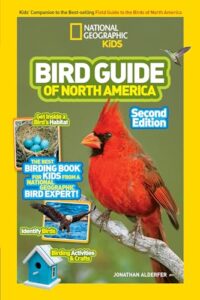
The National Geographic Kids Bird Guide covers 150 North American species, with full two-page spreads for 50 popular birds. Each profile includes range maps, wingspan, weight, and quick visual identifiers.
For birders ready to go beyond visual IDs, pairing the guide with tips on identifying birds by song and calls can sharpen your skills in the field.
Birds are grouped by habitat — backyards, wetlands, forests, and deserts — so your child builds real context, not just a list.
At $10.49 and 208 pages, it’s practical and affordable. It also includes hands-on projects like building feeders and birdbaths, making it a natural fit for active learners.
-focused, so Canadian families may find some of their local birds missing.
- Only 50 species get full profiles — the other 100 are pretty brief, so it’s not a deep field guide.
- Serious young birders will likely outgrow it fast; it’s a starter book, not a long-term reference.
| Best For | Kids ages 6–12, homeschool families, and grandparents looking for a fun way to get children interested in birds and the outdoors. |
|---|---|
| Price | $10.49 |
| Page Count | 208 pages |
| Publisher | National Geographic Kids |
| Target Audience | Kids & families |
| Illustrations | Photos & drawings |
| Conservation Content | 6 ways to help birds |
| Additional Features |
|
- Covers 150 species with great photos, illustrations, and range maps — easy for kids to flip through and actually use.
- Hands-on projects like building feeders and birdbaths keep active and ADHD-friendly learners engaged beyond just reading.
- At $10.49 for 208 pages, it’s a genuinely affordable gift that holds up as a reference over time.
- Leans heavily U.S.
2. Young Birder Guide to North American Birds
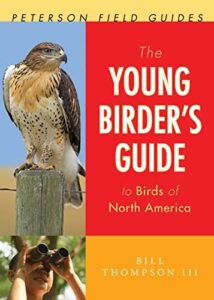
Step up from the National Geographic guide, and The Young Birder’s Guide to North American Birds is ready to meet your child where they are.
It covers ~300 common species — nearly double — with color photos, hand-drawn illustrations, and range maps for each one.
Short "wow facts" spark curiosity without overwhelming beginners.
At just $14.82 and compact enough to slip into a backpack, it’s built for real field use, not just the bookshelf.
| Best For | Kids and beginner birders who want a hands-on field guide they can actually take outside without feeling lost. |
|---|---|
| Price | $14.82 |
| Page Count | 368 pages |
| Publisher | Mariner Books |
| Target Audience | Beginner birders |
| Illustrations | Photos & illustrations |
| Conservation Content | Habitat information |
| Additional Features |
|
- Covers ~300 common species with photos, illustrations, and range maps — way more than most starter guides
- "Wow facts" and vocalization notes make it genuinely fun and easy to engage with
- Compact and affordable at $14.82 — built to go on hikes, not sit on a shelf
- Only 300 species, so some common birds (like the American Tree Sparrow) don’t make the cut
- The stiff binding makes it awkward to hold open in the field
- Thin on migration coverage, so you may need a second resource come spring and fall
3. Birdology Kids Activity Book
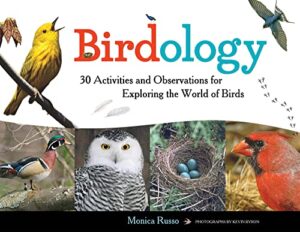
Birdology isn’t just a guide — it’s a hands-on science lab your child carries outside.
The 30 activities cover feeding, nesting, migration, and life cycles, all with clear instructions and age-appropriate goals. Kids build juice-box feeders, sketch flight silhouettes, and log weekly backyard sightings.
Writing and drawing prompts pair naturally with each activity, making it easy to weave in language arts. At $19.99 and 128 pages, it’s a solid, affordable pick for ages 6–10.
| Best For | Kids in upper elementary school (roughly ages 8–12) who love being outside and learn best by doing — plus teachers looking for one book that stretches across multiple grade levels. |
|---|---|
| Price | $19.99 |
| Page Count | 128 pages |
| Publisher | Chicago Review Press |
| Target Audience | Elementary students |
| Illustrations | Full-color photos |
| Conservation Content | Wildlife org contacts |
| Additional Features |
|
- 30 hands-on activities covering feeding, nesting, and migration make it feel more like an adventure than a textbook.
- At $19.99, it’s an easy buy — and the writing prompts make it pull double duty for science and language arts.
- Works just as well at home as in the classroom, with family-friendly projects like building a juice-box feeder or planting hummingbird flowers.
- Younger or early readers may struggle — the reading level fits upper elementary better than early grades.
- English only, so families who speak other languages will need extra support.
- Bird illustrations aren’t credited, which is a small but noticeable gap if artistic attribution matters to you.
4. Big Book of Birds
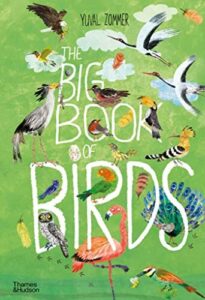
If your child is drawn to big, bold visuals, The Big Book of Birds delivers. Published by Thames & Hudson, its full-color illustrations by Yuval Zommer cover everything from hummingbirds to puffins across 64 oversized pages.
Each spread includes concise fact bubbles, habitat notes, and hidden eggs to spot — keeping young readers engaged. It’s best suited for ages 4–7 and works well for read-alouds. At $16.96, it’s an affordable, visually rich starting point.
| Best For | Kids ages 4–7 who love big, colorful pictures and parents looking for a fun, low-pressure way to spark curiosity about birds and nature. |
|---|---|
| Price | $16.96 |
| Page Count | 64 pages |
| Publisher | Thames & Hudson |
| Target Audience | Ages 4-7 |
| Illustrations | Full-color illustrations |
| Conservation Content | Bird-friendly gardening |
| Additional Features |
|
- Yuval Zommer’s bold, full-color illustrations make it genuinely fun to flip through — kids and adults alike will stop and look
- Hidden eggs and fact bubbles keep it interactive, so it doesn’t just sit on the shelf
- Great value at $16.96 for a large-format book that works for read-alouds, homeschool, or solo exploring
- The stylized illustration style isn’t for everyone — if you want realistic bird art, this isn’t it
- It’s a wide introduction, not a deep dive — don’t expect field-guide-level detail
- The oversized format is a bit bulky for little hands and definitely won’t fit in a backpack
Interactive Bird Identification Apps and Platforms
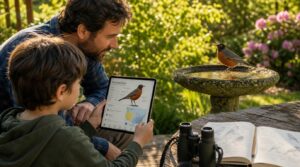
Apps have changed the way families learn birds together. The right platform can turn a quick backyard sighting into a real teaching moment. Here are the tools worth knowing.
Merlin Bird ID App Features
The Merlin Bird ID App is like carrying a field expert in your pocket. It uses Sound ID Offline to identify birds by their calls — no internet needed.
Photo ID accuracy improves when you add your location and date.
The app also offers offline regional packs and pulls from millions of community submissions to make every identification smarter over time.
EBird Mobile App for Citizen Science
The eBird mobile app takes your bird journaling to a whole new level. It’s built for citizen science — meaning your family’s observations actually contribute to global bird monitoring efforts.
- Log sightings offline, then sync later
- Record location, date, species, and count
- Explore community hotspot maps nearby
- Contribute data to real conservation research
Sound and Photo ID Tools
Once you’ve logged a sighting, identifying what you heard or saw gets easier with the right tools. Merlin Bird ID offers both Sound ID and Photo ID features.
Point your phone at a bird or record its call — Merlin analyzes it instantly. It even shows audio spectrograms so kids can see a bird’s song as a visual pattern.
Digital Bird Life Lists
Identifying a bird is satisfying. Saving that sighting forever? Even better.
Apps like Merlin Bird ID and eBird build your automated life list as you go — every bird you log gets added to a running total, organized by location and date.
Here’s what your digital list can do:
- Track first-ever sightings (called lifers)
- Organize birds by region or country
- Attach photos to each sighting
- Add notes on habitat or behavior
- Export your list as CSV or PDF
Regional Bird Packs for Offline Use
Your life list grows online — but what about when you’re hiking with no signal?
That’s where regional offline packs shine.
When you download Merlin Bird ID, you can grab packs that include offline species checklists, regional audio packs, portable field maps, and offline search filters.
Each pack also contains regional habitat notes, so your kids always have a reliable mobile field guide nearby.
Printable and Hands-on Bird Activities
Learning about birds doesn’t have to stay on the page. These hands-on activities bring the lessons to life, whether you’re working at the kitchen table or out in the backyard. Here’s a look at some of the best printable and activity-based tools to add to your homeschool routine.
Life Cycle of a Robin Sequencing Cards
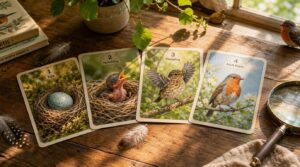
Few activities make a bird unit study click the way sequencing cards do. The Life Cycle of a Robin Printables walks your child from egg to adult through six to eight illustrated stages.
Color coding separates each developmental stage, so even young learners can sort the cards independently. It’s a simple, hands-on classroom activity that quietly builds real bird identification skills.
Bird Bingo and Scavenger Hunts
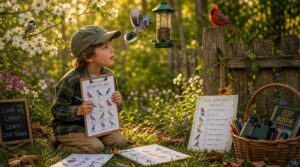
Bird Bingo and scavenger hunts turn your backyard or local trail into a living bird identification guide.
Bingo cards feature local species, while scavenger hunt checklists prompt kids to notice beak shape, color, and calls.
Both fit naturally into your homeschool curriculum and build real observation skills — no fancy setup needed, just a clipboard and curious eyes.
Bird Feeder Craft for Backyard Study
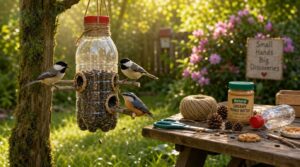
Building a bird feeder craft together is one of the best ways to turn your backyard into a living classroom. A recycled plastic bottle or a few cedar scraps can become a feeder that draws real visitors right to your window.
Pair what you see with Merlin Bird ID to name each species as it arrives.
Binocular Craft for Young Learners
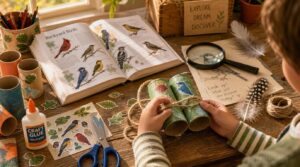
Young learners don’t need fancy gear to feel like real birders. A simple cardboard binoculars craft gives them something tangible to hold outside.
Here’s what makes it work:
- Safety supplies keep it stress-free — use craft glue and blunt scissors
- Fine motor skills grow through cutting, gluing, and decorating
- A neck string adds outdoor focus during walks
- Stickers make each DIY craft feel personal
Bird Research and Writing Sheets
Once you’ve built those cardboard binoculars, your kids are ready to record what they find.
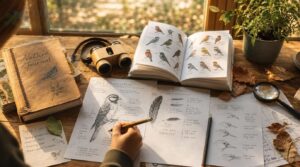
Bird Research Sheets give them a real structure for that — logging date, location, habitat, weather, and physical traits like beak shape and plumage pattern. Pair those with Bird Writing Sheets for reflection and comparison prompts that build both science and literacy skills together.
Integrating Bird Guides Into Homeschool Curriculum

Bird guides aren’t just for backyard walks — they fit right into your homeschool day in more ways than you’d think. Whether you’re covering science, writing, or geography, there’s a natural place for birds in the mix. Here’s how to weave bird identification into your curriculum and make it work for your whole family.
Science Unit Alignment and Lesson Plans
A solid bird unit doesn’t just happen — it needs a clear structure. Lessons built around NGSS performance expectations give your student specific, measurable goals.
The 5E instructional model (Engage, Explore, Explain, Elaborate, Evaluate) keeps each lesson purposeful. Exit tickets at each session help you spot gaps early and adjust before moving on.
Multidisciplinary Learning With Bird Guides
Bird guides don’t stop at science. A good bird identification guide naturally connects to art, writing, geography, and math — making it one of the most flexible homeschooling resources around.
Here’s what that can look like:
- Sketch and label bird anatomy to blend art with science curriculum integration.
- Map migration routes to bring geography and seasonal patterns to life.
- Count and tally backyard species to practice basic math through real observation.
Family team learning makes each activity richer. When everyone joins in, bird watching becomes a shared story, not just a lesson.
Observation and Data Collection Skills
Once you’ve explored multidisciplinary learning, it’s natural to ask: how do you actually record what you see?
Field journaling is your starting point. Spend five minutes observing, then note the time, weather, and species count. Behavior tracking — feeding, singing, flying — turns a simple sighting into real data.
| Skill | How to Practice |
|---|---|
| Observation Timing | Log start and end times per session |
| Weather Logging | Record temperature and wind conditions |
| Sketching Birds | Draw field marks from your bird identification guide |
| Field Identification Skills | Compare plumage and beak shape on-site |
| Behavior Tracking | Note feeding, calls, and movement patterns |
Birdwatching apps like Merlin help confirm uncertain IDs in the field.
Free Downloadable Worksheets and Planners
Once you’ve sharpened your observation skills, you’ll want somewhere to record it all. Free downloadable worksheets and planners make that easy.
Your Bird Unit Study Pack can include graphic organizers, journal templates, and planner pages. Many offer worksheet accessibility options like large print or editable fields.
A free unit study planning pack keeps your whole bird curriculum organized in one place.
Community Sharing for Homeschool Families
You don’t have to figure this out alone. Many homeschooling families connect through local groups to swap resources, plan co‑op lessons, and share bird identification tools.
Resource Swap Events and Shared Digital Catalogs make it easy to find guides, apps, and worksheets without spending much.
Your birdwatcher community is closer than you think.
Frequently Asked Questions (FAQs)
What age is best to start birdwatching?
Starting early works beautifully. Kids as young as 5 can enjoy birdwatching with simple, supervised activities. By age 7 or 8, most children handle short outdoor walks with ease.
How do I teach bird migration to kids?
Start with a migration story narrative — follow one bird’s journey south and back. Then map the route, keep a seasonal bird journal, and use apps like eBird for real citizen science data.
Can bird study count as science credit?
Yes, bird study can count as science credit. You need a structured syllabus, documented lab hours, and a final project. A supervisor must verify your work and add it to your official transcript.
Which backyard birds are easiest to identify?
Some birds practically introduce themselves. The Northern Cardinal, American Robin, and Blue Jay are top picks — bold colors, common feeder visitors, and year-round residents make them perfect first birds for visual identification.
How do I create a bird journal routine?
Pick one consistent time each day — morning works well. Jot the date, weather, and what you see. Keep it short. A simple birdwatching journal habit builds itself when the routine feels easy.
Conclusion
Every great birder starts by missing the bird entirely—binoculars pointed at empty branches while the sparrow flies off laughing. That’s not failure; that’s the beginning.
The best bird identification guides for homeschooling turn those misses into motivation, giving your child tools to look sharper next time.
Between field guides, apps, and hands-on activities, the backyard becomes a living classroom.
Eventually, your kid won’t just spot the bird—they’ll know its name, its song, and exactly why it’s there.