This site is supported by our readers. We may earn a commission, at no cost to you, if you purchase through links.
Each autumn, a chickadee you’ve watched all summer becomes a stranger wearing new clothes. The bird’s colors don’t fade—they’re rebuilt from scratch, one feather at a time, through a tightly orchestrated biological process that begins the moment daylight starts shrinking in late summer.
Shortening days trigger a hormonal cascade involving melatonin, thyroid hormones, and declining testosterone, all coordinating to activate dormant follicle stem cells. The result shapes everything from winter survival odds to how well a bird hides from a hawk mid-migration.
Autumn feather color transformation runs deeper than seasonal aesthetics—it’s a masterclass in biological engineering worth understanding.
Table Of Contents
- Key Takeaways
- What is Autumn Feather Color Transformation?
- Why Feathers Change in Autumn
- How Feather Colors Are Created
- Autumn Molting and Energy Needs
- Survival Benefits of Seasonal Plumage
- Frequently Asked Questions (FAQs)
- What is the word for autumn leaves changing color?
- Why are my bird’s feathers changing color?
- What kind of change is autumn leaves changing color?
- How to change the color of feathers?
- Can urban birds still molt on artificial lighting?
- Do migratory routes affect feather color timing?
- Which bird species molt twice per year?
- How does altitude influence seasonal plumage changes?
- Can feather color predict a birds overall health?
- Conclusion
Key Takeaways
- Shortening autumn days trigger a hormonal cascade—melatonin, thyroid hormones, and dropping testosterone—that wakes up dormant feather follicles and kicks off a full molt.
- Birds don’t just fade into winter; they rebuild their plumage from scratch, swapping bright breeding colors for muted, cryptic tones designed to keep them hidden and alive.
- The color you see in a feather comes from two very different systems: melanin produces blacks and browns from within, while carotenoids—borrowed entirely from diet—create the yellows and oranges.
- Molting is serious physical work, pushing a bird’s metabolic rate up nearly 30%, which means diet quality during autumn directly shapes whether a bird heads into winter strong or vulnerable.
What is Autumn Feather Color Transformation?
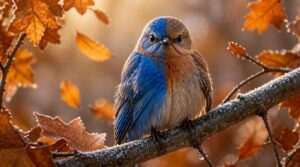
Every autumn, birds go through one of nature’s quieter transformations — trading bright feathers for subtler ones, almost like swapping a summer wardrobe for something built to last the cold.
It’s a process birds manage instinctively, though understanding feather preening and molt care practices can help you support them through it.
It’s not random, and it’s definitely not just fading in the sun. Here’s what’s actually happening when plumage shifts with the season.
Seasonal Plumage Changes
Every autumn, birds undergo seasonal plumage changes driven by a precise biological rhythm. As daylight shortens, photoperiod influence triggers a hormonal switch that signals the body to replace old feathers through molting. These transitions often enable essential camouflage adaptations for species like the Rock Ptarmigan.
Key changes you’ll notice include:
- Shifts from bright breeding colors to subdued, cryptic tones
- Activation of feather follicles by seasonal hormone shifts
- Gradual replacement of worn feathers across the body
Molting Versus Color Fading
Not all color changes you see in autumn birds follow the same path. Molting replaces feathers entirely, while color fading dulls existing ones through pigment loss—no new growth involved.
Molting follows hormonal and photoperiodic cues, whereas fading is influenced by diet and metabolic state. One swaps the feather; the other simply dims it.
Breeding and Nonbreeding Plumage
Think of autumn as the moment birds quietly swap one wardrobe for another. Breeding plumage features brighter colors and bold patterns designed purely for attracting mates. Once the season shifts, nonbreeding plumage takes over — duller, more cryptic, built for survival.
Sexual dimorphism means males usually make the more dramatic switch, while females show subtler seasonal variation through molt timing.
Why Autumn Matters
Autumn isn’t just a backdrop — it’s a biological deadline.
As daylight shrinks, a photoperiodic hormonal cascade kicks off inside birds, driven by a melatonin production surge that signals feather follicles to begin prebasic molt. Shorter days, dropping temperatures, and dietary carotenoid depletion all converge at once, making autumn the season where survival biology quietly becomes the focal point.
Why Feathers Change in Autumn
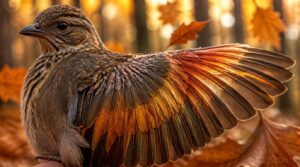
Autumn doesn’t just cool the air — it rewires a bird’s biology from the inside out. The shift in daylight hours sets off a chain reaction that touches hormones, feather follicles, and even how stress affects plumage quality. Here’s what’s actually driving that transformation.
Shorter Daylight Signals
As days grow shorter each autumn, birds don’t just feel it — their bodies respond to it. Photoperiodism, the biological sensitivity to changing day length, acts as nature’s timer. When daylight drops below a critical threshold, specialized sensors in a bird’s brain detect the shift and trigger adaptive timing responses that set the entire molting process in motion.
These shifts in behavior and biology are explored further in this winter migratory bird survival and timing guide, which unpacks how day length drives each instinctive response.
Hormonal Molting Triggers
Once shorter days trigger melatonin release, your body’s equivalent of a seasonal alarm sounds — and for birds, that alarm sets off a complex hormonal cascade. Thyroid hormones surge first, signaling feather follicles to prepare for keratin production. Simultaneously, prolactin peaks, helping decouple breeding from molting so both don’t compete for energy.
As testosterone declines post-breeding, it lifts suppression on follicle stem cells, enabling molt to begin. Meanwhile, molt inhibiting hormone decreases, releasing follicles from their resting state. Chronic stress elevates corticosterone levels, which can quietly sabotage keratin synthesis — producing weaker, duller replacement feathers.
Feather Follicle Activation
Nestled beneath each feather, feather follicles remain as permanent structures in the skin. When photoperiod drops, stem cell activation begins in the follicle collar bulge.
- Dermal papilla signals control when the feather germ forms
- Feather germ formation shapes barbs and barbules
- Melanocyte transfer sets color before keratin hardens
This follicle replacement cycle drives seasonal plumage changes during fall bird molting.
Stress and Feather Quality
When a bird faces chronic stress during molt, its body pays a real price. Elevated corticosterone levels suppress keratin synthesis, producing weaker feathers with feather fault bars — thin, brittle bands marking where growth stalled. Nutritional stress compounds this, limiting the protein feathers need.
Together, these pressures can reduce feather color saturation and slow complete molting, leaving birds more vulnerable heading into winter.
Age-related Color Shifts
Age doesn’t just slow birds down — it quietly rewrites their colors too.
Melanin degradation and carotenoid decline mean older birds produce feathers with visibly reduced saturation, especially in reds and oranges. Structural iridescence also dims as keratin microstructures wear and lose precise spacing.
Add feather wear between molts, and molt timing shifts further, making autumn’s seasonal plumage change a slower, duller process with each passing year.
How Feather Colors Are Created
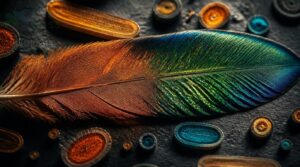
Bird feathers aren’t just colored — they’re engineered. The hues you see come from a surprisingly small set of biological tools, each working in a different way. Here’s how those systems actually produce the colors that shift so dramatically every autumn.
Melanin Feather Pigments
Melanin is the backbone of feather pigmentation in most birds. Two forms drive fall bird plumage changes: eumelanin produces blacks and grays, while pheomelanin ratio shifts create warm browns and rusty tones. Their balance — not sheer volume — shapes the final shade.
- Eumelanin synthesis pathways convert tyrosine into stable dark pigments inside follicle melanocytes
- Melanosome distribution patterns determine how densely pigment packs into each barbule
- Melanin mass contribution remains bounded, so color depth doesn’t simply equal more pigment
- Genetic melanin regulation controls which pigment form dominates during seasonal plumage change
Melanistic individuals show what happens when this system tips too far — feathers darken dramatically through excess deposition.
Carotenoid Yellow and Orange
While melanin builds the dark and earthy tones you’ve just seen, carotenoid pigments handle the warm end of the spectrum — the yellows and oranges that glow across autumn plumage.
Unlike melanin, birds can’t produce carotenoids themselves. Dietary sources — seeds, fruits, and carotenoid-rich insects — supply everything. What a bird eats directly shapes how vivid its seasonal plumage change looks.
| Pigment | Source | Color Produced |
|---|---|---|
| Lutein | Leafy greens, seeds | Soft yellow |
| Beta-carotene | Fruits, insects | Bright orange |
| Zeaxanthin | Seeds, berries | Golden yellow |
During molting, carotenoid deposition peaks as follicles absorb pigments transported through lipoproteins. Pigment stability matters too — oxidation fades intensity over time, especially under harsh light. Antioxidants in the diet help preserve color brightness through winter, supporting both camouflage and visual signaling for future breeding.
Structural Blue Coloration
Not every feather color comes from a pigment. Structural blue coloration works differently — it’s built into the physical architecture of the feather itself.
Tiny nanostructures scatter and reflect blue light through a process called Bragg layer interference, similar to how the Blue Morpho butterfly’s wings glow without a single drop of blue pigment.
Iridescent Feather Effects
Structural iridescence takes things a step further than simple blue scattering. Here, nanoscale melanosome arrangements within feather barbules create multiple overlapping light reflections. These reflections interfere constructively, producing vivid hues that shift with viewing angle — a phenomenon called angle-dependent hue. Watch a grackle move through autumn light, and you’ll see purple dissolve into green within seconds.
In iridescent feathers, pure physics turns purple to green as the light shifts
This iridescent color shift isn’t pigment — it’s pure physics.
Abnormal Plumage Patterns
Not every bird you spot this autumn will wear typical colors. Abnormal plumage patterns arise from disruptions in pigment production, and they’re more common than you might expect.
A leucistic bird carries partial white patches while retaining normal eye color, whereas an albino bird shows completely white feathers with distinctive pink or red eyes. Melanistic individuals display unusually dark, dense plumage, and dilute birds appear washed-out or pale — like a faded photograph of themselves.
Autumn Molting and Energy Needs
Molting isn’t just about looking different—it takes real work from a bird’s body. Replacing feathers demands serious energy, the right nutrients, and some clever biological trade-offs along the way. Here’s what that process actually involves.
Complete Prebasic Molts
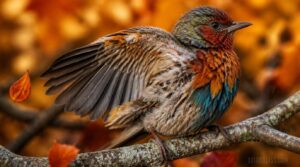
Think of the complete prebasic molt as a bird’s annual reset button. During this process, your autumn observations reveal birds replacing every feather — body, wing, and tail.
Juvenile plumage change marks a critical age classification baseline for field identification. Rapid feather growth demands intense protein synthesis, as keratin-dense feathers drive a bird’s metabolic rate increase of nearly 30 percent.
Partial Feather Replacement
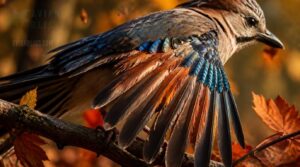
Not every bird undergoes a full annual reset. Partial feather replacement lets many species refresh specific tracts — wing coverts, contour patches, or select primary flight feathers — without replacing everything at once.
- Stepwise primary replacement preserves some flight capability throughout
- Wing covert molt can occur independently from inner feathers
- Patch renewal refreshes color in targeted areas progressively
- Growth rate variation depends on protein intake and body condition
Temporary Flightless Periods
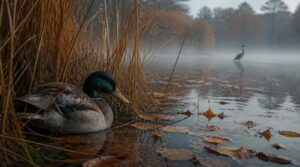
During seasonal molting, some birds pay a steep price: they temporarily lose the ability to fly. This predation risk window opens when synchronous wing replacement pulls all primary flight feathers at once.
Ducks entering eclipse plumage are a clear example — grounded and vulnerable, they rely on camouflage and fat reserve utilization to survive until new feathers grow back.
Protein for Keratin Growth
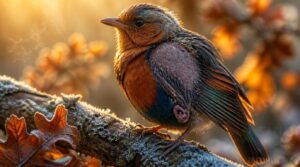
Feathers are made of over 90% keratin, a protein your body builds from amino acids like cysteine and methionine. During fall bird plumage changes, feather follicles demand sulfur-rich amino acids to form the disulfide bonds that give new feathers their strength and flexibility. Without adequate methionine intake, keratin synthesis stalls and feather quality visibly suffers.
Iron and zinc quietly support this process too, enabling the enzyme functions that drive keratin repair and regeneration.
Higher Metabolic Demands
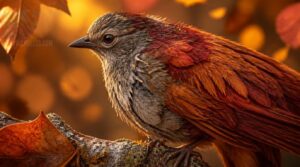
Molt is basically a second job for a bird’s body.
During prebasic molt, a bird’s resting metabolic rate climbs nearly 30 percent, driven by mitochondrial ATP demand in active feather follicles. Corticosterone energy mobilization draws on fat reserves to fuel rapid keratin assembly, while thyroid hormones keep the engine running at the right pace for successful seasonal adaptation.
Survival Benefits of Seasonal Plumage
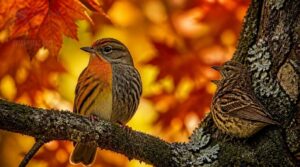
Seasonal plumage isn’t just about looking different — it’s about staying alive. Birds that wear the right colors at the right time eat better, travel safer, and avoid becoming someone else’s meal. Here’s what makes autumn plumage such a powerful survival tool.
Winter Camouflage Advantages
When winter arrives, snow background matching becomes a matter of life and death for many birds. White and light gray plumage blends into snow-covered landscapes, reducing visual detection at typical hunting distances.
The Ptarmigan is a striking example — it shifts from mottled brown to snow-white winter feathers, making it nearly invisible against open snowfields.
Drab Eclipse Plumage
Not all autumn camouflage is about snow-blending. Some birds do it differently.
Male ducks adopt drab eclipse plumage after breeding, swapping iridescent head and throat feathers for muted brown and grey tones. This nonbreeding plumage reduces predator detection while they’re briefly flightless during molting. The color change period lasts weeks, fading courtship signals until the next breeding cycle restores their bright colors.
Migration Concealment Colors
Migration doesn’t just demand stamina — it demands invisibility.
Birds moving through open skies and unfamiliar terrain rely on migratory feather camo to reduce predator detection. Gray-brown and olive-tan tones dominate the autumn concealment palette, matching bare branches and leaf-littered ground with quiet precision.
Here’s what makes seasonal shade blending so effective during migration:
- Matte feather surfaces minimize glare in diffuse autumn light, reducing visibility from above
- Subtle speckling patterns break up a bird’s silhouette against multi-hued backgrounds
- Disruptive wing patterns obscure movement during flight, confusing predators mid-pursuit
- Camouflage color palette shifts toward olive-tan, matching ground textures along migratory corridors
- Autumn light adaptation favors low-contrast plumage that disappears into shadowed undergrowth
These seasonal color changes aren’t accidental. Environmental adaptation shaped every muted tone across millions of migratory generations.
Diet and Color Intensity
Feathers don’t lie about what a bird eats. Carotenoid intake directly shapes yellow, orange, and red hues — birds can’t synthesize these pigments internally, so diet does the heavy lifting.
| Dietary Factor | Effect on Plumage |
|---|---|
| Carotenoid-rich insects | Deepens orange and red pigmentation |
| Protein quality | Reinforces keratin structure for pigment retention |
| Antioxidant diet | Prevents oxidative fading during molt |
| Dietary diversity | Broadens the seasonal color palette |
Dietary pigments from colorful plants and carotenoid-rich insects determine how vivid those seasonal color changes truly appear.
Identifying Autumn Birds
Knowing a bird ate well is one thing — spotting it in the field is another.
In autumn, you rely on persistent field marks: eye rings, tail edge patterns, and beak shape stay consistent even as body color fades. The Redwing’s pale eye stripe and Fieldfare’s spotted breast remain readable clues regardless of molt stage.
Frequently Asked Questions (FAQs)
What is the word for autumn leaves changing color?
The seasonal transformation of tree leaves is commonly called autumn foliage or fall colors. As chlorophyll fades, hidden carotenoid pigments reveal yellows and oranges, while anthocyanins produce vivid reds.
Why are my bird’s feathers changing color?
It’s no coincidence that your bird’s feathers are shifting color right now. Shorter daylight hours trigger hormonal changes that activate molting, swapping bright plumage for muted, survival-ready tones perfectly timed for the season.
What kind of change is autumn leaves changing color?
Autumn leaves changing color is a seasonal pigment shift. As daylight shortens, chlorophyll degrades, revealing hidden carotenoids while trees synthesize anthocyanins, producing vivid reds, oranges, and yellows before leaves drop.
How to change the color of feathers?
Feather color changes through diet, hormones, and molting. Carotenoid-rich foods deepen yellow and orange hues, while melanin levels affect browns and blacks. Stress hormones and protein availability directly shape how vivid or dull new feathers grow.
Can urban birds still molt on artificial lighting?
Yes, urban birds still molt under artificial light, though timing may shift. Light pollution disrupts melatonin signals, altering molt schedules and feather quality, but feather replacement continues despite city lighting conditions.
Do migratory routes affect feather color timing?
Migratory routes directly shape feather color timing. Birds on coastal flyways access richer carotenoid diets, producing brighter yellows sooner, while inland migrants often show delayed or muted autumn colors due to nutrient availability gaps.
Which bird species molt twice per year?
Some birds molt once. Others reset their wardrobe twice. Ducks, sandpipers, snow geese, tropical passerines, and parrots all replace feathers twice yearly, responding to breeding cycles, seasonal cues, and shifting energy demands.
How does altitude influence seasonal plumage changes?
At higher elevations, altitude UV exposure intensifies, accelerating pigment breakdown and shifting alpine pigment shifts toward subtler hues.
Mountain molt timing adjusts to compressed growing seasons, while elevation camouflage favors cryptic tones over vivid breeding colors.
Can feather color predict a birds overall health?
Feather color isn’t just beauty — it’s a health report. Carotenoid health indicators like vivid yellows signal strong nutrition. Plumage uniformity and feather condition reveal stress hormone links, disease detection clues, and overall vitality through pigments and molting cycles.
Conclusion
Watch a male American goldfinch in October—his vibrant summer yellow quietly replaced by muted olive-green almost overnight. That single transformation captures what autumn feather color transformation is really about: a complete biological reset driven by shrinking daylight, hormonal shifts, and precise feather engineering.
Every new plumage isn’t just cosmetic; it’s a survival blueprint written in keratin and pigment. The bird you see again next spring didn’t simply endure winter—it dressed strategically for it.