This site is supported by our readers. We may earn a commission, at no cost to you, if you purchase through links.
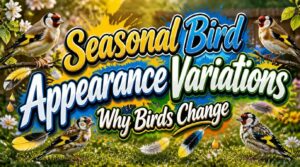
That dull-colored bird pecking through your backyard in February?
By May, it’ll be wearing lemon yellow so vivid it seems almost painted on.
No new bird moved in—it’s the same goldfinch, rebuilt from the inside out.
Seasonal bird appearance variations aren’t cosmetic tricks.
They’re precision biology: hormones surging in response to lengthening days, protein flowing into follicles to build new keratin structures, pigments sourced from diet locking into feathers before they harden.
Understanding what drives these changes rewires how you see every bird you encounter—because plumage isn’t decoration, it’s a seasonal log of exactly what that animal has been doing to survive.
Table Of Contents
Key Takeaways
- Every color shift you see in a bird follows a precise script—lengthening daylight triggers hormone surges that kick off molting, pigment deposition, and feather renewal.
- Bright and dull plumage serve opposite survival goals: vivid breeding colors (like a goldfinch’s lemon yellow) signal health to attract mates, while muted tones (like a mallard’s eclipse plumage) hide birds from predators when they’re most vulnerable.
- Not all feather color comes from pigment—Indigo Bunting’s blue is structural, created by how light bends through microscopic feather structures, so the color actually shifts depending on your viewing angle.
- What a bird eats directly shapes its color, since the carotenoid pigments behind reds and yellows can’t be.
Why Birds Change Seasonally
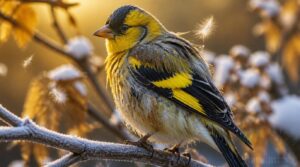
Birds don’t change their colors by accident — there’s a precise biological system behind every shift you notice from season to season. Several distinct mechanisms work together to drive these transformations, from internal chemistry to the slow physical wear of feathers over time. Here’s what’s actually happening.
Understanding how fall bird plumage changes unfold feather by feather makes the whole process far easier to appreciate.
Molting Cycles
Think of molting as a bird’s annual wardrobe reset — structured, energy-intensive, and precisely timed.
Most species complete a full molt in 4–8 weeks, usually after breeding, when energy shifts from reproduction to feather renewal. Primary flight feathers replace themselves in sequence, ensuring you never see a bird suddenly grounded.
Nutritional condition — especially protein intake — directly shapes how successfully new feathers grow.
Seasonal light cues drive photoperiod hormonal changes that initiate the molt.
Hormonal Triggers
Behind molting’s physical reset is a chemical one. As breeding season approaches, your hypothalamus releases gonadotropin-releasing hormone (GnRH), which triggers surges in testosterone and estrogen — the gonadal steroids that directly stimulate pigment deposition and vivid plumage development.
Meanwhile, thyroid hormones raise metabolic rate to fuel feather renewal, and prolactin later suppresses breeding signals once parenting begins.
Daylight Changes
Hormones don’t act in isolation — they need a signal to start. That signal is daylight length, or photoperiod.
As spring approaches, days lengthen rapidly — sometimes by several minutes each week near the vernal equinox. Your brain detects this shift through photosensitive cells, triggering seasonal hormone fluctuations that launch the molt cycle before temperatures even climb.
Feather Wear
Daylight sets the clock — but feathers wear down all year long, and that wear quietly reshapes a bird’s appearance between molts.
Abrasion from branches, plants, and rough substrates frays feather edges and erodes pigmented tips. For some species, like the European Starling, this is the whole point — white-tipped autumn feathers wear away to expose glossy black breeding plumage by spring.
Survival Advantages
Every color shift a bird makes comes with a survival payoff. Seasonal molt delivers five key advantages:
- Predation reduction — white winter plumage blends with snow, cutting predator strikes
- Thermoregulation efficiency — denser feathers trap heat, lowering energy costs in cold
- Foraging stealth — duller tones hide birds while hunting
- Social signaling — bright breeding colors attract mates and deter rivals
- Migration readiness — renewed feathers improve aerodynamic efficiency for long flights
Seasonal Plumage and Breeding Signals
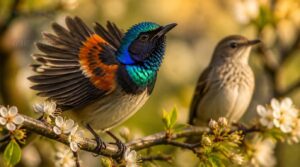
Breeding season turns birds into living signals — color, pattern, and display all working together to attract a mate.
Even when breeding colors fade, structural markings that help identify birds year-round — like wing patterns and facial features — remain surprisingly stable.
The changes you’ll notice aren’t random; they follow precise biological cues that vary in fascinating ways across species.
Here’s a closer look at the key forces shaping seasonal plumage and what each one tells us about how birds compete for a chance to breed.
Mate Attraction
Bright plumage isn’t decoration — it’s a résumé. A male American Goldfinch (Spinus tristis) in lemon-yellow breeding color tells a female everything she needs to know: health, hormone levels, foraging success.
Iridescent throat feathers shift hue with light angle, signaling vigor. Color signal intensity peaks just before breeding season — nature’s way of separating serious candidates from the rest.
Courtship Displays
Plumage alone rarely seals the deal. Watch a male Scarlet Tanager (Piranga olivacea) in action — scarlet body flashing between canopy gaps while his song cuts through the morning air.
That’s a multimodal courtship signal: color, sound, and movement working together. Females assess timing, vigor, and consistency before committing.
The display that combines all three wins.
Sexual Dimorphism
Sexual dimorphism isn’t just about looks — it’s a survival and mating strategy encoded in every feather. Males evolved bright, competitive plumage to win mates; females evolved cryptic, nest-blending colors to survive incubation.
Size differences reinforce this: larger, bolder males dominate territories.
The gap between sexes isn’t random. It’s selection pressure, written in color, shape, and mass.
Sexual dimorphism is selection pressure made visible, written in color, shape, and mass
Lekking Ruff Males
No bird takes "showmanship" more seriously than Calidris pugnax — the ruff.
Male ruffs grow an ornamental collar and head tufts each spring, and no two look alike.
Three distinct plumage morph strategies, governed by a single supergene, drive their lekking behavior: dominant Independents hold small territories, opportunistic Satellites shadow them, and female-mimicking Faeders sneak matings entirely.
Colorful Phalarope Females
In red-necked phalaropes (Phalaropus lobatus), evolution flipped the script. Females display richer chestnut neck patterns and bolder plumage than males — actively pursuing mates while males incubate.
Importantly, female plumage intensity reflects body condition: redder underparts and yellower bill bases signal higher-quality individuals. This sex-reversed system makes female courtship dominance visible, literally wearing fitness on their feathers.
Camouflage Through Seasonal Color Changes
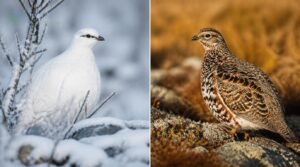
Not every color change is about finding a mate — sometimes it’s purely about staying alive. Seasonal camouflage is one of nature’s most effective survival tools, and birds have refined it to a notable degree. Here’s how different species use color shifts to disappear into their environment throughout the year.
Winter White Plumage
When winter descends, some birds don’t just survive the cold — they disappear into it.
Winter white plumage works through melanin reduction in newly grown feathers, stripping away pigment so the bird reflects snow rather than contrasting against it.
Darker tail and wingtip markings remain, creating silhouette disruption that prevents a clean outline from betraying the bird’s position to a predator.
Arctic Snow Camouflage
Snow doesn’t offer uniform cover — its surface shifts between powdery fresh layers and crusted drifts, each demanding a different match. That’s where white plumage micro-patterns earn their keep.
Species like Lagopus muta and Lagopus lagopus don’t simply go white; subtle gray shadings mimic shadowed snow, disrupting clean outlines that a predator’s motion-sensitive eye would otherwise lock onto instantly.
Summer Tundra Blending
White winter plumage is only half the story. Come summer, Lagopus muta swaps that clean white for mottled browns and tawny rufous tones — a near‑perfect mirror of the Arctic tundra mosaic.
As chlorophyll fades from tundra sedges and grasses, shifting greens toward straw and olive, the ptarmigan’s seasonal color changes track that palette with quiet precision.
Predator Avoidance
That mottled summer coat isn’t just beautiful — it’s a survival system.
Adaptive coloration ties directly to predator avoidance. When a Rock Ptarmigan freezes against lichen-covered rock, it disappears at 10–20 meters. Disruptive color patterns break up body outline, while alarm calls synchronize group vigilance within 1–2 seconds — giving every nearby bird a fighting chance.
Ptarmigan Color Shifts
Few birds master seasonal disguise quite like the ptarmigan. Twice yearly, photoperiod molt synchronization — triggered by shifting day length — replaces their feathers entirely.
In winter, reduced melanin deposition produces pure white plumage, matching snow-covered Alpine terrain.
Come summer, increased melanin patterns create mottled brown and gray tones that mirror tundra rock and lichen — predator-driven evolution refined over millennia.
How Molting Changes Bird Appearance
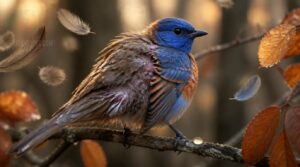
Molting is the engine behind every color transformation you’ve ever noticed in birds — but it doesn’t work the same way for every species.
Some birds go through a complete overhaul, while others swap out only a handful of feathers and call it done.
Here’s a closer look at the key ways molting shapes a bird’s appearance throughout the year.
Complete Molt
A complete molt is a full reset — every primary, secondary, and body feather replaced in one annual cycle. Keratin production needs to spike dramatically during this period, demanding a nutrient-rich diet packed with amino acids and minerals.
Timing matters enormously. Most species complete their seasonal molt cycle after breeding, before migration begins, restoring both insulation and post-molt agility for the journey ahead.
Partial Molt
Unlike a complete molt, partial molt replaces only select feathers — usually body and inner coverts — while retaining remiges and rectrices. That’s what keeps flight capability intact throughout the cycle.
The energy savings are significant.
You can actually spot molt limits in the field: visible contrast bands where new feathers meet retained ones, invaluable for age classification of passerines.
Eclipse Plumage
Eclipse plumage is a master disguise — and a necessary one.
After breeding, male Mallards (Anas platyrhynchos) and Superb Fairy-wrens (Malurus cyaneus) shed their bold colors for dull, cryptic tones. Three reasons this matters:
- Reduces rival aggression during post-breeding vulnerability
- Cuts predation risk while flightless during wing molt
- Synchronizes with molting timetables tied to photoperiod cues
Structural Coloration
Some colors you see on feathers aren’t made from pigment at all — they’re built from light itself. Photonic crystal structures within feather keratin bend and reflect specific wavelengths through Bragg reflection, producing the electric blues of Indigo Buntings (Passerina cyanea).
Spiral nanostructures enhance this effect. Shift your viewing angle, and the color shifts too — that’s iridescent structural coloration working exactly as it should.
Pigment-Based Colors
Pigment-based color works differently than structural color — it’s chemistry, not physics.
Dietary carotenoid sources like fruits, berries, and insects supply the reds and yellows you see in breeding plumage; birds can’t synthesize these themselves. Melanin produces blacks and browns while providing UV protection. Porphyrin pigments fade under sunlight.
Pigment transport proteins carry these compounds directly into growing feathers.
Identifying Seasonal Bird Variations
Knowing what to look for makes all the difference when you’re out in the field. A handful of familiar species show these seasonal shifts in ways that are hard to miss — and worth learning well. Here are some of the clearest examples you’ll encounter.
Goldfinch Seasonal Changes
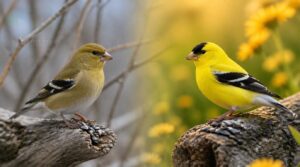
The American Goldfinch (Spinus tristis) is one of North America’s most striking seasonal transformers.
Come spring, males trade their dull olive-brown winter feathers for vivid lemon-yellow breeding plumage — a change driven largely by dietary carotenoids absorbed from seeds. The brighter the food source, the more intense the yellow.
Juveniles won’t display this brilliance until after their first post-fledging molt.
Scarlet Tanager Plumage
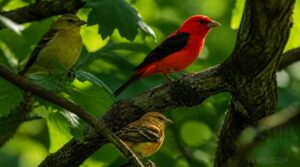
Where goldfinches turn yellow, the Scarlet Tanager (Piranga olivacea) turns scarlet.
Males grow fiery breeding plumage from dietary carotenoid sources, boosting male territorial signaling.
Females stay olive-yellow, gaining female camouflage benefits while nesting.
Juvenile color development lags, resembling moms before true crimson fully arrives—seasonal dimorphism playing out against woodland habitat visibility, rich red against black cutting clean through summer canopy.
Indigo Bunting Colors
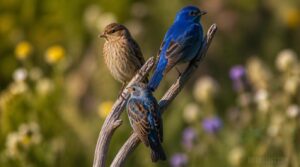
The Indigo Bunting (Passerina cyanea) takes a different route entirely. That vivid blue isn’t pigment — it’s structural coloration, produced by light scattering in the feather barbules. Shift the angle, and the color moves from electric blue to almost black.
- Males peak in saturated blue at breeding season
- Females stay streaked brown for nesting camouflage
- First-year males show patchy blue-brown transitions
- Direct sunlight reveals the truest, most intense hue
Mallard Eclipse Plumage

The Mallard (Anas platyrhynchos) offers one of birding’s most disorienting seasonal surprises. After breeding, males shed their famous iridescent green heads for dull brown eclipse plumage — looking remarkably female‑like from July through September.
That camouflage isn’t accidental. Losing flight feathers simultaneously means reduced flight capability, so cryptic coloring cuts predation risk exactly when males are most vulnerable.
Field Guide Tips
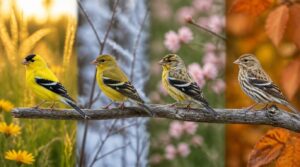
Your field guide is only as good as the light you’re standing in. Lighting shifts color dramatically — a Goldfinch looks nearly orange at dusk.
Start with the visual index to match shapes fast, then confirm field marks with binoculars. Sketch quick notes on plumage.
Digital apps cross-reference seasonal variations instantly, reducing misidentification when birds are mid-molt and genuinely confusing.
Frequently Asked Questions (FAQs)
How is climate change affecting bird camouflage effectiveness?
Like a ghost in the wrong season, white-plumaged birds stand dangerously exposed when snowmelt mismatch arrives early. Climate-induced phenology shifts mean plumage no longer aligns with rapidly changing backgrounds — predators notice first.
Why are stopover sites vital for molting migratory birds?
Stopover sites are refueling lifelines — birds nearly double their energy reserves within days, supporting simultaneous fat accumulation and feather regrowth. Without them, molt fails, flight performance drops, and migration corridors collapse entirely.
How does habitat fragmentation disrupt seasonal molt cycles?
Picture a torn patchwork quilt: that’s fragmented habitat for molting birds.
Migratory corridor delays, insect phenology mismatches, and nutritional mineral deficits raise stress hormone impacts, forcing irregular molting cycles and disrupted seasonal resource allocation across avian adaptation.
Conclusion
A feather is a diary written in keratin and light—each barb a sentence, each molt a new chapter. Once you understand seasonal bird appearance variations, you stop seeing random color and start reading biography: hormones, daylight, diet, survival, all stitched into plumage.
Next time goldfinch flashes yellow past your window, you won’t just see a bird. You’ll see a calendar, a compass, a record of exactly what it took to make it through.