This site is supported by our readers. We may earn a commission, at no cost to you, if you purchase through links.
That drab little bird creeping through your winter hedgerow? Three months ago, it may have blazed in breeding colors vivid enough to stop you mid-stride. The transformation isn’t fading—it’s engineering.
Every fall, birds execute a precise biological overhaul called molt, swapping worn feathers for fresh ones tuned to winter survival. Shortening days trigger a hormonal cascade, starting deep in the brain and ending with keratin-producing follicles building new plumage from scratch. The colors that emerge—or disappear—aren’t cosmetic. They’re calculated.
Understanding why birds change colors in fall means following the science from photoreceptor to feather tip.
Table Of Contents
- Key Takeaways
- Birds Change Color Through Seasonal Molting
- Shorter Fall Days Trigger Molt
- New Feathers Create New Colors
- Fall Colors Help Birds Survive
- Common Birds That Change Color
- Frequently Asked Questions (FAQs)
- Why do birds change color?
- Do birds change colour with the seasons?
- Why do feathers change color after molting?
- Why do birds have a brighter plumage?
- Why do birds change color in winter?
- Do birds recognize their own reflection during plumage transitions?
- How does altitude affect the timing of feather molt?
- Are some bird species born with adult coloration?
- Can injured feathers regrow with different colors or patterns?
- Conclusion
Key Takeaways
- Fall color change isn’t cosmetic — birds physically rebuild every feather from scratch through a hormonally triggered process called prebasic molt, timed precisely by shortening days.
- Shrinking daylight sets off a chain reaction from the pineal gland through the thyroid to individual feather follicles, and even artificial light at night can throw the whole schedule off.
- The dull winter look is a calculated trade-off: muted plumage cuts predation risk, lowers social aggression in flocks, and improves insulation — each benefit tied directly to feather structure, not just color.
- What a bird eats during molt writes itself into the feather permanently — carotenoids from food determine color brightness, while protein fuels the keratin that holds it all together.
Birds Change Color Through Seasonal Molting
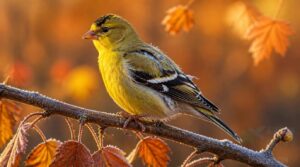
Every fall, birds don’t just look different — they physically rebuild their feathers from scratch. This transformation follows a precise biological sequence, driven by hormones, daylight shifts, and energy trade-offs you might not expect. Here’s how that process actually unfolds.
The full picture of this seasonal reset — from hormonal triggers to feather architecture — unfolds in this deep dive into autumn feather color transformation.
Fall Feather Replacement
Every fall, birds fundamentally rebuild themselves from the outside in. The prebasic molt replaces worn feathers with fresh ones built for winter insulation and function. Flight feathers shed sequentially, so birds stay airborne while replacements grow underneath. Recent research indicates that fall feather molt timing is advancing by roughly one day per year in response to climate shifts.
Molt timing depends on five key factors:
- Post-breeding energy reserves
- Food availability in late summer
- Molt-migration synchronization demands
- Species-specific feather replacement sequences
- Habitat and seasonal plumage needs
Breeding Vs Nonbreeding Plumage
That rebuilt exterior fulfills a double purpose.
Breeding plumage signals genetic fitness — saturated reds, yellows, and iridescent blues evolved purely for mate attraction.
Nonbreeding plumage flips the strategy entirely, trading visibility for survival through muted olives, grays, and browns that blend with winter habitats. The same bird, two radically different looks — each one optimized for a specific seasonal demand.
Complete and Partial Molts
Not every bird goes through the same kind of molt. Complete prebasic molt replaces every feather in one cycle, while partial molt targets only select tracts — body feathers, wing coverts — leaving others intact. Young birds often undergo a preformative molt in their first year.
Both strategies follow a sequential, bilateral pattern, replacing feathers symmetrically so flight capability stays intact throughout.
Migration Timing
Molt and migration overlap more than most people realize. Birds don’t simply finish growing feathers, then depart — molt-migration overlap is common, with some species completing new plumage mid-journey.
Departure windows are driven by day length, energy reserves, and prior-year success. Favorable winds can accelerate long-distance legs, while poor weather extends stopovers until conditions improve.
Feather Growth Cycles
Each feather follows a strict three-stage cycle: follicle activation, active growth, then rest. During the growth phase, keratin synthesis ramps up fast, building a complete feather in roughly two to three weeks.
That process alone can push resting metabolic rates up by 30%. Once growth stops, the follicle quiets — until the next molt trigger resets everything.
Shorter Fall Days Trigger Molt
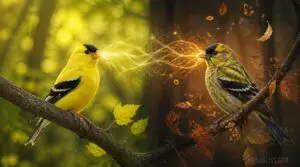
The shift from long summer days to shorter fall ones isn’t just a calendar change — it’s a biological starting gun for molt. Your body clock runs on light, and so does a bird’s, through a chain of hormonal signals that’s more precise than you might expect.
Here’s what actually happens inside a bird when the days begin to shorten.
Photoperiod Changes
Shorter days aren’t just a calendar shift — they’re a biological switch. As late summer arrives, the photoperiod shift in daily light exposure shortens noticeably, and a bird’s brain registers every lost minute of daylight.
This light-sensing trigger also sets off broader physical changes, from feather molting to fat storage, all part of the remarkable bird survival adaptations that help species thrive through seasonal shifts.
Here are five key ways seasonal light cycles reshape a bird’s biology:
- The pineal gland function encodes night length through melatonin duration
- Daylength cues reach the brain via deep-brain photoreceptors
- Photoperiodic timing cues regulate molt, migration, and metabolism simultaneously
- Daylight length signals fine-tune the circadian clock’s seasonal rhythm
- Seasonal photoperiodism ties feather replacement directly to light-dark ratios
The melatonin hormonal cascade lengthens as nights grow longer, signaling that conditions are shifting. That extended melatonin window is practically the bird’s internal calendar — precise enough to coordinate photoperiod influence across multiple organ systems at once.
Hormonal Signals
Once melatonin extends its nightly window, it doesn’t act alone. The avian endocrine system responds with a coordinated hormonal cascade — the pituitary activates, thyroid output rises, and receptor signals reach feather follicles directly.
Cellular receptor signaling then amplifies these cues at the tissue level. Glucocorticoid stress impact can suppress that response, slowing keratin production when energy is strained. Hormone crosstalk mechanisms keep the whole system synchronized.
Melatonin and Thyroid Hormones
The thyroid doesn’t just respond to light — it reacts to melatonin’s chemical message about how much darkness there was. Melatonin receptor signaling works through two receptor subtypes, MT1 and MT2, expressed directly in thyroid follicular cells, letting the pineal gland communicate seasonal timing straight to the tissue that drives feather growth.
That conversation shapes thyroid follicular activity in measurable ways. Melatonin can suppress thyroglobulin expression and dampen follicular output depending on circadian timing. Critically, the T4 to T3 conversion — converting the prohormone thyroxine into its biologically active form — is regulated by deiodinase enzymes whose expression shifts with photoperiod. T3 is what feather follicles actually respond to.
Circadian metabolic alignment keeps this system precise. Melatonin’s nightly peak correlates with reduced thyroid hormone release, while daytime clearance allows T3 to rise and sustain follicle activity. Disrupt that rhythm and the whole molt schedule can slip. Light pollution impacts are real here — artificial nighttime light suppresses melatonin production, blunting the hormonal cascade before it can properly activate the avian endocrine system. For birds in urban environments, that means molt timing can misalign with the season entirely.
Energy Demands
Molt is fundamentally a full-scale construction project running inside a bird’s body — and the energy bill is steep.
- Resting metabolic rate rises up to 28–30% during peak molt
- Dietary protein becomes critical, as feathers represent roughly 25% of a bird’s total protein
- Faster-molting birds lose more body heat, raising thermoregulation costs simultaneously
- Carotenoid-rich and protein-dense foods directly support pigment deposition and keratin synthesis
- Foraging energy budgets tighten when cold fall temperatures raise baseline caloric needs independently
That overlap — molt, thermoregulation, and migration prep all hitting at once — is what makes fall so metabolically demanding.
Stress and Feather Quality
Chronic stress raises corticosterone levels — and that’s a direct threat to feather quality during molt.
When corticosterone spikes, keratin synthesis slows, producing lighter, weaker shafts and visible fault bars across the vane. Nutrient deficiency compounds this: low zinc, biotin, or methionine disrupts keratin formation at the follicle level. Parasites like feather lice add mechanical micro-abrasions, accelerating feather wear and tear .
| Stressor | Feather Impact |
|---|---|
| Elevated corticosterone | Weaker shafts, fault bars |
| Nutrient deficiency | Reduced keratin, lighter feathers |
| Parasite damage | Micro-abrasions, breakage points |
| Environmental disturbance | Shortened growth window |
Feather structural integrity suffers most when stressors overlap — noise, predation pressure, and poor diet hitting simultaneously during peak molt. That’s when you’ll notice dull pigmentation and brittle rachises, both signs that environmental stress on feather pigments has interrupted normal deposition.
New Feathers Create New Colors
Fresh feathers aren’t just replacements — they’re built differently, with pigments and structures that shift a bird’s entire color profile. What you see in fall plumage comes down to the biology happening inside each new feather as it grows. Here’s what’s actually driving those color changes.
Melanin Pigments
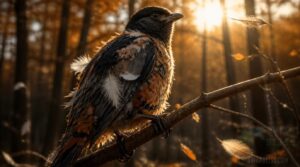
Melanin is the most widespread pigment in bird feathers, and it does far more than just color a coat. It comes in two forms: eumelanin vs. pheomelanin. Eumelanin delivers black, dark brown, and gray tones, while pheomelanin produces reddish-yellow and buff shades. Their ratio in each feather determines the exact shade you’re seeing.
Both forms start with the same raw material — tyrosine — and the tyrosinase enzyme drives the rate-limiting conversion step inside melanocytes. From there, melanosomes (tiny pigment-carrying organelles) migrate through dendritic cell extensions into feather keratinocytes, locking color into place before the feather even finishes growing. That melanosome transfer process is basically a one-way trip — once deposited, the pigment stays put.
What you might not expect is how much keratin reinforcement melanin provides. Melanin-rich feathers are roughly 39% more abrasion-resistant than unpigmented ones, because melanin granules fill gaps between keratin strands. Darker, melanistic plumage also carries real UV protection benefits, shielding follicle tissue from photodamage during molt. In short, melanin synthesis in birds isn’t just about appearance — it’s structural engineering built directly into each feather.
Melanin doesn’t just color feathers — it armors them, making dark plumage 39% more abrasion-resistant than bare keratin alone
Carotenoid-based Colors
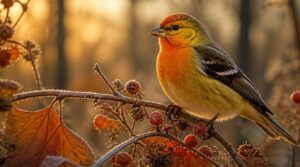
Unlike melanin, birds can’t make carotenoids themselves — every molecule must come from food.
Here’s what dietary acquisition of carotenoids actually controls:
- Pigment concentration during feather growth determines final color brightness
- Yellow-to-red conversion happens enzymatically in feather follicles via CYP2J19
- Fall food scarcity reduces carotenoid intake, dulling new plumage directly
When carotenoid-rich food drops off in autumn, pigment deposition slows, and fresh feathers reflect that deficit immediately. Brighter individuals simply ate better.
Structural Feather Colors
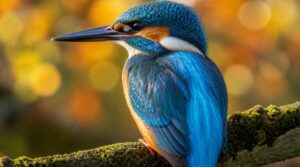
Not every color you see on a bird comes from pigment. Some hues — particularly blues and iridescent greens — are built from nanoscale keratin air structures that scatter light rather than absorb it.
The nanostructure’s size and spacing determine the exact wavelength reflected. Melanin sits beneath these structures, absorbing stray light and sharpening the color’s edge considerably.
Diet and Color Intensity
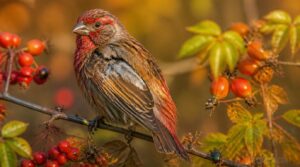
What a bird eats directly shapes feather color intensity. Carotenoids — the diet-derived pigments behind reds, oranges, and yellows — can’t be synthesized internally. Birds must consume them through fruits, seeds, and insects during molt.
Protein intake matters too. It fuels keratin synthesis, the structural backbone that holds pigment in place. Skimp on protein, and even well-pigmented feathers grow in thin and dull.
Fresh Versus Worn Feathers
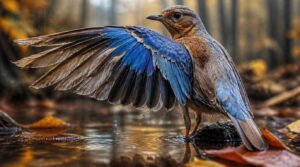
A freshly grown feather is fundamentally peak performance gear. Intact barbules and barbicels lock together to seal out water and trap air for insulation, while smooth vane edges cut through wind with minimal drag.
Worn feathers lose all of that — frayed microstructures leak moisture, reduce loft, and increase turbulence. Feather abrasion also strips pigment granules, dulling colors that once looked sharp.
Fall Colors Help Birds Survive
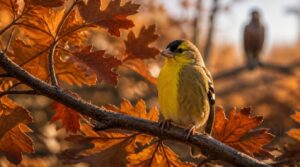
Fall plumage isn’t just about looking different — it’s a survival strategy shaped by millions of years of natural selection. Each color shift fulfills a specific purpose, from hiding in plain sight to signaling the right information to the right birds. Here’s how those autumn colors actually keep birds alive.
Winter Camouflage
Winter camouflage is fundamentally a survival uniform — and for many northern birds, getting it wrong means getting eaten.
Fall molt replaces worn feathers with fresh ones carrying a white-to-light-gray palette that mirrors snowfields and overcast skies. That white isn’t pigment — it comes from light-scattering microstructures within the barbules themselves, bouncing diffuse light outward rather than absorbing it.
Three ways winter plumage actively hides a bird:
- Snowy habitat matching — upper parts mirror snowfields and pale shadows
- Behavioral silhouette control — birds reduce midday movement to minimize shadow casting
- Irregular feather patterning — broken outlines mimic snowdrift textures, not solid shapes
Reduced carotenoids in winter diets also mute any yellow or orange tones, keeping overall coloration dull and inconspicuous.
Reduced Predator Visibility
Dull fall plumage isn’t accidental — it’s cryptic coloration working at every scale. Olive, gray, and brown tones align with bark and branch shadows, breaking a bird’s silhouette against cluttered backgrounds. Camouflage movement patterns matter equally; birds slow their head flicks and forage in dense cover, reducing the motion cues predators rely on most.
| Strategy | Mechanism | Example |
|---|---|---|
| Habitat matching | Feather tones mirror bark and leaf litter | Goldfinch olive-gray plumage |
| Silhouette disruption | Patchy molt breaks recognizable outlines | Starling speckled fall pattern |
| Predator vision evasion | Matte feathers reduce specular reflection | Snow Bunting muted edges |
Nonbreeding Plumage Benefits
Nonbreeding plumage does more than hide a bird — it quietly regulates its entire winter survival budget.
- Social aggression reduction — muted tones lower rivalry cues in mixed flocks
- Metabolic energy conservation — smoother barbs improve insulation, cutting heat loss
- Countershading camouflage — pale underparts dissolve a bird’s silhouette at distance
- Flocking cohesion signals — uniform seasonal coloring aids species recognition during migration
- Feather durability — nonbreeding feathers resist mite damage and wear
Eclipse Plumage in Ducks
After breeding season ends, the Mallard drake doesn’t stay green for long.
Males shed their iridescent plumage and enter eclipse plumage — a drab, female-like phase that lasts weeks to months.
During this window, flight feathers molt simultaneously, leaving ducks temporarily grounded and exposed.
Dull tones blend into reeds and shoreline grasses, cutting predator visibility exactly when vulnerability peaks.
Species Recognition
Drab fall plumage doesn’t mean birds stop recognizing each other — it just shifts how they do it.
Wing and tail patterns, bill shape, and facial markings stay consistent across seasons, giving birds reliable visual anchors even when body color fades. Songs and calls reinforce the picture, with species-specific pitch and tempo filling the gap that muted plumage leaves behind.
Common Birds That Change Color
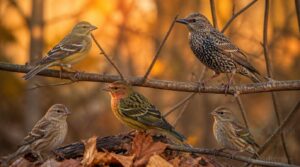
Some birds make the shift in color so obvious you’d barely recognize them from one season to the next. Others pull off the change quietly, swapping bright tones for muted ones while you weren’t looking. Here are five species whose fall transformations are worth knowing.
American Goldfinch
Few birds make fall’s color shift as obvious as the American Goldfinch.
Males drop their bright yellow breeding plumage for olive-gray tones each September, driven by carotenoid reduction as thistle and sunflower seeds grow scarce.
Juveniles start duller and brighten after their first molt.
Even within winter flocks, subtle color differences still signal social rank.
Mallard Ducks
Male mallards trade their iridescent head patterns — that vivid emerald sheen — for brown duck eclipse plumage each June through September. During this flightless window, eclipse plumage camouflage replaces courtship display as the seasonal priority. Their dabbling feeding habits carry on across urban parks and circumpolar wetlands, proof that this seasonal plumage change barely disrupts a mallard’s routine.
| Plumage Phase | Timing | Key Change |
|---|---|---|
| Breeding | October–May | Iridescent green head |
| Eclipse | June–September | Muted brown camouflage |
| Early Change | September | Mixed old and new feathers |
Scarlet Tanager
The Scarlet Tanager runs dual annual molts — vivid red avian pigmentation fades to olive-green each fall, then reverses in spring. That seasonal plumage change costs real energy.
- Canopy foraging habits reach 20–40 feet up
- Nesting height requirements favor mature oak canopy
- Pigment-protein interaction drives carotenoid-based red color
- Tropical wintering routes reach South America
- Male vocalization patterns drop outside breeding season
Snow Bunting
Few birds wear winter as literally as the Snow Bunting. Breeding on high Arctic tundra across Canada, Alaska, and Greenland, they arrive at wintering farmlands already mid-molt — brown-fringed feathers slowly abrading to expose white underlayers.
That feather abrasion does the work camouflage requires. No new molt needed. Their conical bill cracks seeds through the coldest months, keeping them fueled while the white deepens.
Ptarmigan
The Ptarmigan takes seasonal disguise further than almost any bird. White winter plumage blends seamlessly with Arctic snow, while a summer molt reveals mottled brown feathers that match rocky tundra perfectly.
A few traits set them apart:
- Feathered feet act as natural snowshoes
- Chicks are precocial — walking and foraging almost immediately after hatching
- They roost in snow burrows to conserve warmth
No migration needed. Just a wardrobe swap.
Frequently Asked Questions (FAQs)
Why do birds change color?
Like a wardrobe swap before a job interview, birds shift color through seasonal plumage change — driven by molting, pigment deposition, and survival pressures that balance mate attraction against camouflage when conditions demand it.
Do birds change colour with the seasons?
Yes, birds change color with the seasons. Seasonal plumage cycles driven by molting, hormones, and pigment chemistry shift a bird’s appearance from vivid breeding colors to muted winter tones — and back again.
Why do feathers change color after molting?
Feathers don’t lie — fresh growth tells all. New feathers carry richer pigment deposits, restored microstructures, and diet-driven carotenoids, shifting color noticeably from worn plumage through precise pigment-protein interaction during the molting cycle.
Why do birds have a brighter plumage?
Brighter plumage signals genetic fitness to potential mates and strengthens territory defense visibility against rivals. Fresh feathers carry concentrated carotenoid and melanin pigments, while UV reflective properties sharpen species recognition accuracy during breeding season.
Why do birds change color in winter?
Seasonal molt replaces worn feathers with drab, camouflage-toned plumage. Shorter days trigger hormonal shifts that drive this change, helping birds blend into winter habitats and reduce predation risk while conserving energy.
Do birds recognize their own reflection during plumage transitions?
Most birds don’t recognize their own reflection. Magpies are the exception — they pass mirror tests by inspecting marked body parts. During molt, many species simply treat reflections as rivals.
How does altitude affect the timing of feather molt?
Higher elevation shifts molt earlier. Shorter growing seasons and compressed foraging windows force mountain birds to replace feathers faster, before winter cuts off food supplies entirely.
Are some bird species born with adult coloration?
Yes — some species, like certain seabirds and waterfowl, hatch with adult-level coloration already in place. These hatchlings can signal species and sex immediately, skipping the transitional juvenile plumage most songbirds rely on.
Can injured feathers regrow with different colors or patterns?
Yes — a regrown feather can look noticeably different. Pigment deposition shifts with your bird’s diet, hormonal state, and stress levels at the exact moment the follicle rebuilds it.
Conclusion
That drab winter sparrow and its vanished summer brilliance tell the same story—molt is the author, not the ending. Now you know why birds change colors in fall: shortening days trigger hormones, hormones drive follicles, follicles build feathers engineered for survival.
Every pigment deposited, every structural layer aligned, fulfill a specific winter purpose. The bird didn’t lose its color.
It traded one precise tool for another, and that trade keeps it alive.
- https://www.birdwatchingdaily.com/birds/david-sibleys-id-toolkit/david-sibley-how-birds-can-change-color-without-molting
- https://www.mass.gov/info-details/molting
- https://chicagobirdalliance.org/blog/2025/1/3/back-to-basics-plumage-in-winter
- https://www.perkypet.com/articles/why-your-backyard-birds-look-different-in-late-summer
- https://ebird.org/map/yerwar?neg=true&env.minX=132.71964287499998&env.minY=6.7170535114391114&env.maxX=-16.870200875000023&env.maxY=71.4300008096628&zh=true&gp=false&ev=Z&mr=12-2&bmo=12&emo=2&yr=all&byr=1900&eyr=2018