This site is supported by our readers. We may earn a commission, at no cost to you, if you purchase through links.

Hang a feeder at the wrong height, and you’ll spend more time watching squirrels raid it than watching birds visit it. Four feet off the ground looks safe from your kitchen window, but that’s an easy hop for a hungry cat and a short climb for a raccoon. Height isn’t a minor detail here — it’s the difference between a feeder that draws chickadees and cardinals, and one that becomes a buffet for every predator in the neighborhood.
Different species need different setups, too. A ground-feeding junco won’t touch a feeder mounted six feet up, and a hummingbird won’t bother with one at knee level. Backyard feeder height recommendations change based on who you’re trying to feed, what’s lurking nearby, and how close your windows sit. Get the numbers right, and you’ll turn your yard into the kind of stop birds actually remember.
Table Of Contents
- Key Takeaways
- Best Backyard Feeder Height
- Match Height to Bird Species
- Ground Feeders: 0 to 3 Feet
- Mid-Level Feeders: 3 to 8 Feet
- Suet Feeders: 5 to 15 Feet
- Hummingbird Feeders: 4 to 6 Feet
- Height for Predator Protection
- Squirrel-Proof Height and Distance
- Safe Distance From Windows
- Common Feeder Height Mistakes
- Frequently Asked Questions (FAQs)
- What is the 5-7-9 rule for bird feeders?
- Do birds like feeders high or low?
- Can bird feeders be hung too high?
- Should I stop feeding hummingbirds in September?
- How often should I clean my bird feeders?
- What should I store birdseed in for freshness?
- How much daily sunlight does a feeder site need?
- How long should feeder mounting chains be?
- How far should feeders be kept from fences or woodpiles?
- Conclusion
Key Takeaways
- Mount most feeders 5 to 6 feet high to keep seed visible from your window while staying out of easy reach for cats and climbing predators.
- Match feeder height to species: ground foragers need 0 to 3 feet, finches and cardinals prefer 3 to 8 feet, and hummingbird feeders work best at eye level, 4 to 6 feet.
- Use the 5-7-9 rule—5 feet high, 7 feet from structures, and 9 feet below branches—to block squirrel jumps and climbing routes.
- Keep feeders within 3 feet or beyond 30 feet of windows, and add decals or tint, to cut down on collisions.
Best Backyard Feeder Height
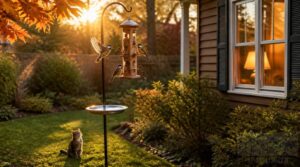
Most backyard feeders work best between 5 and 6 feet off the ground. That height keeps birds visible from your window while staying out of easy reach for cats and other climbers. Here’s how to fine-tune that starting point for your yard.
If you’re looking to attract finches and other small birds, this guide to bird food for small birds offers tips on feeder placement and seed selection.
Quick Height Recommendation
Four to five feet off the ground: that’s your sweet spot for most backyard feeders. This height keeps seed within easy reach for small songbirds while staying too tall for cats to leap up and ambush a meal.
It’s a solid quick height summary to start with, before fine-tuning for the species you actually want to attract.
Ideal Starting Range
Getting the starting height right sets the tone for everything that follows. That 4 to 6 foot window isn’t arbitrary—it’s where most songbirds feel safe while you still avoid ground clutter.
- Fewer spills to clean
- Fewer scared-off visitors
- Steadier feeding routines
Establishing this pattern early helps birds return daily, which is exactly what you want.
Safety Versus Visibility
Height does double duty here: it keeps birds safe from ground predators while still letting you watch the action from your window. That balance matters for predator detection—a feeder too low invites ambush from nearby cover, while one too high loses visual accessibility for both you and cautious songbirds.
Clear sightlines act as a safety signal, warning birds of danger before it strikes.
When to Adjust Height
Give your setup two weeks before making changes. Watch for monitoring bird visitation patterns first—no visitors often means poor accessibility, not wrong height.
Seasonal growth adjustments matter too: branches leaf out, shrubs thicken, changing predator proximity and sightlines. Reassess habitat changes each spring and fall, moving feeders up or down by one foot as conditions shift around your yard.
Match Height to Bird Species
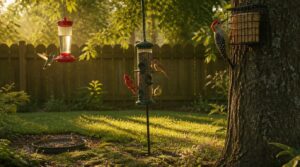
Not every bird eats at the same level, and your feeder placement should reflect that. Ground foragers, finches, cardinals, hummingbirds, and woodpeckers each have their own comfort zone. Here’s how to match your setup to the species you want to attract.
Ground-feeding Birds
Sparrows, juncos, and ground-feeding doves rely on scent and sight to find scattered seed, so keep feeders at 0 to 3 feet. These ground foragers read debris and open soil as feeding cues.
Clean up seed hulls often to limit mold and rodents. Offer nutrient-rich mealworms and seasonal seed variety, especially heavier winter energy needs, to keep this backyard birding favorite well-fed year-round.
Finches and Chickadees
Six feet marks the sweet spot for finches and chickadees, both drawn to tube feeders with nyjer seed. Finches crack shells with conical bills; chickadees pick insects using pointed bills. Watch for:
- Red-washed male house finches
- Black-capped chickadee markings
- Winter mixed-species flocking
- Social foraging behavior
- Seed preference overlap
Many of these visitors belong to the North American finches family.
Mount feeders 3 to 8 feet high, giving these active songbirds clear perches and quick escape routes.
Cardinals and Blue Jays
Seven feet suits both cardinals and blue jays, backyard favorites with unmistakable plumage. Cardinals bring bold red feathers and a thick, seed-cracking beak; jays flash blue with a pointed bill built for nuts.
Mount hopper or tube feeders at 4 to 8 feet, giving jays room to cache food and cardinals space to defend their mate at the perch.
Hummingbird Feeder Height
Hummingbirds are picky about altitude — 4 to 6 feet hits the sweet spot for nectar feeders. That height keeps sugar water visible from multiple garden angles while staying easy to refill.
Partial shade slows nectar spoilage on hot days. Since hummingbirds guard feeding spots fiercely, moderate height reduces territorial disputes and keeps human disturbance minimal along nearby walkways.
Woodpecker Suet Placement
Picture a woodpecker clinging sideways to a tree trunk — that’s the posture your suet feeder needs to support. Mount it 4 to 6 feet up on a sturdy pole or trunk, within sightlines of natural foraging spots.
- Choose cage-style feeders for multi-angle gripping
- Use high-fat suet blends in winter
- Add pepper-infused deterrents for squirrels
- Replenish every 2-3 days in cold
- Secure mounting to stop swinging
Ground Feeders: 0 to 3 Feet
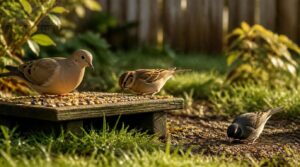
Not every backyard visitor wants to eat off a hanging tray. Some birds feel safest with their feet on solid ground. Here’s what you need to know to set up that space right.
Sparrows and Juncos
Sparrows and juncos forage on the ground, so skip the pole entirely and use a low platform feeder instead. Keep it within 3 feet of the soil, near open patches close to leaf litter or grass edges.
Juncos increase seed intake in cold months, and their soft chip calls often give away a feeding flock before you spot the gray plumage.
Doves and Towhees
Doves and towhees share the ground, but not the same style. Mourning doves show pale brown to gray plumage and feed quietly in pairs, while towhees use a two-footed scratch through leaf litter and announce themselves with a sharp "chewink."
Both need clear, open access:
- Keep soil clear of dense grass
- Scatter seed within 3 feet of ground
- Leave nearby shrub cover for towhees
- Avoid crowding doves’ open approach
Platform Feeder Placement
Give ground foragers a stable stage. Mount the platform 3 to 4 feet high, with a surface at least 8 to 12 inches wide for shared feeding.
Space multiple platforms 15 to 30 feet apart to ease territorial disputes. Choose weather-resistant wood or powder-coated metal for durability, and site it where sun reaches 3 to 6 hours daily, limiting seed moisture.
Clean Ground Beneath
A tidy platform only works if the ground below matches it. Sweep spilled seed within 24 hours to cut down on rodents and mold.
Lay a 6 to 12 inch mulch strip using aged wood chips for drainage. Rake bare soil smooth weekly, and skip dyed mulch—birds may peck at it by mistake.
Rodent Risk Control
Ground platforms sit right at rodent level, so exclusion matters as much as height. Seal gaps larger than a quarter inch near your foundation, and store seed in rodent proof containers with tight lids.
Clean spills fast, remove standing water, and set monitoring traps nearby. Add squirrel baffles or smooth poles for extra predator deterrence—it keeps ground feeding safe without abandoning low placement.
Mid-Level Feeders: 3 to 8 Feet
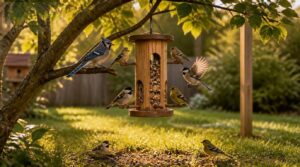
Most backyard regulars, from finches to jays, feed comfortably in this middle zone. The right height depends on the feeder style and which birds you’re hoping to attract. Here’s how to place each type for the best results.
Tube Feeder Height
Mount tube feeders 5 to 6 feet high for best seed access and reduced cat reach. This height suits finches, chickadees, and goldfinches perfectly.
Keep poles stable and smooth—no grooves squirrels can grip. Adjust seasonally: raise slightly in winter when snow builds up.
Position 10 feet from trees, respecting predator reach limits while matching bird species preferences for safe, easy feeding.
Hopper Feeder Height
Four to six feet works best for hopper feeders, striking a balance between refill ease and predator safety.
Stabilize mounting hardware with a rigid pole—wobbly setups spill seed and spook feeding birds.
Space perches 6 inches apart to ease managing bird competition. Shift height seasonally: raise it 6-12 inches once snow piles up, protecting seed from moisture and minimizing seed spoilage underneath.
Nyjer Feeder Height
Six feet is the sweet spot for nyjer feeders, whether you’re using a mesh sock or tube style. This height keeps finches perching with ease while giving them predator sightlines to spot cats below.
- Raccoons prowling at dusk
- Finches darting away from a hidden threat
- Seed scattered and wasted after wind gusts
- Backs aching from low, awkward cleaning
- Juveniles crowding tiny ports, confused and hungry
Shift height seasonally, and clean at ergonomic heights—your arms will thank you.
Cardinal-friendly Placement
Cardinals want more than height—they want a landing zone. Place platform or hopper feeders at 5 to 7 feet, with 4 feet of clearance for safe approach. Perches should measure 0.75 to 1 inch wide, supporting their large feet.
Offer black oil sunflower or safflower seed. Position feeders 3 to 4 feet from shrubs for quick cover without inviting ambush.
Easy Refilling Access
Nobody wants to wrestle a 20-pound seed bag over their shoulder every weekend. Keep hoppers at 5 to 7 feet—within easy arm’s reach for pouring, not stretching.
- Choose wide-mouth feeders for spill-free filling
- Check seals monthly to block moisture
- Store seed in airtight metal bins
- Wipe ports weekly for basic feeder hygiene
Convenient bird feeder placement keeps maintenance consistent, protecting birds and your patience.
Suet Feeders: 5 to 15 Feet
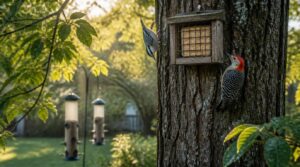
Suet feeders bring in a different crowd than your seed stations. Woodpeckers and nuthatches climb to eat, so height and mounting matter more here. Here’s what to keep in mind before you pick a spot.
Woodpecker Feeding Habits
Watch a woodpecker feed, and you’ll notice a distinctly vertical foraging posture, braced against bark like it’s climbing a ladder. That chisel-like beak digs out beetle larvae and ants year-round, with seasonal diet shifts toward nuts in winter. Their specialized tongue extracts hidden insect prey diversity from tunnels.
Suet feeders mimic this natural substrate foraging, which is why 5 to 15 feet works best.
Nuthatch Access Needs
Nuthatches share suet feeders with woodpeckers, but their headfirst bark foraging sets them apart. That upside-down grip lets them probe crevices missed from above.
Place suet near mature trees with thick bark, ideally within sight of nesting cavities. Keep a water source nearby, and choose quiet, sheltered spots—these birds avoid noisy, exposed feeding areas.
Rough-barked Mounting Poles
The pole itself matters as much as its height. Rough-barked mounting poles give woodpeckers and nuthatches real grip, cutting slips compared to smooth finishes.
Many are made from biodegradable, natural materials that resist weathering for years while limiting chemical leaching into your soil. The texture also retains a thin moisture layer, which helps stabilize freestanding pole setups during dry spells without inviting rot.
Stable Suet Placement
Grip is only half the equation. Suet feeders need a stable base too, so mount a suet cage at 5 to 6 feet using rigid, not swinging, hardware.
A cage design:
- Blocks squirrel pulling
- Resists wind-induced swinging
- Shields against thermal suet spoilage
- Keeps insectivorous birds feeding steadily
Place it partly shaded—this ideal feeder height balances access with protection during your regular bird feeder maintenance routine.
Avoid Excessive Swinging
A rigid mount matters as much as height. Limiting chain length to 6-10 inches cuts swing during gusts or busy landings.
Anchor pole bases firmly and choose brackets with dampening features. This stabilizing mounting hardware keeps suet steady, protects perching birds, and maintains your ideal feeder height without sway compromising access.
Hummingbird Feeders: 4 to 6 Feet
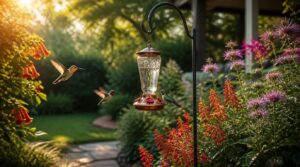
Hummingbirds need a different setup than seed-eating birds. Height alone won’t guarantee visits, so placement details matter too. Here’s what to check before you hang that nectar feeder.
Eye-level Nectar Access
Ever notice how hummingbirds seem to lock onto a feeder without circling first? That’s eye-level placement at work.
- Reduces neck twisting during frequent visits
- Improves visual detection for fast-flying birds
- Aligns ports with beak height, cutting spillage
Mounting nectar feeders at bird eye level speeds search efficiency. Precise port alignment keeps nectar where it belongs—inside the bird, not dripping below.
Partial Shade Placement
Shade does more than keep you cool on a summer afternoon—it protects nectar too. Aim for 3 to 6 hours of sunlight, positioning feeders where morning rays give way to afternoon shade. This slows fermentation and reduces glare, making the feeder easier for hummingbirds to spot.
Nearby shade-tolerant plants like astilbe or ferns add cover without blocking flight paths, while damp soil beneath needs regular moisture checks.
Easy Cleaning Height
Scrubbing nectar feeders shouldn’t require a ladder. Keeping your station within the 4 to 6 foot range puts trays at arm’s length for quick wipe-downs every 2 to 3 days.
- Long-handled brush for ports
- Mild soap spray bottle
- Microfiber cloth for wiping
- Small basin for rinsing
- Stiff brush for buildup
Smooth, removable parts resist grime, cutting your maintenance time a lot.
Away From Busy Paths
Hummingbirds spook easily, so skip the spot next to your main walkway. Set feeders 10 to 20 meters from foot traffic, near natural cover like shrubs, to cut human scent and pedestrian disturbance.
This creates natural foraging zones and gives you real wildlife observation distances without birds bolting every time you step outside for coffee.
Reduce Nectar Overheating
Sweet nectar turns thin and watery once it warms, which throws off nectar viscosity and sugar concentration your visitors rely on.
Fight back with these steps:
- Hang feeders under natural lighting filtered by leaves, not direct sun
- Choose light-colored reservoirs for better thermal insulation
- Refill mornings or evenings
- Rely on airflow dissipation by mounting on a breezy pole
- Rinse often to block microbial growth prevention
Height for Predator Protection
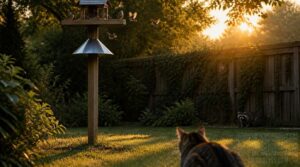
Height does more than help birds feed comfortably. It also decides whether cats and raccoons get an easy meal. Here’s what actually keeps predators out of reach.
Cat Jumping Distance
Never underestimate a house cat’s hind leg power. From a standstill, most cats clear 4 to 5 feet vertically.
| Jump Type | Typical Range |
|---|---|
| Vertical (standing) | 4-5 ft |
| Vertical (running start) | 6+ ft |
| Horizontal bound | 5-7 ft |
| Landing traction | Best on carpet |
| Ambush risk | Highest near ledges |
Keep feeders above 6 feet, well past comfortable horizontal bound range.
Raccoon Climbing Barriers
Cats aren’t the only climbers to plan for. Raccoons rotate their hind feet 180 degrees, letting them descend headfirst and grip almost any textured surface.
Rough wood, brick, and mesh give claws footholds, while raccoons usually max out around 6 to 8 feet on standard barriers. That’s why height alone won’t stop them—surface texture and pole geometry matter just as much for real predator protection.
Smooth Pole Baffles
Raccoon claws can’t grip what they can’t hold onto. That’s why smooth pole baffles work: no texture means no foothold, unlike rough wood or brick.
Choose a wide-diameter baffle, 16 to 23.5 inches, for real predator climbing resistance. Galvanized steel or UV-stabilized plastic both offer weatherproof baffle options with easy wraparound installation—no need to remove your feeder from its pole.
Minimum Safe Height
Baffles only work if height backs them up. Set feeders at least 5 to 6 feet up—tall enough that jumping cats can’t reach feeding birds, low enough for easy refills.
This baseline also covers ground hazard prevention: adequate clearance stops rain splash and debris buildup below. Check mounting points seasonally; wind and snow load can shift stability, so adjust height when weather conditions demand it.
Avoid Shrub Ambush Points
Height only solves half the problem—proximity to cover matters just as much. Keep feeders 10 to 15 feet from dense shrubs, cutting ambush risk for climbing predators.
Prune back branches to open predator sightlines and vegetation clearance year-round. Remember seasonal growth impacts: spring foliage hides threats fast. Good bird habitat management means checking cover each season, not just once.
Squirrel-Proof Height and Distance
Squirrels can outmaneuver almost any feeder setup you throw at them. That’s where a simple measuring rule comes in handy. Grab a tape measure, and let’s break down the exact numbers you need.
Use The 5-7-9 Rule
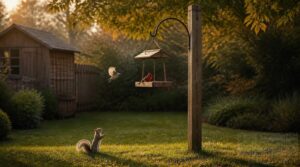
Squirrels are clever, but they’re not magic—one simple formula beats their best tricks. The 5-7-9 rule gives you a quick mental checklist for bird feeder positioning without overthinking it.
Instead of guessing, you’re layering three measurements that together reduce decision drift: height, distance from structures, and clearance from branches. Each number targets a specific jump or leap squirrels rely on, cutting off their access points one by one.
Five Feet High
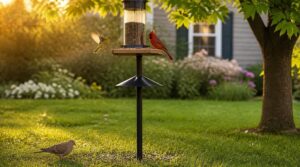
Five feet marks the sweet spot for backyard bird feeders, balancing species accessibility with predator safety. Ground foragers, finches, and cardinals all reach this height comfortably, giving you strong great bird viewing from a window.
Mounting at five feet also improves stability and sway control on a single pole. You’ll get easy refilling convenience without stretching or bending, keeping seed fresh and feeders steady.
Seven Feet From Structures
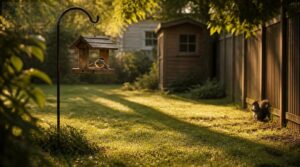
A gap of seven feet from walls, sheds, or fences keeps your feeder out of easy squirrel-jumping range. This spacing also clears Predator Ambush Zones, preserves Flight Path Clearance, and cuts window collisions by reducing glare.
In tight Urban Yard Spacing, it still allows safe Maintenance Access Safety and Reflection Reduction—proof that knowing how high to hang feeders isn’t just about height alone.
Nine Feet Below Branches
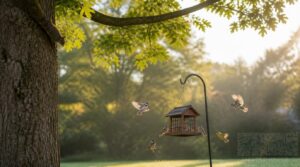
Nine feet of clearance below any overhanging branch closes off a squirrel’s easiest launch pad—think of it as removing the diving board.
Nine feet of clearance beneath overhanging branches removes a squirrel’s easiest launch pad into your feeder
- Vertical clearance safety stops leaping attacks
- Reduces canopy proximity risks near trunks
- Limits predator ambush zones overhead
This buffer works alongside your 5-7-9 rule, giving climbing predators no clean angle while keeping the best height for bird feeders intact for avian safety.
Add Wide Cone Baffles
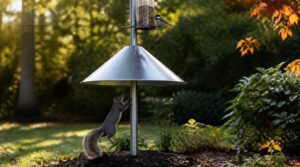
A wide cone baffle turns the pole into a slide, not a ladder. Mount it 8 to 10 feet up, curved edge down, so gravity-based deterrence does the work. Choose galvanized steel for durability.
A 16 to 18 inch diameter blocks climbing mechanics cold, stopping gray squirrels and other climbing predators before they reach the seed—your best backyard predator deterrent.
Safe Distance From Windows
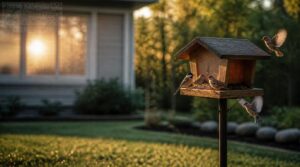
Windows cause more bird deaths than most predators combined. Distance and glass treatment both change the odds. Here’s how to place your feeder for a safer approach.
Within Three Feet
Glass acts like a mirror at close range, so place feeders within 3 feet of windows to limit collision speed. Birds launching from this zone can’t build enough momentum to injure themselves on impact.
This distance also creates safe wildlife handling zones for refilling and close observation. You’ll get excellent visual cue identification—plumage, size, behavior—without disturbing natural foraging patterns nearby.
Beyond Thirty Feet
Beyond thirty feet, you’re working with remote station placement—far enough from windows and patios to erase collision risk entirely.
This distance also blends feeders into natural landscape features like tree lines and hedgerows.
- Larger yards
- Multiple stations
- Species variety
- Reduced human buffer
Seasonal foliage growth affects visibility, so recheck placement each spring for best vertical space optimization.
Reduce Glass Reflections
Not every yard allows thirty feet of clearance, and that’s when glare management matters most. Diffused light management cuts reflections without moving a single feeder.
Try sheer curtains, frosted film, or window tint effectiveness to soften glass. Anti-reflective coatings and polarizing filters also help. Combined with smart feeder positioning, these tools protect birds and improve your birdwatching experience while preventing window collisions.
Face Away From Sunrise
Orient feeders with their back to the sunrise. This cuts morning glare and keeps birds visible as they land. You’ll strain your eyes less, and plumage colors show true instead of washing out in backlight.
Birds also settle faster, supporting steadier dawn feeding. Good mounting method and placement work together here—small tweaks, better viewing, calmer birds.
Add Window Decals
Even with smart mounting method and sun angle, glass still fools birds. Window decals close that gap.
Pick from three decal material types:
- Perforated vinyl (visible outside, subtle from inside)
- Frosted vinyl (diffused light, casual privacy)
- Opaque decals (highest contrast)
Clean and dry surfaces first, then set decals at eye level for high-visibility graphics. Quality vinyl resists fading 3-7 years, protecting bird access near your feeders and viewing equipment alike.
Common Feeder Height Mistakes
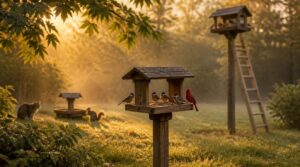
Even careful backyard birders slip up on height sometimes. A few inches too low or too high can undo all your good planning. Here are the mistakes worth watching for.
Hanging Feeders Too Low
A feeder sitting below 4 feet is basically a dinner bell for cats and raccoons. Ground scavenger threats rise fast, and low-level mold growth builds in damp, spilled seed. Cat ambush zones start right at ground level.
Keep hanging feeders at 5 to 6 feet, giving birds clear sightlines and denying predators an easy launch point.
Placing Feeders Too High
Why go higher than 15 feet if chickadees can’t reach it anyway? Beyond that mark, small bird accessibility drops fast, forcing extra wingbeats and higher energy expenditure per visit.
- Harder ladder access raises maintenance safety risks
- Seed spills scatter unseen, drawing pests below
- Distant feeders lose visibility for quick predator checks
- Swaying poles unsettle timid species
- Refilling becomes a genuine chore
Keep ideal feeder positioning practical, not aspirational.
Ignoring Nearby Jump Points
Skip a spot near fence gaps or low shrub lines, and you’ve created a hidden entry point predators use like an unmarked back door. These access gaps cause predator ambush risks and blind spots in your own patrol habits.
Keep 10 to 15 feet of horizontal clearance from dense vegetation. Ideal feeder positioning accounts for every approach path, not just the obvious ones facing your window.
Using Long Swinging Chains
A long chain can add nearly 1.5 times its length to the seat’s swing arc, turning a gentle sway into real swing arc clearance trouble near feeders. That extra motion means greater moving load stress on hooks and joints, accelerating chain wear patterns.
Choose short, rated chains with strong hardware corrosion resistance to keep feeders stable, safe, and steady for the birds visiting them.
Moving Feeders Too Often
Birds build mental maps of your yard, and shuffling the feeder weekly wrecks that memory. Bird habituation takes time, so let a location settle for a season before relocating.
Constant moves disrupt foraging routines and cut visitation. Instead, establish one or two feeding zones and rotate between them seasonally—balancing hygiene benefits with the steady, predictable positioning birds actually rely on.
Frequently Asked Questions (FAQs)
What is the 5-7-9 rule for bird feeders?
Good fences make good neighbors—and good spacing makes safer feeders. The 5-7-9 rule means placing feeders 5 feet high, 7 feet from structures squirrels use, and 9 feet from windows or branches, optimizing predator buffers and reducing collisions.
Do birds like feeders high or low?
Neither, really—it depends on the species. Ground foragers like groundfeeding doves and sparrows stay low, while canopy dwellers prefer height. Match feeder type to natural feeding zones for the best visibility and safety.
Can bird feeders be hung too high?
Icarus flew too close to the sun, and feeders face a similar limit. Past 7 feet, ladder safety risks rise, wind exposure increases swinging, shy birds avoid unstable perches, and refilling turns into a chore.
Should I stop feeding hummingbirds in September?
Not necessarily. Keep feeders up through migration stopover support, cleaning every 3-5 days to avoid nectar fermentation. Watch regional timing and remove once temperatures near freezing or lingering birds disappear, whichever comes later.
How often should I clean my bird feeders?
A dirty feeder spreads disease faster than any predator ever could. Clean every two weeks normally, weekly in hot or humid weather, and every 2 to 3 days for hummingbird nectar—preventing mold, fermentation, and outbreaks among your backyard visitors.
What should I store birdseed in for freshness?
Use airtight metal or thick plastic containers with rubber gaskets, kept in a cool, dry spot between 60-70°F.
This blocks moisture and pests, protecting black oil sunflower seeds and preserving avian nutrition for wild birds visiting your feeding station.
How much daily sunlight does a feeder site need?
Aim for 3 to 6 hours of partial sun daily. Morning exposure feeds birds early, while afternoon shade slows nectar spoilage and fermentation, balancing sunlight seasonality, temperature control, and predator visibility for safer, more active feeding stations.
How long should feeder mounting chains be?
Think of the chain like a fishing line: too long invites trouble, too short starves access. Keep 2 to 3 feet of vertical drop, ensuring corrosion-resistant hardware, stable tension, and species-specific clearance above soil or mulch.
How far should feeders be kept from fences or woodpiles?
Keep feeders 10 to 15 feet from fences and woodpiles, cutting off predator ambush zones and squirrel jump angles. This horizontal clearance blocks rodent access and stealthy raccoon approaches, giving birds a clear escape path away from hidden cover.
Conclusion
A feeder’s height works like a lock on a door, keeping the right guests in and the wrong ones out. Solid backyard feeder height recommendations aren’t guesswork; they’re built from how animals climb, jump, and fly.
Mount tubes at 5 feet, suet at 8, and nectar feeders at eye level, and predator visits drop fast. Get the numbers right, and the birds will keep coming back.
- https://www.countryliving.com/gardening/outdoors/a71098576/where-to-hang-your-hummingbird-feeder
- https://duncraft.com/blogs/birding-tips/bird-feeder-placement-guide-attract-more-birds-stop-squirrels-and-prevent-window-collisions
- https://www.cnet.com/home/yard-and-outdoors/dont-know-where-put-your-bird-feeder-what-wildlife-expert-recommends
- https://www.massaudubon.org/nature-wildlife/birds/bird-feeding
- https://ask.ifas.ufl.edu/publication/UW192