This site is supported by our readers. We may earn a commission, at no cost to you, if you purchase through links.
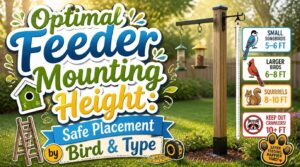
Six inches too low, and raccoons treat your feeder like a drive-through window. Six inches too high, and you’re hauling a ladder out every weekend just to add seed. Mounting height isn’t a minor detail—it determines which species show up, how safe they stay while feeding, and how often you’ll curse your own setup during a refill.
Most backyard mistakes trace back to guesswork: a hook screwed into whatever post was handy, a pole planted without measuring predator reach. The best feeder mounting height actually shifts depending on feeder style and the birds you’re hoping to attract, from ground-forager to hummingbird.
Get the numbers right, and you’ll build a station that’s stable, predator-resistant, and genuinely easy to maintain.
Table Of Contents
- Key Takeaways
- Best Bird Feeder Mounting Height
- Heights by Feeder Type
- Heights for Different Birds
- Predator-Safe Feeder Placement
- Window and Weather Safety
- Frequently Asked Questions (FAQs)
- What is the 5 7 9 rule for bird feeders?
- Can bird feeders be hung too high?
- How high is too high for a hummingbird feeder?
- What is the perfect height for a bird feeder?
- How often should I clean my feeder?
- Whats the correct height for goat hay feeders?
- How do hog feeder heights differ from bird feeders?
- Should feeder height change with the seasons?
- Do window decals really prevent bird collisions?
- Conclusion
Key Takeaways
- Most feeders belong at 5–6 feet, though hoppers and woodpecker suet feeders do better at 6–10 feet and ground foragers need food at or near ground level.
- Following the 5-7-9 rule—5 feet high, 7 feet from structures, 9 feet below overhead cover—keeps feeders out of reach of climbing and ambushing predators.
- Placing feeders within 3 feet of a window or beyond 30 feet avoids the dangerous mid-range collision zone created by glass reflections.
- Seasonal and species-specific adjustments, like raising feeders in snow or mounting nectar feeders above 5 feet to dodge cats, keep the setup safe year-round.
Best Bird Feeder Mounting Height
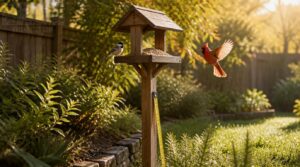
Getting feeder height right isn’t guesswork—it’s the difference between a backyard full of visitors and one that sits empty. The sweet spot most experts point to is 5 to 6 feet, but the reasoning behind that number matters just as much as the number itself. Here’s what you need to know before you grab that hammer.
For a closer look at how ground clearance affects visibility and safety from predators, this guide to ideal backyard feeder height recommendations breaks down the four-to-five-foot range in more detail.
Standard 5–6 Foot Range
Five to six feet off the ground marks the best height to mount for most backyard feeders, balancing species accessibility with feeding zone stability. This range works across:
- Hopper feeders
- Tube feeders
- Platform designs
You’ll find this height creates ideal circumstances for viewing angles and refilling convenience alike, maximizing both bird traffic and your own ease of maintenance without constant bending or stretching.
Why Height Matters
That mounting height isn’t arbitrary — it directly affects predator detection, giving birds a clear line of sight to approaching cats or hawks. It also curbs seed debris control and limits rodent access near the base, while protecting nearby flower beds.
For you, this range strikes the most favorable conditions for maintenance ergonomics, keeping refills quick and spills minimal.
Backyard Visibility
Ergonomics aside, the 5–6 foot window also gives you a front-row seat from the kitchen sink or patio chair.
Clear sightlines depend on landscape choices: keep hedges low, mulch beneath feeders for contrast, and prune summer foliage that blocks view.
Five ways to sharpen visibility:
- Trim shrubs below 6 feet
- Use bare mulch for contrast
- Position feeders toward seating
- Reduce reflective surfaces nearby
- Rotate placement seasonally
Easy Refilling Access
Good visibility earns its keep at refill time, too. Ergonomic refill heights within the 5–6 foot range mean avoiding back strain while pouring seed, since your palm naturally cradles the base.
| Refill Factor | Result |
|---|---|
| Stable refill platforms | Fewer spills |
| Tool-assisted refilling | Peak efficiency |
| Proper seed spill management | Less rodent activity |
This setup delivers the best result obtainable for daily maintenance.
Choosing materials and layouts that resist grime buildup from the start, as outlined in this guide to keeping bird aviaries clean, saves countless hours down the road.
Heights by Feeder Type
Not every feeder belongs at the same height, since each design attracts birds with different feeding habits and physical needs. Your hopper, tube, platform, suet, and nectar feeders all have their own sweet spot for placement. Here’s exactly where to hang each one for the best results.
Hopper Feeders
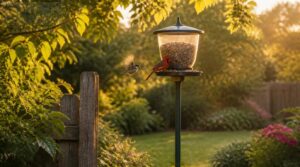
Gravity flow mechanics make hopper feeders self-regulating: seed drops from the bin only as birds clear the tray, giving peak efficiency with minimal waste.
For best results, mount them 6 to 10 feet up on a UV resistant pole.
Adjustable outlets control flow rate, while sealed lids prevent moisture ingress, protecting the 2-to-20-liter capacity from spoilage.
These systems can integrate with automated packaging lines to simplify large-scale material handling.
Tube Feeders
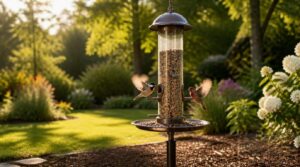
Clear polycarbonate cylinders let you track seed levels at a glance, while UV-resistant materials resist clouding for years.
Mount tubes 4 to 6 feet up, away from shrubs, for the best placement and predator visibility.
- Seed deflectors reduce scatter
- Sealed caps prevent moisture buildup
- Metal bases resist weather damage
- Port size limits overfeeding
- Perch spacing suits songbirds
Platform Feeders
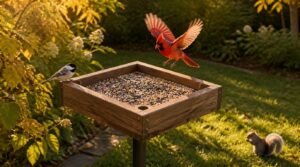
Platform feeders work best mounted 5–6 feet up, giving you great seed spillage control via a raised tray lip while staying accessible to songbirds and squirrel-wary alike.
Look for weatherproof coating benefits and a drainage hole to prevent mold. These accommodate the widest seed type compatibility—mixed blends, sunflower hearts, safflower—making them the most desirable choice for mixed-flock feeding stations.
Suet Feeders
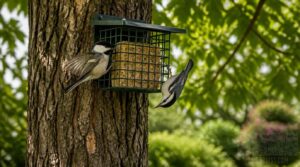
Fat cakes wrapped in wire mesh cage designs deter squirrels while letting chickadees and nuthatches slip through easily. Mount these 5–6 feet up for best results, ideally near tree cover to keep suet from melting.
Choose weatherproof material choices like powder-coated metal, and stick to a weekly cleaning maintenance routine. Single or dual suet cake capacity models both work well for targeted bird species like woodpeckers.
Nectar Feeders
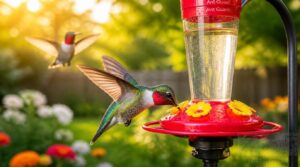
Hummingbirds don’t just visit nectar feeders—they defend them. Hang yours 4–6 feet up, away from cats, using a 10% sugar concentration for the best results. Bright red ports work as color attraction strategies.
Ant guards prevent contamination, and washing every 3–7 days curbs nectar spoilage prevention issues before mold sets in.
Heights for Different Birds
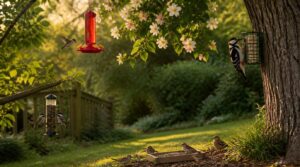
Different species bring different feeding habits to your yard, and those habits should guide where you hang each feeder. A hummingbird won’t approach the same way a woodpecker does, and a ground-feeding sparrow has entirely different needs than a flock of chickadees. Here’s how mounting height shifts depending on which birds you’re hoping to attract.
Hummingbirds and Orioles
Sweet-tasting energy drives these two species differently: hummingbirds need nectar sugar concentration near 20-25%, while orioles tolerate weaker mixes since fruit rounds out their diet.
Mount both feeders 4-6 feet high. Hummingbirds fiercely defend that territory; orioles don’t. During migration, your yard becomes a stopover site, so staggering bloom succession keeps nectar flowing from spring through fall.
Woodpeckers
Woodpeckers need feeders mounted 6–10 feet up, mimicking the tree trunks they’d naturally forage on. Their zygodactyl foot grip and stiff tail brace them at height, while a shock-absorbing skull experiences repeated impact from drumming and excavation work.
Suet satisfies their wood-boring insect diet best. For the best placement, secure feeders to a sturdy trunk or post — these birds want height, texture, and stability, not a wobbly perch.
Ground-Feeding Birds
Ground foragers like doves and sparrows do best when feed sits at ground level or within 6 inches of it, mimicking natural foraging in leaf litter and soil.
- Keep zones spill-free with regular sweeping
- Choose open sightlines for predator awareness
- Prevent soil moisture buildup under trays
- Maintain flat, stable ground for easy access
Clear sightlines let birds spot threats early, supporting safer, more diverse feeding activity.
Small Songbirds
Chickadees, finches, and sparrows weigh just 8 to 30 grams, so standard 5–6 foot mounting works well for best foraging.
Seed eaters favor sunflower and nyjer at feeders, while insects supply breeding-season protein for chicks. Nesting material sources like twigs and grasses often sit nearby in shrubs.
Diverse plantings support this foraging habitat diversity, encouraging natural vocalizations and healthy activity as seasonal migration patterns bring new visitors through your yard.
Mixed Backyard Flocks
Chickens, ducks, and geese sharing a yard need feeders set at that same 5–6 foot range, but housing space management matters more here since species differ in size and reach.
- Ramps for shorter ducks
- Multiple stations to curb interspecific aggression
- Elevated platforms protecting feed from species pest control foragers
Diverse flocks also boost nutrient cycling patterns, while a watchful goose often fills flock sentinel roles naturally.
Predator-Safe Feeder Placement

Height alone won’t keep your feeders safe if a raccoon can still climb the pole or a hawk finds cover nearby. Predators test every angle, so placement matters just as much as elevation. Here’s what you need to know to keep your birds out of harm’s way.
Use Pole Baffles
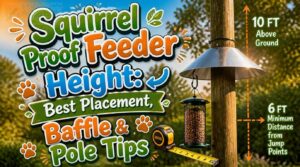
Pole baffles remain your best defense against squirrels and raccoons. Choose a wraparound design with a 16- to 23.5-inch diameter, matched to your pole’s width, for the best squirrel deterrence.
Confirm pole compatibility before buying — most fit 0.5- to 1-inch poles. Weatherproof galvanized steel or UV-stabilized plastic ensures durability, while installing wraparound designs just below the feeder blocks climbing access entirely.
Follow 5-7-9 Rule
Three numbers, one memorable formula: mount feeders 5 feet high, keep them 7 feet from structures, and leave 9 feet of open space below overhead cover. This height threshold limits ground-predator access while the buffer zone deters ambush attempts from cats or raccoons hiding nearby.
Follow the 5-7-9 rule: five feet high, seven feet from structures, nine feet of open space below overhead cover to outsmart predators
Consistent placement across your yard simplifies maintenance and creates ideal conditions for safe, predictable feeding—no guesswork required each time you add a new station.
Distance From Shrubs
Six to eight feet is the sweet spot between your feeder and any shrub line—close enough for cover, far enough to kill predator ambush zones. Sightline maintenance matters most; regular shrub pruning tips like thinning branches keep cats from stalking unseen.
Adjust seasonally, since spring growth and managing microclimates around damp shrub beds shift that buffer for the best placement.
Cat-Safe Nectar Height
Feline reach limits top out around five feet, so mounting nectar feeders above that line keeps hummingbirds out of paw range.
Sturdy mount stability prevents swaying that draws curious cats closer, while nectar scent reduction—via prompt cleanup—cuts insect attraction prevention issues too.
Pair this height with predator inspection clearance below the pole for truly ideal, cat-safe placement.
Open Ground Feeding Areas
Ground-feeding species need open sightlines, not just food. Choose a flat, well-drained patch with light gravel for substrate drainage and natural foraging texture, spaced for social spacing among flock members.
Keep the zone visible from multiple angles for predator visibility, free of dense brush. A shallow tray elevates seed slightly, while weekly cleanup maintains seed hygiene for healthy, safe foraging conditions.
Window and Weather Safety

Height alone won’t protect your birds if glass and weather work against you. Windows cause more collisions than most predators ever will, and soggy seed invites its own set of problems. Here’s how to position your feeder so it stays safe, dry, and easy to reach.
Rule of 3 or 30
A window’s reflection can look like open sky to a bird, which is exactly why placement distance matters so much.
The Rule of 3 or 30 means mounting feeders within 3 feet of glass or beyond 30 feet entirely:
- Under 3 feet: birds can’t gain damaging speed
- Beyond 30 feet: birds have room to redirect flight
- Between these: creates a dangerous impact zone
- Decals help reduce reflections regardless of distance
Avoid Collision Zones
Distance alone won’t guarantee safety—visual collision zones form wherever glare, reflections, and shelter corridors near eaves confuse flight paths. Create a perimeter safe pathway with clear sightlines, then add ground level barriers like low fencing to redirect birds away from windows.
For the best results, pair distance rules with decals, angled glass, and trimmed shrubs for true collision-zone avoidance.
Sheltered Feeder Spots
A roof overhang or dense canopy does more than block rain—it creates a natural windbreak that keeps feeders steady and calm for approaching birds. Foliage density matters here: too sparse offers no aerial predator cover, too thick blocks your sightlines. For the best conditions, place feeders 6 to 12 feet from shelter, balancing quick refills with a bird’s need for fast retreat.
Keep Seed Dry
That same overhang protects against a subtler threat: moisture. Wet seed clumps and molds fast, so built-in covers matter as much as windbreaks.
- Choose feeders with hoods or roofs
- Check seed weekly for clumping
- Avoid overfilling in damp seasons
- Empty and dry hoppers after storms
- Store bulk seed in airtight containers
Dry, sheltered feeders mean healthier birds and less waste.
Maintain Safe Access
A dry feeder does you no good if the path to it isn’t safe. Maintain a non-slip walkway, at least 3 feet wide, with stable mounting that won’t wobble in wind.
Keep routes obstruction-free and add weatherproof signage marking safe entry points. Store refilling tools nearby for one-handed use.
That’s the best way to get access, favorable conditions for both you and your birds.
Frequently Asked Questions (FAQs)
What is the 5 7 9 rule for bird feeders?
Squirrels can leap nearly 8 feet horizontally, which is why the 5-7-9 rule exists: mount feeders 5 feet high, 7 feet from structures, and 9 feet below branches for true predator ambush prevention and best mounting geometry.
Can bird feeders be hung too high?
Yes — anything above 7 feet works against you, causing maintenance difficulty, poor refilling safety, and reduced bird visibility, while offering little added protection since squirrel reach and predator agility often exceed expectations at greater heights anyway.
How high is too high for a hummingbird feeder?
Low enough for easy refilling, high enough to dodge predators — that’s the balance. Beyond 8 to 10 feet, ladder safety risks climb, visibility arcs shrink, and wind vibration causes leaks, so the best placement stays near 6 feet.
What is the perfect height for a bird feeder?
For most backyards, 5 to 6 feet hits the sweet spot, balancing songbird access with predator deterrence and collision risk. It suits tube and hopper styles, keeps refilling manageable, and allows for stable, weatherproof mounting for easy daily use.
How often should I clean my feeder?
Like sourdough starter, feeders sour fast without upkeep. Clean every two weeks under normal conditions, weekly in humid weather;
Nectar feeders need attention every 2–3 days to prevent fermentation and stop pathogen spread from spoiling good feeding conditions.
Whats the correct height for goat hay feeders?
Set adult goat hay feeders 30 to 40 inches high, adjusting lower for Nigerian Dwarf goats or kids. Match bar spacing (4–6 inches) to breed size, tune seasonally as herd composition shifts, and you’ll cut hay waste while preventing neck strain.
How do hog feeder heights differ from bird feeders?
Ever wonder why a hog trough sits chest-high while a finch feeder perches overhead?
Livestock vs songbirds explains it: hogs need waist-level access for handlers, while birds require species specific elevation near 5–6 feet for predator deterrence and contamination control.
Should feeder height change with the seasons?
Yes. Snowy region adjustments call for raising feeders a foot to beat drifts; spring favors lower spots for ground foragers; summer shade helps most; fall migration shifts benefit slight height changes; bear country often means seasonal removal.
Do window decals really prevent bird collisions?
Absolutely—when applied correctly, decals stop birds cold before impact.
Exterior application with grid pattern spacing near two inches, using high contrast or UV reflective coatings, achieves the best results, cutting collisions across species far better than scattered single decals ever could.
Conclusion
Goldilocks knew the value of "just right," and your feeder deserves that same precision. The best feeder mounting height isn’t one fixed number—it’s a calculated balance between species biology and predator reach, adjusted inch by inch.
Measure twice, mount once, and recheck baffles each season as growth and snowfall shift the math. Get it right, and your yard becomes what every biologist hopes for: a safe, thriving feeding station, humming with activity year-round.
- https://www.perkypet.com/articles/how-high-should-i-hang-my-bird-feeder
- https://www.reallywildbirdfood.co.uk/news/post/where-should-i-put-my-bird-feeder
- https://www.cnet.com/home/yard-and-outdoors/dont-know-where-put-your-bird-feeder-what-wildlife-expert-recommends
- https://duncraft.com/blogs/birding-tips/bird-feeder-placement-guide-attract-more-birds-stop-squirrels-and-prevent-window-collisions
- https://www.birdcollective.com/blogs/news/hummingbird-feeders-where-to-place-them-and-why-it-matters