This site is supported by our readers. We may earn a commission, at no cost to you, if you purchase through links.

In 1973, a Rüppell’s griffon vulture collided with a commercial aircraft at 37,000 feet over West Africa. That’s cruising altitude for a passenger jet. The bird didn’t survive the encounter, but the fact it reached that height at all is astonishing.
Most birds you’ll spot outside your window never climb past 500 feet. Yet some species cross the Himalayas, ride jet streams, and push into air so thin and cold it would kill most living things within minutes.
Understanding how high a bird can fly before it dies reveals a quiet kind of biological genius hiding in plain sight.
Table Of Contents
- Key Takeaways
- Typical Bird Flight Altitudes
- Death Limit: Around 37,000 Feet
- Highest Flying Birds Recorded
- Why Birds Fly So High
- High-Altitude Survival Adaptations
- Frequently Asked Questions (FAQs)
- How high can a bird fly before rain?
- How high can a bird fly?
- What happens if a bird flies high?
- How high do migratory birds fly?
- Can birds fly above the ground?
- How high can an eagle fly?
- How high can a bird fly without dying?
- What is the highest height a bird can fly?
- What happens when birds fly to high?
- Can birds fly at 30,000 feet?
- Conclusion
Key Takeaways
- The highest any bird has ever flown is 37,000 feet — confirmed in 1973 when a Rüppell’s griffon vulture flew straight into a jet engine over West Africa, which is a memorable, if grim, way to set a record.
- Most birds stay well below 500 feet in daily life, but migratory species routinely climb to 2,000–5,000 feet to catch favorable winds, with long‑haul migrants occasionally pushing close to 20,000 feet.
- Above 20,000 feet, thin air, extreme cold (around –56°C at cruising altitude), and oxygen deprivation combine into a lethal trifecta that would knock out most living things within minutes.
- High‑altitude birds like the bar‑headed goose and Rüppell’s griffon vulture survive where others can’t thanks to specialized hemoglobin, ultra‑efficient unidirectional lungs, dense insulating feathers, and higher muscle capillary density — adaptations fine‑tuned over generations.
Typical Bird Flight Altitudes

Most birds aren’t chasing records — they’re just going about their day. But altitude still shapes everything they do, from the robin outside your window to the crane crossing a mountain range. Here’s how different birds stack up regarding how high they actually fly.
Migration turns ordinary birds into endurance athletes, and altitude shifts drive more of that behavior than most people realize.
Backyard Birds Under 500 Feet
Most backyard birds never come close to testing their avian physiological limits. Your local chickadees, house finches, and mourning doves spend their days well below 500 feet — often just 5 to 40 feet off the ground — hopping between feeders, shrubs, and lawn edges. That’s not laziness. That’s smart living.
Migration at 2,000–5,000 Feet
Once migration season kicks in, birds shift gears completely. Most migratory species climb to 2,000–5,000 feet — high enough to catch favorable wind corridor currents, low enough to stay safe.
Radar detection networks regularly pick up these busy nocturnal highways. Thermal updrafts along ridges give soaring birds a free lift, saving precious energy across hundreds of miles.
In the western United States, birds often fly at around 800 m (2,600 ft) due to mountainous terrain, reflecting the higher western flight altitudes.
Long Flights Near 20,000 Feet
Some long-haul migrants push well beyond that mid-range comfort zone. A handful of species begin their ascent near 5,000 feet and keep climbing — sometimes reaching close to 20,000 feet during sustained nonstop migration.
- Thin air means fewer obstacles
- Higher altitude unlocks faster tailwinds
- Less turbulence makes the journey smoother
- The payoff is real: shorter travel time, lower energy cost
Wind-assisted Cruising Heights
Wind doesn’t just push birds along — it’s basically their free fuel. Once a bird climbs to altitude, jet stream tailwinds can reach over 100 mph, carrying migrants across continents with barely a wingbeat. Meanwhile, thermal soaring lets birds spiral upward on warm rising air columns, gaining thousands of feet without burning much energy at all.
| Wind Type | Altitude Range | Key Benefit |
|---|---|---|
| Thermal Updrafts | 1,000–10,000 ft | Free altitude gain |
| Jet Stream Tailwinds | 20,000–35,000 ft | Massive speed boost |
| Coastal Updrafts | 500–3,000 ft | Sustained smooth glide |
Seasonal wind patterns shift these corridors dramatically — monsoons, polar fronts, and pressure systems all reshape where the best "highways" are each year. Birds don’t fight the air. They read it.
Mountain Route Altitude Changes
Mountains don’t ease birds in gently — they demand instant adaptation. Steep elevation gains can push altitude up by 3,000 meters in just a few kilometers, forcing birds to find thermals fast or burn precious energy flapping harder in thinning air.
Here’s what changes along a mountain route:
- Oxygen availability drops sharply above 4,000 meters
- Wind funneling passes accelerate gusts unpredictably
- Snow and ice effects increase turbulence and shift thermal patterns
- Altitude gradient shifts compress microclimates into short vertical bands
- Thermal updraft reliability decreases on exposed, shadowed ridgelines
Death Limit: Around 37,000 Feet

So what actually happens when a bird pushes past its limits? There’s a ceiling up there — roughly 37,000 feet — and what lies beyond it is genuinely unforgiving. Here’s what makes that altitude so dangerous for birds.
Beyond raw altitude, understanding how birds navigate long distances reveals why pushing that 37,000-foot ceiling can unravel their entire migratory strategy.
Highest Verified Bird Altitude
Here’s a number that stops most people cold: 37,000 feet. That’s the highest any bird has ever been confirmed in flight.
In 1973, a Rüppell’s griffon vulture was verified at that altitude over West Africa — not by a researcher watching through binoculars, but because the bird flew straight into a jet engine. An unforgettable data point, to say the least.
The only confirmed record of a bird at 37,000 feet came from a vulture swallowed by a jet engine
Why Most Birds Stay Lower
That 37,000-foot record is genuinely astonishing — but here’s the thing: it was a fluke, not a routine commute.
Most birds stay below 5,000 feet because that’s where life actually is. Food, cover, familiar air.
Rüppell’s vultures normally cruise around 6,000 meters (≈19,700 ft) — still impressive, but a world away from that jet-engine encounter.
Lethal Oxygen Shortage Risk
Oxygen thins fast above 20,000 feet. At that point, altitude hypoxia becomes a genuine threat — cognitive function slips, muscles weaken, and coordinated flight gets shaky. Below 12% oxygen, you’re looking at fatal depletion territory.
Birds operating near 37,000 feet hit that wall hard, where the breathing crisis isn’t theoretical. It’s a physiological clock ticking toward blackout.
Extreme Cold Exposure
At 37,000 feet, the temperature averages –56°C (–69°F). That’s not cold — that’s a different category of brutal entirely. For any bird pushed that high, airway cooling kicks in fast, reducing lung function and thickening mucus until breathing becomes a genuine struggle.
Exposed tissue faces frostbite signs within minutes. Even Rüppell’s Griffon Vulture, built for extreme heights, relies on dense feathering as a natural layer system against that freeze.
Thin-air Flight Failure
Then there’s the physics problem. Barometric pressure loss at extreme heights means the air itself becomes too thin to generate reliable lift — wings have to work harder for less result. Oxygen depletion limits kick in fast, causing muscle weakness and impaired judgment. Here’s what thin atmosphere does to a bird:
- Flapping efficiency drops sharply
- Endurance collapses quickly
- Judgment and coordination fade
- Hypoxic collapse becomes possible
Highest Flying Birds Recorded
So which birds have actually made it to the extreme heights we’ve been talking about? A handful of species stand out — each with its own record and its own notable story. Here are the highest-flying birds ever recorded.
Rüppell’s Griffon Vulture
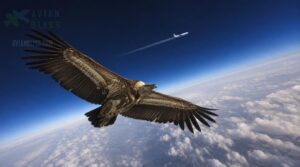
The undisputed champion of avian altitude is the Rüppell’s griffon vulture. In 1973, one was confirmed at 37,000 feet — the same cruising height as a commercial jet — after being ingested by an aircraft engine over West Africa.
That’s higher than Mt. Everest by a wide margin. A notable, if unfortunate, way to claim a high altitude flight record.
Common Crane
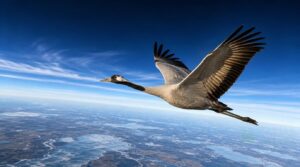
The common crane (Grus grus) holds its own impressive spot in high‑altitude flight records, observed at 33,000 feet during migration. That’s barely below the vulture’s record.
These tall, grey birds breed in wetland marshes across Europe and Asia, winter in warmer southern regions, and fuel their long journeys on seeds, grains, and the occasional invertebrate — practical eaters for serious travelers.
Bar-headed Goose

If the common crane made you raise your eyebrows, meet the bar-headed goose — a bird that crosses the Himalayas like it’s a minor inconvenience.
- Tracked at 27,825 feet while passing over the world’s highest peaks
- Breeds on high-altitude Central Asian plateaus, often above 3,000 meters
- Winters in India’s wetlands, making its migration route one of Earth’s most demanding
- Specialized hemoglobin pulls oxygen from air so thin it would knock you out
Whooper Swan

The whooper swan doesn’t get enough credit. While the bar-headed goose battles Himalayan passes, this large waterbird — bred on subarctic lakes and wintering across European wetlands — was radar-tracked at 27,000 feet.
That’s not a typo. It’s a record-breaking altitude record for a bird better known for its trumpet call and aquatic plant diet than extreme high-altitude flight.
Alpine Chough

Meet the alpine chough — a glossy black crow with a canary-yellow bill that calls cliff faces home. It nests in rocky habitat crevices, forages in alpine meadows, and soars mountain thermals like it was born to it. It was.
- Holds the highest altitude record for any passerine bird
- Documented at 26,500 feet — barely survivable oxygen levels
- Masters cliff nesting and flock dynamics in brutal conditions
- Thrives where most birds wouldn’t last an hour
Why Birds Fly So High

So why do birds bother climbing so high in the first place? It turns out there are some pretty compelling reasons — and none of them are accidental. Here’s what’s actually pulling them upward.
Safer Migration Routes
Think of bird migration altitude as a kind of natural highway system — and the safest lanes sit well above the chaos below.
Long-distance migratory routes push birds to 2,000–5,000 feet, where legal route expansion mirrors how organized flyways reduce dangerous detours.
Regional coordination, monitoring data, and information campaigns help protect both birds and the skies they cross.
Favorable Wind Currents
Birds don’t just fly high — they ride the sky like seasoned surfers catching invisible waves.
Thermal updrafts, ridge channelling effects, and jet stream utilization give migrating birds a serious mechanical advantage. Here’s what that looks like in practice:
- Mountain valley winds create smooth uplift paths, letting birds climb with almost no flapping
- Narrow ridges and canyons concentrate wind speed by 20–40%, amplifying lift dramatically
- Wind shear benefits near coastal cliffs stabilize level flight at mid-elevations
- Jet stream edges over high plateaus offer long, smooth glides that extend range
Wind assistance in migration isn’t a bonus — it’s the whole strategy.
Himalayan Pass Crossings
The Himalayas aren’t just mountains — they’re a wall that birds must either fly around or fly over.
Bar-headed geese choose over, crossing passes like ThorungLa at 5,416 m and NitiPass at 5,818 m during spring and autumn’s narrow safe windows. At those heights, oxygen drops by half, yet these geese keep climbing.
Predator Avoidance
Altitude isn’t just about endurance — sometimes, it’s the fastest escape route available.
Flying high puts birds out of reach of most ground predators instantly. Here are four key ways altitude keeps them safe:
- Sudden vertical ascent breaks pursuit before predators can react
- Alarm calls ripple through flocks, triggering mass climbs
- Erratic flight patterns confuse attackers during rapid ascent
- Height as refuge replaces dense cover where none exists
Energy-saving Soaring Flight
Soaring isn’t laziness — it’s genius. Rather than burning energy with constant flapping, birds like the Rüppell’s Griffon Vulture exploit thermal soaring, riding invisible columns of rising warm air at 70–85 km/h. They spiral upward for free, then glide long distances.
Wind soaring and ridge lift do the same, harvesting wind shear and terrain-driven updrafts to stretch every calorie further.
High-Altitude Survival Adaptations
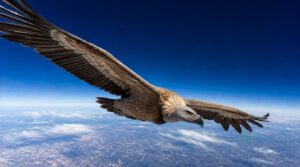
So how do birds actually pull this off without passing out at 30,000 feet? It turns out their bodies are built for thin air in ways that would honestly seem like cheating if you were a mammal. Here’s what makes them so remarkably good at surviving up there.
High-affinity Hemoglobin
Think of hemoglobin as your blood’s oxygen taxi. In Rüppell’s Griffon Vulture, high-affinity hemoglobin grips oxygen tightly even where the air is desperately thin — around 11,300 meters up.
A small genetic mutation in the αD subunit makes all the difference.
The tradeoff? Oxygen unloading to tissues slows, but at that altitude, simply staying conscious is the real victory.
Efficient Avian Lungs
Hemoglobin gets oxygen into the bloodstream — but bird lungs decide how much is available in the first place. And here’s where avian physiology genuinely surprises you.
Unlike your lungs, birds use unidirectional airflow. Air moves one way, continuously, powered by air sac pumps that keep ventilation steady through both inhalation and exhalation. Parabronchial exchange across a dense capillary network then pulls oxygen with impressive efficiency — even when it’s desperately scarce up high.
Low-oxygen Muscle Performance
Getting oxygen into the blood is only half the battle. The muscles still have to use it — and at altitude, that’s where things get genuinely tough.
High-altitude birds pull this off through three interlocking upgrades:
- Higher capillary density floods flight muscles with more delivery points
- Mitochondrial power output stays efficient even as oxygen availability drops
- Fatigue resistance strategies shift recruitment toward endurance fibers
Rüppell’s Griffon sustains hours of soaring on almost nothing.
Cold-resistant Feather Insulation
Muscles burning through thin air need more than just oxygen delivery — they need armor against the cold.
At 11,300 meters, temperatures drop to around –56 °C. Down loft traps warm air close to the body, and feather density on exposed areas buffs that protection considerably. Birds like bar-headed geese carry exceptionally dense under-down — nature’s own insulated jacket, built for summits most climbers respect from a distance.
| Feature | Function | Example Species |
|---|---|---|
| Down Loft | Traps warm air pockets | Rüppell’s Griffon Vulture |
| Preening Oils | Repels moisture, preserves loft | Bar-headed Goose |
| Thermal Layers | Blocks convective heat loss | Alpine Chough |
Preening oils from the uropygial gland keep feathers water-resistant and fluffy — critical when oxygen availability at altitude is already pushing physiological limits. Wet, collapsed feathers lose insulation fast. That’s a problem you can’t afford at 6,000 meters.
This insulation evolution didn’t happen overnight. High-altitude adaptation shaped these birds across generations, fine-tuning every filament for survival where air pressure effects on birds make every breath — and every degree of warmth — count.
Lightweight Wing Mechanics
Wings at altitude aren’t just about shape — they’re about survival engineering.
Lightweight wing mechanics rely on carbon fiber spars, structural lattice internals, and flexible wing skin that bends without breaking under thin-air loads. Load path design channels aerodynamic forces efficiently, while additive manufacturing allows hollow internal geometries impossible to carve by hand. Less weight, same lift.
At 11,300 meters, that tradeoff isn’t optional — it’s everything.
Frequently Asked Questions (FAQs)
How high can a bird fly before rain?
Before rain, most birds drop to below 500 feet. Insects sink lower, thermals weaken, and the air shifts. Birds simply follow the food and the signals nature sends.
How high can a bird fly?
Most birds stay below 500 feet during daily life. Migrants climb to 2,000–5,000 feet. The record? A Rüppell’s griffon vulture at 37,000 feet — higher than most commercial flights cruise.
What happens if a bird flies high?
The higher a bird climbs, oxygen grows scarce, temperatures plunge, and muscles start to fail. Hypoxia can cause disorientation, exhaustion, and ultimately death — a brutal combination that makes extreme altitude a one-way door for most species.
How high do migratory birds fly?
Most migratory birds cruise between 2,000 and 5,000 feet, riding favorable winds to cover vast distances efficiently. Long-haul migrants can climb to around 20,000 feet when crossing major barriers.
Can birds fly above the ground?
Yes — obviously. Birds don’t just exist on the ground. They’re built for the sky. Some, like Rüppell’s Griffon Vulture, reach 37,000 feet. That’s cruising altitude for a commercial jet.
How high can an eagle fly?
Eagles commonly soar between 1,000 and 3,000 meters (roughly 3,300 to 9,800 feet), riding thermal updrafts with ease. Golden eagles in mountain terrain can briefly push past 12,000 feet using strong ridge currents.
How high can a bird fly without dying?
Ironically, birds don’t think much about altitude limits — they just fly. Most stay below 500 feet daily, but migrants push to 37,000 feet, where oxygen deprivation and thermal stress mark the physiological ceiling.
What is the highest height a bird can fly?
The highest a bird has ever flown is 37,000 feet — that’s a Rüppell’s griffon vulture, discovered after it struck a jet engine over West Africa in Higher than most commercial flights cruise.
What happens when birds fly to high?
Fly too high, and everything works against a bird at once. Oxygen thins out, muscles start to fail, and the cold hits hard. It’s a fast, compounding problem with no easy exit.
Can birds fly at 30,000 feet?
Yes — a handful of birds genuinely can. Rüppell’s griffon vulture reached 37,000 feet, confirmed by a jet engine encounter. That’s commercial cruising altitude. Most birds, though, tap out well below that.
Conclusion
What separates a sparrow from a Rüppell’s griffon vulture isn’t just size—it’s a body built for the impossible.
Knowing how high a bird can fly before it dies reframes what you thought you understood about endurance, adaptation, and survival. These aren’t lucky creatures winging it.
They’re precision-engineered for altitude, cold, and razor-thin air.
Next time a bird crosses your sky, consider what that small frame might actually be capable of. The answer might surprise you.
- https://peregrinefund.org/explore-raptors-species/vultures/ruppells-vulture
- https://www.forbes.com/sites/scotttravers/2024/08/18/the-highest-flying-bird-was-found-a-tenth-of-the-way-to-space
- https://birdsoftheworld.org/bow/species/bahgoo/cur/introduction
- https://pmc.ncbi.nlm.nih.gov/articles/PMC3574432
- https://www.birdspot.co.uk/numbers/the-12-highest-flying-birds-in-the-world