This site is supported by our readers. We may earn a commission, at no cost to you, if you purchase through links.
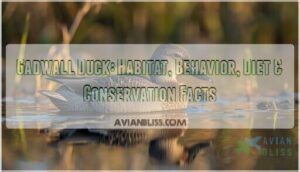
Most waterfowl enthusiasts can identify a flashy mallard or elegant pintail from across a marsh, but the gadwall remains North America’s most underappreciated duck. This medium-sized dabbler trades bold colors for subtle elegance—males display intricate gray vermiculation that reveals itself only upon close inspection, while females wear understated brown plumage with distinctively thin dark bills.
What the gadwall lacks in showiness, it compensates with adaptability, thriving in shallow wetlands from prairie potholes to coastal marshes across three continents. You’ll spot these ducks dabbling in vegetation-choked waters where others won’t venture, their white wing patches flashing during takeoff like a hidden signature.
Understanding gadwall identification, behavior, and habitat needs offers insight into wetland health and conservation priorities that protect entire ecosystems.
Table Of Contents
- Key Takeaways
- Gadwall Overview and Identification
- Gadwall Habitat and Distribution
- Gadwall Behavior and Diet
- Gadwall Reproduction and Life Cycle
- Gadwall Conservation and Population Status
- Frequently Asked Questions (FAQs)
- What is the difference between a black duck and a gadwall?
- Where do gadwall birds live?
- What does a gadwall look like?
- What does a gadwall call?
- Where is the gadwall most common?
- How old is gadwall?
- Is a gadwall a diurnal duck?
- Is Gadwall good eating?
- How rare are Gadwall ducks?
- What is another name for a Gadwall?
- Conclusion
Key Takeaways
- Gadwalls thrive in vegetation-dense wetlands where other ducks won’t venture, using their white wing patches and subtle gray vermiculation as identification markers that reveal themselves only at close range.
- These medium-sized dabblers occupy shallow freshwater habitats across three continents, shifting between prairie potholes during breeding season and coastal marshes in winter through predictable migration corridors.
- Conservation efforts targeting prairie wetland restoration directly boost gadwall populations, which have climbed to approximately 2.3 million birds since the 1990s despite ongoing habitat loss threatening 40 percent of critical delta ecosystems.
- Gadwall reproduction depends on dense shoreline vegetation within 1-2 meters of water, where females incubate 7-12 eggs for 23-28 days while males depart after egg laying, leaving precocial chicks to develop under maternal guidance alone.
Gadwall Overview and Identification
You’ll find the gadwall swimming quietly in wetlands across North America, Europe, and Asia, often overlooked despite its subtle beauty.
Males sport intricate gray-brown plumage with fine black vermiculation, while females wear understated brown tones with distinctively thin, dark bills.
During the breeding season, males transform into some of the most colorful bird species found in wetland habitats.
Here’s what you need to know to identify this medium-sized dabbling duck in the field.
Physical Description and Key Features
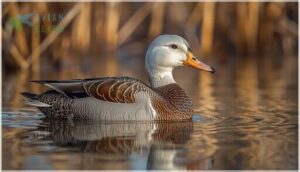
Gadwall plumage patterns shift between breeding and nonbreeding males, displaying brownish gray bodies with pale gray heads. Bill shape differs markedly: breeding males show orange-tawny bills with black tips, while females carry mostly dark gray bills.
Body proportions mirror mallards, though gadwall duck characteristics include a steeper forehead and square head structure. White secondary covert patches flash distinctively during flight.
Size, Weight, and Measurements
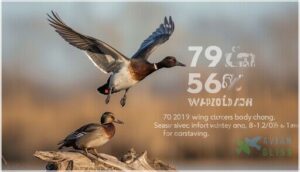
You’ll find body length ranges from 50 to 56 cm, with wingspans stretching 79 to 89 cm across populations. Weight variance shifts seasonally—adults usually measure 640 to 900 grams, though winter fat reserves boost mass by 8 to 12 percent.
Size comparison to mallards shows similar proportions, yet measurement techniques reveal gadwalls carry slightly narrower wing chords at 20 to 23 cm.
Male Vs. Female Gadwall Characteristics
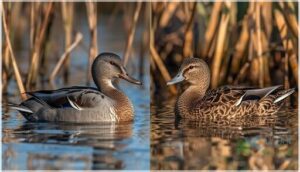
Beyond measurements, you’ll notice sexing techniques hinge on plumage patterns and bill shapes. Males sport gray-brown bodies with black-and-white vermiculation, while females wear mottled brown that blends into marsh vegetation.
Key duck species characteristics for identifying sex:
- Males display a white wing speculum more conspicuous in flight
- Females show thin orange-brown bill edges
- Males emit soft nasal meeps during mating behaviors
- Females produce higher-pitched quacks with sharper clucks when alarmed
Color pattern and vocal differences make field identification straightforward. To learn more about this widespread waterfowl, explore these details in the Gadwall identification guide.
Distinguishing Gadwall From Similar Ducks
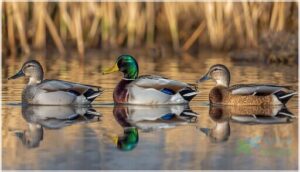
Once you’ve nailed the basics, separating gadwall from lookalike dabbling ducks becomes straightforward. Focus on bill shape and wing speculum—gadwall flash a bold white patch in flight, while mallards show blue.
| Feature | Gadwall | Mallard | American Wigeon |
|---|---|---|---|
| Bill shape | Narrow, dark slate | Broad, yellow-orange | Short, blue-gray |
| Wing speculum | White | Blue with white borders | Green |
| Head profile | Square, steep forehead | Rounded | Rounded, pale crown |
| Beak color | Black (both sexes) | Yellow (male), orange (female) | Gray-blue |
Feather patterns and undertail coverts clinch identification among waterfowl when bird species identification gets tricky. For in-depth information about the gadwall’s habitat and distribution, explore further resources.
Gadwall Habitat and Distribution
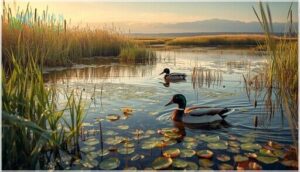
You’ll find gadwalls across wetlands in North America, Europe, and Asia, where shallow water and thick vegetation create ideal conditions.
These ducks share wetland habitats with many sparrow species that prefer dense grasses near water’s edge.
Their range shifts dramatically between breeding and wintering seasons as they follow reliable food sources and open water. Understanding where these ducks live throughout the year reveals how they adapt to changing landscapes and climates.
Preferred Wetland Environments
You’ll find gadwall thriving where wetland ecosystems offer the right mix of conditions. These freshwater wetlands provide critical habitat through:
- Water depths of 0-1.5 meters supporting aquatic plants
- Neutral to mildly acidic water chemistry that boosts forage
- Emergent vegetation creating protective cover
- Habitat diversity including marshes, ponds, and shallow lakes
- Ecological balance sustaining wetland ecology and waterfowl conservation efforts
Breeding and Nesting Locations
Regarding breeding habitat, gadwalls stake their claim in dense vegetation near wetlands—think grassy shorelines and marsh edges within 1-2 meters of water. You’ll spot their well-concealed ground nests lined with down and dry grasses, each holding 7-12 camouflaged eggs.
Nest site selection hinges on cover density; here’s what shapes their nesting materials and brood-rearing success across waterfowl breeding grounds:
| Nesting Feature | Specification | Purpose |
|---|---|---|
| Nest Location | Ground in dense vegetation | Predator concealment |
| Distance to Water | 1-2 meters from wetland edge | Quick chick access post-hatch |
| Clutch Size | 7-12 eggs | Standard waterfowl reproduction |
| Incubation Period | 23-27 days | Female-only incubation |
| Nest Materials | Down, grasses, reeds | Insulation and camouflage |
Migration Patterns and Wintering Grounds
Understanding avian migration patterns reveals gadwalls’ impressive north-south journeys from Canadian breeding grounds to southern U.S. and Mexican wintering grounds. Migration timing kicks off in October through December, with spring returns starting late February.
Stopover ecology during these transitions centers on refueling at shallow wetlands, where you’ll find:
- Short 2-14 day layovers at reliable marshes
- Flocking behavior that aids navigation
- Gradual departures reducing competition
Flyway conservation and winter habitat quality directly impact their breeding success.
Global and Regional Range
You’ll trace gadwalls across three continents where wetland ecology and management shape their survival.
In North America, breeding populations span Alaska through prairie Canada, with regional distribution shifting southward each fall via established avian migration corridors. European gadwalls nest from Scandinavia to Russia’s Urals, wintering along Atlantic coasts. Asian populations bridge Siberian marshes to China’s coastal zones, revealing geographic variation driven by habitat fragmentation and ongoing range expansion.
Gadwall Behavior and Diet
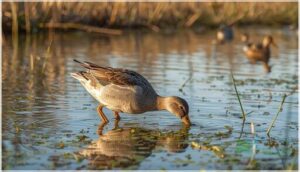
Gadwall ducks feed primarily through dabbling, a technique where they tip forward in shallow water to reach submerged vegetation. Their diet shifts throughout the year based on available food sources and breeding demands.
You’ll find their social behaviors and migration patterns are closely tied to these feeding strategies.
Feeding and Foraging Techniques
You’ll find gadwalls using classic dabbling duck techniques to reach food just below the surface. They tip tail-up while swimming, extending their necks to harvest submerged vegetation and invertebrates.
Their foraging strategies shift with the seasons—seed consumption peaks during migration, while aquatic plants and tubers anchor their diet in winter. These avian diet specialists thrive in vegetated shallows where dabbling techniques access the richest food sources.
Typical Diet and Seasonal Variation
Aquatic plant consumption drives gadwall nutrition year-round, but seasonal food shifts reveal their dietary adaptations. Wetland foraging intensifies when seeds and pondweed dominate winter waters, while nutrient intake patterns shift toward invertebrates—snails, insect larvae, crustaceans—during spring breeding.
This avian diet flexibility tracks wetland phenology, with eating habits adjusting as habitat resources cycle through the seasons.
Social Structure and Pair Bonding
When food shifts, so does the Gadwall’s social structure. Mate selection isn’t just about looks—courtship rituals like head-bobbing and synchronized dives help cement pair bonding.
Gadwall courtship goes beyond appearance—head-bobbing and synchronized dives forge pair bonds that shape their social structure
Monogamous relationships form each breeding season, with pairs defending territory and sharing parental duties. Social hierarchy emerges as bonded pairs claim the best nesting spots, shaping behavior and reproduction across this duck species.
Flight and Migration Behavior
Just as Gadwall pairs stake their claim on nesting turf, their Flight Patterns show a knack for teamwork. Migration Routes stretch across continents, with Altitude Control and Wind Assistance shaping every journey. You’ll notice these dabbling ducks:
- Glide in loose flocks for safety
- Use stopover ecology to refuel
- Adjust flight speed with wind shifts
Bird Migration reveals their sharp avian behavior.
Gadwall Reproduction and Life Cycle
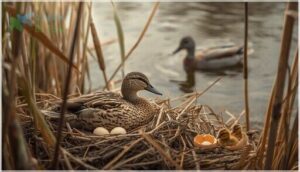
Gadwall reproduction follows a predictable annual cycle that begins with pair formation in late winter. The female selects the nest site and performs most parental duties while the male departs after egg laying.
Understanding their breeding timeline, nesting behavior, chick development, and lifespan gives you a complete picture of how these ducks perpetuate their populations.
Breeding Season and Pair Formation
Breeding unfolds as day length increases and spring wetlands flourish. You’ll spot males performing head bobs, bill dips, and wing flashes during courtship rituals, accompanied by soft whistles that solidify pair bonding.
Females assess these displays and territory quality before mate selection. Pairs form on breeding grounds, often maintaining bonds across seasons.
This coordination in breeding habits facilitates successful nesting strategies and brood defense throughout the avian biology cycle.
Nesting Habits and Egg Laying
Once paired, females select well-concealed nest sites within 100 to 300 meters of water edges, usually in dense grasses or sedge beds.
You’ll find clutch sizes ranging from 7 to 10 olive-buff eggs laid daily over 1 to 2 weeks.
Incubation periods last 23 to 28 days, maintained exclusively by females who regulate temperature through body heat and down-lined nest insulation.
Chick Development and Parental Care
Within hours of breaking free from egg incubation, precocial chicks leave the nest under maternal guidance, drawn to wetland edges where they forage under constant brooding supervision. You’ll see feather growth accelerate through week two, boosting thermoregulation as parental guidance gradually shifts from intensive nestling care to protective monitoring.
- Mothers shield hatchlings from predators with alarm calls and defensive posturing
- Down-covered chicks practice swimming within their first day outside the nest
- Protein-rich insects fuel rapid growth during critical early weeks
- Females adjust brooding frequency as developing plumage improves temperature control
Lifespan and Survival Rates
Generally, adult gadwall survive 5 to 7 years in the wild, though favorable habitats push lifespan toward 8 or even 10 years. Survival rates hover around 60 to 70 percent annually for mature birds, while juveniles face harsher mortality factors—only 40 to 60 percent reach their first birthday.
Age distribution and population trends hinge directly on habitat impact, making wildlife conservation and ornithology efforts essential for sustaining healthy gadwall numbers across breeding and wintering grounds.
Gadwall Conservation and Population Status
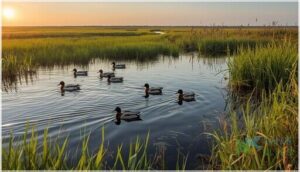
You’ll find that Gadwall populations are doing surprisingly well compared to many waterfowl species. Their numbers have climbed steadily since the 1990s, though they still face real challenges from habitat loss and shifting climate patterns.
Here’s what you need to know about their conservation status, the threats they’re up against, and what’s being done to keep their wetlands intact.
Current Population Trends
Global gadwall population trends show stable to slowly increasing numbers, with regional fluctuations driven by wetland conditions and climate effects. North American populations hover around 2.3 million birds, reflecting significant increases since the 1990s.
Wildlife population dynamics reveal demographic shifts tied to prairie pothole availability and coastal habitat impact. The IUCN status remains Least Concern, though year-to-year population fluctuations warrant ongoing habitat conservation monitoring.
Major Threats and Challenges
Habitat destruction strips away wetlands faster than you realize—up to 40 percent lost in some river deltas. You’ll find gadwalls battling multiple challenges:
- Climate shift alters migration timing and shrinks traditional wintering ranges
- Pollution effects degrade foraging habitats through algal blooms and sedimentation
- Disease outbreaks like avian influenza strike wintering populations hard
Human disturbance and hunting pressure add layers to conservation concerns.
Conservation Efforts and Habitat Protection
You’ll see real gains when conservation programs lock down prairie pothole wetlands—the Duck Nesting Habitat Initiative alone restores 300,000 acres across five states. Wetland restoration brings drained ponds back to life by plugging ditches, while habitat preservation through the Conservation Reserve Program adds 2 million ducks yearly.
These wildlife management tactics prove ecosystem conservation delivers measurable waterfowl conservation efforts when landowners commit long-term.
Legal Status and Hunting Regulations
You need Hunting Licenses before harvesting gadwalls—Federal Regulations under the Migratory Bird Treaty Act set the baseline, while state agencies fine-tune seasons and Bag Limits. Wildlife Enforcement officers check compliance to protect migration corridors. Here’s what Wildlife Management demands:
- Valid waterfowl permit plus proof of hunter education
- Species-specific Bag Limits (usually 2-6 gadwalls daily)
- Strict seasonal windows matching breeding cycles
- No baiting or spotlighting under Conservation Laws
Violating Hunting and Harvesting Regulations means fines, suspensions, or criminal charges—Wildlife Conservation Efforts depend on your compliance with Conservation standards.
Frequently Asked Questions (FAQs)
What is the difference between a black duck and a gadwall?
You’d think two brown dabbling ducks would look alike, but gadwall males sport gray bodies with white wing speculum, while American black ducks show darker chocolate plumage with olive bills and duller wing patches.
Where do gadwall birds live?
You’ll find these ducks in wetland ecosystems across North America, Europe, and Asia. Their geographic range spans freshwater lakes, marshes, coasts, and shorelines.
Where waterfowl conservation protects gadwall duck habitat from ongoing habitat loss and bird migration disruptions.
What does a gadwall look like?
You’ll spot a medium-sized duck with understated gray-brown plumage patterns, a steep head profile, and a thin, dark beak shape.
Males show black rear feather colors while females display mottled brown body proportions across their 18-22 inch measurements.
What does a gadwall call?
At dawn in a quiet marsh, you’ll hear a nasal quack from a hen gadwall—higher pitched than a mallard’s.
Males produce soft grunts during displays and light whistles in flight, offering subtle auditory cues for bird identification.
Where is the gadwall most common?
You’ll find the highest concentrations in North America’s Central Flyway during winter months.
Their breeding grounds center on prairie pothole wetlands across the Dakotas and southern Manitoba, where shallow lakes and rivers support abundant nesting pairs.
How old is gadwall?
Wild gadwalls usually live 3 to 5 years, though banded individuals reach about 7 years. Captive birds occasionally approach a decade with consistent shelter and food, demonstrating how survival trends shift with environment.
Is a gadwall a diurnal duck?
You’ll catch this duck when the sun’s up and about. Gadwalls are diurnal, feeding and socializing during daylight hours with peak activity at dawn and dusk, reflecting circadian rhythms typical in avian ecology.
Is Gadwall good eating?
Gadwall meat offers mild flavor and lean protein, though you’ll need proper brining and careful cooking to avoid dryness.
The nutritional value stands out, while gamey notes stay minimal with correct preparation techniques.
How rare are Gadwall ducks?
Common yet concealed—that’s the Gadwall Rarity paradox. Despite a Least Concern conservation status and over 2 million individuals globally, habitat loss and muted plumage make sightings sparse outside prime wetlands, fooling observers into believing they’re uncommon.
What is another name for a Gadwall?
You might hear birders call this dabbling duck a “gray duck” or “gray mallard” thanks to its subdued plumage.
Regional hunters sometimes use those nicknames when identifying the species in the field.
Conclusion
Protecting prairie wetlands preserves the gadwall and countless species that share its world. You’ve seen how this unassuming duck thrives where others can’t—a demonstration to nature’s quiet resilience.
Every marsh you protect, every conservation effort you support, ripples outward beyond a single species. The gadwall doesn’t demand attention with bright feathers, but its presence signals healthy ecosystems worth defending.
Your awareness transforms overlooked birds into conservation priorities.