This site is supported by our readers. We may earn a commission, at no cost to you, if you purchase through links.
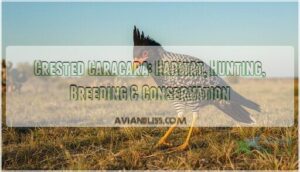
You won’t find this falcon perched in a tree scanning for prey from above. The crested caracara walks across the ground like a long-legged scavenger, part raptor and part opportunist, blending behaviors you’d expect from a vulture with the sharp features of a true falcon.
With its black cap, bare yellow-orange face, and bold contrasting plumage, this bird stands out across its range from Texas to the grasslands of South America. It’s equally comfortable stealing kills from vultures as it is hunting live prey, making it one of the most adaptable raptors in the Americas.
Understanding what sets the crested caracara apart—from its unusual ground-foraging habits to its threatened status in parts of the U.S.—reveals why this species occupies such a unique ecological niche.
Table Of Contents
- Key Takeaways
- What is a Crested Caracara?
- Where Do Crested Caracaras Live?
- How Do Crested Caracaras Hunt and Feed?
- Crested Caracara Breeding and Nesting Habits
- Conservation Status and Protection Efforts
- Frequently Asked Questions (FAQs)
- How rare is a caracara?
- Is it legal to shoot a caracara in Texas?
- What are some interesting facts about Crested Caracara?
- Is the caracara a hawk or eagle?
- What are some interesting facts about crested caracaras?
- Where are Crested Caracaras found?
- Is the Crested Caracara native to Texas?
- Is the Crested Caracara native to Florida?
- Why is the Crested Caracara endangered?
- How do crested caracaras communicate with each other?
- Conclusion
Key Takeaways
- The crested caracara stands apart from typical falcons by walking across open ground to scavenge carrion and hunt live prey, combining raptor features with vulture-like opportunism across habitats from Texas to South America.
- You’ll recognize this bird instantly by its black cap, bare yellow-orange face, and bold black-and-white plumage—physical traits that remain consistent year-round and make field identification straightforward even at a distance.
- Despite global populations listed as Least Concern by the IUCN, U.S. populations hold federal threatened status due to habitat loss from agriculture and urban development, making targeted conservation efforts essential for regional survival.
- Their unique feeding strategy blends scavenging roadkill with active hunting of insects and small mammals, often stealing fresh carrion from vultures through bold, opportunistic tactics that minimize energy expenditure.
What is a Crested Caracara?
The crested caracara is a large black-and-white falcon found across the Americas, from the southern United States down to South America.
It belongs to the broader falcon family, which includes a remarkable variety of types of bird species ranging from diminutive falconets to these powerful scavengers.
You’ll recognize this striking bird by its bold markings, yellow-orange face, and distinctive black cap. Let’s look at what makes this raptor unique, starting with its scientific classification and physical features.
Scientific Classification and Taxonomy
You’ll find the Crested Caracara classified under the binomial nomenclature Caracara plancus, with the subspecies Polyborus plancus audubonii representing North American populations.
This raptor belongs to Falconidae within the order Falconiformes, placing it among falcons in taxonomic ranks. Understanding these classification systems reveals evolutionary relationships—ornithology shows how species identification connects this bird to its falcon relatives while distinguishing it from true hawks.
Referencing the hierarchical classification system helps further clarify how organisms are organized from domains down to species.
Physical Characteristics and Appearance
Beyond taxonomic labels, you’ll notice the Crested Caracara through distinctive field marks essential for bird species identification and ornithology. This raptor’s physical traits aid bird watching and avian biology studies.
The following characteristics distinguish it:
- Black and white plumage texture creates bold contrast across the body
- Yellow-orange leg coloration and bare facial skin stand out vividly
- Strong, slightly hooked beak structure allows for scavenging
- Flat head shape with prominent black cap defines its profile
These feather patterns distinguish it from similar raptors.
Size and Wingspan Measurements
You’ll recognize size dimorphism in Crested Caracara measurements: adults span 1.0 to 1.3 meters across outstretched wings, while body length reaches 48 to 65 centimeters. Males average slightly longer wing tips than females, yet body mass index remains comparable at 0.9 to 1.7 kilograms.
Feather growth accelerates rapidly in juveniles, with flight capabilities developing within three to four months post-hatch.
Distinctive Black Cap and Yellow-Orange Face
You’ll notice the black cap creates a sharp border against the yellow-orange facial coloration, forming the crested caracara’s signature look. This plumage pattern remains constant year-round, with the pale beak structure and bright face serving as visual signals during raptor biology interactions.
The head shape frames these features distinctly, making bird identification straightforward even at distance in avian ecology fieldwork.
Where Do Crested Caracaras Live?
You’ll find crested caracaras across a wide range of the Americas, from the southern edges of the United States all the way down to South America.
In the southwestern U.S., they share desert habitats with other remarkable species like the tiny elf owl, which nests in the same saguaro cacti that caracaras often perch on.
These birds adapt to different landscapes, but they prefer open country where they can spot food from a distance. Their habitat choices tell you a lot about how they hunt and survive in the wild.
Geographic Range Across The Americas
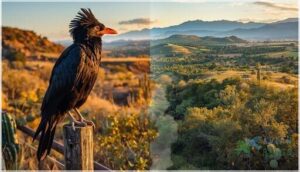
The Crested Caracara spans the Americas from the Southern United States to the tip of South America. You’ll encounter this adaptable raptor across a vast geographic range shaped by open country and human influence.
- North America: Year-round presence in Texas and southwestern states, with Central America serving as a key migration corridor
- South America: Populations thrive in Venezuela, Colombia, Brazil’s Cerrado, and Andean foothills
- Range Expansion: Conservation corridors and habitat connectivity enable movement across agricultural landscapes
Research on birds highlights the importance of understanding geographic range sizes in biodiversity, which helps inform conservation priorities for wide-ranging species like the Crested Caracara.
Habitat Preferences and Terrain Types
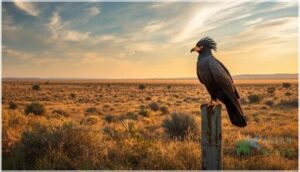
From savannas to scrublands, you’ll find Crested Caracaras in Open Landscapes where Terrain Selection emphasizes visibility.
Habitat Diversity includes deserts, grasslands, and prairie edges—all offering low Vegetation Types and scattered perches.
These raptors thrive at varied Elevation Preferences, using agricultural fields and seasonal wetlands for wildlife habitat.
Understanding habitat selection helps habitat conservation efforts combat Habitat Loss.
Their Habitat and nesting success depends on open country with unobstructed sightlines.
Southern United States Distribution
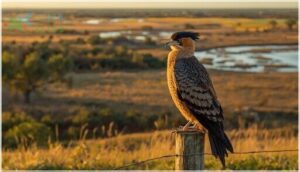
In the Southern United States, you’ll encounter the Crested Caracara across southern Arizona, Texas, and Florida’s coastal plain.
Geographic Range extends into New Mexico and parts of Louisiana, Mississippi, and Alabama.
Regional Migration patterns shift with seasons, while Urban Encroachment and Habitat Fragmentation threaten populations.
Climate Impact and Habitat Loss challenge Bird Species Conservation efforts, making Wildlife conservation critical for this species.
Presence in Urban and Roadside Areas
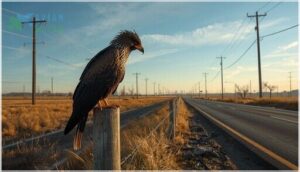
You’ll find Crested Caracaras perched on telephone poles and fence lines along highways, scanning for roadkill and carrion.
Their Urban Roosting sites include utility towers and dead trees at city edges. Their bold scavenging behavior near human activity reflects notable adaptability, though Urban Development and Habitat Loss remain serious threats.
Roadside Foraging provides easy meals, making Urban Habitat patches—park edges, golf courses, vacant lots—increasingly important for survival.
How Do Crested Caracaras Hunt and Feed?
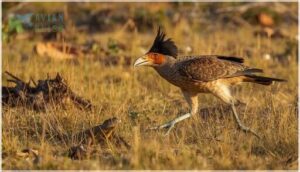
You’ll find that crested caracaras don’t hunt like typical falcons. These opportunistic birds blend scavenging with active hunting, using their long legs and sharp beaks to exploit almost any food source they encounter.
Their feeding strategy breaks down into four key approaches.
Scavenging and Carrion Consumption
You’ll often find caracaras scavenging roadkill and carcasses like vultures, relying on carrion consumption for high-energy meals with minimal effort. Their foraging impact on ecosystem cleanup is significant, removing rotting matter across open landscapes.
- Keen vision spots carcasses from high perches or during flight
- Smell helps with carcass detection in open habitats
- Fresh to moderately decomposed remains are preferred
- Scavenging reduces hunting time and energy expenditure
- They patrol roadsides frequently for carrion sources
Live Prey and Hunting Techniques
When caracaras shift from scavenging to active hunting, their prey selection includes insects, reptiles, and small mammals. You’ll notice their stealth approaches involve staying low, moving slowly, and using short, decisive strikes with sharp talons.
Their ambush tactics rely on keen vision to spot prey movement from perches or while walking. Their hunting strategies adapt quickly, switching between patient stalking and opportunistic pouncing when targets appear vulnerable.
Ground Foraging Behavior
Unlike most raptors, you’ll see crested caracaras walking or running across pastures and fields to search for meals. Their long legs let them spend hours on foot, scratching soil to uncover insects, turning over debris, and digging into turtle nests buried in sand.
These ground scavenging foraging techniques work best in open habitats like:
- Grasslands with short vegetation
- Disturbed farmland soils
- Sandy beaches near water
- Roadside shoulders at dawn
Interaction With Vultures and Food Stealing
When caracaras spot turkey vultures circling carrion, they don’t wait politely. You’ll witness opportunistic foraging at its boldest—these birds use scavenger tactics to muscle in on fresh carcasses, stealing exposed organs while vultures tear open hides.
Caracaras boldly steal fresh carrion from vultures, muscling in to snatch choice organs before larger scavengers can react
This carrion competition defines their feeding behavior. They dash in from the side, snatch choice bits, then retreat before larger scavengers react. Food theft becomes survival strategy in vulture feeding zones.
Crested Caracara Breeding and Nesting Habits

Crested caracaras form monogamous pairs that stay together for multiple breeding seasons.
They build their nests in trees or tall shrubs using sticks and branches arranged into a shallow platform.
Understanding their nesting habits reveals how these raptors raise their young from eggs to independence.
Nest Construction and Location
You’ll discover these raptors build sturdy platform nests from sticks and twigs, usually 40 to 70 centimeters across. Tree selection favors tall species or cacti 6 to 20 meters high, offering clear vantage points.
Nest maintenance continues year-round, with both parents adding fresh material each breeding season to preserve structural integrity. Branch arrangement creates a shallow cup nest, 5 to 12 centimeters deep, lined with softer vegetation.
Egg Laying and Clutch Size
After nest construction, you’ll see females deposit one to three eggs, most often two per clutch. These pale blue-green eggs measure 50 to 60 millimeters long and weigh 40 to 60 grams.
Clutch variation depends on diet quality and nest sites, with better-fed pairs producing larger clutches. Egg formation spans several days during early breeding season.
Incubation Period and Parental Care
Both parents share incubation strategies across 28 to 32 days, rotating shifts to balance nesting behavior with foraging. You’ll notice parental roles switch regularly, maintaining stable egg temperature critical for brood survival.
One adult guards territory while the other warms the clutch. This biparental cooperation in Crested Caracara avian ecology ensures continuous protection, supporting successful hatching in bird behavior patterns shaped by environmental demands.
Fledgling Development and Independence
You’ll observe Fledgling Growth over 6 to 8 weeks before Nest Departure, when young Crested Caracara start brief flights. Parental Guidance fosters developing Foraging Skills as juveniles scavenge carrion and chase small prey.
Independence Milestones unfold across 2 to 3 months, with fledglings gradually extending daily travel from 1 to 3 kilometers. This Bird behavior and ecology pattern reflects critical Raptor biology and behavior shaping Avian ecology and conservation outcomes.
Conservation Status and Protection Efforts

The crested caracara holds a unique conservation status that differs across its range.
In the United States, this distinctive raptor is federally listed as threatened, particularly in Florida where its population faces ongoing challenges. Understanding its legal protections and the threats it faces helps you grasp why conservation efforts remain essential for this species.
IUCN and Federal Threatened Status
The Crested Caracara holds federal threatened status under the Endangered Species Act, which the U.S. Fish and Wildlife Service enforces to protect species facing decline.
While the IUCN lists the species as Least Concern globally, regional populations warrant threat assessment due to habitat preservation needs. This dual conservation status reflects different endangered classification systems evaluating species protection priorities across varying geographic scales.
Population Trends and Habitat Threats
You’ll notice population fluctuations across the Americas tied to shifting land use and habitat quality.
Habitat fragmentation from agriculture and urban sprawl reduces native grasslands caracaras need for foraging.
Climate shifts alter prey availability and nesting success. Human impact through roadside development creates both food sources and collision risks.
These threats to endangered species demand targeted conservation efforts and habitat conservation and restoration to support wildlife management and protection goals.
Legal Protection in The United States
Federal laws provide the crested caracara with legal protection under threatened status. You’ll find the US Fish and Wildlife Service enforces constitutional rights and civil protections through the Endangered Species Act.
The FWC collaborates on environmental safeguards and judicial enforcement to shield nesting sites and habitats. Despite its IUCN status of Least Concern globally, federal status ensures ongoing regulatory oversight.
Conservation Measures and Future Outlook
You can advance species protection through targeted wildlife corridors and habitat restoration in key caracara ranges. Conservation planning now integrates climate adaptation strategies to safeguard shifting foraging zones.
Ecological conservation efforts combine standardized monitoring with community-driven data collection. Wildlife conservation depends on flexible management that adapts to changing prey availability.
Endangered species preservation succeeds when conservation biology and research inform practical species preservation actions across the Americas.
Frequently Asked Questions (FAQs)
How rare is a caracara?
You won’t often spot one in most of North America. This threatened species faces range limits and local population declines, though the IUCN lists Caracara plancus audubonii as Least Concern globally.
Is it legal to shoot a caracara in Texas?
No, you can’t shoot a caracara in Texas. Federal regulations and Texas hunting laws protect this threatened species under the Migratory Bird Treaty Act, with legal consequences including criminal penalties for violations.
What are some interesting facts about Crested Caracara?
Despite their fearsome talons, Crested Caracaras often prefer walking to flying.
This Falconidae species thrives in tropical habitats through wildlife adaptation, frequently scavenging roadkill—making bird watching and observation of their unique raptor behavior surprisingly easy.
Is the caracara a hawk or eagle?
The Crested Caracara isn’t a hawk or eagle—it’s a falcon. Despite its hawk-like appearance and scavenging behavior, this Bird of prey belongs to Falconidae, making Caracara plancus a tropical falcon with unique Raptor Characteristics.
What are some interesting facts about crested caracaras?
Like a bold opportunist at nature’s table, you’ll find crested caracara behavior fascinating—these adaptable raptors from the Falconidae family combine scavenging skills with aerial prowess, thriving across tropical habitats through outstanding wildlife adaptation.
Where are Crested Caracaras found?
You’ll find these raptors across the Americas, from southern U.S. states like Texas and Florida through Mexico, Central America, and South America to Patagonia—adapting to everything from coastal marshes to high plateaus.
Is the Crested Caracara native to Texas?
You’ll spot these striking raptors soaring across Texas skies—they’re absolutely native here.
The Crested Caracara (Caracara plancus) thrives in southern habitat zones, especially coastal plains and brush country, demonstrating notable urban adaptation.
Is the Crested Caracara native to Florida?
Yes, you’ll find this striking raptor established across central and southern Florida.
It breeds in dry prairies, pastures, and ranchlands—a true Florida native with dedicated Wildlife Protection status due to habitat loss.
Why is the Crested Caracara endangered?
Habitat loss and fragmentation pose the gravest threats to endangered species like this raptor.
Climate change, road mortality, poison exposure, and human persecution compound habitat destruction. Despite federal protections, these combined pressures threaten survival.
How do crested caracaras communicate with each other?
Crested Caracaras use vocal signals like rattling calls and alarm calls paired with crest displays and visual cues to coordinate group foraging, defend territory, strengthen social bonding, and communicate during courtship.
Conclusion
The crested caracara walks the line between scavenger and predator, thriving where adaptation matters most. You’ve seen how it bridges two worlds—falcon ancestry meets vulture-like opportunism—across grasslands from Texas to Argentina.
Its survival depends on open habitats and protected status where populations face pressure. Understanding this raptor’s dual nature reveals why flexibility, not specialization, sometimes wins in the wild. That lesson extends far beyond one extraordinary bird.