This site is supported by our readers. We may earn a commission, at no cost to you, if you purchase through links.
A single Mourning Dove can eat up to 2,500 seeds in one day, quietly blending into your backyard while feeding alongside its neighbors. Doves aren’t all pale and unremarkable—some, like the Nicobar Pigeon, shimmer with metallic greens, while others, such as the Victoria Crowned Pigeon, sport a regal feather crest taller than your hand. From the city’s hedges to remote rainforests, types of doves have adapted to thrive in every corner.
Whether you’re spotting a common ground dweller or admiring a rare, exotic species, each dove’s shape, color, and behavior offers clues to its story. Let’s trace their footprints across habitats, plumage, and survival.
Table Of Contents
- Key Takeaways
- Common North American Dove Types
- Small Ground-Dwelling Doves
- Colorful Exotic Dove Species
- Dove Identification Features
- Dove Habitats and Conservation
- Frequently Asked Questions (FAQs)
- What species of dove is in the Bible?
- What is the difference between a mourning dove and a ground dove?
- How many types of doves are there?
- What are the most common doves in North America?
- Which genus of birds are doves?
- What is a common ground dove?
- What are the most common doves?
- What is the difference between a dove and a Mourning Dove?
- What does it mean when a dove visits you?
- What is an all white dove called?
- Conclusion
Key Takeaways
- Doves span an enormous range of looks and sizes, from the tiny 6-inch Common Ground Dove to the 75-cm Victoria Crowned Pigeon, so appearances alone can tell you a lot about where a species lives and how it survives.
- North America’s five most common doves—Mourning, White-winged, Eurasian Collared, Inca, and Common Ground—each occupy a distinct niche, making habitat and behavior your best clues for telling them apart.
- Plumage color, eye color, beak shape, wing markings, and call type all work together as a natural ID toolkit, and these traits often shift with age, season, and breeding condition.
- Several dove species are critically endangered—like the Grenada Dove with roughly 160 individuals left—because habitat loss, fragmentation, and invasive predators continue to shrink their last remaining strongholds.
Common North American Dove Types

North America is home to a surprisingly diverse group of doves, each with its own look, habits, and preferred hangout.
If you’re curious about their lifespans and what affects their survival, this guide to how long doves live in North America breaks it all down.
Whether you’re spotting one at your backyard feeder or hearing a familiar coo on a quiet morning, knowing who’s who makes the experience a lot more rewarding. Here are five of the most common dove species you’re likely to encounter across the continent.
Mourning Dove
The mourning dove haunts open habitat across North America, a slender brownish-gray bird known for its soft, unmistakable cooing call. Five facts define it:
- Pale plumage with a pinkish chest
- Body, 9–13 inches
- Twigs used for nesting materials
- Seeds dominate its dietary habits
- Multiple breeding cycles, two eggs each
These birds often use agricultural farmlands to find abundant grain fields.
Predators and storms pose survival challenges, yet dove populations still thrive.
White-winged Dove
Where the mourning dove favors open farmland, the white-winged dove claims the sun-baked Southwest as its home. You’ll recognize it instantly by those bold white wing patches, which flash like signals against brownish-gray feathers in flight.
Look closer and you’ll spot crimson eyes ringed in bare blue skin — a striking combination. These birds adapt well to desert heat and often travel in loose, chattering flocks.
Eurasian Collared-Dove
Unlike the white-winged dove’s desert roots, the Eurasian Collared-Dove arrived as a newcomer — reaching North America through the Bahamas in 1974, then spreading steadily across the continent.
That black crescent collar at the nape makes it easy to spot. You’ll find it in suburban yards and farms, where it feeds on seeds and breeds through multiple clutches each year.
Inca Dove
The Eurasian Collared-Dove spread fast, but the Inca Dove keeps a lower profile. Small and unassuming at just over 8 inches, it wears pale feathers with dark edges that create a fish-scale look across its entire body.
You’ll spot it walking steadily on open ground, foraging for seeds in yards and parks, having quietly expanded its range into urban neighborhoods across the American Southwest.
Common Ground Dove
Tiny enough to mistake for a sparrow, the Common Ground Dove tops out around 6 to 7 inches. Its scaly neck and chest pattern helps it disappear against bare earth as it walks — never hops — searching for seeds.
Unlike the Mourning Dove’s distinctive reddish-pink feet, you’ll find the Common Ground Dove’s coloring more subtle, as detailed in this guide to dove species in Virginia.
It nests low, raises multiple broods each season, and calls in soft, repeated whispers you might barely notice.
Small Ground-Dwelling Doves

Not all doves perch high in the trees — some spend most of their lives close to the ground, quietly going about their business in the underbrush. These small, ground-dwelling species have their own distinct looks and habits that make them surprisingly easy to tell apart once you know what to watch for. Here are some of the most notable ones you’re likely to encounter.
Zebra Dove
The Zebra Dove gets its name from the fine black-and-white barring striped across its neck and chest — a pattern that’s hard to miss once you know it.
These small, slim birds, stretching 20 to 23 cm, prefer open ground in tropical regions, foraging slowly for seeds in pairs. They form strong pair bonds, with males cooing softly during courtship displays.
Diamond Dove
At just 19 to 21 cm long and weighing barely 30 grams, the Diamond Dove is one of Australia’s smallest pigeons. Native to semi-arid inland regions, it forages on the ground for grass seeds in pairs or small groups.
Its bright red eyes ringed in orange make it unmistakable. Captive birds often display color mutations, though typical gray-brown plumage and white-spotted wings remain consistent.
Plain-breasted Ground Dove
The Plain-breasted Ground Dove lives close to the earth. Its grey-brown plumage mirrors bare soil and leaf litter, making it easy to overlook even nearby. Three traits help you spot it:
- Pinkish legs on open ground
- Reddish eyes with a faint blue ring
- Short wings built for quick flights
Both parents incubate two white eggs per nest.
Blue-eyed Ground Dove
Few doves stop you in your tracks quite like this one. The Blue-eyed Ground Dove carries vivid blue eyes ringed by bare gray skin — unmistakable even at a glance. At just 15.5 centimeters, it forages quietly across South American grasslands, picking seeds from open ground.
It’s critically rare, with only a few hundred individuals remaining.
Ground Dove Identification
Spotting a ground dove means looking low. Their muted browns and scaled feather patterns melt perfectly with leaf litter, making them nearly invisible until they dart off in a burst of wing whirring.
Look for a compact silhouette and short tail as they forage for seeds. The Common Ground Dove’s subtle red bill base and soft calls can help with identification.
Colorful Exotic Dove Species

Some doves and pigeons stand out for their vivid colors and unusual plumage, catching your eye in an instant. These exotic species come from far-off islands, lush forests, and tropical regions around the world. Here are several striking examples you might encounter.
Nicobar Pigeon
One of the most striking members of the Columbidae family, the Nicobar Pigeon stands out with its metallic green and copper plumage and short, pure white tail. You’ll spot it across small Southeast Asian islands, often foraging in large flocks.
Its muscular gizzard lets it digest tough seeds—an adaptation rarely matched. Evolution links it closely to the extinct dodo.
Victoria Crowned Pigeon
If the Nicobar Pigeon catches your eye, you’ll find the Victoria Crowned Pigeon just as stunning. This bird, native to New Guinea, stands as the world’s largest pigeon, measuring up to 75 cm.
Its lace-like feather crest—white-tipped and fan-shaped—rises above deep red eyes and bluish-grey plumage. Foraging on the forest floor, it disperses fruit seeds.
Pink-necked Green Pigeon
If you’re curious about plumage dimorphism, the Pink-necked Green Pigeon stands out. Males show a pink neck, gray head, and yellow-orange belly, while females have greener tones. You’ll find these birds in Southeast Asian forests, feeding mainly on fruit like figs. Their nests are simple twig platforms, and they often forage in small, social groups.
- Pink neck in males
- Fruit-based diet
- Year-round breeding
- Southeast Asian range
Superb Fruit Dove
Next to the Pink-necked Green Pigeon, the Superb Fruit Dove brings color to the rainforest canopy. Males show a fiery orange nape, purple crown, and green ears; females stay mostly green for camouflage.
Both sexes eat rainforest fruit, especially figs. They nest high in dense branches, sharing care for two eggs. Listen for soft coos and high-pitched notes overhead.
Pink-headed Fruit Dove
The Pink-headed Fruit Dove stands out in Indonesia’s mountain forests, where males show a vivid pink-purple head and throat, accented by a white neck band.
You’ll find these birds foraging high in the canopy, searching for figs and berries. Their nests are flimsy cups, tucked away in remote trees, and both parents share the job of incubating their single white egg.
Dove Identification Features
If you’re wondering how to spot one dove from another, there are a handful of clues you can look for. These features range from colors and markings to the sounds they make and how they move. Let’s walk through the main traits that help you tell them apart.
Plumage Colors
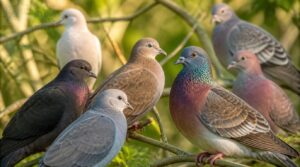
Dove plumage colors reveal much about their health and environment. Melanin pigments create matte grays, browns, and blacks, while carotenoids produce bright reds and yellows, depending on diet. Structural coloration brings iridescent blues and greens that shift with light.
During breeding, males often show richer colors, and seasonal molts can change intensity and pattern.
Wing and Tail Markings
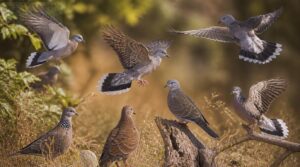
You’ll spot doves by their distinct wing patches and tail markings. Many species have white bars or spots that stand out during flight or display, helping you separate them in the field.
These patterns aren’t just for show—they signal fitness, aid in camouflage, and often stay consistent between males and females. Changes from molt or age can sharpen or fade these markings.
Size and Shape
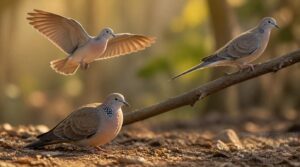
You’ll notice doves range from 23 to 28 centimeters in length, with a wingspan between 38 and 48 centimeters. Most have a compact body, short neck, and modest head size.
Their tail shape—often square or rounded—helps control flight. Ground-dwelling types appear plumper, while forest species look slender. In flight, their silhouette stretches, wings extending just beyond the tail.
Beak and Eye Color
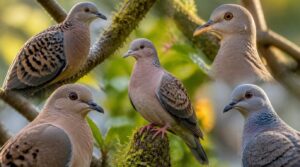
Every dove’s beak and eye color acts as a silent signal. Brighter beaks often mean a healthy bird, especially during breeding season when color intensifies. Diet shapes beak hue—yellow and orange tones come from carotenoids, while darker beaks rely on melanin.
Eye color shifts with age; juveniles show paler irises that deepen as they mature, helping you spot younger birds.
Calls and Flight Patterns

Birds in flight often rely on distinctive calls to stay connected. Mourning doves emit a soft, rising whistle, while white-winged doves use a rasping coo that carries over open terrain. Flight calls sharpen during alarm, change pitch in windy weather, and accelerate as flocks move. Calls also help avoid collisions and signal altitude changes.
- Rising whistle for keeping the group together
- Alarm calls with sharper notes
- Pitch variation during weather shifts
Dove Habitats and Conservation

Doves settle into a surprising range of habitats, from city parks to dense forests and arid scrublands. Each environment shapes their behaviors and survival in unique ways. Let’s look at the main places where these birds make their homes and how conservation efforts fit in.
Backyard and Urban Habitats
Backyard habitats are lifelines for urban doves like the Mourning Dove, offering shelter in hedges and trees. Dense cover and leaf litter help ground dwellers nest safely.
Bird feeders provide seeds, while native plants attract insects and fruit. Clean, shaded water features reduce disease and predation.
Connected yards form corridors, letting urban wildlife move freely and thrive amid city life.
Forest and Woodland Species
Woodland doves rely on canopy layer diversity and rich understory plant communities for nesting and foraging. Deadwood offers microhabitats for insects, boosting food web complexity. Forest edge effects mean you’ll spot species at boundaries, where light and resources change. Tropical woodlands shelter rare doves, while mixed-age trees provide varied nesting sites.
- Canopy gaps
- Deadwood microhabitats
- Understory shrubs
- Edge habitats
- Mixed tree ages
Desert and Scrubland Doves
Desert and scrubland doves thrive where arid landscapes meet scattered shrubs and dry washes. You’ll often spot Mourning Doves, White-winged Doves, and Inca Doves foraging for seeds on open ground or nesting in low, thorny cover.
These birds rely on access to water and show impressive toughness in harsh climates, adapting their habits to unpredictable desert resources.
Rare Endangered Doves
Some doves live on the edge of extinction, like the Grenada Dove with just 160 adults left in the wild, or the Blue-eyed Ground Dove, now barely seen in Brazil’s Cerrado.
A few dove species, like the Grenada Dove and Blue-eyed Ground Dove, teeter on the brink of extinction with only a handful left
Conservation teams use captive breeding, restore habitats, and fight invasive predators. For island species, keeping genetic diversity strong and managing threats are constant, challenging jobs.
Habitat Loss Threats
Habitat fragmentation slices landscapes into islands, shrinking dove populations and limiting their movement. Urban sprawl and agricultural runoff degrade nesting sites, pollute water, and wipe out native plants.
Invasive plant competition replaces essential food sources, while shifting climate phenology means food and nesting cycles don’t always line up. Protecting these natural habitats keeps endangered species and familiar backyard doves thriving.
Frequently Asked Questions (FAQs)
What species of dove is in the Bible?
When you peel back the layers, you’ll find the biblical dove is usually a rock dove or Eurasian collared dove. Hebrew uses “tor” for turtledove and “yonah” for pigeon, both symbolizing peace and purity.
What is the difference between a mourning dove and a ground dove?
You’ll spot a mourning dove by its long, pointed tail, larger size, and mournful cooing. Common ground doves are smaller, with short, rounded tails, quicker calls, and spend more time foraging low in brush.
How many types of doves are there?
Over 300 recognized species exist worldwide, though you’ll commonly encounter around 25 types of doves in field guides. Taxonomic revisions continue to shift that count as scientists uncover distinct characteristics across diverse habitats.
What are the most common doves in North America?
Five species quietly dominate North American skies: Mourning Doves, White-winged Doves, Eurasian Collared-Doves, Inca Doves, and the Common Ground Dove — each recognizable by its call, markings, or the way it moves.
Which genus of birds are doves?
Doves belong to the family Columbidae, which spans many genera. The most familiar include Columba, Streptopelia, and Columbina — each representing distinct evolutionary branches that molecular studies have confirmed as genuinely separate lineages.
What is a common ground dove?
Weighing barely an ounce, the Common Ground Dove is North America’s smallest dove — only 15 to 18 cm long — with a scaly, pale gray chest and a habit of foraging slowly across open ground for seeds.
What are the most common doves?
The most common doves you’ll spot across North America are the Mourning Dove, White-winged Dove, Eurasian Collared-Dove, Inca Dove, and Common Ground Dove, each thriving in distinct regional habitats.
What is the difference between a dove and a Mourning Dove?
Think of "dove" like a medieval catch-all term — it covers hundreds of species. The Mourning Dove stands apart through its long, pointed tail, black wing spots, and soft, mournful cooing no other species quite matches.
What does it mean when a dove visits you?
When a dove lands near you, many people take it as a sign of peace — a quiet nudge toward calm, forgiveness, and openness to healing in your relationships and inner life.
What is an all white dove called?
A pure white dove doesn’t have one official name — it’s usually a white Barbary dove (Streptopelia risoria) or a selectively bred white rock dove. The term "white dove" describes the color, not a single species.
Conclusion
A plain backyard dove and a shimmering Nicobar Pigeon share the same family tree—one blends into fence posts, the other stops you cold. That contrast is the whole story.
The many types of doves reward anyone who slows down enough to notice the wing markings, beak shape, and habitat clues hiding in plain sight. Every species carries a distinct identity. Once you know what to look for, no dove looks ordinary again.
- https://extension.okstate.edu/fact-sheets/mourning-doves
- https://www.birdcollective.com/blogs/news/what-s-the-difference-between-a-pigeon-and-a-dove
- https://www.birdsandblooms.com/birding/bird-species/medium-sized-land-birds/mourning-dove-vs-pigeon
- https://outforia.com/types-of-doves
- https://myodfw.com/wildlife-viewing/species/doves-and-pigeons