This site is supported by our readers. We may earn a commission, at no cost to you, if you purchase through links.
A cat can close 15 feet in under two seconds, low to the ground, silent until the pounce. Bird feeders turn your yard into a hunting ground, drawing ground-feeders and songbirds right into striking range. Dawn and dusk make it worse, when cats hunt hardest and birds feed most.
Good news: you don’t need to choose between feeding birds and keeping neighborhood cats safe. Smart placement, a few physical barriers, and humane deterrents can keep cats away from feeders without harming anyone. Get the setup right, and your yard becomes a spot birds trust and cats simply lose interest in.
Table Of Contents
- Key Takeaways
- How Cats Threaten Bird Feeders
- Place Feeders Beyond Cat Reach
- Add Predator-Proof Feeder Barriers
- Use Humane Cat Deterrents
- Avoid Unsafe Cat Control Methods
- Frequently Asked Questions (FAQs)
- What is the 3-3-3 rule for cats?
- What repels cats permanently?
- What is a smell that cats absolutely hate?
- How do I keep cats out of my backyard and away from my pet birds?
- How long does it take deterrents to work?
- Will these methods harm other backyard wildlife?
- Do cats eventually get used to deterrents?
- Should I combine multiple deterrent methods together?
- How do I handle a persistent neighborhood stray cat?
- Conclusion
Key Takeaways
- Cats hunt best at dawn and dusk, so keeping feeders clear of cover and placing them 15 meters from hiding spots cuts ambush risk significantly.
- Combining physical barriers like pole baffles, cone guards, and mesh with proper pole height (3-4 meters) blocks most cat access without harming them.
- Humane deterrents such as motion-activated sprinklers, ultrasonic devices, and citrus scents work best when layered together, since cats adapt quickly to single methods.
- Skip harmful methods like mothballs, essential oils, and petroleum jelly, and keep pet cats indoors to protect both birds and your own cat’s health.
How Cats Threaten Bird Feeders

Cats are natural hunters, and your bird feeder can turn into their favorite hunting ground. It’s not just about a cat sneaking around your yard, it’s about the specific habits that put birds at risk. Let’s look at exactly how cats threaten your feeder, so you know what you’re up against.
If you’re noticing more feline visitors lately, exploring an outdoor cat deterrent for birds can help you turn your yard back into a safe space for feeding.
Stalking and Ambush Behavior
A cat crouched near your feeder isn’t resting, it’s working. Feline hunting behavior relies on patience over speed: watch routines, wait low in cover, then strike fast.
That’s the ambush pattern. Cats track feeding times, stay hidden in shrubs, and move in short, silent bursts. By the time a bird notices, it’s often too late.
Ground-feeding Risks
Feeding on the ground does more than draw hungry cats out of hiding, it builds a messy buffet. Spilled seed grows bacteria and mold, spreads pathogens between species, and pulls in rodents that predators love to chase. Add germinating seeds and soil damage, and you’ve got a bird feeder pole with no baffle looking pretty smart right about now.
Seed Spills Attract Birds
That mess doesn’t just rot, it rings a dinner bell. Ground foraging patterns shift fast once finches, sparrows, and jays spot easy pickings.
Watch for:
- Larger flocks clustering into feeding colonies
- Non-target species crashing the buffet
- Seed husks feeding insects, drawing more traffic
More birds bunched low means easier targets, and every hungry visitor near your bird feeders raises the odds a cat’s already watching.
Outdoor Cat Hunting Patterns
Knowing when cats hunt makes preventing predation easier. Outdoor cats favor dawn and dusk, when prey moves most. Feline stalking tactics rely on low crouches and a final lunge within two body lengths.
Because they are obligate carnivores, these animals are biologically driven to seek out meat.
Prey preference shifts toward birds near feeders, while territorial movement patterns keep cats circling familiar cover. Watch for lingering near a favorite perch. That’s often a post-hunt behavior cue worth noticing.
Place Feeders Beyond Cat Reach

Where you put your feeder matters just as much as what kind you buy. A cat can’t ambush what it can’t reach or hide near. Here’s how to set up placement that keeps your birds safe.
Open Yard Placement
Open ground is your best friend here. Give feeders 15 meters of clear space, so cats can’t sneak up unseen.
Key moves:
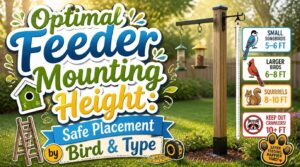
- Ideal pole height: 2.5-3 meters up
- Keep a 1.8-meter vegetation clearance radius
- Orient feeders away from tree lines
- Use single hanging feeders
- Protect flight path safety for birds
This ambush zone reduction keeps both feathered visitors and outdoor pets safer.
Simple additions like fencing, netting, or strategically placed shrubs can make a big difference, and this guide on protecting backyard birds from cats walks through which barriers work best for different yard setups.
Distance From Shrubs
Shrubs give cats their favorite trick: hiding in plain sight. Keep a 4 to 6 foot buffer from shrub canopies, and push dense clusters back at least 5 feet.
Canopy height matters too. Taller shrubs create bigger shadows and better cover, so give them more room. This buffer zone keeps predator visibility low and your feeder easy to watch from the kitchen window.
Safe Pole Height
Height does most of the heavy lifting here. Aim for 3 to 4 meters of pole clearance—cats rarely climb past that without a boost from nearby cover.
Add a baffle to the pole for backup, and check base plate scaling against your local wind load. Taller poles need wider footings.
- Keep 3–4m for hanging feeders
- Add cone baffles below the platform
- Widen the base for wind resistance
- Leave room for safe maintenance access
Avoid Fences and Trees
A fence line looks safe, but it’s a launch pad for cats. Stay 7 to 15 feet from trees and fences alike.
| Hazard | Fix |
|---|---|
| Fence-hugging feeder | Move to open space |
| Tree roots damaged by posts | Set posts 2-4 ft off trunk |
Use mulch, not concrete, near roots for good drainage and easy access.
Use Hanging Feeders
A wobbly feeder is a cat’s worst enemy. Swiveling chain suspension or a flexible cord keeps the bird feeder shifting and hard to grab. This movement, paired with high-altitude mounting, clears most jumping ranges.
Add weight-activated ports and a spill tray, and you’ve got smart bird feeder accessories working as physical barriers—solid catproofing without touching your feeder’s placement or your bird traffic.
Add Predator-Proof Feeder Barriers
Placement alone won’t stop every determined cat. Sometimes you need a physical barrier that blocks access no matter how they approach. Here are five field-tested options worth adding to your setup.
Metal Pole Baffles
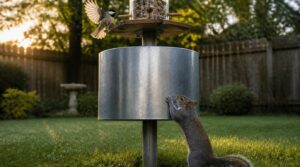
Metal pole baffles wrap right around your existing pole, no need to take the feeder down. Pick one with an 18 to 23 inch diameter for solid squirrel deterrence and predator prevention.
Go with galvanized or powder-coated steel for weather resistance and rust protection. Installation’s simple: clamp it on, tighten the collar, done. A quick retrofit that turns a climbable pole into a real physical barrier.
Cone-shaped Predator Guards
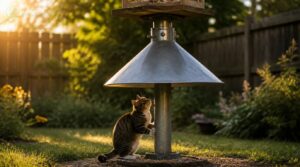
Baffles handle general climbing, but nest boxes and platform feeders often call for something more targeted: a cone-shaped predator guard. Made from galvanized metal, 30 to 36 inches wide, it forms a tapered funnel predators can’t scale.
Install it tight against the pole, no gaps. Loose fits invite adaptation, so secure mounting hardware matters as much as the cone itself.
Weight-activated Feeders
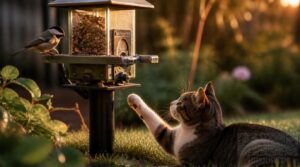
Cones and baffles stop climbing, but a weight-activated feeder grips the problem differently. The perch senses body weight, so light birds keep ports open while cats or squirrels trigger a shut-down.
Calibrate the threshold for your local songbirds, and check sensors regularly for seed buildup that can jam the mechanism. Sturdy metal housing holds up best outdoors.
Spill Trays and Catchers
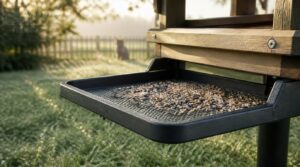
Spill trays catch dropped seed before it hits the ground and lures cats in. A leak proof design with raised edges keeps seed contained, no seepage, no mess to clean up.
Look for removable inserts for easy wipe-downs. Sturdy, weather-resistant materials hold up outdoors year-round, keeping your catproofing methods working without constant upkeep.
Mesh Access Barriers
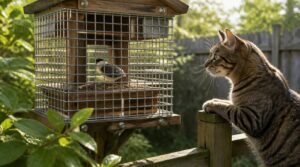
Sometimes a spill tray isn’t enough on its own. That’s where mesh access barriers earn their keep, wrapping feeders in corrosion resistant steel or aluminum mesh sized between 1/2 and 1 inch.
Three things matter most:
- The right mesh sizing for cat-blocking, bird-friendly gaps
- Tamper-resistant mounting hardware
- Regular safety checks for bent or loose spots
Use Humane Cat Deterrents
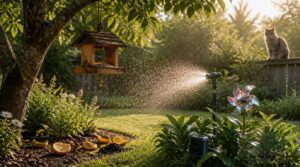
Barriers only go so far, since a determined cat can still find a way around them. Sometimes you need a gentler nudge, something that makes the yard less appealing without ever hurting the animal. Here are five humane deterrents that work with a cat’s natural instincts, not against them.
Motion-activated Sprinklers
A quick blast of water can turn a stalking cat into a fleeing one in seconds.
Motion-activated sprinklers detect movement within 15 to 40 feet, then fire a burst lasting 5 to 10 seconds. Adjust sensor sensitivity to avoid false triggers from wind or leaves.
Many run on solar power, so battery replacement isn’t a constant chore. It’s startling, not harmful—just an unpleasant surprise.
Ultrasonic Cat Repellents
Cats can’t hear you coming, but they sure can hear this. Ultrasonic devices use a PIR sensor to detect movement, then emit sound between 20-60 kHz—safe for humans, irritating for feline ears.
- Weatherproof housings survive rain and snow
- Battery life stretches for months with pulsed emissions
- Multiple tones reduce habituation risk
Reposition units occasionally to keep cats guessing.
Citrus Scent Barriers
Ever notice how a whiff of orange peel makes your nose wrinkle? Cats feel that tenfold. Limonene, the oil in citrus rinds, drives off feline visitors fast.
| Method | Refresh Cycle |
|---|---|
| Fresh peels | Every 2–3 days |
| Diluted oil spray (1–2%) | After rain or dew |
| Sachets | Weekly |
| Post-storm | Immediately |
Rain and wind cut scent dispersion, so timing matters.
Uncomfortable Ground Textures
Paws hate surprises underfoot. Loose gravel or crushed stone shifts and crunches with each step, throwing off a cat’s stalking stability and giving away its position.
Scat mats with blunt plastic spikes work the same way, adding tactile paw discomfort without hurting anyone. Try knobby carpet runners, textured pavers, or a layer of pine needle mulch. Uneven, noisy ground just isn’t worth the trouble for a hunting cat.
Spiky Safe Plantings
Nature builds its own barriers, and a ring of spiky plants works as well as any store-bought guard. Try agave, yucca, or coneflower along perimeter planting zones for a native, drought tolerant barrier.
Layer heights for vertical foliage layers, keep spines pruned each season, and you’ve got safe gardening that helps songbird habitat preservation year-round.
Avoid Unsafe Cat Control Methods

Not every cat deterrent you hear about is safe to use. Some popular tricks can actually harm cats, birds, or your yard. Here’s what to skip and why.
No Mothballs Near Feeders
Grandma’s trick won’t work here, and it’s riskier than it sounds. Mothballs release naphthalene fumes that are toxic to pets and wildlife, and many areas actually restrict outdoor use by law. Worse, they contaminate soil and runoff without even repelling cats reliably. Skip them entirely.
Safer picks include predator guards, motion sprinklers, and smart placement—effective without the health gamble.
Avoid Essential Oils
Skip essential oils, too. They’re toxic plant extracts, and pets don’t need much exposure to get sick from them.
Steer clear of:
- Peppermint or wintergreen (skin burns)
- Eucalyptus (breathing trouble, even seizures)
- Citrus oil (eye and skin irritation)
- Pennyroyal or fennel (higher toxicity risk)
Diffusing or spraying these outdoors risks animal ingestion. Stick with safer, natural repellents instead.
Skip Petroleum Jelly
Petroleum jelly on poles sounds clever, but it’s messy and often ineffective outdoors. Rain washes it off fast, and it can attract dirt, insects, or curious pets who lick it—risking mild toxicity.
Non-petroleum coatings work better outside:
| Option | Pros | Cons |
|---|---|---|
| PVC pipe sleeve | Slick, weatherproof | Costs more |
| Silicone spray | Easy reapply | Needs upkeep |
| Metal baffle | Humane, effective | Upfront install |
Bell Collars Have Limits
Bell collars sound like an easy fix, but they come with real trade-offs. Bells can snag on brush, creating entanglement risks, and small ones pose choking hazards if chewed loose.
- Impairs a domestic feline’s natural stealth
- Adds collar weight and irritation
- Bell durability is often poor outdoors
For protecting birds, avian safety needs more than a jingle—these cat deterrents only go so far.
Keep Pet Cats Indoors
If your own cat prowls the yard, the real fix is simple: keep your cat indoors. Indoor cats live 12-15 years versus 2-5 outdoors, avoid traffic, disease, and poison risks. Ease the switch with perches, puzzle feeders, and 10-15 minute play sessions. A catio or screened balcony gives outdoor sights without the wildlife toll—good domestic cat management protects birds and your cat.
Keeping your cat indoors nearly triples its lifespan while sparing local birds from the hunt
Frequently Asked Questions (FAQs)
What is the 3-3-3 rule for cats?
Give a new cat three days to decompress, three weeks for building feline trust, and three months for full settling-in milestones. This gentle timeline eases adoption stress and reflects normal cat behavior during a big life change.
What repels cats permanently?
Truth is, nothing works forever on its own.
Layering physical barriers with scent-based deterrents and motion-activated deterrents builds lasting protection—since cats adapt fast, mixing methods keeps your yard unpredictable, which is the real key to reliable, long-term results.
What is a smell that cats absolutely hate?
Citrus oil tops the list—orange or lemon peels overwhelm a cat’s nose fast. Vinegar, mustard powder, and coffee grounds work too, though scent deterrents need reapplying after rain to stay effective.
How do I keep cats out of my backyard and away from my pet birds?
Protecting your yard takes teamwork: combine motion-activated deterrents, scent barriers, and safe distance from feeders. Talk with neighbors about community cat management and support local spay-neuter programs—reducing roaming cats protects your birds and theirs too.
How long does it take deterrents to work?
Most cat deterrent methods need 7 to 14 days of steady use before you’ll see results. Motion-activated sprinklers work fastest, often within a week. Weather, consistency, and cat persistence all affect timing, so keep monitoring and stay patient.
Will these methods harm other backyard wildlife?
Good news: humane deterrent efficacy doesn’t come at another animal’s expense. Sprinklers, ultrasonic devices, and scent barriers target cats without harming songbirds, squirrels, or pollinators.
Skip toxic substances like mothballs, and you’re protecting your whole yard’s natural balance, not just your feeder.
Do cats eventually get used to deterrents?
Some do, especially with single-method setups. Habituation patterns vary by personality, but rotating sprinklers, scent, and texture keeps cats guessing. Deterrent rotation paired with combined strategies slows learning speed and gives you better long-term effectiveness overall.
Should I combine multiple deterrent methods together?
Yes — layering deterrents works best. Pair motion-activated sprinklers with scent-based cues like citrus, then rotate them regularly. This avoids habituation risks and keeps predator deterrence humane and effective, without relying on just one method.
How do I handle a persistent neighborhood stray cat?
Start by checking cat health and identifying feral temperament through its response to you.
Check for a microchip at your local shelter, then contact animal services about TNR programs—they’ll handle humane trapping while you focus on scent deterrents around feeders.
Conclusion
Think of your yard like a castle with a moat. The water alone doesn’t stop every intruder, but paired with high walls and a watchful eye, it works. That’s how you keep cats away from feeders: layered defenses, not one trick. Distance, barriers, and gentle deterrents each pull their weight. Skip harsh chemicals. Stick with humane, tested methods. Do this right, and your feeder becomes a safe harbor, not a hunting ground.
- https://www.humaneworld.org/en/resources/how-keep-cats-bird-feeders-and
- https://newmarket.wbu.com/problem-solving-cats
- https://blog.nwf.org/2017/09/keeping-birds-safe-from-outdoor-cats
- https://www.thayerbirding.com/keep-cats-away-from-bird-feeders
- https://thevetdesk.com/pet-lifestyle/cats/how-to-keep-cats-away-from-bird-feeders