This site is supported by our readers. We may earn a commission, at no cost to you, if you purchase through links.
Most birders spend years chasing glimpses through binoculars, never realizing that heavy lifting could be done by their ears. On a single spring morning, an experienced birder might identify a dozen species before spotting a single feather—just by listening.
Sound is how birds actually communicate, stake territory, warn each other, and find mates, so tuning into their calls puts you inside their world in a way that visual identification never quite does.
Learning to identify birds by their calls takes patience, but the payoff reshapes every walk you take outdoors.
Table Of Contents
- Key Takeaways
- Why Learn Bird Calls?
- Learn Bird Sounds Step by Step
- Recognize Key Sound Patterns
- Use Apps and Sound Libraries
- Read Bird Call Spectrograms
- Practice Calls in The Field
- Frequently Asked Questions (FAQs)
- Why should I learn a few bird calls?
- How do I learn bird call identification?
- Can you learn bird identification using song & calls?
- How do you know if a bird has a call?
- Can weather conditions affect how bird calls sound?
- How do juvenile birds differ in their vocalizations?
- Do birds call differently during migration versus breeding?
- How long does it take to recognize calls confidently?
- Conclusion
Key Takeaways
- Listening for bird calls rather than just watching for them lets you identify far more species, including ones hiding in thick brush where your eyes can’t reach.
- Starting with common backyard birds and spending just 5–15 minutes outside each day builds your ear faster than any app or textbook ever could.
- Apps like Merlin Bird ID and the Audubon Bird Guide give you real-time identification, offline sound libraries, and spectrograms that turn invisible calls into patterns you can actually study.
- Most beginners can confidently recognize familiar calls within 2–6 weeks of daily practice, and that skill permanently changes how alive the outdoors feels.
Why Learn Bird Calls?

Learning bird calls opens up a whole new layer of what’s happening around you outdoors. Once you start recognizing voices instead of just watching for movement, your time in the field changes completely. Here are a few reasons why it’s worth learning.
It’s a skill anyone can build up gradually, and learning bird calls and songs by ear is a great place to start sharpening that awareness.
Identify Hidden Birds
Most birds spend their lives tucked inside dense brush, high canopies, or shadowy undergrowth — and birding by ear is often your only real option for finding them. A sharp alarm call can pinpoint a hidden thrush behind leaves instantly. Understanding core identification elements can dramatically improve call‑based identification.
- Directional sound localization helps you track calls to their exact source
- Nocturnal species like owls reveal themselves through voice alone
- Habitat acoustic cues signal which birds likely share that space
Improve Bird Watching
Knowing a call before you spot the bird gives you an edge that binoculars alone can’t match. Birding by ear sharpens your overall attention, so you’re scanning smarter, not harder.
When you log what you hear in a field notebook alongside habitat notes and weather conditions, patterns start to emerge — and your whole field experience deepens naturally over time.
Notice Seasonal Visitors
Sharpening your ear opens up a world you’d otherwise miss entirely — seasonal visitors.
Spring migration peaks in May, when species variety jumps noticeably and unfamiliar calls appear in familiar spots. After rain showers, insects re-emerge and migrants follow, filling hedgerows with sound. Learning to recognize those contact calls and flocking patterns tells you a new wave of travelers has arrived, long before you spot a single wing.
Bird Safely at Dawn
Dawn is also when birds are most exposed, so quiet observation matters. Staying still and keeping your distance protects nesting birds while the chorus builds around you.
Early morning light is low, and predators are stirring, so birds stay tucked in dense cover. Listening from a fixed spot rather than moving through the habitat keeps everyone — bird and birder alike — a little safer.
Build Stronger Field Skills
The more you listen, the sharper your birding by ear becomes. Keep a field log with date, location, and weather to track how sound changes across different habitats and seasons.
- Run active listening drills for 15 focused minutes each day
- Pair each bird call with the bird’s visible behavior and movement
- Review your log weekly to steadily track identification progress
Learn Bird Sounds Step by Step

Learning bird calls doesn’t have to feel overwhelming, especially when you break it into small, manageable steps. Like any skill, it builds naturally over time if you stay consistent and keep things simple. Here’s where to start.
Start With Common Species
The birds you hear most often are your best teachers. Common species like robins, sparrows, and chickadees are ideal starting points because their calls are simple, repetitive, and easy to memorize.
They’re everywhere, their plumage is stable season to season, and they keep steady local populations year-round, giving you endless, low-pressure chances to practice bird call identification before tackling trickier species.
Listen Daily Outdoors
Even five minutes outside each morning can reshape how you hear the world. A fixed daily window — same time, same route — trains your ear faster than any app alone.
When tricky calls trip you up, songbird melody identification tips help you tell apart species that even seasoned birders mix up.
Pick a nearby trail and stick to it. You’ll notice new calls emerging week by week. Keep a quick voice memo or notebook handy to capture what you heard before the sounds fade.
Compare Songs and Calls
Most birders don’t realize that songs and calls are fundamentally different types of vocalizations. Songs are longer, learned, and usually tied to courtship or territory. Calls are short, sharp, and largely instinctive — used for quick communication like warning flockmates of danger.
Hearing both from the same species sharpens your ear considerably, because you stop guessing and start listening with purpose.
Repeat Short Audio Clips
Repetition is genuinely one of the fastest ways to wire a call into memory. Aim to replay each clip 3 to 5 times, pausing briefly between plays so your brain can consolidate what it just heard.
Try slowing playback slightly — tiny timing differences between similar species become obvious that way.
Even a two‑minute drill during your morning routine builds surprisingly sharp ears over time.
Practice One Habitat Weekly
Picking one habitat and sticking with it for a week does something clever — it strips out the noise. Instead of chasing every new environment, you go deeper into one.
A forest edge sounds completely different from a wetland shoreline, and your ears need time to learn those differences. Noticing how marsh wrens call from reeds, or how flycatchers perch quietly at edges, builds that habitat-specific ear naturally.
Recognize Key Sound Patterns

Every bird has a kind of acoustic fingerprint — a combination of patterns that sets it apart from everything else singing in the trees. Once you start hearing those patterns, identification clicks into place much faster than you’d expect. Here are the key elements to listen for.
Every bird carries an acoustic fingerprint — learn to hear it, and identification clicks into place
Rhythm and Repetition
Most birds repeat their calls in a steady, recognizable tempo — common passerines usually sing between 100 and 180 notes per minute. That rhythm isn’t random; it carries meaning, shifting faster during tense territorial disputes and smoother during courtship.
Listen for repeated syllable motifs, like short chucks separated by brief pauses. Those patterns make species identifiable even from a partial recording.
Pitch and Tone
Rhythm tells you when a bird is singing — pitch tells you who it is. Higher-pitched calls usually come from smaller birds, while larger species tend to produce deeper, lower tones.
A Carolina Wren sounds bright and sharp; a Great Blue Heron sounds throaty and rough. That contrast in timbre — the texture of the sound — is just as useful as pitch itself.
Song Length
How long a bird sings matters. A House Wren rattles on for several seconds, while a Cedar Waxwing gives a brief, wispy note that lasts barely a heartbeat.
Song duration is a real clue.
Short calls often signal alarm or contact, while longer songs usually mean a bird is establishing territory or attracting a mate.
Repeated Syllables
Many birds repeat a syllable like a signature. The Red-winged Blackbird‘s "konk-la-ree" locks into a steady rhythm, making it unmistakable. That rhythmic staccato pattern acts as a territory advertisement — a clear "I’m here" broadcast across open marshes.
Repetition also helps you locate the caller. Follow the beat, and you’ll find the bird.
Similar-sounding Species
Some birds sound so alike that even experienced birders do a double‑take.
The Barn and Screech Owls both hollow‑hoot at dusk, and the Willow and Sedge Warblers trade rapid trills that blur at distance. Shorebird peeps from Sandpipers and Sanderlings, or the mimicry swaps between Mockingbirds and Thrushes, make birding by ear genuinely tricky — but that challenge is exactly what sharpens your ear over time.
Use Apps and Sound Libraries

Your phone can be one of the most useful tools you’ll ever bring to a trail. A handful of well-designed apps and sound libraries make it easier to identify calls on the spot, build your ear over time, and revisit recordings whenever you want. Here are the best ones worth knowing about.
Merlin Sound ID
If you’ve ever wondered what’s singing just outside your window, Merlin Bird ID answers in seconds. Tap Sound ID, and it starts real-time audio analysis, matching sounds with AI confidence scores for bird call identification.
- Compare audio against reference recordings in the library
- View the audio spectrogram to see each call’s shape
- Works offline, so birding by ear never stops
Audubon Bird Guide
For bird song learning on the go, the Audubon Bird Guide App gives you over eight hours of vocalizations to practice birding by ear anywhere. It tracks your life list and logs digital field notes by date and location.
| Feature | What It Does |
|---|---|
| Seasonal plumage variations | Shows photos by age, sex, and season |
| Confidence indicator accuracy | Flags likely matches during bird call identification |
| Life list tracking | Records every sighting automatically |
| Offline access | No Wi-Fi needed in the field |
Regional Audio Filters
Think of regional audio filters as noise-canceling headphones built specifically for birding. These tools shape incoming sound using frequency shaping and noise suppression, targeting the 1–4 kHz range where most local species call.
For Falkenstein’s forests, habitat presets suppress wind and rustling while preserving trill patterns.
Spatial filtering even separates canopy sounds from understory ones, helping you pinpoint exactly where a bird is calling.
Offline Field Listening
What happens when you wander into a dense forest with no signal? You still need answers. That’s where offline audio databases come in — preloaded libraries that work without any connection.
- Download localized sound libraries before heading out
- Use 24-bit recordings for cleaner playback
- Carry weatherproof, battery-efficient devices
- Enable offline mode in Merlin or Audubon beforehand
- Bring a backup power bank
No signal, no problem.
Personal Call Playlists
Think of your playlist as a personal field guide for your ears. Pair each bird’s call with a contact name or category — family, frequent callers, rare visitors — so recognition becomes instinctive.
Short clips under 1.5 seconds work best. Label each one clearly, rotate them daily, and your auditory memory sharpens fast.
Read Bird Call Spectrograms
Spectrograms turn sound into a picture you can actually study, which makes them surprisingly useful for learning bird calls. Once you know how to read one, patterns that seemed invisible suddenly stand out. Here’s what to focus on when you’re getting started.
Time and Frequency

A spectrogram shows you time on one axis and frequency on the other, so a long call stretches horizontally while a high‑pitched one sits near the top. Darker areas reveal where spectral energy concentrates most strongly.
Watching how a call’s loudness rises and falls — its temporal envelope — tells you just as much as its pitch.
Note Shape

Once you understand time and frequency on a spectrogram, the shape of each note starts telling its own story. A short burst looks like a small dot, while a long sustained tone stretches into a bar.
Think of it like musical silhouettes:
- Steep vertical marks signal rapid pitch changes
- Flat horizontal lines indicate steady, held tones
- Blurry, stacked marks suggest complex, layered sounds
Whistles Versus Nasal Sounds

Note shape gives you structure, but sound quality tells you what you’re really hearing.
Whistled calls appear as clean, single lines on a spectrogram — smooth tonal contours with stable pitch. Nasal sounds stack into multiple fuzzy lines, reflecting turbulent airflow and less defined resonance.
| Feature | Whistles | Nasal Sounds |
|---|---|---|
| Spectrogram look | Single, clean line | Stacked, blurry marks |
| Pitch stability | Steady | Irregular |
Compare Reference Recordings
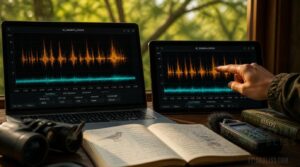
Once you can read a spectrogram, the next step is knowing what to compare it against. That’s where reference recordings come in.
Pull up a known recording from a bird call database and lay it beside your own.
Match loudness levels first, then scan both spectrograms for rhythm, frequency range, and note shape — small differences often reveal a lot.
Practice With Bird Song Hero
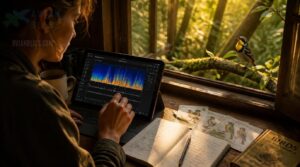
Matching spectrograms side by side becomes much easier with practice, and Bird Song Hero turns that practice into a game. You listen to a song, then pick the visual that matches it.
Over 50 species are included, and an Master round challenges your sharpest skills. It’s one of the best tools for training your ear and eye together.
Practice Calls in The Field

Knowing a bird’s call is one thing — hearing it in the wild is something else entirely. The real learning happens outside, where wind, distance, and a dozen competing sounds put your ears to the test. Here are a few practical habits that’ll sharpen your field listening fast.
Listen at Dawn
Dawn is birding’s golden hour. Song activity peaks within 30 minutes after sunrise, and cool morning air can carry distant calls surprisingly far.
- Arrive before civil sunrise
- Listen as owls fade and songbirds join
- Track which species sings first each morning
- Note the peak 90-minute window carefully
This daily sequence trains your ear quickly and builds lasting recognition.
Choose Quiet Habitats
Where you stand matters as much as when you arrive. Dense vegetation and tall hedgerows can cut background noise by 10 decibels or more, creating a natural acoustic refuge that lets softer calls come through cleanly.
Forest interiors, wetland reed margins, and small topographic dips all offer reliable habitat noise buffers that help your ears focus on what actually matters.
Record Clear Audio
A good recording captures what your ears miss. Use a handheld digital recorder with a directional microphone, positioned 6–12 inches from the source.
- Record in WAV format at 44.1 kHz for lossless detail
- Use a furry windscreen to block wind rumble
- Enable a high-pass filter below 100 Hz
- Apply gentle noise reduction in post to preserve harmonics
Match Sound With Sight
Your ears pick up the sound, but your eyes seal the deal. When a call rings out, scan for movement or color in the direction it came from.
A flash of red wing or a tail flick often follows the note. This sound-to-sight link trains your brain to store both cues together, making future identifications much faster.
Join Birding Walks
There’s no faster shortcut to sharper ears than walking alongside someone who already has them. Joining a bird walk puts you next to a local guide who can point out calls in real time, in the exact habitat where those birds live.
Arrive early, stay quiet, and bring a notebook. The birding community you meet on that trail often becomes your longest-lasting field resource.
Frequently Asked Questions (FAQs)
Why should I learn a few bird calls?
Bird calls reveal a hidden layer of the natural world. Detecting hidden species roosting in dense canopy, tracking seasonal migrations, and optimizing dawn sessions becomes far easier once your birding ear training begins.
How do I learn bird call identification?
Start small: pick five local species and build daily listening habits with short sessions.
Mix in mnemonic phrase creation, species comparison drills, and basic spectrogram analysis.
This trains your ear gradually, turning scattered noise into recognizable, memorable patterns over time.
Can you learn bird identification using song & calls?
Absolutely. With acoustic memory techniques and consistent practice, your brain naturally builds species signature recognition.
Learning through observation, daily listening, and auditory pattern training turns confusing chirps into confident bird song identification, proving sound-based identification mastery is well within reach for any beginner.
How do you know if a bird has a call?
Every bird call is like a quick text message, short and to the point. You’ll spot one through brief, simple vocal structures: a sharp alarm signal warning of danger, or a soft contact call keeping mates connected during immediate communication.
Can weather conditions affect how bird calls sound?
Yes, weather reshapes a bird’s acoustic signature.
Warm air sharpens pitch, humidity dulls tones, wind scatters sound, rain absorbs frequencies, and fog blurs clarity, while noise pollution and day-versus-night soundscape ecology further shift how clearly calls travel to your ears.
How do juvenile birds differ in their vocalizations?
Oddly enough, young birds can’t sing yet — not properly. Their early attempts, called subsong, sound breathy and loose, more like babbling than a recognizable tune, with variable pitch and tempo shifting constantly as they practice.
Do birds call differently during migration versus breeding?
Yes, birds do call differently. Breeding songs are longer and more complex, while migration calls stay short and simple — built for distance and wind, not impressing a mate.
How long does it take to recognize calls confidently?
Most beginners recognize common calls within 2–6 weeks of daily practice. Short sessions of 10–15 minutes each day work better than occasional long ones. Consistency really is the whole game here.
Conclusion
Research suggests that experienced birders identify roughly twice as many species by ear as by eye on any given morning in the field. That’s not a small edge—it’s a fundamentally different way of being out in the world.
Learning to identify birds by their calls opens a layer of the outdoors that most people walk right through without ever noticing. Once your ears are tuned in, silence itself starts to feel loud with life.