This site is supported by our readers. We may earn a commission, at no cost to you, if you purchase through links.

Somewhere over West Texas, a Ferruginous Hawk (Buteo regalis) rides a thermal so effortlessly it looks bored—wings locked, scanning 100 acres below for the slightest flicker of movement. That hawk isn’t unique.
Texas hosts over 30 species of birds of prey, more than almost any other state, because its landscape refuses to commit to just one identity. Coastal marshes, Chihuahuan desert, Piney Woods, open prairie—each draws different hunters.
Whether you’ve watched a shadow cross your backyard or spotted something massive perched on a highway sign, Texas raptors reward anyone willing to learn their secrets.
Table Of Contents
- Key Takeaways
- Types of Birds of Prey in Texas
- Texas Birds of Prey Species
- Birds of Prey Habitats in Texas
- Characteristics of Texas Birds of Prey
- Common Birds of Prey in Texas
- Less Common Birds of Prey in Texas
- Rare Birds of Prey in Texas
- Where to Spot Texas Birds of Prey
- Tips for Identifying Texas Birds of Prey
- Conservation Efforts for Texas Birds of Prey
- Frequently Asked Questions (FAQs)
- What birds of prey are in Texas?
- What is a hawk’s favourite food?
- What are the most common hawks in Texas?
- What birds of prey can you see in Texas?
- How many birds of prey are there in Texas?
- What are the smallest birds of prey in Texas?
- What is a bird of prey?
- What is the common bird of prey in Texas?
- What is the most common hawk in Texas?
- What is the big GREY bird in Texas?
- Conclusion
Key Takeaways
- Texas hosts over 30 raptor species — hawks, falcons, owls, eagles, and vultures — because its wildly varied landscape, from Gulf Coast marshes to the Chihuahuan Desert, gives every hunter a different stage to work from.
- Each raptor carries a built-in toolkit you can read in the field: wing shape tells you how it flies, beak curve tells you what it eats, and tail length tells you whether it’s built for speed or endurance.
- Conservation wins are real but fragile — bald eagles nesting pairs in Texas grew from just 5 in 1971 to roughly 160 today, yet habitat loss, lead poisoning, and toxins moving up the food chain still quietly chip away at raptor populations.
- You don’t need a remote wilderness to find these birds — Red-tailed Hawks hunt highway medians, Peregrine Falcons nest on city bridges, and a simple nest box on your barn can bring a Kestrel to your doorstep.
Types of Birds of Prey in Texas

Texas is home to more than 30 species of birds of prey, and each one has its own personality, hunting style, and favorite hangout.
From hawks and falcons to owls and kites, Texas birds of prey species and identification guide breaks down what makes each one worth watching for.
From tiny falcons hovering over roadsides to massive eagles patrolling lakeshores, the variety here is genuinely impressive.
Here’s a look at the main groups you’ll encounter across the state.
Hawks Found in Texas
Texas is home to at least 15 regularly occurring hawk species — and honestly, that’s notable for any single state. From soaring buteos to quick accipiters, these raptors shape Texas wildlife in ways you can watch firsthand.
- Red-tailed Hawks dominate roadsides year‑round, showing impressive urban adaptation
- Harris’s Hawks practice cooperative hunting in South Texas brush
- Swainson’s Hawks follow predictable migration patterns each spring and fall
- Northern Harriers bring seasonal abundance to winter grasslands
Their notable ultraviolet vision in hawks aids hunting.
Falcons in Texas
If hawks made you look up, falcons will make your jaw drop. Texas hosts six core falcon species — Peregrine Falcon, American Kestrel, Merlin, Prairie Falcon, Aplomado Falcon, and Crested Caracara — making Raptor Species Identification genuinely exciting here.
- Peregrine Wintering along the Gulf Coast means Coastal Stooping on shorebirds at breathtaking speeds
- Urban Kestrel sightings happen in parks, farms, and roadsides statewide
- Aplomado Recovery through structured Reintroduction Success programs restored breeding pairs to southern grasslands
- Bird Watching in Texas peaks in winter, when falcon diversity hits its seasonal high
- Raptor Conservation and Texas Wildlife protections keep these populations climbing
The extremely rare Collared Forest‑Falcon hasn’t been seen in Texas for years. Collared Forest‑Falcon rarity
Eagles in Texas
From agile falcons, we shift to true giants. Two eagle species rule Texas skies — the Bald Eagle and Golden Eagle.
Bald Eagles favor River Foraging along lakes and coastal bays, with roughly 160 active nesting pairs statewide. Golden Eagles prefer rugged canyons in far west Texas. Winter Migration brings extra birds south from Canada each December.
But challenges remain — Lead Poisoning from gut piles still kills birds today.
Strong Conservation Laws and ongoing Habitat Preservation efforts are keeping Population Trends pointed upward.
Vultures in Texas
After eagles, meet nature’s sanitation experts. Both the Turkey Vulture (Cathartes aura) and Black Vulture (Coragyps atratus) are essential birds of prey in Texas — masters of Carcass Detection and communal Roosting Behavior.
But Human Conflict over livestock losses creates real tension.
Legal Protection under federal law, paired with active Wildlife Conservation and Habitat Preservation, keeps Population Trends stable across the state.
Owls in Texas
When night falls, owls take over.
Great Horned Owls (Bubo virginianus) rule every habitat — forests, deserts, even urban owl roosts in your backyard.
Barred Owls haunt eastern woodlands, while Barn Owls silently quarter farmland fields.
Winter Owl Migration brings Short‑eared Owls to open grasslands.
Owl Conservation Challenges like habitat loss make Raptor Rehabilitation Centers and active Wildlife Management in Texas are absolutely critical for keeping these Nocturnal Hunting Techniques alive in the wild.
Texas Birds of Prey Species

Over 30 raptor species call Texas home — and honestly, that number still surprises me every time I say it out loud.
You’ve got dietary specialization happening at every level: Ospreys (Pandion haliaetus) diving feet‑first for fish, Turkey Vultures sniffing out carrion with impressive precision, and Great Horned Owls taking down prey as large as skunks after dark.
Texas sits along critical migration corridors, so seasonal visitors swell those numbers even further. Urban nesting is rising too — Peregrine Falcons now breed on city bridges and skyscrapers.
- Several species carry threatened status, including Northern Aplomado Falcon
- Habitat loss quietly shrinks breeding populations each year
- Migration corridors concentrate thousands of birds of prey into narrow windows
- Toxins move up food chains directly into raptors
- Every species lost reshapes the ecosystem below it
Birds of Prey Habitats in Texas

Texas covers an almost absurd range of terrain — from piney woods to desert flats to Gulf Coast marshes — and raptors have claimed a slice of nearly all of it.
Where a bird hunts, nests, and raises its young depends almost entirely on the land beneath its wings.
Here are the four key habitat types where you’re most likely to encounter Texas birds of prey.
Forest Habitats
Texas forests are far more than scenery — they’re working ecosystems.
In Big Bend’s riparian corridors, cottonwood galleries concentrate Barred Owls, Cooper’s Hawks, and Zone‑tailed Hawks within surprisingly small stretches.
Mixed‑species nesting thrives where water meets trees.
Forest fire impacts can reshape these communities quickly.
For serious bird watching and habitat ecology insight, these dense Texas stands reward patient, quiet observation.
Grasslands and Deserts
Grasslands and deserts might look empty at first glance — but they’re actually prime real estate for open‑country raptors.
White‑tailed Hawks use yucca perches to scan southern Texas savannas, while Swainson’s Hawks ride desert thermals during migration. Savanna nesting and sand‑dune hunting give these birds of prey a serious ecological role, controlling rodents and reptiles across Texas’s most wide‑open landscapes.
Wetlands and Coastal Areas
Coastal Texas is where migration gets serious. Ospreys and bald eagles work the bays and estuaries, targeting estuary fish prey with surgical precision — ospreys plunge feet‑first, eagles simply steal. The Gulf Coast acts as one of North America’s most powerful coastal migration bottlenecks, funneling thousands of raptors around open water.
- Saltmarsh nesting provides habitat for harriers and kites along tidal edges
- Tidal roosting sites concentrate birds during peak migration weeks
- Mangrove perches give coastal raptors elevated hunting vantage points
Urban and Backyard Habitats
Don’t overlook your own neighborhood — it might already be raptor territory. Across Dallas-Fort Worth and other Texas metros, Garden Raptors have quietly claimed the urban landscape. Light Tower Roosts and transmission poles serve as the new cliff faces, while Rooftop Nesting falcons treat high‑rises like canyon walls.
Pole Perches along highway medians give Red‑tailed Hawks perfect sightlines over mowed grass teeming with rodents. Parkland Hunting corridors thread through greenbelts where accipiters ambush songbirds near feeders.
Understanding Habitat and Distribution in cities opens up serious Bird Watching opportunities right outside your door. Support Conservation Efforts and Habitat Preservation by doing a few simple things:
- Keeping mature trees standing as natural nest anchors
- Eliminating rodenticide use that poisons raptors through their prey
- Installing nest boxes on barns or outbuildings
- Maintaining water features for drinking and bathing
- Reducing window strike hazards with visible decals
Characteristics of Texas Birds of Prey

Every raptor you’ll spot across Texas carries a set of built-in tools that make it a master of its environment.
From body size and feather patterns to beak shape and hunting tactics, these traits tell a bigger story than most people realize.
Here’s a closer look at the key characteristics that define Texas birds of prey.
Size and Shape
Size and shape are your first clues to bird identification in the field. Raptors in Texas span a wild range — American Kestrels stretch just 9–12 inches with wingspans of roughly 20–24 inches, while Bald Eagles reach 40 inches long with an 80-inch spread.
Tail morphology matters too: hawks show fan-shaped tails, falcons carry slim tapered ones, and eagles display plank-like wings with blocky heads.
Body proportions and beak length round out each raptor’s unmistakable silhouette.
Plumage and Coloration
Once you’ve nailed size and shape, feathers open a whole new world of raptor identification. Plumage and coloration in Birds of Prey in Texas tell stories — age, sex, even season.
- Juvenile Plumage signals youth: young Red-tailed Hawks show streaky pale breasts and banded brown tails instead of the adult’s bold rufous.
- Sexual Dimorphism is subtle in Texas — Broad-winged Hawks and Crested Caracaras look nearly identical between sexes, so birders rely on size differences instead.
- Molt Timing runs March through September, leaving hawks with mismatched fresh and worn feathers — a surprisingly useful Species Identification clue.
- Thermoregulatory Color is real science: pale, reflective dorsal plumage helps West Texas raptors stay cooler under brutal summer sun.
- Camouflage Patterns — mottled browns, streaked undersides — help Bird Identification tricky, since the same markings hiding a hawk from prey also hide it from you.
Beak Shape and Size
Feathers told you what to look for — beaks tell you how a raptor makes a living. In Avian Biology and Behavior, beak shape is basically a built‑in résumé.
Beak Curvature separates hunters from scavengers fast. Red‑tailed Hawks carry a deep, hooked curve for tearing muscle from mammals. Eagle Beak Size is especially massive — Bald Eagles need that heavy tool to wrench apart fish and waterbirds. Vulture Beak Length runs surprisingly long, letting Turkey Vultures reach deep inside carcasses that other Species Identification candidates can’t access.
Here’s a fun one for Raptor Identification and Bird Identification: falcons have a Tomial Tooth — a notch on the upper beak — for snapping through a bird’s spine cleanly. Hawks don’t have it.
Owl Beak Placement is equally clever — tucked low under dense facial feathers, it stays clear of their sound‑gathering ears. Habitat and Ecology shapes every curve.
Hunting Styles
Beaks hint at the diet — but watching a raptor hunt reveals the whole story. Texas predatory birds run a surprisingly varied playbook.
Red-tailed Hawks master thermal soaring, riding warm air in lazy circles until a mouse moves. A hovering kestrel freezes mid-air like a tiny drone. Harriers work ground-level quartering low over marsh grass. Owls? Pure stealth night pounce.
Harris’s Hawks flip the script entirely — cooperative flushing pursuit, hunting in family teams.
Common Birds of Prey in Texas

Texas may have over 30 raptor species, but a handful show up so often they’ve practically become locals. Whether you’re driving a rural highway or scanning a lakeside tree, these birds are the ones you’ll spot again and again.
Here are four of the most common birds of prey you’re likely to encounter across the state.
Red-tailed Hawk
If you’ve spent any time driving Texas highways, you’ve already met the Red-tailed Hawk (Buteo jamaicensis) — perched boldly on a fence post, scanning for its next meal. These raptors are masters of thermal soaring, riding invisible air columns with smooth grace.
A cornerstone of bird watching and habitat preservation efforts, this species reminds us that birds of prey in Texas can flourish alongside people.
- Vocalizations: That piercing scream? Hollywood borrows it for every eagle scene.
- Nesting Materials: Large stick platforms, reused yearly, built high in trees or on towers.
- Territory Size: Pairs defend 0.85–5.2 sq km depending on food availability.
- Urban Adaptation: They thrive near cities — utility poles make perfect hunting perches.
American Kestrel
Meet Falco sparverius — Texas’s smallest falcon and perhaps its most charming. The American Kestrel packs serious personality into a 9–12‑inch frame. Plumage Sexual Dimorphism makes identification easy: males flash blue‑grey wings and rufous backs, females wear warm brown streaking. Watch for their signature Hovering Hunting Technique — rapid wingbeats suspending them mid‑air before they drop onto grasshoppers or mice.
| Feature | Male | Female |
|---|---|---|
| Wing Color | Blue-grey | Rufous-barred |
| Weight | 80–143 g | 86–165 g |
| Primary Prey | Insects, lizards | Small mammals |
| Nesting Preference | Urban cavities, nest boxes | Same |
| Texas Presence | Year-round breeding | Year-round |
Bald Eagle
From the nimble kestrel to North America’s most iconic raptor — the Bald Eagle (Haliaeetus leucocephalus) commands every glance.
With wingspans stretching up to 2.3 meters, these Birds of Prey in Texas dominate lakes, rivers, and coastal bays.
Conservation Success is real: Texas grew from just 5 breeding pairs in 1971 to roughly 160 active nests today.
- Dietary Preferences: Primarily fish, coots, and soft-shell turtles
- Nesting Habitat: Tall trees near water, reused annually
- Winter Migration: Northern birds swell Texas Raptors populations seasonally
Turkey Vulture
The Turkey Vulture (Cathartes aura) is nature’s sanitation crew — and honestly, one of Texas’s most underappreciated raptors.
Its bald head adaptation keeps bacteria from fouling feathers during feeding.
Masters of thermal soaring, they ride updrafts with wings locked in a shallow V, rarely flapping.
Scavenger ecology at its finest: detecting carrion at parts-per-billion concentrations.
Reproductive timing peaks March through June, nesting in hollow trees or caves.
Less Common Birds of Prey in Texas

Not every raptor shows up at your backyard feeder or along the highway median — some take a little more effort to find.
Texas does host a handful of species that appear less regularly, either passing through on migration or turning up only in the right habitat at the right time of year.
Here are four worth keeping on your radar.
Broad-winged Hawk
Few raptors in Texas pull off a disappearing act quite like the Broad-winged Hawk (Buteo platypterus). This forest bird stays hidden in the canopy — then vanishes south in one of nature’s most dramatic mass migrations. Peak thermal soaring peaks mid-September near Corpus Christi, where kettles of thousands spiral overhead.
- Migration Patterns: Fall travel covers roughly 62 miles daily toward South America
- Breeding Timing: Nests in eastern Texas woodlands April through August
- Dietary Preferences: Targets frogs, snakes, and insects near forest edges
- Conservation Status: Threatened by habitat preservation gaps and forest fragmentation
Sharp-shinned Hawk
At just 9 to 13 inches long, the Sharp-shinned Hawk is North America’s smallest hawk — and one of the sneakiest birds of prey in Texas.
Migration timing runs September through May.
Watch for its squared tail tip and shoulder-heavy shape for quick bird identification.
It raids feeders targeting songbird prey, making urban habitat use surprisingly common.
Juvenile plumage shows brown streaks, not adult reddish bars.
Osprey
Where the Sharp‑shinned hunts by stealth; the Osprey (Pandion haliaetus) hunts by pure physics. This fish‑catching specialist plunges feet‑first from 30–100 feet up, fully submerging on impact. Those reversible outer toes and spiny spicules grip slippery fish like nature’s vice.
- Migration Timing: Passes through Texas mid‑March to May, returns September–November
- Nesting Sites: Prefers tall structures near lakes, bays, and rivers
- Plumage Details: White underparts, dark brown back, distinctive dark eye stripe
Peregrine Falcon
Where the Osprey drops into water, the Peregrine Falcon (Falco peregrinus) drops through the air — hitting stooping speeds beyond 320 km/h, faster than any other animal on Earth. That’s not a typo.
The Peregrine Falcon stoops at over 320 km/h, making it the fastest animal on Earth
In Texas, cliff nests anchor breeding pairs in Big Bend and the Trans-Pecos region.
But their urban adaptation is impressive — bridges and skyscrapers work just as well.
Prey diversity keeps them sharp: pigeons, shorebirds, even bats.
For bird identification, watch for slate-blue wings and a bold black "mustache.
Rare Birds of Prey in Texas
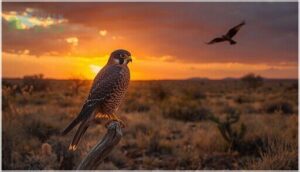
Some birds of prey show up rarely in Texas that spotting one feels like striking gold. These aren’t your roadside Red-tails — they’re the kind of sightings that make birders stop mid-sentence and reach for their binoculars.
Here are the rare raptors worth knowing about.
Golden Eagle
Few birds of prey in Texas command attention like the Golden Eagle (Aquila chrysaetos). That unmistakable Nape Feather Display — golden shimmer visible 200 yards out — tells you something ancient is overhead.
- Dietary Preferences: Mammals, rabbits, prairie dogs
- Mating Rituals: Dramatic aerial dives on cliff ledges
- Altitudinal Migration: Seasonal movement through Trans-Pecos mountains
- Territory Size: Up to 60 square miles
Habitat Preservation and Conservation Efforts are critical for keeping these raptors soaring.
Great Horned Owl
While the Golden Eagle rules the daylight ridges, nightfall belongs to another giant — the Great Horned Owl (Bubo virginianus).
This is Texas’s true year-round resident among nocturnal raptors, holding the same territory season after season, announcing ownership through deep, resonant Territory Calls that carry half a mile.
Its Night Vision is remarkable, and Diet Diversity is real — from mice and rabbits to skunks and other owls.
Nesting Preferences lean toward abandoned hawk nests in tall trees.
Impressively, Urban Adaptation makes Bird Identification in Texas backyards surprisingly common.
Habitat loss remains the biggest threat to their stability.
Barred Owl
Unlike their booming neighbor, Barred Owls (Strix varia) seduce you with haunting “who cooks for you” calls, and their Vocalization Patterns are unmistakable once you’ve heard them.
In Texas, they favor dense eastern forest Habitat Preservation zones, where Territory Size spans roughly 300–600 acres. Prey Preferences run toward small mammals, frogs, and crawfish. Winter Roosting happens deep in riparian woodlands. Conservation Status stays stable, though habitat loss nudges populations in certain regions.
For Bird Identification, look for bold horizontal breast barring across the round, dark‑eyed face.
Northern Saw-whet Owl
Meet Aegolius acadicus — the Northern Saw-whet Owl, Texas’s pocket-sized winter visitor. Barely larger than your fist, this owl’s Winter Range stretches into central and eastern Texas woodlands, where Habitat Preservation matters deeply.
Its repetitive tooting Vocalizations cut through cold nights like a metronome. Diet Preferences lean toward mice and voles. Conservation Status remains stable, but protecting Nest Sites and advancing Conservation Efforts keep these charming Owls thriving for Bird Identification enthusiasts.
Where to Spot Texas Birds of Prey

Texas puts raptors within reach if you know where to look.
From protected wild lands to your own backyard, the right spots can turn a casual outing into something unforgettable.
Here are the best places to start your search.
National Parks and Wildlife Refuges
Texas’s national parks and refuges are where raptor-watching gets seriously good. Each site offers something distinct:
- Big Bend Raptor Habitat hosts zone-tailed hawks, peregrine falcons, and golden eagles across dramatic desert canyons.
- Guadalupe Eagle Views reward you with soaring golden eagles on 7-foot wingspans above rocky peaks.
- Aransas Salt Flat Hawks — red-tailed and white-tailed hawks patrol 115,000 acres alongside whooping cranes.
- Laguna Atascosa Grassland Falcons and Santa Ana Migration Hotspot together log over 800 combined bird species in Texas, making wildlife preservation here genuinely count.
State Parks and Forests
State parks are where Texas raptor-watching gets personal.
Atlanta State Park‘s dense Pineywoods shelter over 130 nesting bird species in Texas, including Cooper’s hawks and sharp-shinned hawks. Caddo Lake‘s cypress‑swamp mosaic hosts barred owls year‑round.
Raptor watch platforms help you scan forest edges without disturbing active nesting tree species. Prescribed burn benefits and invasive species control keep understories open — exactly what hunting raptors need.
Visitor education programs at park nature centers connect you to ongoing conservation efforts and habitat preservation that keep these birds thriving.
Backyard and Urban Areas
Your backyard might be hosting Texas raptors right now. Red-tailed Hawks claim rooftops as perching sites, while Cooper’s Hawks slice through trees chasing feeder birds.
Put up nest boxes for American Kestrels — they’ll move in fast.
Watch for window collisions, light pollution disorienting owls, and rodenticide risks poisoning your local hunters.
Habitat preservation choices protect urban bird watching and strengthen wildlife conservation street by street.
Birding Tours and Festivals
Want to level up your raptor game fast?
Guided tours and festivals across Texas make it happen.
Migration Watch Events near Corpus Christi track thousands of Broad-winged Hawks daily each fall.
Raptor Photography Workshops sharpen your skills alongside pros.
Falconry Demonstrations bring you glove-to-talon close.
Night Owl Prowls reveal secret hunters after dark.
Family-friendly Raptor Hikes combine bird identification with conservation efforts — making every trail a classroom for understanding these stunning birds.
Tips for Identifying Texas Birds of Prey

Spotting a bird of prey is one thing — knowing exactly what you’re looking at is where the real magic happens.
A few key clues can turn a mystery silhouette into a confident ID in seconds.
Here’s what to look for.
Size, Shape, and Structure
Every raptor tells its story through body design alone. Master these five structural clues for confident birds of prey identification:
- Wing Aspect Ratio — broad, rounded wings (buteos) mean soaring; long, pointed wings (falcons) mean speed
- Tail Morphology — Cooper’s Hawks show long rounded tails; Red-tailed Hawks fan short, broad tails
- Body Proportions — eagles look barrel-chested and powerful; kestrels look slim and lightweight
- Leg Talon Structure — massive curved talons signal big-prey hunters; osprey talons have barbed soles for gripping fish
- Beak Dimensions — deeply hooked beaks tear meat efficiently
Understanding avian biology this way transforms guesswork into mastery.
Plumage and Coloration Patterns
Once you’ve nailed structure, color becomes your next superpower for birds of prey identification. Texas raptors are walking lessons in avian biology — and the variety is genuinely wild.
Take morph variation: Red-tailed Hawks range from nearly white to almost black. Juvenile plumage adds another layer — young Bald Eagles are uniformly dark brown for years before earning that iconic white head. Sexual dimorphism shows up beautifully in American Kestrels, where males flash blue-gray wings, females simply don’t have.
| Pattern Feature | What to Look For | Example Species |
|---|---|---|
| Underwing Contrast | Dark wingtips vs. pale inner wing | Turkey Vulture |
| Camouflage Markings | Barred browns blending into bark | Great Horned Owl |
| Morph Variation | Light vs. dark full-body color | Ferruginous Hawk |
Color isn’t decoration — it’s identity.
Habitat and Behavior
Color clues get you far, but habitat and behavior seal the deal. Where a raptor hunts tells you almost as much as what it looks like.
- Coastal Nesting and wetland edges attract Ospreys and Bald Eagles
- Cooperative Hunting in south Texas brush signals Harris’s Hawks
- Seasonal Migration kettles overhead mean Broad-winged or Swainson’s Hawks
- Urban Roosting on ledges and towers? Classic Peregrine Falcon territory
Conservation Efforts for Texas Birds of Prey

Texas’s birds of prey have made an impressive comeback — but that didn’t happen by accident.
Dedicated people across the state are working hard every day to make sure raptors keep soaring over Texas skies for generations to come.
Here’s a look at the key efforts driving that mission.
Habitat Preservation
Habitat preservation for birds is the foundation that everything else rests on. In Texas, groups like the Peregrine Fund have restored over 550 acres of grassland at Laguna Atascosa alone — and that’s just one site.
You can support this work by encouraging native vegetation planting, dead tree retention (raptors nest in those!), and raptor nest boxes on your property. Power line mitigation and habitat diversity across prairies, forests, and wetlands all matter. Prairie restoration and conservation efforts give Texas raptors a fighting chance.
Hunting Regulations
Under federal and state law, almost all raptors are fully protected — you can’t hunt, trap, or possess them without special permits. The Migratory Bird Treaty Act is the backbone here. Texas falconry permits require at least 32 square feet per bird and five years of experience.
- Permit Requirements: mandatory for any legal raptor handling
- Protected Species: includes virtually every Texas raptor
- Conservation Efforts: regulations directly support ecological balance
- Habitat Preservation for Birds: tied directly to legal nest protections
Research and Monitoring
Tracking raptors takes real science. Banding programs and telemetry studies follow individual birds across migratory flyway routes, while nest success surveys reveal whether populations are holding steady.
Population modeling pulls all that data together, giving ornithology researchers a clearer picture of ecosystem balance.
TPWD’s hawk watches at Bentsen-Rio Grande Valley count thousands annually — numbers that quietly shape Texas conservation efforts season after season.
Education and Outreach
Getting involved doesn’t require a biology degree. School Programs, Raptor Workshops, and Youth Ambassadors initiatives across Texas turn curious kids into real conservation partners.
Citizen Science platforms with Interactive Maps let you log sightings that directly support Ornithology and Research efforts statewide. Every observation you contribute strengthens Wildlife Management decisions, broadens our understanding of Avian Diversity, and keeps Conservation Efforts and Initiatives — and Ornithology in Texas — moving forward.
Frequently Asked Questions (FAQs)
What birds of prey are in Texas?
Texas hosts over 30 raptor species — hawks, falcons, eagles, owls, and vultures — each shaped by migration patterns, dietary specialization, and seasonal abundance across the state’s remarkably diverse landscapes.
What is a hawk’s favourite food?
depends on the hawk. Size-based prey selection, habitat influence, and individual learning all shape the answer.
Most hawks favor small mammals — mice, rabbits, squirrels — but seasonal diet shifts keep things interesting.
What are the most common hawks in Texas?
The Red-tailed Hawk tops the list, year-round and unmistakable. You’ll also spot Cooper’s Hawks in wooded suburbs and Harris’s Hawks ruling South Texas scrub with their fascinating cooperative hunting techniques.
What birds of prey can you see in Texas?
With over 52 species documented, you’ll find everything from the ubiquitous Red-tailed Hawk to Bald Eagles and Osprey near waterways.
Seasonal migration brings even more variety — citizen science apps like eBird help you track them all.
How many birds of prey are there in Texas?
Roughly 52 raptor species call Texas home — hawks, falcons, owls, eagles, kites, and vultures combined. That’s an impressive Taxonomic Breakdown across one state’s skies.
What are the smallest birds of prey in Texas?
Texas’s tiniest raptors pack serious power in small frames. The American Kestrel — just 22–31 cm long — and the Sharp-shinned Hawk, barely larger, are the state’s smallest birds of prey.
What is a bird of prey?
Think of them as nature’s sharpest hunters — raptors, or birds of prey, are carnivorous birds built to catch and eat other animals.
They use powerful talons, hooked beaks, and razor-sharp predatory vision.
What is the common bird of prey in Texas?
The Red-tailed Hawk is your most reliable Texas raptor.
Its rusty tail, soaring silhouette, and year‑round presence across farms, highways, and backyards make it unmistakable — a true master of urban adaptation and open‑country hunting.
What is the most common hawk in Texas?
Ever wonder which hawk you spot most on a Texas road trip?
That’s almost certainly the Red-tailed Hawk — a bold, adaptable raptor with a blazing rusty tail and a wingspan stretching up to 52 inches.
What is the big GREY bird in Texas?
Several large grey raptors roam Texas.
The Gray Hawk (Buteo nitidus) is a strong contender — a medium-sized raptor with soft grey plumage, bold tail bands, and distinctive calls along riverine perches in the lower Rio Grande Valley.
Conclusion
Most people drive past a Red-tailed Hawk on a highway sign and think, "Cool bird"—then forget it existed by the next exit.
Congratulations, you’re no longer that person.
Learning Texas birds of prey doesn’t just sharpen your eyes; it rewires how you read a landscape.
Every soaring silhouette becomes a story, every screech a clue.
Texas handed you 30-plus raptors and endless sky.
The only question left is when you’re heading out.