
This site is supported by our readers. We may earn a commission, at no cost to you, if you purchase through links.

Each January, an Arctic tern completes one of the most remarkable feats in the animal kingdom—crossing from the Antarctic pack ice back toward the Arctic Circle, wrapping up a round trip that can stretch beyond 60,000 kilometers. It doesn’t stop because it’s tired or cold; it stops when the prey runs out. That single biological fact reframes everything you think you know about how birds endure polar winters.
Arctic birds winter behavior isn’t a story of survival against the odds—it’s a masterclass in physiological engineering. Counter-current heat exchangers built into their legs, salt glands that concentrate brine several times saltier than seawater, and down underlayers that cut radiative heat loss even in subzero winds reveal adaptations precise enough to make an engineer envious. Some species migrate to escape the dark season entirely, while others dig into snowdrifts, share body heat in rotating huddles, and cache food beneath frozen tundra to outlast months of polar night. Understanding how they do it—and what threatens those systems now—opens a window into one of nature’s most complex survival architectures.
Table Of Contents
- Key Takeaways
- How Arctic Birds Survive Winter
- Winter Migration Patterns
- Cold-Weather Feeding Strategies
- Shelter and Social Winter Behavior
- Winter Threats to Arctic Birds
- Frequently Asked Questions (FAQs)
- How do Arctic birds survive the cold?
- Why am I hearing birds in January?
- What is the most common bird in the Arctic?
- What is the Arctic bird in summer and winter?
- How do Arctic birds communicate during winter months?
- Do Arctic birds experience reduced activity in darkness?
- How does permafrost affect Arctic bird winter survival?
- Can Arctic birds adjust their heart rate in cold?
- How do chicks develop tolerance to freezing temperatures?
- Conclusion
Key Takeaways
- Arctic birds like the snowy owl and willow ptarmigan survive brutal winters through layered physiological engineering—counter-current heat exchangers, dense down underlayers, and feathered legs that slash heat loss before it ever reaches the extremities.
- The Arctic tern’s annual round trip of up to 60,000 kilometers isn’t wandering—it’s a precisely wind-optimized circuit that positions the bird at nutrient-rich upwelling zones, exposing it to nearly 80% of Earth’s annual daylight across its lifetime.
- Cold‑weather feeding isn’t passive survival: species like the Arctic raven and chickadee cache thousands of high‑fat food items with spatial memory accurate to within 5 centimeters, while the northern fulmar carries stomach oil delivering up to 12 kilojoules per gram as a concentrated energy reserve.
- Sea ice loss—down roughly 40% since 1979—isn’t a distant forecast for ice‑dependent species like ivory gulls and puffins; it is already compressing foraging windows, triggering prey mismatches, and eroding the nesting coastlines these birds have relied on for millennia.
How Arctic Birds Survive Winter
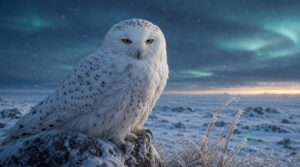
Arctic winters are brutal—temperatures plunge, winds cut to the bone, and darkness stretches for months. Yet certain birds don’t flee; they stay and thrive through an impressive set of biological tools built right into their bodies. Here’s what makes that possible.
The Willow Ptarmigan is a standout example—every feather and physical adaptation it carries serves a precise survival purpose in those unforgiving conditions.
Dense Insulating Feathers
If you’ve ever wondered how Arctic birds endure temperatures that would send most animals into a tailspin, the answer lies in their striking feather architecture. Beneath the sleek outer plumage sits a dense underlayer of down — soft, fluffy fibers that trap warm air directly against the skin, forming a thermal buffer that windswept tundra simply can’t penetrate.
Feathered Legs and Talons
That insulation doesn’t stop at the feathers you can see. The snowy owl (Bubo scandiacus), for instance, carries dense feathering down to the talons, trapping a thin warm layer directly against the skin of the legs — exposed extremities that would otherwise hemorrhage heat into subfreezing air. Feathered legs also shed moisture and ice, keeping birds mobile across snow-covered terrain.
Counter-current Heat Exchange
Feathered legs offer a first line of defense, but Arctic birds carry another thermal trick deeper in their anatomy. Countercurrent heat exchange works inside the circulatory system itself — arteries and veins run parallel along the leg, transferring warmth from outgoing arterial blood to returning venous blood, slashing heat loss from the core before it ever reaches the feet.
Winter Molt Adaptations
What drives this transformation is a finely tuned biological clock. Molt timing cues — primarily photoperiod and dropping temperatures — trigger Arctic birds to replace worn summer plumage before peak cold arrives. Replacement feathers feature densely packed feathers with tighter barbs, cutting convective heat loss, while the downy undercoat expands to boost feather insulation properties by up to 20 percent.
Salt Glands in Seabirds
While most Arctic birds battle cold through feathers and fat, seabirds like the Northern Fulmar (Fulmarus glacialis) carry a hidden survival tool: supraorbital salt glands. These compact cephalic organs excrete concentrated saline fluid — often saltier than seawater itself — allowing fulmars to drink freely at sea without losing precious water. Here’s what makes them astonishing:
- Highly vascularized tubules actively pump sodium and chloride ions into an excretory canal via Na⁺/K⁺-ATPase transporters.
- The secreted solution can reach salinities several times higher than surrounding seawater.
- Parasympathetic nerve signals trigger acetylcholine receptors, initiating calcium release and glandular secretion during feeding.
- Salt gland size scales with salt intake, adapting across tubenose species to match marine feeding demands.
This convergent physiological adaptation, appearing independently across distinct avian lineages, complements renal function to maintain electrolyte balance — quietly sustaining seabirds through months of open-ocean winter survival.
Winter Migration Patterns
Not every Arctic bird faces winter the same way—some escape it entirely, while others stay put and tough it out. The strategies vary widely depending on the species, and the routes some birds take are nothing short of remarkable. Here are the key migration patterns worth knowing.
Arctic Tern Routes

No creature on Earth logs more miles than the Arctic tern, Sterna paradisaea, whose annual round trip between polar extremes covers 40,000 to 60,000 kilometers — enough that a single bird accumulates over two million kilometers across its lifetime. These exceptional Atlantic route variations aren’t random wandering; they reflect finely tuned migration navigation secrets shaped by wind, prey, and geography.
Their navigational precision rivals any instrument ever built, a testament to the migratory bird species habits that evolution has quietly perfected over millennia.
No creature on Earth travels farther than the Arctic tern, logging up to 60,000 kilometers every year
| Route Name | Direction | Key Feature |
|---|---|---|
| Atlantic West Africa | Southbound | Exploits nutrient-rich coastal upwelling zones |
| Atlantic Brazil | Southbound | Feeds where tropical and temperate waters converge |
| Mid-Ocean Atlantic | Northbound | Trans-oceanic leg toward Greenland and Iceland |
| Pacific Coastal | Southbound | Used by select North American colonies |
| Mid-Ocean Pacific | Northbound | Alternative return for Pacific-wintering individuals |
Departing Arctic breeding grounds in late July or August, terns ride prevailing winds southward, pausing at stopover site strategies that replenish fat reserves. Along the West African coast, upwelling concentrates fish and krill, drawing birds into feeding frenzies lasting one to three weeks. These aren’t casual rest stops — they’re calculated fuel depots enabling wind-assisted flights across vast, featureless ocean. On the northbound spring leg, favorable tailwinds compress the return to roughly 40 days, a proof of impressive flight endurance in long migrations that exposes terns to nearly 80 percent of Earth’s annual daylight.
Puffins at Sea
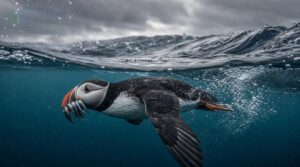
When Arctic tern routes steal the spotlight, it’s easy to overlook another extraordinary traveler — the Atlantic Puffin, Fratercula arctica, which spends its entire winter at open sea. Here’s what makes its offshore life so fascinating:
- Paddle swimming propels it underwater using powerful wingbeats
- Beak storage holds up to twelve fish simultaneously
- Group foraging spreads across productive cold-water zones
- Surface resting conserves energy between dives
Dense plumage and insulation keep it thriving far from shore.
Red Phalarope Migration

Few shorebirds live as nomadically as the Red Phalarope (Phalaropus fulicarius), spending up to eleven months entirely at sea. Using a fly-forage strategy, it follows ocean fronts and upwellings, pausing where crustaceans and zooplankton concentrate. Females depart Arctic breeding grounds first, with males following weeks later — a fascinating sex-specific migration timing that staggers pressure on wintering feeding grounds across the Pacific and Atlantic.
Ross’s Gull Winter Range

Of all the Arctic’s wandering seabirds, Larus rossea may be the hardest to actually find in winter. Ross’s Gull doesn’t retreat south like most gulls — instead, it moves deeper into the ice, favoring pack ice margins and leads in the northern Bering Sea and Sea of Okhotsk, where open water persists long enough to yield amphipods, copepods, and small fish. Occasional Atlantic coast sightings remind us how much we still don’t know about its full winter range.
Resident Arctic Species
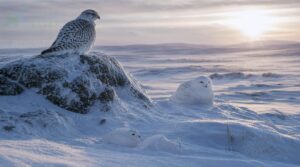
Not every Arctic bird packs its bags when winter arrives. Some species — the Gyrfalcon (Falco rusticolus), Snowy Owl (Bubo scandiacus), and Rock Ptarmigan (Lagopus muta) — stay put year-round, relying on winter-white camouflage, dense insulation, and sharp hunting instincts to endure the cold.
- Gyrfalcon hunts ptarmigan across open tundra using speed and territorial dominance
- Snowy Owl uses feathered talons and acute hearing for winter hunting beneath snow
- Rock Ptarmigan shifts to pure white plumage for predator avoidance
- Nesting fidelity draws residents back to the same cliff ledges and burrows each year
- Plumage and insulation trap warmth even during prolonged sub-zero wind exposure
Cold-Weather Feeding Strategies
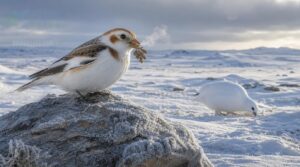
Surviving an Arctic winter isn’t just about staying warm — it’s about fueling a body under constant metabolic pressure. Arctic birds have developed some remarkably precise feeding strategies to keep energy levels high when food is scarce and temperatures are unforgiving. Here’s how they do it.
Fat Reserves Before Winter
Before the Arctic locks down in ice and cold, birds face a critical race: accumulate enough fat to survive. Hormonal regulation triggers appetite surges in late summer, driving birds to consume energy-dense foods that optimize fat deposition. These subcutaneous fat reserves serve double duty — fueling metabolism and adding insulation. Crucially, birds balance storage efficiency against flight trade-offs, since excessive fat impairs aerial performance.
Diving for Marine Prey
Once fat reserves are secured, seabirds shift their focus to the sea itself. Species like the Atlantic puffin (Fratercula arctica) rely on torpedo-shaped bodies and strong, tucked wings to pursue fish underwater, while nictitating membranes protect their eyes in icy depths, keeping vision sharp where light barely penetrates.
Seed-based Winter Diets
Not every Arctic bird can chase fish. For land-dwelling species like the snow bunting (Plectrophenax nivalis) and Lapland longspur (Calcarius lapponicus), winter foraging across the Arctic tundra habitat means working the snow’s surface for seeds — particularly sunflower and grass seeds rich in polyunsaturated fats and roughly 6–7 grams of protein per serving — fueling survival in the subnivean world below.
Food Caching Behavior
Seeds get a bird through lean days, but some species think further ahead. Arctic ravens (Corvus corax) and chickadees cache thousands of high-fat items — nuts, seeds, small invertebrates — scattered across their home range in dispersed, territory-anchored locations, often 2–15 cm deep. Here’s what makes this behavior exceptional:
Studies show that about 70 % of chickadee searches occur within 5 cm of the expected cache location, reflecting high retrieval accuracy.
- Birds create dummy caches when watched, actively deceiving would-be thieves
- Spatial memory guides retrieval weeks or months later with striking precision
- Caching peaks before severe winter sets in, building a distributed food safety net
Stomach Oil Energy Stores
The northern fulmar (Fulmarus glacialis) carries something notable in its stomach — a dense, lipid-rich oil averaging 9–12 kilojoules per gram, far outpacing raw fish in caloric punch. This energy density advantage lets parents deliver concentrated fuel to chicks efficiently, even when foraging trips run long. That metabolic investment pays off directly in fledging mass and chick survival.
Shelter and Social Winter Behavior
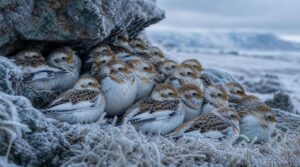
Staying warm in the Arctic isn’t just about feathers—it’s also about knowing when to stick together. Beyond their impressive physical adaptations, Arctic birds rely on smart social behaviors and shelter choices to push through the coldest months. Here’s a closer look at the key strategies they use.
Huddling for Warmth
When temperatures plunge below freezing, some Arctic birds rely on one another as living insulation. Huddle formation dynamics reveal that tight groupings reduce each bird’s exposed surface area, slowing radiative heat loss dramatically. Here’s what makes social heat conservation so effective:
- Individuals share core body warmth through direct contact
- Group size optimization balances heat retention against competition for central spots
- Behavioral synchronization cues coordinate when birds rotate from cold outer edges inward
- Behavioral thermoregulation reduces metabolic strain across the entire group
This energy conservation in cold environments can mean the difference between survival and exhaustion.
Snow Burrows and Cavities
Beyond the warmth of a huddle, some Arctic birds take shelter entirely underground—burrowing into snow pack insulation that keeps internal temperatures near freezing even when the air outside drops dangerously low.
This subnivean habitat functions like a natural thermos, its walls and ceiling trapping metabolic heat while buffering against brutal wind.
Snow burrow architecture usually features a narrow entrance shaft, just 5–20 centimeters wide, leading into a compact living chamber with a stable, compacted floor—small enough to retain warmth, yet allowing a quick escape when predators approach.
Escape tunnels branching laterally from the main shaft give birds an essential secondary exit, while entrance orientation toward leeward, wind-protected points limits cold drafts infiltrating the burrow.
The subnivean climate inside maintains surprisingly high humidity, which aids plumage condition and moisture balance, critical to thermoregulation.
Some individuals or pairs even defend preferred territorial burrows, returning seasonally as reliable shelter anchors within familiar foraging ranges.
When you consider how precisely these insulation strategies match the physics of heat retention, Arctic birds start looking less like passive survivors and more like remarkably capable engineers of their frozen world.
Leeward Roosting Sites
Step outside a snow burrow and you’ll find another survival trick hiding in plain sight: the leeward roost. By selecting cliff faces, dense vegetation, or terrain features that block prevailing winds, Arctic birds slash convective heat loss dramatically, maintaining stable microclimates that buffer brutal overnight temperature swings and give their well-insulated plumage the best possible conditions to do its thermoregulatory work.
Rotating Huddle Positions
When birds huddle together, the group doesn’t simply press close and stay put — rotation mechanics transform a static cluster into a living heat engine. Individuals continuously cycle between exposed outer locations and warm interior spots, ensuring fair heat distribution across all members while keeping thermoregulation costs low for every bird in subzero temperatures.
Avoiding Wind Exposure
Wind isn’t just uncomfortable for Arctic birds — it’s one of winter’s most dangerous energy drains. That’s why wind-protected roosts behind cliff faces, rock outcrops, and snow drifts aren’t random choices; they can slash heat loss by up to 60 percent compared to exposed perches, giving birds a genuine thermal edge when temperatures plummet.
Winter Threats to Arctic Birds

Arctic birds are remarkably resilient, but their winter survival now faces pressures that no amount of dense feathering or behavioral adaptation can fully offset. Climate change, human activity, and shifting ecosystems are reshaping the Arctic faster than many species can respond. Here’s a closer look at the key threats putting these birds at risk.
Sea Ice Loss
Sea ice loss stands as one of the most urgent threats facing Arctic birds today. Since 1979, Arctic sea ice extent has declined by roughly 40 percent, shrinking from approximately 7 million to around 4 million square kilometers at the annual minimum — a transformation that reshapes entire ecosystems.
Here’s what’s driving this rapid loss:
- Ice Albedo Decline — As melt ponds form earlier each season, surface reflectivity drops, causing the Arctic Ocean to absorb more solar energy and accelerating further melt.
- Ocean Heat Intrusion — Warmer Atlantic waters push beneath the ice, melting it from below while weakening the halocline layer that once acted as a thermal barrier.
- Regional Melt Patterns — Seas like the Barents and Kara show faster retreat than others, driven by wind patterns and ocean heat transport that push ice away from coastlines.
- Coastal Erosion Risks — Reduced sea ice exposes shorelines to wave action, threatening the nesting sites that ground-nesting seabirds depend on.
For species with strong sea ice dependence — ivory gulls, puffins, guillemots — habitat loss due to warming isn’t a distant forecast. It’s already shrinking their foraging windows and breeding grounds, nudging some populations toward ecosystem tipping points that may prove difficult to reverse.
Changing Prey Availability
As sea ice retreats, it doesn’t just erase habitat — it quietly rewires the marine food web beneath it. Prey size distribution shifts, smaller schooling fish grow more abundant near melt edges, and phenological mismatches widen as plankton blooms no longer align with peak foraging windows, forcing species like puffins to search harder for increasingly unpredictable prey.
Oil Spill Risks
Unpredictable prey is only part of what makes Arctic winters so perilous. Oil spill contamination poses an equally devastating threat — when oil coats a seabird’s feathers, it destroys the insulating structure that keeps the bird alive in sub-zero conditions, causing rapid hypothermia. Cleanup challenges in remote Arctic habitat, where harsh weather slows response timelines considerably, mean long-term marine food web damage often follows.
Increased Winter Predation
Beyond oil spills, increased predation pressure reshapes winter survival in ways that are easy to overlook. Arctic foxes expand their range as warming winters push them further north, bringing new threats to ground-roosting species. Birds respond through flocking defense mechanisms and strategic sheltering in leeward sites, relying on collective vigilance rather than camouflage alone when nocturnal hunting pressures intensify under polar darkness.
Conservation Monitoring Efforts
Keeping a close watch on Arctic bird populations requires tools that earlier naturalists could only dream of. Today, satellite monitoring programs map breeding colonies at 1–3 meter resolution, while banding and mark-recapture studies build individual life histories across wintering ranges. Together, these approaches reveal population trends that would otherwise go undetected in some of Earth’s most remote landscapes.
What makes modern conservation genuinely exciting is how many threads it weaves together:
- Health surveillance networks use camera traps, feather sampling, and mortality reporting to catch emerging disease or contaminant threats early.
- Risk assessments integrate sea-ice data, prey availability indices, and predator surveys to prioritize where intervention matters most.
- Citizen science platforms extend spatial coverage dramatically, with local and indigenous communities contributing verified sightings through digital apps.
International cooperation ties it all together. Protected-area designations and cross-border agreements safeguard migratory corridors that no single nation controls alone, ensuring that the data gathered each season actually translates into meaningful action on the ground.
Frequently Asked Questions (FAQs)
How do Arctic birds survive the cold?
Arctic birds don’t just endure winter — they’re engineered for it. Compact bodies and facial feathers cut heat loss, while feather fluffing and wing curling maintain a personal microclimate inches from the skin.
Why am I hearing birds in January?
That chorus you’re hearing isn’t your imagination. As daylight increases after the December solstice, resident species like cardinals and chickadees begin singing to claim territory and respond to hormonal cues — even with snow still on the ground.
What is the most common bird in the Arctic?
Ironically, the most abundant Arctic seabird isn’t a striking predator — it’s the Little Auk, a compact colonial nester with a short bill adapted for zooplankton, breeding by the millions on cliff ledges.
What is the Arctic bird in summer and winter?
From sun-drenched tundra to storm-lashed winter seas, Arctic birds shift plumage, diet, and range dramatically between seasons — transforming into entirely different-seeming creatures as breeding intensity gives way to cold-weather survival.
How do Arctic birds communicate during winter months?
Birds rely on dry calls and whistles to stay connected when storms cut visibility. Low-frequency rumbles carry across ice, while wing flicks and plumage patterns help flocks orient and coordinate without a single sound.
Do Arctic birds experience reduced activity in darkness?
No, Arctic birds don’t go dormant in darkness. Circadian rhythm flexibility lets species like murres maintain active darkness foraging tactics, using sound and polarized light to locate prey through the polar night.
How does permafrost affect Arctic bird winter survival?
Permafrost thaw is quietly reshaping the game for nesting birds. Islet nesting refuges formed by ice wedge collapse create natural predator barriers, cutting Arctic fox access and boosting survival odds substantially.
Can Arctic birds adjust their heart rate in cold?
Yes — through cold-induced bradycardia and cold-induced vasoconstriction, Arctic birds fine-tune their circulatory system, linking heart rate variability to metabolic rate, enabling precise thermal regulation with seasonal heart adjustments and vascular countercurrent exchange.
How do chicks develop tolerance to freezing temperatures?
Like a seedling hardening to frost, chicks build cold tolerance through hormonal adjustments, rapid feather insulation growth, metabolic boosts, and parental brooding, while microhabitat use shields them from lethal wind chill.
Conclusion
What these birds endure each winter isn’t hardship—it’s orchestrated precision, a biological contract written in feather, fat, and instinct. Arctic birds winter behavior reveals creatures so finely calibrated to their environment that even the coldest polar night becomes, for them, simply another season to navigate. As sea ice retreats and prey shifts, understanding these systems matters more than ever. The tern doesn’t ask whether the journey is possible. It simply flies.