This site is supported by our readers. We may earn a commission, at no cost to you, if you purchase through links.
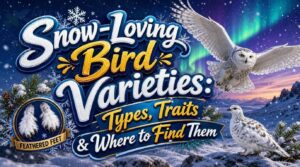
Most birds head south when temperatures drop—but a surprising number do the opposite.
Snow-loving bird varieties don’t merely tolerate winter; they’re built for it, with feathered feet that act as snowshoes, plumage that shifts color with the seasons, and metabolisms fine-tuned for subzero survival.
The Snowy Owl hunts in broad daylight across open tundra. The Willow Ptarmigan turns white on cue, vanishing against the snowpack.
From Arctic coastlines to backyard feeders, winter birds reveal just how creative evolution gets when the temperature falls.
Table Of Contents
Key Takeaways
- Some birds—like the Snowy Owl (Bubo scandiacus) and Willow Ptarmigan (Lagopus lagopus)—don’t flee from winter; they are physiologically built for it, with feathered feet, seasonal plumage shifts, and cold-tuned metabolism.
- Backyard feeders stocked with suet, black-oil sunflower seeds, and nyjer attract cold-hardy species like Black-capped Chickadees and Pine Siskins, making winter survival a community effort between birds and observers.
- Snow-loving birds rely on layered survival strategies—insulating down feathers, fat reserves, seed-caching, and flock aerodynamics—to stay alive when temperatures drop below freezing.
- From Arctic tundra specialists like the Arctic Redpoll (Acanthis hornemanni) to coastal foragers like the Purple Sandpiper (Calidris maritima), winter birds occupy nearly every habitat most species abandon.
Best Snow-Loving Bird Varieties
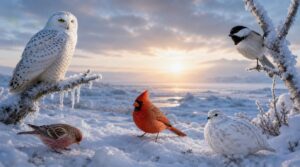
Some birds don’t just tolerate winter — they’re built for it. From the Arctic tundra to open snowfields, a handful of species have turned brutal cold into their natural home.
Their cold-weather survival toolkit — from dense feathering to slowed metabolism — mirrors the same remarkable strategies seen in Arctic-adapted shorebirds like the American Golden-Plover.
Here are five that do it best.
Snowy Owl
The Snowy Owl (Bubo scandiacus) is built for Arctic tundra life. Its circumpolar breeding range spans the Arctic tundra around the North Pole. Its feathered feet act like built-in snowshoes, and silent low flight makes it a ghost over open fields. Lemming predation drives nearly everything — breeding success, Arctic nomadism, migratory patterns.
- Daytime hunting sets it apart from most owls
- Camouflaged flight keeps prey unaware until it’s too late
- Cold climate adaptations start from beak to toe
Willow Ptarmigan
Unlike the Snowy Owl’s year-round white coat, the Willow Ptarmigan (Lagopus lagopus) employs a long-term strategy—shifting its plumage from winter white to summer brown to seamlessly blend with the Arctic tundra’s seasonal changes.
Its snowshoe feet provide insulation and mobility in deep snow, though their role diminishes in warmer months. The species also shifts habitat, favoring sheltered valleys in winter and open tundra in summer.
| Trait | Winter | Summer |
|---|---|---|
| Seasonal plumage changes | Pure white | Brown mottled |
| Snowshoe feet | Active insulation | Reduced role |
| Habitat | Sheltered valleys | Open tundra |
Ground nesting in alpine habitats demands territorial calls and specialized cold climate adaptations.
Snow Bunting
The Snow Bunting (Plectrophenax nivalis) trades the Ptarmigan’s dramatic molt for subtler seasonal shifts—a rusty-brown wash in winter that fades into striking black-and-white breeding plumage. These changes align precisely with Arctic tundra conditions, driven by strict molt timing.
Large flocks swirl over open fields, making winter birdwatching genuinely rewarding.
- Ground nesting in rocky crevices keeps eggs safe from Arctic winds
- Territorial songs and flight displays mark breeding territory on arrival
- Seed preference shifts seasonally, favoring grasses and sedges through winter
Arctic Redpoll
Where the Snow Bunting dazzles in flocks, the Arctic Redpoll (Acanthis hornemanni) quietly holds its ground. This compact finch inhabits Arctic tundra year-round, relying on a seed and insect diet, and fat reserves built before temperatures plunge.
Partial migration takes some birds southward, but many stay put—surviving on seed specialization, dense feathers, and tundra habitat know-how that would impress any seasoned birder.
Rough-Legged Hawk
Meet the Rough-legged Hawk (Buteo lagopus)—a master of Arctic tundra cliff nesting that follows the food south each winter.
- Cliff Nesting: Breeds on Arctic ledges, lining stick nests with grass and down.
- Hover Prey: Kites effortlessly above open ground, scanning for movement below.
- Lemming Dependence: Small mammals—especially lemmings—drive nearly every hunting decision.
- Banded Tail ID: Look for broad wings and a distinctive banded tail in flight.
- Winter Habitat Shift: Rough-legged Hawks trade Arctic harsh conditions for southern marshes and fields, perfecting energy conservation in cold open terrain through their calculated predatory behavior.
Backyard Birds That Love Winter
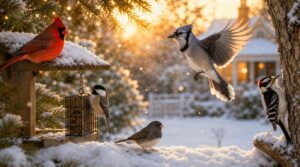
You don’t have to travel far to spot birds that thrive in winter — some of the best ones show up right outside your window. A well-stocked yard can attract a surprising mix of cold-weather regulars.
From chickadees to dark-eyed juncos, this guide to cold-weather bird species breaks down exactly who’s likely visiting your yard this season.
Here are five backyard birds you’re likely to see when the temperature drops.
Black-Capped Chickadee
Few backyard visitors earn their place in winter like Poecile atricapillus. Blackcapped Chickadees thrive at deciduous edge habitats—birches, alders, and forest margins—where seed-caching behavior sustains them through harsh winters. Their bold feeder defense is remarkable for an 11-gram bird.
| Trait | Winter Detail |
|---|---|
| Metabolic Conservation | Regulated shivering preserves energy overnight |
| Alarm Calls | Dee-note count signals predator threat level |
Dark-Eyed Junco
The Dark-eyed Junco (Junco hyemalis) is a reliable winter companion you will spot hopping beneath feeders. Through elevational migration, it descends from highland forests to your yard each season.
Watch for its distinctive tail feather markers—white flashes that signal alarm mid-flight.
Flocks practice seed foraging and brush-roosting to endure cold, demonstrating adaptive survival strategies.
This species serves as a textbook example of cold tolerance in birds, showcasing resilience through communal behaviors.
Northern Cardinal
The Northern Cardinal (Cardinalis cardinalis) is perhaps winter’s most vivid reward for backyard bird watchers. Its carotenoid plumage stays brilliantly red year-round — no seasonal fade, no dull moult. Its territorial song rings out even on cold mornings, a sign this resident species never truly leaves.
- Feeder attraction: Black-oil sunflower seeds bring cardinals reliably close
- Seed preferences: Males often let females feed first at shared stations
- Nest construction: Dense shrubs near feeders double as nesting habitat
- Birdwatching tips for winter: Watch at dawn — that’s peak cardinal activity
White-Crowned Sparrow
That bold crown pattern — two black stripes flanking a crisp white center — makes the White-crowned Sparrow (Zonotrichia leucophrys) one of the easiest to identify in winter bird identification. It winters across brush habitat and garden edges, adapting well to snowy landscape conditions.
Each bird carries song dialects learned in youth, retained for life. Watch shrubby borders at dusk for reliable sightings.
Pine Siskin
Few backyard visitors signal winter quite like the Pine Siskin (Spinus pinus). This streaked finch masters adaptation to snowy landscapes through relentless tracking of seeds across shifting cone crops. Its slender bill morphology manipulates nyjer seeds with precision that broader-billed finches can’t match.
Watch for three reliable signs:
- A yellow wing flash during low-light flurries
- Acrobatic clinging to nyjer feeders
- Buzzy calls overhead during cold-weather migration
Cold-Coast Snow Bird Species

The cold coast has its own cast of winter birds — ones built for wind, waves, and freezing shorelines. From rocky Atlantic outcrops to open marshes, these species claim the edges most birds abandon.
Here are five cold-coast snowbirds worth knowing.
Purple Sandpiper
If you’re drawn to cold-coast birdwatching, the Purple Sandpiper (Calidris maritima) is worth seeking out. This stocky shorebird excels at rocky intertidal foraging, using precise bill shell prying to extract mussels from crevices. Its purple sheen plumage appears briefly in good light.
Tidal cycle timing drives its feeding rhythm, and strong site fidelity brings it back to the same shorelines each winter.
Common Goldeneye
From rocky shorelines, your gaze shifts to open bays — where the Common Goldeneye (Bucephala clangula) demands attention. This striking diving duck follows reliable migration corridors from boreal wetlands to coastal wintering waters.
- Plumage Identification: Males show an iridescent green-black head with a circular white cheek patch
- Diving Adaptations: Submerges 30–60 seconds targeting aquatic invertebrates
- Winter Water Preferences: Favors clear coastal bays and large inland lakes
- Tree Cavity Nesting: Breeds in boreal forest cavities near wetlands
- Habitat Preferences: Orange-legged females blend into shorelines during migration stopovers
Snow Goose
Where the Goldeneye favors quiet bays, the Snow Goose (Anser caerulescens) commands entire wetlands. Following major Migratory Flyways, flocks can number in the hundreds of thousands — their vocal communication carrying miles across shorelines.
| Trait | Detail |
|---|---|
| Breeding Habitat | Arctic tundra and coastal marshes |
| Diet | Crop feeding on corn, rice, soybeans |
| Migration | Three major North American flyways |
| Plumage | White or blue morph |
| Population Management | Regulated hunting and habitat monitoring |
American Bittern
Where Snow Geese dominate open wetlands, the American Bittern (Botaurus lentiginosus) masters stillness. Its streaked brown plumage provides near-perfect marsh camouflage in dense cattail marshes. That Booming Call—a low, resonant sound—echoes across wetland ecosystems at dusk.
- Relies on Stalking Forage techniques in shallow vegetated zones
- Wintering range extends through southern U.S. marshes and brackish wetlands
- Wetland Habitat quality directly shapes its cold tolerance
- Exhibits strong Nest Site Fidelity when marshes remain undisturbed
- Habitat selection in winter favors dense emergent vegetation for concealment
The bird’s survival hinges on undisturbed wetlands, where its cryptic behavior and habitat loyalty intersect.
Winter Shorebird Habitats
When the tide pulls back twice daily, winter shorebirds get to work. Mudflat Foraging drives species like the Purple Sandpiper to exposed intertidal zones, where bivalves and crustaceans are briefly accessible.
Saltmarsh Roosting offers shelter during storms, while Coastal Resting Zones in calm lagoons reduce energy loss. These habitats provide critical refuge and recovery areas for the birds.
Tidal Synchrony shapes every feeding window — shorebird ecology here runs on the ocean’s schedule.
Mountain and Forest Winter Birds
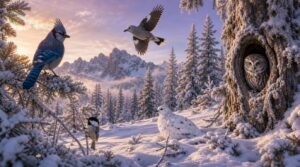
Mountain and forest habitats are home to some of winter’s most resilient birds, thriving where temperatures drop and snow piles deep. These species have evolved specific traits that let them outlast the cold while staying surprisingly active.
Here are five mountain and forest birds worth knowing.
Pine Grosbeak
The Pine Grosbeak (Pinicola enucleator) is a standout in boreal forests — chunky, about 9 inches long, with a conical bill built for cone feeding and conifer seed extraction. Its bold white wing bars make it easy to spot mid-flight.
Watch for irruptive movements bringing these birds south in winter, where budding forage sustains them. Bird conservation efforts increasingly protect their boreal habitat.
Mountain Chickadee
The Mountain Chickadee (Poecile gambeli) thrives in conifer habitat from sea-level to 12,000 feet, relying on food caching and spatial memory to survive lean months. Watch for elevational migration as birds descend to foothills when snow deepens.
Their sunning behavior on exposed winter perches is easy to spot — a reliable reward for cold-tolerance birding in coniferous forests.
White-Winged Crossbill
Few winter birds are as specialized as the White-Winged Crossbill (Loxia leucoptera). Its crossbill bill mechanics — where the upper mandible crosses the lower at an angle — enable cone seed specialization that most birds can’t match.
This nomad of the boreal forest ecosystem follows irregular irruption patterns tied to spruce cone availability.
Remarkably, winter breeding occurs mid-season when spruce forest habitat offers abundant cones.
Gray Jay
The Gray Jay (Perisoreus canadensis) is boreal forests’ boldest neighbor. Unlike migrants, it stays put year-round through sheer resourcefulness.
- Food caching using saliva keeps it fed when snow buries everything
- Territorial pairs defend 65–70 hectares alongside family group dynamics
- Bold human approach makes campsite sightings almost guaranteed
- Feather insulation and habitat adaptation for winter drives impressive cold tolerance in birds
Bohemian Waxwing
The Bohemian Waxwing (Bombycilla garrulus) arrives like a rumor — suddenly everywhere, then gone. These nomadic movements, called irruptions, follow berry foraging opportunities across boreal and Arctic regions.
Watch for crested plumage in silky gray-brown tones and distinctive wax tips on secondary feathers. Their high-pitched calls announce flock arrivals before you spot them.
Count this among the winter birds you may see this year in snowy landscapes as part of their adaptations.
How Snow Birds Survive Winter
Winter isn’t just something snowbirds endure — it’s something they’re built for. From layered feathers to smart flocking instincts, these birds have real strategies that keep them alive when temperatures plunge.
Here’s a closer look at how they pull it off.
Insulating Feather Layers
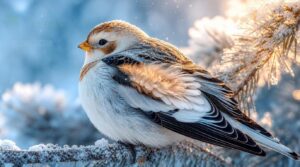
Think of a bird’s feathers as a finely engineered thermal system. Down Feather Structure forms a dense inner layer near the skin, creating Thermal Air Pockets that resist heat loss through avian thermoregulation.
Contour Feather Function adds an outer shield, while Barbule Interlocking seals gaps against wind. This Windproof Outer Layer, combined with high feather density, ensures robust protection.
These adaptations make winter plumage essential for temperature regulation mechanisms in freezing conditions.
Seasonal White Plumage
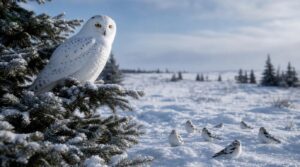
Beyond feather structure lies another clever survival trick: color itself. Molt timing ensures species like the snowy owl and snow bunting complete their shift to winter plumage before the first snowfall.
- Camouflage Benefits hide birds from predators on open snowfields
- Feather Insulation improves as denser white feathers replace summer coats
- Species Recognition relies on subtle dark markings within seasonal plumage coloration
- Energy Trade-offs mean molting demands extra calories during cold months
High-Energy Winter Feeding
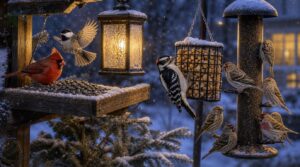
Molting costs calories — and that bill comes due fast. Winter bird feeding isn’t just a kind gesture; it’s genuinely life-sustaining. Suet blends packed with crushed peanuts and oats keep overnight temperatures from depleting fat reserves. Sunflower hearts attract cardinals and chickadees. Nyjer seed for finches draws siskins and redpolls. Heated waterers prevent dehydration. Feeding frequency matters too — steady, small offerings outperform occasional large ones.
Winter bird feeding isn’t charity — it’s the difference between survival and freezing before dawn
| Food Type | Target Species | Key Benefit |
|---|---|---|
| Suet Blends | Woodpeckers, Nuthatches | High-fat overnight fuel |
| Black Oil Sunflower / Sunflower Hearts | Cardinals, Chickadees | Calorie-dense winter bird feeding |
| Nyjer Seed for Finches | Pine Siskins, Redpolls | High-calorie small seed energy |
Nutrient balance and high-energy seed varieties together sustain both plumage repair and metabolic warmth.
Flocking and Migration
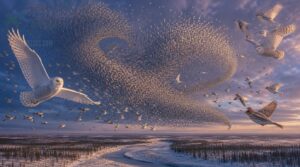
Feeding fuels the journey — and for many snowbirds, that journey is everything.
Flock dynamics are driven by simple neighbor-alignment rules, enabling aerodynamic drafting that reduces individual energy costs. Constant shifts in flock morphology during flight optimize collective efficiency.
Collective navigation relies on magnetic fields, stars, and landmarks to guide migratory paths. These mechanisms ensure precise orientation across vast distances.
Stopover selection and energy budgeting along migratory bird routes directly shape seasonal migration timing, determining which species appear in specific regions and when observers might encounter them.
Snowy Birdwatching Tips
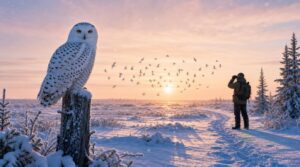
Spotting a Snowy Owl or Snow Bunting in the field comes down to preparation. Cold weather birding rewards those who plan ahead.
- Optics Selection: Use binoculars with 42mm+ lenses for low-light bird identification.
- Light Management & Sound Cues: Go at dawn; listen for chattering calls carrying across snow.
- Snow Trail Approach & Warm Layering: Move slowly on marked trails, dressed in waterproof layers.
Frequently Asked Questions (FAQs)
What kind of birds like snow?
Like winter’s own architects, some birds don’t just survive snow — they’re built for it.
Snowy Owls, Snow Buntings, Arctic Redpolls, and Ptarmigans use physiological acclimation, energy storage, and predator avoidance to thrive where others retreat.
Are juncos and snowbirds the same thing?
Juncos and snowbirds are the same bird.
"Snowbird" is simply a popular nickname for the Dark-eyed Junco (Junco hyemalis), a small sparrow that reliably appears at winter feeders across North America.
Do birds remember if you feed them?
It’s no coincidence your chickadees arrive right as you step outside. Birds do remember you, your feeder location, your face, and even your schedule — loyalty built on consistent rewards.
Which snow birds sing during winter months?
Several birds keep singing through winter. Northern Cardinals belt out clear whistles from exposed branches.
White-crowned Sparrows hold their melodious calls on frosty mornings.
Dark-eyed Juncos add soft, high-pitched notes on calm days.
How do snow birds find mates in winter?
Birds of a feather flock together." Snow birds find mates through territory songs, feather displays, and food gift exchange.
These courtship rituals strengthen pair bonding, often sealed by vocal duets during cold winter foraging.
Can snow-loving birds predict incoming storms?
Snow-loving birds don’t predict storms — they sense them. Barometric sensitivity triggers pre-storm feeding, shelter selection, and flock mobilization.
Vocal suppression often follows as conditions worsen, a quiet but telling shift in winter bird behavior.
Do snow birds sleep differently in freezing temperatures?
Yes — think of it as nature’s power-saving mode. Extended night roosts, feather fluffing, group huddling, and metabolic downshift all help birds conserve heat and energy through freezing nights.
Conclusion
Winter doesn’t silence the natural world—it reveals which snow-loving bird varieties were shaped by it. The ptarmigan’s white coat, the chickadee’s restless energy at your feeder, the snowy owl’s patient scan across open fields: each one is a different answer to the same cold question.
You don’t need to travel far to witness these adaptations. Step outside, look up, and winter stops feeling empty. It starts feeling full.