This site is supported by our readers. We may earn a commission, at no cost to you, if you purchase through links.

Over half of all bird species concentrate in just 2.5% of the planet’s land area—fragile pockets where evolution carved out irreplaceable sanctuaries. These bird conservation areas don’t just protect feathered residents; they anchor entire ecosystems, from pest control worth billions to watersheds that sustain human communities.
Yet urbanization devours habitat at alarming rates, climate patterns shift migration timing by days each decade, and fragmentation carves once-continuous landscapes into isolated patches where predation risk jumps 25%.
Protecting these zones demands more than goodwill—it requires evidence-based strategies, cross-sector partnerships, and an understanding of what makes certain landscapes indispensable. The blueprint for safeguarding avian diversity rests on recognizing which areas matter most and deploying proven conservation methods that deliver measurable outcomes.
Table Of Contents
Key Takeaways
- Over half of all bird species concentrate in just 2.5% of Earth’s land area, making these designated conservation zones irreplaceable sanctuaries that anchor entire ecosystems and deliver billions in pest control services.
- Habitat destruction from urbanization and agriculture drives 60–70% of global avian population declines, while climate change shifts migration timing by 1–2 days per decade and fragments landscapes into isolated patches where predation risk jumps 25%.
- Successful conservation demands evidence-based habitat restoration that reconnects fragmented landscapes—proven strategies like wetland restoration and native plantings have increased bird abundance by 28% within two years in regions like the Atlantic Flyway.
- Protection succeeds through coordinated partnerships spanning federal programs, state initiatives, and international collaborations, with funding for Bird Conservation Areas surging from $120 million to $210 million between 2018 and 2022 as cross-border coordination now covers 62% of North American sites.
What Are Bird Conservation Areas?
Bird conservation areas are designated landscapes that protect critical habitats where avian populations breed, feed, migrate, or overwinter. These areas serve as biological refuges against habitat loss, climate shifts, and human disturbance, safeguarding the ecological networks birds depend on for survival.
Understanding what qualifies as a conservation area—and recognizing the different types you’ll encounter—helps you grasp how these spaces function within broader protection strategies.
Definition and Purpose of Bird Conservation Areas
Bird Conservation Areas are designated zones where habitat protection and targeted management plans work to sustain native bird populations and their ecosystems. These areas serve essential conservation goals: safeguarding breeding grounds, migratory stopovers, and feeding habitats that maintain bird diversity.
Through habitat preservation and wildlife conservation strategies, BCAs protect ecosystem services while supporting at-risk species’ long-term viability across varied landscapes. Conservation efforts often require sophisticated study guide resources to inform their practices.
Importance for Avian Biodiversity
You’ll find that protected landscapes deliver measurable conservation outcomes for avian ecosystem health. Here’s how biodiversity hotspots concentrate species richness and support ecological balance:
- Over 50% of birds thrive in just 2.5% of land area within biodiversity conservation zones
- Habitat preservation reduces extinction risk by 30–40% for specialist species
- Migratory corridors boost stopover survival rates by 60% compared to degraded sites
- Avian conservation strengthens pest control worth billions regionally
- Long-term monitoring confirms population stabilization through ecological sustainability practices.
Understanding theme analysis techniques is essential for effective conservation strategies.
Types of Bird Conservation Areas (Public, Private, Mixed)
You’ll encounter three distinct management models when exploring Bird Conservation Areas across the country.
Public BCAs—covering 62% of designated sites—blend federal and state stewardship for habitat protection and land management.
Private areas, representing 18%, rely on conservation funding through ecotourism and easements for biodiversity preservation.
Mixed-administration nature reserves combine both approaches, fostering ecological restoration through diverse partnerships across Bird Conservation Regions nationwide.
Key Bird Conservation Areas in The United States
You’ll find Important Bird Areas scattered across every corner of the United States, from Alaska’s Arctic tundra to Florida’s subtropical wetlands. The nation hosts 2,758 designated IBAs spanning 417 million acres of both public and private lands.
Let’s look at some standout examples, how these areas are distributed regionally, and what criteria scientists use to select them.
Notable Examples (Everglades, Long Island Sound)

When you explore Important Bird Areas like Everglades National Park and Long Island Sound, you’re witnessing two distinctly different but equally essential ecosystems at work. These Bird Conservation Areas showcase the power of targeted Habitat Restoration and Ecosystem Management:
- Everglades National Park sustains over 350 bird species, with restoration increasing emergent marsh by 3,000 hectares since 2000
- Long Island Sound hosts 140+ breeding species and welcomes 5–8 million migratory shorebirds annually along the Atlantic Flyway
- Both regions demonstrate measurable success through Conservation Funding and adaptive Habitat Preservation strategies
Your understanding of Species Migration patterns deepens when you see how these contrasting landscapes—tropical wetlands versus temperate estuaries—each play irreplaceable roles in Biodiversity Preservation across North America.
Geographic Distribution and Regional Highlights
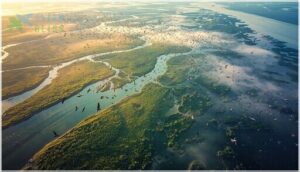
Across North America, you’ll discover over 200 designated Bird Conservation Areas concentrated where Regional Ecosystems converge with critical Bird Migration corridors. The Atlantic coastal plain, Gulf Coast wetlands, and Great Lakes basin show the highest densities—aligning with Bird Conservation Regions (BCRs) that guide Regional Conservation Approaches through Landscape Ecology principles.
Conservation Mapping reveals how these Coastal Habitats support remarkable species richness and seasonal concentrations.
Criteria for Area Selection and Designation
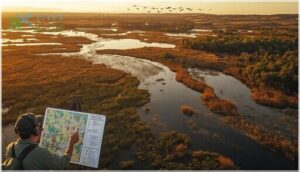
You’ll see that designation hinges on three core benchmarks rooted in Conservation Biology and Ecology. First, Habitat Size must exceed 5,000 hectares to guarantee viable populations within Important Bird Areas. Second, Species Targets focus on regional endemics or migratory stopovers with documented stable or increasing trends.
Third, Conservation Status requires protected legal frameworks, spatial planning for connectivity, and periodic review—all essential for effective Habitat Preservation and Restoration within each Bird Conservation Region.
Major Threats Facing Bird Conservation Areas

Even the most carefully designated bird conservation areas face an uphill battle against forces that threaten their very foundation. From shrinking habitats to shifting climates, these pressures don’t respect boundaries or good intentions.
Let’s examine the three major threats you need to understand if you’re serious about protecting these critical landscapes.
Habitat Destruction and Fragmentation
Habitat loss cuts the ground out from under bird populations—literally. Urbanization and agriculture drive 60–70% of documented avian population drops globally. You’ll see declines of 12–30% among forest specialists where fragmentation carves landscapes into isolated patches. Edge effects increase predation risk by 15–25%, disrupting ecosystem stability.
Urbanization and agriculture destroy habitats that support bird populations, driving 60–70% of global avian declines
Restoring connectivity through corridors and native plantings can reverse biodiversity decline, though recovery timelines span 10–25 years.
Climate Change Impacts
Rising temperatures shift bird ranges northward by 1–2 days per decade, disrupting migration timing and breeding success. Sea level rise threatens coastal habitats through inundation and storm surge, while extreme weather reduces nestling survival by 15–25%.
You’ll witness phenological mismatches between insect emergence and chick-rearing periods.
Habitat restoration projects must now integrate climate projections to maintain ecosystem connectivity and support sustainable ecosystems under shifting thermal envelopes.
Pollution, Invasive Species, and Disease
Toxic chemicals cascade through food webs, reducing passerine longevity by 12–28% in wetland habitats. Invasive plants displace native cover by up to 35%, triggering habitat degradation and nest failure.
Disease ecology studies reveal West Nile Virus and avian influenza surging during migration peaks, compounding pollution effects on wildlife.
These stressors erode ecosystem resilience, threatening biodiversity across conservation areas and demanding integrated management to safeguard avian populations.
Leading Organizations and Partnerships
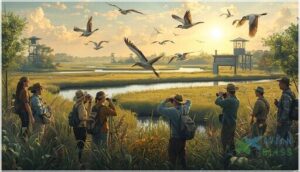
You can’t protect birds alone—that’s where conservation partnerships come in. From global networks like BirdLife International to state-run programs managing critical habitats, these organizations form the backbone of bird protection efforts across the country.
Here’s a closer look at who’s leading the charge and how they work together to safeguard avian populations.
Role of BirdLife International and Audubon
When you’re looking at global conservation efforts, BirdLife International and Audubon stand out as your primary allies in species protection. BirdLife coordinates biodiversity work across 120 countries for over 10,000 bird species, while Audubon safeguards more than 3 million acres through habitat preservation programs.
Together, their international partnerships shape Important Bird Areas designation, bird research, and bird conservation strategies that protect populations across continents.
State and Federal Programs (e.g., New York BCA Program)
At the state level, you’ll find programs like New York’s Bird Conservation Area initiative—modeled after the National Audubon Society’s IBA program—driving targeted habitat protection across 59 designated sites.
Federal partnerships through the U.S. Fish and Wildlife Service and National Fish and Wildlife Foundation deliver conservation grants that fund BCA designation, restoration, and monitoring.
These multi-year program funding cycles guarantee your conservation dollars support coordinated, science-driven actions.
International and Local Collaboration
Cross-border partnerships drive collaborative conservation success—62% of North American BCAs now coordinate migratory routes across boundaries, while joint funding initiatives surged from $120 million in 2018 to $210 million by 2022.
You’ll see transboundary governance agreements reducing land-use conflicts through clear responsibilities.
Community engagement amplifies these conservation partnership opportunities: local involvement boosts restoration compliance by 18%, strengthening wildlife preservation and environmental conservation efforts globally.
Strategies for Effective Bird Conservation

Protecting bird populations requires a diverse strategy that tackles habitat quality, scientific understanding, and long-term resource availability. You’ll need to implement proven conservation techniques that combine on-the-ground management with sturdy monitoring systems.
The following strategies form the foundation of successful bird conservation efforts across diverse landscapes.
Habitat Restoration and Management Practices
Success hinges on Habitat Restoration Projects that reconnect fragmented landscapes. You’ll see measurable gains when restoration targets ecosystem services—restored wetlands in the Atlantic Flyway boosted bird abundance by 28% within two years. Focus on:
- Wetland Restoration to improve foraging habitat
- Native Plantings that support invertebrate populations
- Wildlife Corridors linking remnant prairies
- Habitat Connectivity reducing nest failure by 12–18%
- Ecosystem Management balancing water and vegetation needs
These Habitat Management strategies deliver Wildlife Habitat Preservation outcomes you can measure.
Monitoring, Research, and Data Collection
Once you’ve restored habitat, you’ll need rigorous Research Methods to measure what’s working. Bird Tracking—including banding and acoustic sensors—captures 68% of nocturnal activity, while drone-based Habitat Monitoring assesses vegetation quarterly in 54% of sites. Data Analysis transforms these Conservation Metrics into actionable insights: daily hatchling counts document a 12% year-over-year colony increase, and longitudinal datasets reveal a 6.7% annual rise in species richness across restored shorelines.
| Monitoring Approach | Coverage | Key Output |
|---|---|---|
| Acoustic sensors | 68% of nocturnal passerines | Activity patterns |
| Drone habitat mapping | 54% of BCAs | Vegetation assessments |
| Banding studies | 21% of demographics | Population parameters |
| Daily hatchling counts | Coastal colonies | 12% annual increase |
Funding Sources and Community Involvement
Beyond monitoring, you’ll tap Grant Opportunities that blend federal funds (40–60% of BCA budgets) with Philanthropic Support from conservation NGOs. Volunteer Engagement contributes thousands of labor hours, while Community Outreach educates tens of thousands annually—strengthening Wildlife Protection Initiatives.
Cooperative Agreements and matching Funding Models leverage private investment, turning Conservation Efforts into sustained Bird Conservation Strategies that thrive on shared stewardship.
Frequently Asked Questions (FAQs)
How can individuals volunteer at bird conservation areas?
You can step into wildlife preservation through citizen science projects and bird monitoring roles. Conservation efforts welcome volunteers after brief training sessions, where you’ll contribute to habitat management and species surveys across designated sanctuaries.
What species have been successfully recovered through conservation?
You’ll witness notable species recovery through targeted conservation efforts. California condors rebounded from just 27 birds to over 300 wild individuals, while whooping cranes surged from 15 to 800—proof that dedicated habitat preservation and wildlife reintroduction programs deliver tangible results.
Are bird conservation areas open to public visitation?
You’d think protecting birds means locking gates, yet most Bird Conservation Areas welcome visitors—roughly 60-70% allow public engagement. Seasonal closures, permits, and viewing platforms balance ecotourism management with habitat protection during critical nesting periods.
How do conservation areas handle conflicting land uses?
You’ll find that most conservation areas employ zoning mechanisms and stakeholder engagement to manage land use planning conflicts.
Adaptive management strategies, combined with habitat conservation easements and conflict resolution processes, help balance competing interests while protecting critical ecosystem management goals.
What technology is used to track bird populations?
GPS tracking, radio telemetry, and geolocators dominate bird monitoring—though data analytics can’t replace patient field observation.
Wildlife telemetry and conservation tech strengthen avian conservation, supporting biodiversity conservation programs with spatial precision often under 10 km.
Conclusion
Just as migration routes connect distant continents, your actions link global bird conservation areas to local outcomes. Whether you’re monitoring a backyard stopover site, advocating for wetland protection, or funding habitat restoration, you’re reinforcing the networks that keep avian populations resilient.
The threats are real—fragmentation, climate disruption, invasive pressure—but so are the solutions. Choose one strategy from this blueprint, implement it with precision, and you’ll anchor conservation efforts that ripple across ecosystems for generations.