This site is supported by our readers. We may earn a commission, at no cost to you, if you purchase through links.

A single barn owl family can clear out hundreds of rodents in one nesting season. That’s free pest control working right in your backyard, no chemicals needed! But here’s the catch: old, hollow trees are disappearing fast, leaving cavity dwellers with nowhere to raise their young.
That’s where you come in. A well-built bird house for owls gives these hunters a safe place to nest, and it gives you a front-row seat to nature’s quiet magic.
Ready to give owls a real home? You’ll find every measurement, material, and placement tip you need to build one that actually works.
Table Of Contents
- Key Takeaways
- Choose The Right Owl House
- Build an Owl Nest Box
- Install Your Owl House Safely
- Top 4 Owl Houses
- Attract and Maintain Nesting Owls
- Frequently Asked Questions (FAQs)
- Is there a bird house for owls?
- Are owl boxes a good idea?
- How high should an owl nest box be?
- How to build a bird house for owls?
- What kind of bird house do owls like?
- How to attract an owl to an owl house?
- Where is the best place to put an owl house?
- Will owls use an owl house?
- How long does it take for owls to move in?
- Are owl houses safe for other backyard wildlife?
- Conclusion
Key Takeaways
- Match your owl box’s size and entrance hole to local species like Tawny, Little, or Pygmy Owls, since dimensions and hole size determine which cavity dwellers will actually nest inside.
- Build with untreated cedar or pine, skip exterior perches, and add drainage holes and predator guards to keep the nesting box safe, dry, and free from ambush risks.
- Mount your owl house 10 to 20 feet high, facing east or south, in a quiet spot at least 100 meters from busy paths to boost occupancy and reduce stress.
- Keep owls coming back by using natural nesting materials, reducing outdoor lighting, providing nearby water, cleaning the box each winter, and watching for unwanted nesters like starlings.
Choose The Right Owl House
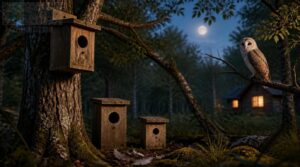
Every owl species has its own idea of a perfect home. Before you grab a hammer or click "buy," you’ll want to match the box to your local cavity dwellers. Here’s what to check before choosing yours.
Once your box is up, patience pays off, since knowing the best time of day to spot owls can turn a quiet yard into a nightly show.
Match Local Owl Species
Which owls actually live near you? In Saxony, Tawny Owls are common forest residents, alongside Little Owls in open fields and Pygmy Owls in conifer stands.
Long-eared Owls prefer dense pine or spruce groves. Matching your owl nesting box to these local habitat preferences boosts your odds of attracting real nesting pairs, not just curious visitors.
Compare Box Dimensions
Size matters more than you’d think when picking owl house plans. A Tawny Owl needs roughly 20-28 cm internal length and 25-30 cm height, while Pygmy Owls want much smaller cavities.
Wall thickness around 12-20 mm keeps insulation solid without cramping floor area. Check total volume too—smaller cavity dwellers thrive in tighter spaces, larger species need room to stretch.
Check Entrance Hole Size
Get the entry hole right, and you’ll invite the right tenant while keeping predators out. Species size matching is everything: screech owls need about 3 inches, barred owls up to 3.5, while cavity dwellers in tight spots prefer 2.5 to 3 inches. To make sure safety, you should also incorporate essential predator protection measures like baffles.
Smooth edges prevent injury during entry. Add an entrance reducer for extra predator deterrence, and check regional diameter variations before finalizing your owl house plans.
Use Untreated Wood
Untreated wood keeps your box safe and breathable for nesting owls. Cedar, cypress, and pine top the list—they resist rot naturally and won’t overheat inside. Skip chemical preservatives; owls are sensitive to fumes near eggs.
Yes, untreated wood absorbs moisture and weathers gray over time. That’s fine! It’s part of good owl house plans, letting your DIY owl house look natural in its surroundings while staying rot resistant.
Avoid Exterior Perches
That little ledge invites predator ambush risks, giving hawks and raccoons a front-row seat to watch the entrance.
Perches also confuse owlets, causing tricky owlet entry difficulties instead of clean, head-on landings. They trap droppings, creating sanitation and debris buildup, and speed up weathering and durability loss. Good owl house plans skip perches entirely—your nesting box stays safer, cleaner, and better protected against predator protection concerns.
Build an Owl Nest Box
Ready to pick up a saw and get building? With the right owl species in mind, building a nest box is easier than you’d think. Here’s what you’ll need to bring your box from raw lumber to a cozy cavity dweller’s home.
Gather Tools and Materials
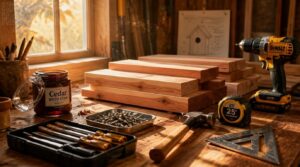
Before any sawdust flies, round up your Essential Toolkits and supplies. Good prep saves headaches later!
You’ll need:
- Screwdriver set, hammer, and drill
- Tape measure and carpenter’s square for Measuring Precision
- Cedar wood, stainless screws, and safety goggles
Untreated cedar or pine works best for Wood Selection. Don’t skimp on Hardware Durability — corrosion-resistant fasteners matter for outdoor owl house plans.
Cut Panels Accurately
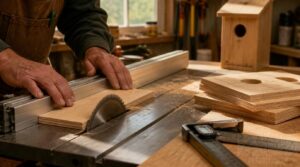
Precision starts here! A sharp, high-quality saw blade keeps edges clean and prevents tearout on your plywood panels.
Before you start cutting boards for owl boxes, brush up on identifying Pennsylvania owl calls so you know which species you’re building for.
Calibrate your saw fence so cuts stay parallel within 0.2mm. Verify squareness with a digital square before you start cutting.
Careful cutting now means your owl nesting box fits together perfectly later — no wobbly walls in your DIY owl house project!
Assemble Walls and Roof
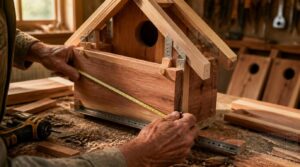
Now the fun part — putting your cut panels together! Before fastening anything, check panel alignment by squaring each piece against the frame and measuring diagonals for warps.
Work corner-to-center, using shims to keep joints flush. For the roof:
- Align rafters with wall top plates
- Add metal connectors for rigid support
- Check corner measurements
- Keep the ridge line straight
Add Drainage Holes
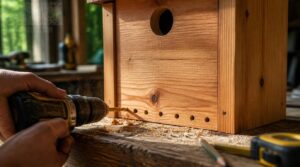
Water doesn’t belong inside an owl nesting box. Drill drainage holes along the lowest edge of the floor, spaced 2 to 3 inches apart, using a good hole diameter of 1/8 to 1/4 inch.
| Step | Purpose |
|---|---|
| Deburr drill edges | Prevents injury |
| Space holes evenly | Moisture control |
| Check monthly | Prevents mold growth |
A weatherproof nesting box keeps chicks dry and healthy!
Install Cleaning Access
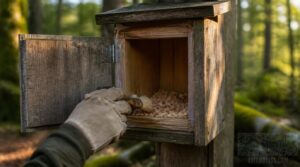
Ever try cleaning a nest box by tearing the whole thing apart? Don’t. Panel placement matters most—put access on the side or rear, centered near nesting height.
Use a corrosion-resistant hinge for durability, and size the opening 4 to 6 inches for easy reach. Add sealant application around edges to block drafts. Simple cleaning mechanisms keep your weatherproof nesting box owl-friendly and low-stress for visitors!
Install Your Owl House Safely
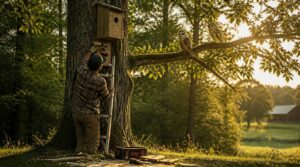
Once your box is built, placement makes all the difference! A few smart choices now will keep your new tenants safe and happy for years. Here’s exactly where and how to hang it right.
Choose Quiet Habitat
Where you place your owl house matters just as much as how you build it. Owls crave calm, quiet corners away from foot traffic and roadways.
Minimizing traffic noise and busy sidewalks boosts occupancy rates. Plant dense buffer vegetation near the entrance to muffle sound and reduce human disturbance. Skip playgrounds and driveways—your cavity dwellers want peace, not commotion, for nesting site selection.
Mount at Proper Height
Height matters as much as habitat. Mount your owl box 10 to 15 feet up for most species, or up to 18 feet in open fields to dodge vandalism. If you’re working with a tighter urban lot, this step-by-step guide to space-saving urban bird house designs offers clever mounting alternatives for balconies and rooftops.
Avoid branch interference by checking clearance overhead. Secure mounting poles deep into the ground, add metal wraps to stop sway, and always use a sturdy ladder—safety first!
Face East or South
Once your box is mounted, direction matters just as much as height. Face the entrance east or south to catch gentle morning warmth while avoiding harsh afternoon sun.
This orientation helps with sunlight thermal regulation, speeds moisture evaporation, and offers real wind exposure mitigation against prevailing gusts—no matter your latitude or climate zone.
Add Predator Guards
Sunlight only protects so much—raccoons and snakes still climb. That’s why predator guards matter for any nesting box.
Ring-style or stove pipe guards block claws and coils without blocking owl access. Choose galvanized steel or heavy-duty polyethylene for decade-long durability. Install guards 6 to 15 feet up, with the lower edge sitting 6 inches below the entrance. Check twice yearly for corrosion, and clean with mild soap.
Avoid Busy Pathways
Even the best owl house plans fall short if you mount your box along a well-worn trail. Pedestrian traffic patterns raise wildlife corridor stress, triggering predator avoidance behaviors that keep owls away entirely.
Quiet corridors show stronger nesting success correlations, so pick spots at least 100 meters from busy paths. Human disturbance mitigation isn’t optional—it’s basic nesting site requirements for cavity dwellers seeking safety!
Owls need quiet corridors far from busy paths—reducing human disturbance is essential to their nesting safety
Top 4 Owl Houses
Not sure where to start shopping? These four owl houses cover different species, sizes, and budgets. Take a look and find the right match for your backyard.
1. UUMENHA Carbonized Cedar Owl Box
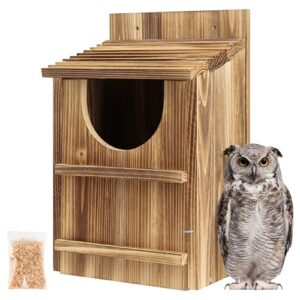
Screech owls will feel right at home in the UUMENHA Carbonized Cedar Owl Box. Its 3-inch entrance hole fits screech owls and similar cavity dwellers perfectly, while keeping bigger predators out.
Built from carbonized cedar, this box resists moisture and skips harmful paint. Top and bottom vents keep temperatures steady, and the quick-assembly kit makes setup a breeze!
At 14.5 × 9 × 7.5 inches and 3.86 lbs, it’s sturdy yet manageable. Included wood shavings give owls a cozy nesting start right away.
| Best For | Backyard wildlife enthusiasts hoping to attract screech owls or similar cavity-nesting birds with an easy-to-install, natural shelter. |
|---|---|
| Material | Cedar wood |
| Entrance Hole Size | 3 inches |
| Assembly Type | Pre-drilled quick assembly |
| Ventilation | Top and bottom vents |
| Target Species | Screech owls |
| Weight | 3.86 lb |
| Additional Features |
|
- Carbonized cedar construction naturally resists moisture and decay without the need for paint
- Quick-assembly kit with pre-drilled holes and included wood shavings make setup and move-in simple
- Top and bottom vents help regulate temperature for a more comfortable nesting environment
- Small screws and pre-drilled holes may not align perfectly, sometimes requiring an extra tool
- Cedar’s softness may limit the box’s durability beyond a single nesting season without reinforcement
- No guarantee of attracting owls, since success depends on location, habitat, and local bird populations
2. Cedar Wood Bird House Set
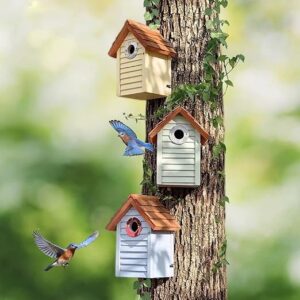
For a rustic touch, the Cedar Wood Bird House Set brings New England charm right to your yard. Its natural cedar construction resists rot and moisture without any chemical treatments, keeping things safe for small nesters.
Ventilation gaps and a sloped roof keep the interior dry and comfortable. A side panel makes cleaning simple, and pre-drilled holes speed up assembly. Just know the included screwdriver runs short-handled, so grab your own tools for a smoother build!
| Best For | Gardeners and families who want an easy DIY project that gives bluebirds, wrens, or squirrels a safe, rustic-looking place to nest. |
|---|---|
| Material | Cedar wood |
| Entrance Hole Size | 1.5 inches |
| Assembly Type | Pre-drilled manual assembly |
| Ventilation | Not specified |
| Target Species | Bluebirds, wrens, squirrels |
| Weight | Not specified |
| Additional Features |
|
- Durable cedar wood construction resists rot and moisture, with a UV coating that helps colors stay vibrant for up to 5 years
- Stainless steel entrance hole guard keeps predators out while protecting inhabitants from sun damage
- Pre-drilled pilot holes and a side cleaning panel make assembly and upkeep quick and simple
- Requires manual assembly, which may not appeal to those wanting a ready-to-use option
- Included screwdriver has a short handle, so a full-size tool is recommended for a smoother build
- Mounting holes may be too small for larger 8 screws, and an extra coat of deck stain may be needed to extend outdoor durability
3. Handmade Wooden Screech Owl House
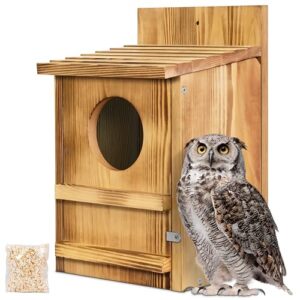
Small but mighty, this handmade option gives cavity dwellers a cozy fit. The round entrance hole, sized 3.75 to 4.25 inches, welcomes screech owls while keeping larger predators out.
Cedar construction offers natural weather resistance, and a smooth-edged opening protects delicate feathers during entry. A short overhang above the hole cuts down on rain intrusion.
The hinged back panel makes cleaning painless each winter. It’s a solid pick for anyone wanting a snug, screech-owl-specific home without sacrificing durability!
| Best For | Homeowners who want a dedicated, snug shelter to attract screech owls for backyard conservation and natural rodent control. |
|---|---|
| Material | Wood |
| Entrance Hole Size | Not specified |
| Assembly Type | Manual assembly |
| Ventilation | Cut corner vents |
| Target Species | Small to medium owls |
| Weight | 5.84 lb |
| Additional Features |
|
- Predator-safe design with a smooth, correctly-sized entrance hole that protects owls while keeping larger animals out
- Durable, weather-resistant thick wood construction built for long-term outdoor use
- Hinged back panel makes seasonal cleaning quick and easy
- Requires manual assembly, and included mounting hardware may feel flimsy to some users
- Entrance size is suited specifically to screech owls, so it won’t accommodate larger owl species
- May occasionally attract squirrels instead of or alongside owls
4. Large Carbonized Barred Owl Nesting Box
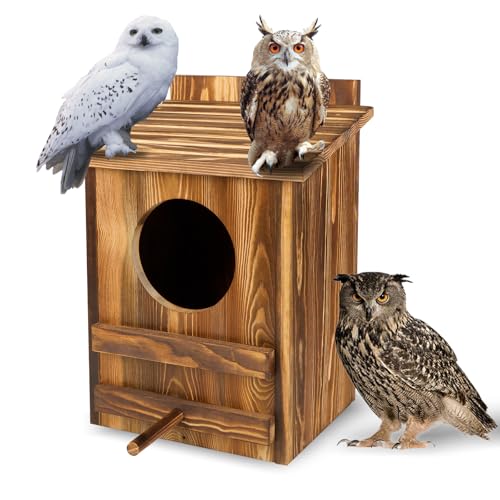
Barred owls need room to grow, and this box delivers with a spacious 15 by 15 inch floor and 23-inch height. That interior cavity keeps siblings comfortable without crowding.
Carbonized cedar resists moisture and fungal growth, while the untreated interior stays safe for sensitive owlets. The 7-inch entrance hole strikes a fair balance, easy for juveniles, tough for predators.
A removable floor panel simplifies winter cleaning. Mount it 20 to 30 feet up, and you’ve got a durable home built for serious cavity dwellers!
| Best For | Homeowners or gardeners looking to attract Barred, Screech, or Barn Owls for natural pest control and backyard biodiversity. |
|---|---|
| Material | Carbonized cedar/pine |
| Entrance Hole Size | 5.1 inches |
| Assembly Type | Pre-drilled quick assembly |
| Ventilation | Side ventilation holes |
| Target Species | Barred, Screech, Barn Owls |
| Weight | 7.56 lb |
| Additional Features |
|
- Carbonized cedar construction resists rot and fungal growth for long-term durability
- Ventilated side holes and a waterproof roof help maintain a dry, comfortable interior
- Comes with pre-drilled holes and a handheld screwdriver for quick, easy assembly
- May need additional sealing, longer screws, or wood glue for extra weatherproofing and stability
- Countersunk roof screw holes can collect water if not monitored
- Uneven mounting surfaces may require wooden shims to keep the box level
Attract and Maintain Nesting Owls
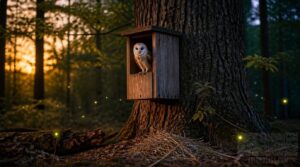
Putting up the box is just the first step toward welcoming these cavity dwellers home. To keep owls coming back year after year, you’ll want to give them the right conditions inside and out. Here are five simple habits that make a real difference.
Add Proper Nesting Material
Nesting material makes the difference between an empty box and a happy nesting pair. Skip synthetic stuffing—it traps moisture and risks suffocation. Instead, offer twigs, dried grasses, pine needles, or untreated wood chips that mimic what’s naturally available nearby.
Rotate materials seasonally, matching Saxony’s local plants and humidity. Keep piles dry to prevent mold, and always avoid dyed paper, treated pet hair, or dryer lint.
Reduce Outdoor Lighting
Bright yard lights can scare owls away fast—these nocturnal hunters prefer dim, quiet spaces. Swap to shielded fixtures that direct light downward, and choose warm LEDs (3000K or lower) instead of harsh blue-white bulbs.
Quick fixes:
- Add motion sensors
- Use photocells for auto shutoff
- Try targeted light distribution
- Install dimmable smart controls
- Go solar for pathways
Small changes make your backyard genuinely owl-friendly!
Provide Nearby Water
Lighting isn’t the only draw—water seals the deal. Reservoir proximity gives owls easy access to amphibians and insects, key prey for cavity dwellers like screech and barred owls.
| Water Feature | Benefit | Season |
|---|---|---|
| Shallow banks | Safe drinking access | Year-round |
| Riparian brush | Cover for prey | Spring-Summer |
| Inlet streams | Extra water points | Wet months |
Good water quality keeps prey webs healthy near your owl box!
Clean During Winter
Once nesting season wraps up, your owl box needs a little TLC. Clean between November and January while owls aren’t actively guarding eggs, and stick to once a month to avoid disturbance.
- Scrape out old debris and soiled bedding
- Check drainage holes for clogs
- Inspect interior corners with a flashlight
- Watch for mold or dampness buildup
Good moisture management keeps your nesting box winter-ready for returning cavity dwellers!
Monitor Unwanted Nesters
Not every visitor to your owl house is welcome. Starlings and woodpeckers often move in before owls get the chance, so check every 3-4 days during nesting season.
Watch for nesting material changes and note occupancy duration. Quick species identification helps you catch displacement early, whether you’re following owl house plans or maintaining existing bird nesting boxes built to proper nesting site requirements.
Frequently Asked Questions (FAQs)
Is there a bird house for owls?
Species-specific designs exist for barn owls, screech owls, and barred owls, offering natural nesting alternatives as habitat loss compensation. Nesting box availability keeps growing, giving cavity dwellers targeted owl housing that meets their unique nesting site requirements perfectly.
Are owl boxes a good idea?
Absolutely, they’re a smart move!
Owl boxes offer natural pest control, easing rodent populations while compensating for habitat loss. A well-placed barn owl nest box helps maintain nature’s balance, giving cavity dwellers safe nesting spots and your yard fewer unwanted visitors.
How high should an owl nest box be?
Too low invites predators, too high blocks maintenance. Best mounting heights run 12-18 feet for barn owls, 10-20 feet for barred owls. Match species height preferences to your habitat, and keep predator access prevention in mind!
How to build a bird house for owls?
Grab essential woodworking tools, choose sustainable cedar or pine, and cut panels with precise measurements. Assemble sturdy walls, add ventilation gaps, weatherproof the exterior sparingly, and install a hinged roof for easy cleaning access later.
What kind of bird house do owls like?
Like a good pair of shoes, it’s got to fit! Owls want nesting box requirements matching their size, quiet natural habitat mimicry, sturdy predator avoidance design, and proper climate insulation—identify your local species first, then build accordingly.
How to attract an owl to an owl house?
Owls seek out natural prey abundance, quiet habitat connectivity, and darkness.
Reduce lighting, limit human disturbance near the nesting box, and let local rodent populations thrive—your yard becomes an irresistible hunting ground for cavity dwellers seeking shelter and food nearby!
Where is the best place to put an owl house?
Pick a quiet, low-traffic spot with clear flight paths and predator concealment nearby. Avoid power lines and busy areas.
Face the entrance east or south, matching local climate patterns, to keep nesting boxes cozy and attract owls naturally!
Will owls use an owl house?
Yes—if you build it like the medieval falconers once did, minus the gauntlet! Occupancy success depends on habitat suitability, prey availability, and low competition. Cavity dwellers readily settle into well-placed nesting boxes when human activity stays minimal nearby.
How long does it take for owls to move in?
Give it a few weeks to a full season! Prey availability and quiet habitat selection speed things up, while courtship timing during nesting season affects occupancy delays. A well-placed nesting box near food sources helps attract owls to your backyard faster.
Are owl houses safe for other backyard wildlife?
Fewer rodents around means safer conditions for everything else, too. With predator guards, no exterior perches, and untreated wood, boxes protect non-target species while keeping songbird competition and chemical exposure low across your whole avian habitat.
Conclusion
A hollow tree takes decades to grow, but your hands can replace one in a single weekend. That’s the quiet power behind a bird house for owls—it turns loss into welcome.
Choose the right size, mount it high, guard it from predators, and you’ll hand a family of hunters a true home. Then step back, watch, and listen.
Fewer rodents, more magic—that’s a legacy worth building, one box at a time.
- https://efotg.sc.egov.usda.gov/api/CPSFile/6050/649_FL_OTH_Structures_for_Wildlife-Nest_Den_Boxes_Sp
- https://www.barnowltrust.org.uk/barn-owl-nestbox/owl-boxes-for-trees
- https://www.audubon.org/news/how-build-screech-owl-nest-box
- https://www.birds.cornell.edu/k12/educators-guide-to-nest-boxes
- http://www.carriep.org/nest-box-sizes-and-placement