This site is supported by our readers. We may earn a commission, at no cost to you, if you purchase through links.
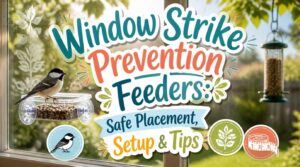
Nearly a billion birds die each year in the U.S. from window collisions, and your feeder might be the reason one hits your glass. That thump against the window isn’t random—it’s physics. A bird flying at full speed sees open sky in your reflection, not a barrier, and glass never gives an inch on impact.
Feeder placement decides whether that collision proves fatal or harmless. Get the distance wrong, and you’re setting up a high-risk impact zone right where birds gather to eat. Get it right, and the same feeder that draws them in also keeps them safe.
That’s where window strike prevention feeders come in—smart placement, the right hardware, and a few window treatments turn your backyard from a hazard into a genuine sanctuary.
Table Of Contents
Key Takeaways
- Feeder placement distance determines collision severity, since birds hitting glass within three feet can’t build the momentum needed for a fatal impact, while distances beyond thirty feet give them enough reaction time to spot and avoid the glass.
- The 3-to-10-foot range is the most dangerous because it lets birds gain speed without giving them enough distance to recognize the glass and correct course.
- Breaking up window reflections with decals spaced four inches apart, tape grids, external screens, paracord barriers, or one-way films stops birds from mistaking glass for open sky.
- A stunned bird faces serious predator risk in the minutes after a strike, so placing it in a quiet, dark container and contacting a licensed wildlife rehabilitator if it doesn’t improve within an hour gives it the best chance of survival.
Why Feeders Trigger Window Strikes
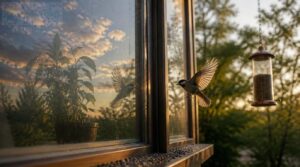
Your feeder isn’t the problem—what’s happening on the glass next to it is. Birds see sky, clouds, or your houseplants reflected back and think they’re flying into open space, not toward a hard surface. Here’s what’s really going on every time a bird hits your window.
The good news is that a well-placed window-mounted bird feeder can actually reduce these collisions by breaking up the reflective illusion right where birds tend to approach.
Reflections and Habitat Illusions
Ever wonder why a bird dive-bombs a window on a perfectly clear day? Glass often creates sky reflection confusion, doubling trees and clouds into a false, open flight path.
This habitat illusion shifts with the seasons — afternoon sun intensifies reflections, deepening perceived habitat depth.
Birds simply can’t parse real space from mirrored space, which is exactly why smart bird strike prevention starts with spotting these shifting illusion zones near your feeder.
Indoor Plants Near Glass
That houseplant on your sill isn’t just decor — it’s bait. Glass transmits light while reflecting glare, and a leafy fern behind it reads as real habitat to a bird racing past.
Light intensity shifts and reflective growth patterns make the illusion worse at certain hours, tricking birds mid-flight. Bird feeder distance from window matters even more when plants are staged nearby, compounding the confusion that leads to strikes.
Speed and Impact Force
Speed turns a startled flutter into a disaster, thanks to basic physics. Kinetic energy scales with speed squared — doubling flight speed quadruples collision force on impact.
That’s why a bird cruising at full tilt toward a feeder hits glass with brutal momentum transfer, especially when contact time is short. Rigid glass offers zero energy absorption, making even modest speeds lethal at close range. On top of that, the force of impact is heavily influenced by the bird’s mass.
Stunned Bird Predator Risk
Surviving the crash is only half the battle. A stunned songbird sitting on the ground enters a predator ambush window — disoriented, wings drooped, unable to flee. Opportunistic predators, from neighborhood cats to hawks, key in on this vulnerability fast.
A stunned bird on the ground, disoriented and unable to flee, becomes easy prey in the crucial minutes after a window strike
Post-collision survival depends on those first minutes. If you find an injured raptor or stunned bird, contact wildlife rehabilitation before nature takes its course.
Safest Feeder Placement Distances
Where you place a feeder matters just as much as how you place it. Distance changes everything, from the speed a bird builds up to whether it even sees the glass coming. Here’s how to map out your yard for the safest setup.
Within Three Feet
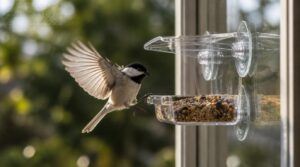
Here’s the trick: put your feeder practically on the glass, and physics works in your favor. A window bird feeder mounted within three feet means birds can’t build lethal momentum before landing.
Pair that close-range feeder with a couple more spread around your yard, since attracting birds across different climates often means adjusting placement and food type to suit local species.
Suction-cup feeders offer visual depth cues, so birds judge distance accurately instead of mistaking reflections for open sky. Low-speed approaches turn potential disasters into gentle, predictable landings—no dangerous impact force involved.
Avoid Three-to-ten-foot Zone
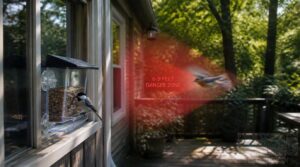
Six to nine feet away feels safer than right next to the glass—but that’s exactly the problem. This gap gives birds just enough room to build speed, yet not enough to spot the glass and correct course.
It’s the danger zone in the 3-foot-30-foot rule, where depth perception errors peak and window strikes happen most often.
Skip it entirely.
Beyond Thirty Feet

Past thirty feet, birds finally get what they need most: reaction time. At this bird feeder distance from window, approach speed drops enough for accurate depth perception, cutting collision risk dramatically.
Think of it like a geographic boundary—similar to how a longitude barrier shapes territory, this distance line separates safety from danger. That’s the 3foot30foot rule in action: real collision mitigation, not guesswork.
Space Feeders Eight Feet Apart

One window bird feeder is fine—two side by side is a setup for trouble. Spacing feeders eight feet apart gives birds side approach visibility instead of a straight shot at glass, cutting mirrored reflections and distributing bird activity across your yard.
This isn’t guesswork; it’s collision mitigation woven right into your backyard layout planning, pairing naturally with the 3foot30foot rule for real bird collision prevention.
Reduce Flocking Congestion
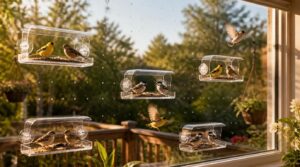
Ever watch a dozen finches mob a single perch? That’s a bottleneck waiting to happen. Dispersing perching opportunities across multiple window feeders eases the crush, reducing bird crowding and panicked launches toward glass.
Managing feeding traffic means thinking beyond one station—spread your bird feeding stations, vary heights, and give every visitor room to land without a mid-air scramble. Calmer flocks mean fewer collisions.
Best Window-Mounted Feeders
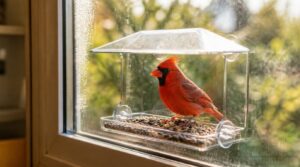
Here’s a trick that sounds backwards but works: putting a feeder right on the glass is often safer than keeping it a few feet away. When there’s no room to build up speed, there’s no room for disaster. So let’s look at the window-mounted options that actually earn a spot on your glass.
Suction-cup Seed Feeders
Suction-cup feeders solve the collision-avoidance puzzle by putting the object right where a bird can see it, no glass to misjudge.
- Load capacity: most hold up to 1.5 kg on four evenly spaced cups
- Silicone seals: check weekly, especially after rain or heat swings
- UV-stable materials resist cracking, extending suction cup durability for years
Clean, dry glass keeps the seal — and the bird — secure.
Acrylic Tray Feeders
Acrylic tray feeders give you a clear view of your visitors while doing double duty for collision avoidance.
Trays drain well, resist yellowing, and hold 1-2 pounds of seed. Mount with suction cups rated for 3+ pounds — same principle as suction-cup feeders.
Clean sides show mold or spoiled seed instantly, so monitoring seed levels and cleaning methods stay easy, and mounting strength keeps everything put.
Window Hummingbird Feeders
Hummingbirds size up glass before they commit, pausing to inspect reflections that mirror flowers nearby. Window feeders solve this by giving them something real to land on.
Look for flower shaped ports, gasketed anti-leak seals, and UV-stable polycarbonate that won’t yellow. Reliable suction cups hold through gusty afternoons, keeping your feeder from becoming another window strike statistic.
Heavy-duty Mounting Options
Bigger feeders need real hardware, not just suction cups. Use corrosion resistant brackets with lag bolts into studs, or masonry anchors for brick walls.
- Stainless brackets for salt exposure
- Dual anchor points for stability
- Vibration dampening hardware for gusts
- Weatherproof mounting seals against moisture
Proper load distribution keeps heavy feeders secure, protecting your window feeder and preventing dangerous collapses near glass.
Stable Feeder Placement
Wait, let me re-evaluate the grouping for better flow.
Sentence 1 & 2 are about placement.
Sentence 3 is about visibility.
Sentence 4 is about safety/distance.
Once mounted securely, think about how the feeder sits day to day. Windward placement cuts feed spillage and keeps suction-cup feeders from rattling loose in gusts.
Set feeder height where you can watch clearly, minimizing animal glare and optimizing sight lines. Keeping bird feeder distance from window stable, alongside solid anchoring, makes your setup genuinely bird-safe against window strikes.
Window Treatments Near Feeders
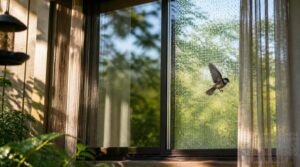
Good placement only solves half the problem—your glass still needs to stop reflecting sky and trees like an open flight path. That’s where window treatments come in, breaking up the mirror effect before a bird ever gets close.
Here are five options worth adding to your setup, from simple screens to science-backed films.
External Window Screens
External window screens act like a cushion, absorbing impact instead of letting a bird hit hard glass.
Mesh made from fiberglass or aluminum lasts 10 to 20 years, resisting UV rays and weathering. Screens also cut solar heat by up to 60%.
Mounted with screws or magnetic fasteners, they’re simple to clean and remove—one of the most reliable bird safety measures you can install.
Bird-safe Decal Spacing
Four inches is the magic number — space window decals no more than 4 inches apart, both directions, or birds will still try to thread the gap.
Dots and small squares beat single motifs for the best pattern density. Apply them outside, since exterior placement holds up better and reads clearer to birds. UV reflective options add collision deterrence without changing your view — a smart, birdsafe upgrade.
Tape Grid Patterns
Grids work like a lattice, breaking reflections into pieces birds can actually read. Standard spacing sits at 3 inches, though tighter 2-inch lines help most in high-glare conditions.
Choose durable vinyl or polyester tape — clear options stay unobtrusive while still cutting glare. Clean glass first, use a level for straight lines, and expect to replace tape after 6-12 months as weather takes its toll.
Paracord Curtain Barriers
Ever seen a curtain of cord stop a bird cold—without a single strike? That’s paracord barriers at work.
Type III paracord (550-lb strength) forms a grid pattern with buried knots and proper tensioning methods for zero sag. Why it works:
- Visual deterrent birds instantly recognize
- UV-resistant nylon survives seasons outdoors
- Adjustable width, any window
- Removable for cleaning—no damage
Exterior hardware keeps it taut, preventing collisions reliably.
One-way Reflection Films
Picture your window turning into a mirror by day—that’s the magic of one-way films. Light differential mechanics drive it: when outside brightness exceeds interior light, the reflective coating dominates, creating a strong visual deterrent that prevents bird mortality.
Watch for mirror effect reversal at night, though—dim interiors flip the glass transparent. Quality coatings resist yellowing and often block harmful UV rays too.
Feeder Planning for New Homes

Moving into a new house gives you a rare head start most bird lovers never get. Instead of fixing window strikes after the fact, you can plan your yard around bird safety from day one. Here’s what to think through before you plant a single shrub or hang a single feeder.
Bird-safe Window Locations
Building a new house or picking your first home with birds in mind? Look at glass exposure before you fall for granite countertops.
Avoid south- and west-facing walls with heavy tree reflections nearby—sun glare peaks there in early morning and late afternoon. Skip lots with water features close to windows, too. Both create reflective landscape hazards that birds read as open sky, setting up window collisions before you’ve even hung a feeder.
Feeder Zones Before Landscaping
Sketch your feeder zones before the shovel ever hits dirt. Establish sight lines from your main windows, then mark safe distances—beyond 30 feet, or tight against the glass—before planting a single shrub.
Plan pathways, shade, and a nearby water source together. Early zone planning saves you from ripping out landscaping later, and it sets your yard up as a genuinely bird-safe habitat from day one.
Avoid Reflective Glass Corridors
Glass corridors—stretches where windows line up back-to-back—create mirror image illusions that double the trouble, reflecting sky and foliage across several panes at once. Birds read these as continuous habitat, not obstacles.
Walk your site before building. Where glass faces glass, or trees mirror endlessly, you’ve got sky reflection hazards stacking up. Choose staggered window placement instead, and you’ll cut collision risk before construction even starts.
Plan Screens and Barriers
Staggered windows solve half the puzzle—external screens and visual barriers finish the job. Choose UV resistant materials and corrosion resistant hardware so screens survive years of rain and sun.
Mount barriers 2 to 3 feet above feeder height, match colors with fence lines, and pair window decals for birds with physical preventing measures like mesh screening for a truly bird-friendly architecture.
Safer Backyard Bird Habitats
A truly safe backyard blends native plant selection with smart feeder placement, not just glass fixes. Native shrubs offer natural shelter and food, easing feeder dependence.
Add a safe water feature away from predator corridors, and adjust plantings seasonally.
That’s how backyard birding becomes real habitat management, not just window-strike prevention—giving birds year-round refuge, not just a safer pane of glass.
Frequently Asked Questions (FAQs)
What should I do with a stunned bird?
Give the bird a fighting chance: place it gently in a quiet, dark container, wear gloves, avoid food or water, and monitor recovery signs closely. If no improvement within an hour, contact a licensed wildlife rehabilitator for proper avian trauma care.
How often should I check on a recovering bird?
Check twice daily for the first 48 hours, watching breathing and alertness. If stable, drop to once or twice daily, spacing to every 12 hours. Weakness or confusion means checking every 4–6 hours, and contacting a licensed wildlife rehabber if there’s no improvement within 48 hours.
When is it safe to release a recovered bird?
Release once the bird flies confidently for 30+ seconds straight, shows steady takeoffs, and eats normally. Pick mild 50-75°F weather, morning hours, and a familiar site—then watch quietly for 15-30 minutes before walking away.
What supplies help safely handle an injured raptor?
Thick leather gloves and safety glasses shield you from talons and beak strikes.
Use a ventilated, absorbent-lined carrier, move slowly, and contact a licensed wildlife rehabilitator promptly—proper avian injury recovery starts with calm, careful handling that protects both you and the bird’s feathers.
Who should I contact for wildlife rehabilitation help?
Your local rehab center is a lifesaver — literally. State wildlife agencies and national directories can point you to a licensed wildlife rehabilitator nearby; for life-threatening injuries, call emergency services first for proper avian injury recovery protocols.
Conclusion
A feeder is only as safe as the glass standing behind it. Move yours inside three feet or past thirty feet, and that same window turns invisible to a bird moving forty miles an hour.
Window strike prevention feeders work because they respect physics, not luck. Add decals, screens, or angled placement, and you’ve turned a killing zone into a dinner table. Your backyard can feed birds without ever costing one its life.
- https://www.birdsavers.com
- https://www.audubon.org/magazine/think-you-have-bird-friendly-backyard-think-again
- https://birdsconnectsea.org/our-work/urban-conservation/bird-safe-cities/preventing-bird-window-collisions
- https://www.allaboutbirds.org/news/why-birds-hit-windows-and-how-you-can-help-prevent-it
- https://www.fws.gov/library/collections/bird-friendly-home-toolkit