This site is supported by our readers. We may earn a commission, at no cost to you, if you purchase through links.
A Northern Cardinal’s song carries up to a quarter-mile through dense forest—a biological broadcast system refined over millions of years. Birds communicate across frequencies we’re only beginning to decode, navigate thousands of miles without GPS, and adapt to environments from Arctic tundra to tropical rainforests.
Yet nearly three billion North American birds have vanished since 1970, a decline that’s reshaping ecosystems in ways scientists are still unraveling. Your ability to identify species, understand their behaviors, and recognize threats directly influences conservation outcomes.
This bird information guide translates complex ornithological research into practical knowledge you can use—whether you’re tracking migration patterns in your backyard or contributing data that shapes habitat protection policies.
Table Of Contents
Key Takeaways
- North America has lost nearly 3 billion birds since 1970—a 29% decline driven by habitat destruction, climate change, pesticide use, and collision risks that demand immediate conservation action.
- Your ability to identify species through vocalizations, feeding behaviors, and migration patterns directly translates into citizen science contributions that shape habitat protection policies and conservation outcomes.
- Birds like Blue Jays and Great Horned Owls demonstrate remarkable cognitive abilities and adaptability, with tool use, vocal mimicry, and hunting strategies that challenge traditional assumptions about avian intelligence.
- Citizen science initiatives such as the Great Backyard Bird Count have generated over 2 billion bird sightings, creating data-driven conservation analytics that inform species protection decisions at unprecedented scales.
Key Bird Species and Characteristics
You’ll find some of North America’s most recognizable birds right in your backyard or nearby woodlands. Each species brings something distinct to the table—whether it’s striking plumage, unique vocalizations, or exceptional hunting skills.
Here’s a closer look at six key birds that define the continent’s avian landscape.
Northern Cardinal – Range and Identification
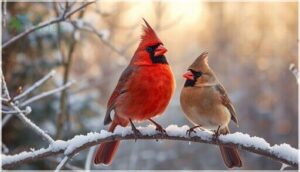
You’ll find Northern Cardinals across the eastern two-thirds of North America—about 110 million strong from Texas to New England. Males flash vivid red plumage with black masks, while females wear warm browns tinged with russet. Both sexes sport that unmistakable thick bill and pointed crest.
Listen for their clear whistled songs year-round; unlike many species, cardinals don’t migrate, anchoring themselves to their territories through every season. The Northern Cardinals’ year-round presence is attributed to their adaptability to various breeding bird habitats.
Barred Owl – Behavior and Activity Patterns

Barred Owls break the nocturnal mold you’d expect from their kind. While they hunt primarily at night, you’ll catch them calling and foraging during daylight hours too. Their space use shifts dramatically—urban studies in Louisiana show nocturnal home ranges expand to four times their daytime roosts.
Watch for these diel activity patterns:
- Peak territorial calling occurs late March through April before egg-laying
- Autumn vocal surges coincide with juvenile dispersal
- Foraging behavior concentrates at forest edges and open understory
- Radio-telemetry reveals roughly 1-square-mile annual ranges in Michigan
- Prey composition runs 76% mammals, with flying squirrels delivering substantial biomass
Their adaptability challenges traditional assumptions about strictly nocturnal hunting in owl species. Understanding the full diel cycle research is vital for effective conservation efforts.
Blue Jay – Intelligence and Adaptability

Blue Jays shatter expectations when you look beyond their loud, colorful reputation. You’re watching corvids whose forebrain neuron density rivals primates—they’ve mastered tool usage in captivity, raking food with newspaper strips, and field reports from 2025 confirmed the first wild tool-use observation. Their cognitive abilities extend to vocal mimicry, perfectly imitating hawk calls to clear feeding stations.
Consider their ecological fingerprint:
| Cognitive Domain | Observed Behavior |
|---|---|
| Problem Solving | High success in mechanical tasks |
| Social Learning | Hawk-call mimicry varies by experience |
| Dietary Flexibility | Omnivorous exploitation of mast crops |
| Seed Dispersal | Cache acorns across habitat gaps |
Your backyard visitor doubles as an ecosystem engineer, transporting oak seeds that shape forest regeneration patterns across fragmented landscapes.
Red-tailed Hawk – Distribution and Physical Traits
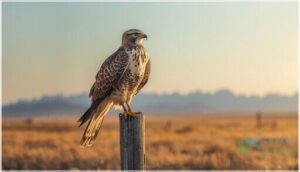
While jays tinker with tools, you’ll find the Red-tailed Hawk commanding airspace from Alaska’s interior down through Panama—Buteo jamaicensis spans the Americas like no other raptor. Females outweigh males by 25%, packing up to 1,470 grams into 52-inch wingspans built for graceful soaring.
- Rufous tails blazing against winter skies, signaling adult plumage
- Roadside poles transformed into hunting thrones across open grasslands
- Juvenile confusion—brown-banded tails that won’t flush red until year two
- Desert cliffs to agricultural edges, morphs shifting light to dark westward
Hawk migration corridors pulse with these adaptable predators whose habitat flexibility secures their conservation status as North America’s most widespread large hawk—3.1 million strong across fragmented landscapes where species diversity hinges on such resilient generalists.
Great Horned Owl – Hunting and Range
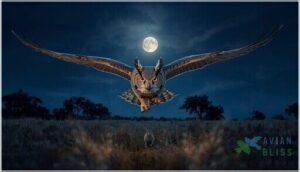
You’ll witness Bubo virginianus ruling nearly every habitat from Alaska’s boreal forests to Argentine grasslands—its Great Horned Owl mastery spans deserts, wetlands, and suburban edges wherever scattered perches support ambush hunts.
Territorial pairs defend 2 to 16 square kilometers year-round, with peak Hunting Tactics unfolding 20:30 to midnight as silent wings carry them 90 meters from elevated roosts toward Prey Selection dominated by rabbits, voles, and skunks.
Conservation Status remains stable across this dominant predator’s continental Wildlife Conservation stronghold.
House Finch, Gray Catbird, Mourning Dove – Notable Features

You’ll spot Haemorhous mexicanus males by their rosy breast wash—spanning 16–27 g and 20–25 cm wingspans—while females wear streaked gray-brown across both surfaces.
Gray Catbird vocalizations deliver 435 elements per male in marathon song bouts reaching 9.5 kHz.
Mourning Doves stretch 23–34 cm with white-edged tails and subtle feather coloration differences: males show pinkish chests, females duller tones—classic dove nesting habits favor open-country perches where their pointed silhouettes define backyard ornithology.
Bird Habitats and Global Distribution

Birds don’t respect borders the way we do—they spread across continents, settle into specific corners of the world, and sometimes stake claims on remote islands where evolution takes wild turns.
Understanding where different species live and why they end up there reveals patterns you won’t find in any field guide’s range map alone. Let’s break down the forces and geographies that shape bird distribution across the planet.
Regional Habitats of Popular Birds
Have you ever wondered why you’ll find a Northern Cardinal thriving at a woodland edge but rarely deep in old-growth forest? Each bird species carves out its niche in the landscape, responding to habitat structure in remarkably predictable ways.
Here’s where you’ll encounter some of North America’s most familiar species:
- Northern Cardinal – Woodland edges, thickets, shrubby second-growth, and riparian corridors across the eastern and central United States
- Blue Jay – Eastern backyards, woodlots, and forest margins where intelligence meets adaptability
- Barred Owl – Southern swamps and mature forest ecosystems with dense canopy cover
- Mourning Dove – Agricultural fields, grasslands, suburbs, and open country from coast to coast
- Grassland birds and wetland conservation zones – Open farmland, coastal habitats, and urban landscapes with scattered shrubs
Understanding these patterns unlocks your ability to predict where species will appear and why certain areas harbor greater diversity than others.
Country-Level Bird Species Diversity
Which countries hold the crown for avian biodiversity? Colombia leads globally with roughly 1,917–1,958 bird species—nearly 18% of all species richness worldwide. Peru and Brazil follow closely, each supporting over 1,800 species, while Indonesia dominates outside the Americas with approximately 1,791 species.
These biodiversity hotspots reveal where habitat quality and conservation efforts matter most for protecting endemic birds and supporting wildlife ecology across migration routes.
Island Endemism in Southeast Asia
Why does Southeast Asia harbor such remarkable island biodiversity? The region hosts roughly 2,630 bird species, with about 871 endemics—one-third showing species endemism shaped by habitat fragmentation across thousands of islands.
- Indonesia’s 542 endemic birds rank among the highest globally for conservation status urgency
- Wallacea’s 249 endemic species face regional extinction from habitat loss and the Asian songbird crisis
- Borneo’s 61 montane endemics demand targeted bird conservation across altitudinal zones
- Sulawesi’s maleo exemplifies flagship species requiring ecological conservation action
- Wildlife ecology research reveals trapping pressures threaten range-restricted songbirds despite conservation efforts
Factors Shaping Bird Ranges
What determines where you’ll find a cardinal versus a catbird? Climate change drives range shifts—nearly 96% of northern European species have moved or changed occupancy.
Habitat fragmentation cuts populations by 22–45% in some forests, while species interactions limit elevational ranges in tropical mountains.
Bird migration strategies, biotic pressures, and habitat destruction continuously reshape ecological balance, forcing species to adapt or retreat from once-suitable territories.
Bird Behavior and Identification Techniques
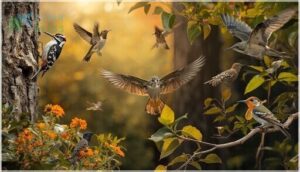
You can’t truly know a bird until you understand how it moves through the world. Each species carries its own signature—whether that’s a distinctive call echoing through the forest, a specialized feeding technique honed over millennia, or an epic migration that defies explanation.
Let’s break down the key behavioral traits and identification methods that’ll help you recognize birds in the field with confidence.
Vocalizations and Songs
You’ll discover new worlds when you understand bird song evolution and vocal learning. Most avian research shows that bird sounds fall between 1,000 and 8,000 Hz—perfect for acoustic properties analysis and bird identification techniques.
The dawn chorus starts 30 to 60 minutes before sunrise, offering prime bird watching and observation opportunities.
Frequency analysis reveals that fewer than half of 10,000 species are vocal learners, transforming how ornithological research approaches communication.
Feeding Habits and Adaptations
You’ll recognize birds faster when you understand their feeding guilds—insectivores, frugivores, granivores, nectarivores, omnivores, and carnivores each reveal distinct beak adaptations and foraging strategies.
Watch how hummingbirds with shorter wings defend nectar territories while longer-winged species trapline between flowers, minimizing energy expenditure.
New Caledonian crows break the mold entirely: their precision bills let them wield tools, extracting hidden prey that redefines avian ecology and bird identification techniques.
Migration Patterns and Strategies
You’ll see migration routes split into complete and partial strategies—about 61% of North American species you track show partial migration, where some individuals stay put while others journey thousands of miles.
Watch how Hudsonian Godwits master nonstop flights lasting six days from Chile northward, refueling at critical stopover sites that demand your protection as habitat loss threatens these ancient avian ecology patterns.
Visual Identification Tips
Catching fleeting glimpses means you’ll rely on field marks—those eye rings, wing bars, and tail spots that separate lookalikes when color fools you in backlight. Master bird silhouettes first, then layer in plumage patterns and visual cues.
Remember:
- Shape trumps color when distance blurs details
- Binoculars reveal what naked eyes miss in wildlife identification
- Quick sketches lock memory before consulting guides
That’s bird ID freedom—reading feathers like a field ornithology research veteran.
Conservation Status and Threats

You can’t protect what you don’t understand is threatened. Right now, bird populations worldwide are facing serious pressure, and the numbers tell a sobering story.
Let’s break down what’s driving these declines and why habitat loss sits at the center of the crisis.
Causes of Population Decline
You’re watching bird populations freefall—North America alone has lost nearly 3 billion birds since 1970, a staggering 29% drop. Climate change, pesticide use, and collision risks from windows are among the key drivers of this decline. Human activities, including habitat conversion, cat predation, and fragmentation, further exacerbate the problem, particularly in grasslands, deserts, and coastal areas. As these threats compound, the conservation status of many species worsens, underscoring the urgent need for wildlife conservation and species protection.
North America has lost nearly 3 billion birds since 1970—a 29% freefall driven by climate change, pesticides, collisions, habitat loss, and predation
| Threat Category | Primary Impact | Annual Mortality/Effect |
|---|---|---|
| Climate Change | Range contraction, water loss | Threatens 1/6 of species |
| Pesticide Use | Prey base collapse, toxicity | Grassland birds down 53% |
| Collision Risks | Window/building strikes | ~600 million deaths/year |
| Cat Predation | Direct mortality | 1–4 billion deaths/year |
| Habitat Loss | Conversion, fragmentation | 2.9 billion birds lost |
Environmental impact intensifies as these pressures interact, creating a dire situation where half of all bird species are in decline. Habitat preservation and conservation efforts cannot wait, as the interconnected nature of these threats demands immediate and comprehensive action.
Habitat Loss and Degradation
Across forests, grasslands, and wetlands, habitat destruction is driving species toward oblivion—you’re witnessing a planet-wide unraveling. Forest fragmentation severs wildlife corridors, disrupting ecosystems and pushing specialists to the brink.
- North American grassland birds lost 53% of their population since 1970 through conversion alone
- Below 30% forest cover, 18 habitat-dependent species vanish entirely
- Shorebird numbers dropped 33% as coastal wetlands disappeared
Environmental impact demands immediate conservation efforts focused on habitat preservation and wildlife management practices.
Bird Research, Education, and Citizen Science

You don’t need a PhD to contribute to bird science anymore. From online tutorials that sharpen your identification skills to global counts where your backyard observations join millions of others, the doors are wide open.
Here’s how you can learn, participate, and help shape what humanity knows about birds worldwide.
Online Bird Guides and Tutorials
You’ll find a revolution in bird identification unfolding at your fingertips. Online courses from Cornell Lab of Ornithology’s Bird Academy have drawn over 238,000 learners, while All About Birds and digital field guides provide instant species tracking through apps like BirdNET.
These wildlife education platforms blend videos, quizzes, and conservation tools—equipping you to master identification skills that once required years of fieldwork.
Citizen Science Initiatives (e.g., Great Backyard Bird Count)
You can join half a million birders who transform observation into conservation action through projects like the Great Backyard Bird Count, which documented 1,086 species across India in 2025 alone.
Cornell Lab initiatives—Project FeederWatch and NestWatch—engage citizen participation in bird surveys that inform conservation status assessments and species mapping.
Your checklists become data analysis fuel, expanding spatial coverage beyond traditional methods and directly supporting conservation efforts for at-risk populations.
Data Collection and Its Impact on Research
You’re contributing to a data revolution—over 2 billion bird sightings now power conservation analytics and drive wildlife conservation efforts at scales ornithologists once thought impossible.
Your observations fuel research methods that shape ecological conservation and sustainability:
- Species tracking systems integrate 20 years of community records covering nearly 9,000 bird species for avian research and study
- Data quality standards using completeness thresholds identify well-surveyed areas and guide future bird surveys
- Environmental science models now incorporate detection probability corrections, improving accuracy in ornithological research and conservation decisions
Frequently Asked Questions (FAQs)
How do birds navigate during long-distance migration?
You wouldn’t guess it, but migrating birds master a toolkit—magnetic compass, sun navigation, star guidance, olfactory cues, and terrain routing—to cross continents, switching between systems when conditions change mid-flight.
What should I feed wild birds year-round?
You’ll want black oil sunflower seed year-round—it attracts the widest variety and packs serious energy.
Add nyjer, peanuts, and suet in winter when birds need fats for survival and thermoregulation.
How can I attract specific birds to my yard?
Think of your yard as a stage—you set the scene with native plants, water features, and bird feeders offering seasonal foods, and specific species arrive.
Strategic yard layout plus bird-friendly homes create wildlife management practices that transform casual bird watching into targeted feeding success.
When is the best time to watch birds?
You’ll catch the dawn chorus at its peak—one hour before sunrise through 10:00 AM—when bird activity, feeding, and territorial songs intensify.
Migration peaks and favorable weather conditions heighten detection rates dramatically.
How do I identify birds by their flight patterns?
You can identify birds by analyzing wingbeat frequency, flight speed, and soaring techniques. Watch for migration routes during peak seasons, and use bird tracking data to distinguish species by their unique movement patterns aloft.
Conclusion
Every feather on a wing represents a choice—yours to observe, identify, and protect the species sharing your ecosystem. This bird information guide furnishes you with taxonomic precision and behavioral insights that transform casual birdwatching into measurable conservation impact.
Three billion birds won’t return through passive appreciation alone. Your field notes, habitat assessments, and citizen science contributions become the data that redirects policy, restores corridors, and reclaims what extinction has already begun erasing.
- https://www.sciencedaily.com/releases/2016/12/161212133645.htm
- https://www.pnas.org/doi/10.1073/pnas.2023170118
- https://worldrainforests.com/03birds.htm
- https://biodiversitymapping.org/index.php/birds/
- https://figshare.com/articles/dataset/A_global_dataset_of_directional_migration_networks_of_migratory_birds/26162269