This site is supported by our readers. We may earn a commission, at no cost to you, if you purchase through links.
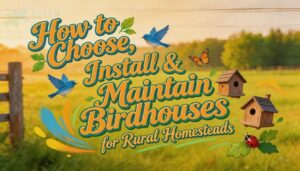
A single bluebird pair will eat roughly 300 insects per day during nesting season—a statistic that reframes birdhouses from decorative extras to working infrastructure on a homestead. Most rural properties already have the habitat birds need: tree lines, fence posts, shrubs, and open pasture.
What they often lack is the right housing in the right place, built from materials that survive years of rain, frost, and summer heat without constant attention. Getting those details right—entrance diameter, wood species, mounting height, predator guards—is the difference between a box that sits empty and one that hosts generation after generation of cavity nesters that keep your garden and orchard in balance.
Table Of Contents
Key Takeaways
- A single bluebird pair eats around 300 insects daily during nesting season, making birdhouses functional pest control tools rather than just decorative additions to your homestead.
- Entrance hole diameter is the single most important spec to get right — a 1½-inch hole invites bluebirds, while anything larger opens the door to unwanted squatters like starlings.
- Placement beats aesthetics every time: mount boxes 5–10 feet high, face entrances away from prevailing wind and harsh sun, and keep territorial species at least 15–25 feet apart.
- Seasonal maintenance — cleaning out old nests, checking for cracks, clearing drainage holes, and refinishing pine surfaces — is what separates a birdhouse that lasts a decade from one that rots after two winters.
Choose Birdhouses for Rural Birds
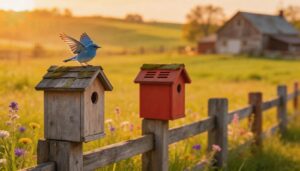
Picking the right birdhouse for a rural homestead isn’t just about what looks good on a fence post — it’s about matching the house to the birds already living on your land. A few key details, like entrance hole size, wood type, and ventilation, make the difference between a house that sits empty and one that gets claimed every spring.
If you’re just getting started, this guide to wooden birdhouse designs for beginners breaks down which features actually matter before you build or buy.
Here’s what to look for before you buy.
Match Entrance Hole Size to Local Species
The entrance hole is where species-specific nesting preferences either succeed or fail. Following standard entrance dimensions helps guarantee that the right species select your birdhouse. Get it wrong and you’ll attract squatters instead of the birds you want.
Use these hole size guidelines for North American birds:
- Chickadees and wrens: 1⅛ inches
- Nuthatches and titmice: 1¼ inches
- Bluebirds: 1½ inches
- Owls: 3 inches or more
Smaller holes naturally handle non-target exclusion by blocking larger, territorial birds.
Choose Cedar, Pine, or Weatherproof Materials
Once you’ve got hole size sorted, material choice is your next big decision.
Cedar is the best option — its natural oil resistance keeps rot and insects at bay for decades without much intervention, and its dimensional stability means fewer warped walls after a wet winter.
Pine and cedar houses both work well, but pine needs sealing to match cedar’s weatherproof construction.
If sustainability credentials and long-term cost efficiency matter to your maintenance cycle, cedar wins.
Look for Ventilation, Drainage, and Clean-out Access
Material choice matters, but a well-built box lives or dies by its internal design.
Ventilation hole size — usually 1 to 2 square inches per side — keeps airflow pathway optimization working on hot days. Drainage channel placement at the floor prevents pooling after rain. A solid cleanout door design makes ease of cleaning straightforward, and weatherproof seal integrity protects the interior between seasons.
Select Natural Finishes That Blend With Homestead Settings
Once you’ve sorted ventilation and drainage, the finish is what ties a birdhouse to its surroundings. Earth Tone Palettes — taupe, sage, charcoal — naturally mirror weathered fencing and barn siding.
Oil-Based Protection penetrates cedar and pine without peeling, while UV-Resistant Stains slow color fading substantially. For a rustic cedar birdhouse or vintage farmhouse birdhouse, Low Luster Coatings and a Reclaimed Wood Look keep things grounded and authentically rural.
Balance Durability, Insulation, and Long-term Value
Thinking long-term changes how you shop for a birdhouse. Cedar and pine with Thermal Break Design and Insulation Layer Integration keep chick temperatures stable across seasons.
Here’s what drives Long-Term ROI:
- Sustainable Sourcing reduces replacement frequency
- Warranty Coverage signals genuine build confidence
- Seasonal durability withstands freeze-thaw cycles
- Weather-resistant finishes protect durable wooden birdhouses for backyard settings
Balance price and quality, and you’ve got a durable and sustainable solution.
Install Birdhouses on Your Homestead
Getting the location right makes all the difference between a birdhouse that sits empty and one that’s busy every spring. Before you grab a hammer, there are a few key placement decisions that will set your homestead up for real success.
Pairing smart placement with the right materials — like cedar, which naturally sheds rot and weather — gives you the best shot at a thriving setup, and this guide to birdhouse installation tips and placement walks you through both.
Here’s what to think about when installing your birdhouses.
Pick Quiet Locations Near Shrubs, Trees, or Fence Lines
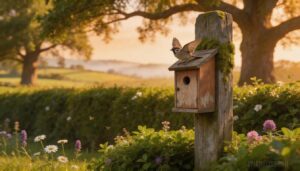
Where you place a birdhouse matters as much as which one you choose.
Shrub microclimate conditions near dense hedges reduce wind exposure and give birds a safe perch to scout before entering. Tree shade benefits keep interior temperatures stable on hot afternoons. Fence line accessibility lets you reach boxes easily for maintenance while using existing posts.
| Location Type | Key Advantage |
|---|---|
| Shrub Edge | Predator cover strategies, insect-rich foraging |
| Tree Line | Natural shade, established flight routes |
| Fence Line | Easy access, reduced ground moisture |
Edge habitat diversity hosts multiple species within the same rural garden aesthetics, strengthening your birdfriendly habitat and contributing meaningfully to habitat conservation.
Mount Houses 5–10 Feet Above Ground
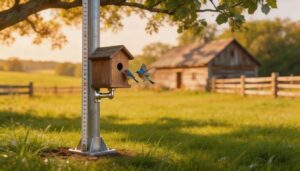
Aim for five to ten feet when deciding on birdhouse placement — that height range hits a sweet spot for predator protection features for nesting boxes, microclimate management, and easy seasonal access.
Pole material choice matters here too; galvanized steel with a stability base design keeps things steady on uneven ground.
Swivel mounting via a bird house mounting bracket lets you reposition entrances without pulling the whole setup down.
Face Entrances Away From Prevailing Wind and Harsh Sun
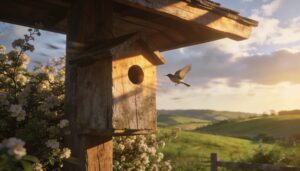
Wind and sun are two forces that quietly determine whether your birds settle in or skip your setup entirely. Leeward Orientation keeps entrances shielded from prevailing gusts, while a Sun Blocking Overhang or Shade Canopy Design prevents midday heat buildup inside the cavity.
- Entrance Tilt Angle deflects debris and gusts inward
- Windbreak Placement using shrubs calms airflow by up to 40%
- Face openings away from southwest sun exposure
- Roof overhang shields without blocking entry
- Seasonal placement and location strategies shift with local wind patterns
Space Birdhouses for Territorial Species
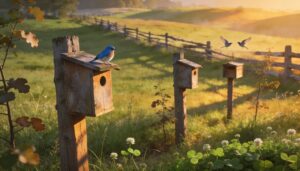
Birds are fiercely territorial, and crowding their houses invites constant conflict.
Territorial Spacing Guidelines recommend keeping boxes 15 to 25 feet apart for most cavity nesters, with Species-Specific Spacing pushing that to 40–60 feet for owls or woodpeckers.
Cluster Orientation Strategies, using staggered entrance angles, reduce line-of-sight battles, while Adjacency Conflict Mitigation through natural wood construction and vegetation buffers keeps neighboring pairs from fighting rather than nesting.
Add Predator Guards and Sparrow Deterrents
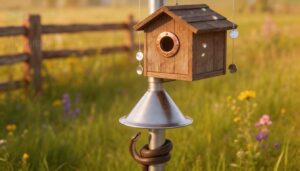
Even the best-placed birdhouse fails if predators reach it first. A pole-mounted predator guard — metal or heavy plastic — stops raccoons and snakes before they climb within striking distance.
A pole-mounted predator guard stops raccoons and snakes before they ever reach your birdhouse
Baffle Placement Height matters: install squirrel guards for bird houses 5–8 feet up. Your three-layer defense:
- Predator Guard Materials — smooth metal or coated plastic resists gripping and chewing
- Mesh Barrier Sizing and Metal Portal Protectors — copper portal protectors or zinc-coated steel limit entrance size, blocking sparrows and larger intruders
- Reflective Deterrent Strategies — hang reflective surfaces near entry points to discourage house sparrows without harming them
Run Seasonal Guard Checks twice yearly to catch cracks or misalignment before nesting begins.
Place Birdhouses Near Gardens, Orchards, or Pasture Edges
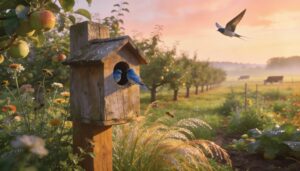
Once your guards are in place, think about where your birds will actually hunt.
Integrating birdhouses into garden spaces, orchard edges, or pasture borders provides real Edge Habitat Benefits — swallows and bluebirds patrol flying insects daily, delivering Pest Control Synergy that no spray can match.
Near water features, occupancy rates climb noticeably. Seasonal Edge Placement near flowering trees also enhances Pollinator Attraction as birds disperse seeds while foraging.
Maintain Birdhouses Year-Round
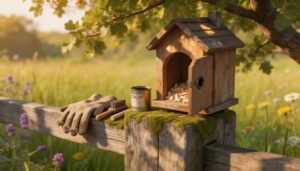
A birdhouse that’s built well can still fail early if it doesn’t get basic attention between seasons.
Cleaning, inspecting, and making small repairs on a regular schedule keep your boxes safe and ready when birds start scouting for nest sites. Here’s what to stay on top of throughout the year.
Clean Boxes After Nesting Season Ends
Once the last fledgling leaves, your Autumn Cleaning Routine begins — and timing it right makes all the difference. September through November is your window.
Open the cleanout door, bag and discard all old nesting material for proper Nest Material Disposal, then use Boiling Water Disinfection to kill lingering mites. These Parasite Removal Techniques protect next year’s tenants.
- Remove old nest material completely
- Pour boiling water over interior surfaces
- Rinse, then air-dry thoroughly
- Reapply Sealant Reapplication on wooden joints
Inspect for Cracks, Loose Hardware, and Rust
After cleaning, run your hands along every panel and joint—this is your Visual Crack Checks moment. Use the Flashlight Shadow Test: hold a light inside and watch for thin lines of daylight appearing through hairline fractures, especially around the entrance hole. Hardware Tightening Tips are straightforward—tap screws gently; anything that rattles needs immediate attention.
| Problem | Where to Check | What to Do |
|---|---|---|
| Hairline cracks | Joints, entrance hole edges | Seal with weather-resistant wood glue |
| Loose screws/hinges | Cleanout door, mounting brackets | Re-drive or replace with stainless steel |
| Surface rust | Metal portal protection rings, nails | Wire-brush, apply rust-inhibiting primer |
| Hinge wobble | Cleanout access panel | Replace hinge; check predator risk |
| Bracket misalignment | Bird House Mounting and Installation | Realign, tighten, recheck after wind |
Rust Prevention Strategies are simple when caught early—orange specks on hardware spread fast into adjacent wood, accelerating rot from the inside out. A Seasonal Inspection Schedule twice yearly, early spring and late fall, keeps durable wooden birdhouses in reliable shape season after season.
Refinish Pine Surfaces for Weather Protection
Once you’ve handled any rust or hardware issues, pine surfaces deserve your attention next. Sand with 120–150 grit to open the grain, then wipe clean before applying a weather-resistant sealant with UV blocking and moisture resistance built in.
Polyurethane works well for your classic pine birdhouse—apply thin coats under good cure conditions, ideally 65–75°F, for lasting seasonal maintenance and protection.
Check Drainage and Ventilation Before Spring
Before nesting season kicks off, a quick drainage and ventilation check can save you a lot of headaches later. Pour water around the base for a simple Water Flow Test and watch how it moves — your Base Slope Evaluation should confirm ground slopes away from the house. Don’t overlook a Moisture Accumulation Check inside, either.
- Clear debris blocking drainage holes and ventilation holes
- Confirm the cleanout door seals without trapping humidity
- Run an Airflow Inspection by feeling for breeze near vents
- Check the Roof Overhang Assessment to make sure rain sheds cleanly
Monitor Occupancy Without Disturbing Nests
Watching what’s happening inside your birdhouses doesn’t mean you have to get close. Camouflaged remote cameras, infrared time-lapse setups, and motion-triggered recording let you track nesting preferences and bird health monitoring without ever opening the cleanout door mid-season. Temperature sensors and data loggers quietly signal occupancy through heat patterns.
Understanding bird species’ nesting needs means respecting their space while still staying informed.
Replace Damaged Parts to Extend Birdhouse Life
When a birdhouse starts showing its age, targeted repairs beat full replacement every time. Swap warped cedar roof boards using corrosion-resistant nails, upgrade rusty hinges to stainless steel hardware, and add metal portal protectors to reduce entrance wear.
Reinforce weak corners with reinforced corner brackets, then seal everything with a non-toxic preservative. Small fixes like these quietly add years of seasonal birdhouse durability and maintenance to every box on your property.
Top 5 Birdhouse Picks
After covering cleaning schedules, inspections, and seasonal upkeep, the next step is knowing which birdhouses are actually worth putting up on your homestead. The options below cover a solid range of materials, styles, and species compatibility — so there’s something useful here whether you’re housing wrens or bluebirds.
Here are five picks worth considering.
1. Storey Birdhouse Building Guide
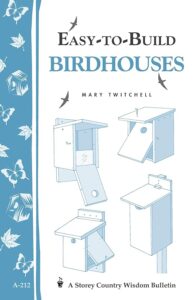
If you’d rather build than buy, the Storey Birdhouse Building Guide is worth keeping on your workbench. For just $4.99, this compact 32-page booklet walks you through six functional designs — including wren houses, wood-duck boxes, and kestrel shelters — each with a tool list, cutting diagram, and mounting guidance.
It also covers material selection and predator-proofing, which makes it genuinely useful for beginners. Fair warning: the content stays basic, and the 1999 publication date means some recommendations may feel dated.
| Best For | Beginner woodworkers and backyard birders who want simple, ready-to-build plans without hunting down designs online. |
|---|---|
| Price | $4.99 |
| Material | Paper/Booklet |
| Weight | 1.59 oz |
| Assembly Required | N/A |
| Cleaning Access | N/A |
| Bird Size Suitability | Multiple species |
| Additional Features |
|
- Covers six different bird species, so you can build for whatever birds are actually in your yard
- Each design comes with a tool list and cutting diagram — no guesswork
- At $4.99, it’s a pretty low-risk buy
- Pretty surface-level stuff; don’t expect deep detail or advanced techniques
- Published in 1999, so some material or hardware advice might be behind the times
- It’s a print-only booklet — no digital version if you’d rather pull it up on a tablet in the shop
2. Cartman Hanging Colorful Wooden Birdhouse
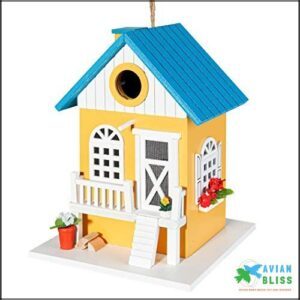
The Cartman Hanging Colorful Wooden Birdhouse ($19.99) punches above its price tag for casual backyard setups. Built from smooth-sanded cedar with stainless steel hardware, it resists moisture and rust without extra effort on your part.
The front hinged door with magnetic closure makes seasonal cleanouts genuinely quick, and the removable mesh nest platform adds a practical layer most budget houses skip. At 7×9×7 inches and just 1.1 pounds, it’s best suited for small songbirds like wrens, finches, and bluebirds.
| Best For | Casual backyard bird lovers, gift-givers, and parents looking for a fun, low-maintenance way to attract small songbirds. |
|---|---|
| Price | $19.99 |
| Material | Cedar Wood |
| Weight | 1.1 lb |
| Assembly Required | No |
| Cleaning Access | Front hinged door |
| Bird Size Suitability | Small to medium |
| Additional Features |
|
- Front hinged door with magnetic closure makes cleanouts fast and easy
- Cedar wood naturally resists insects and moisture — no extra sealing needed out of the box
- Comes fully assembled with hanging hardware, so setup takes minutes
- Lightweight build can sway or tip in strong winds without extra anchoring
- Some buyers have received units with minor damage or unglued pieces on arrival
- Wood will need periodic resealing or repainting to hold up through multiple seasons
3. Wooden Bird House With Pole
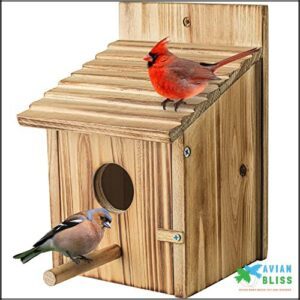
If you want a birdhouse that stays put through wind, rain, and a few curious raccoons, the Wooden Bird House With Pole is worth a close look. The galvanized steel pole holds the box at 5 to 8 feet — right in that sweet spot for small songbirds like chickadees and bluebirds.
Cedar or fir construction resists moisture naturally, and the clean-out door means fall maintenance won’t require tools or frustration.
A stabilizing base stake keeps it upright even on soft garden soil.
| Best For | Backyard gardeners and nature lovers who want to attract small songbirds like finches and bluebirds without spending a lot of time on setup or maintenance. |
|---|---|
| Price | $19.99 |
| Material | Solid Wood |
| Weight | 1.2 lb |
| Assembly Required | No |
| Cleaning Access | Removable side door |
| Bird Size Suitability | Small cavity-nesters |
| Additional Features |
|
- Easy to clean — the side door opens up so you can clear out old nests and get it ready for the next season without any hassle.
- Solid wood build with a weather-resistant finish holds up well through rain and sun, especially if you add a coat of stain.
- Simple to hang — comes with mounting nails and fits on most branches or garden structures right out of the box.
- Some buyers get theirs without the perch pole, even though it’s listed as included — worth double-checking when it arrives.
- The edges around the entrance hole can be rough and sharp, so a quick sand before hanging is a good idea.
- Not built for heavy weather — if you live somewhere with strong winds or harsh winters, you’ll want to add extra screws or a bracket to keep it secure.
4. NATUREYLWL Weatherproof Wooden Bird House
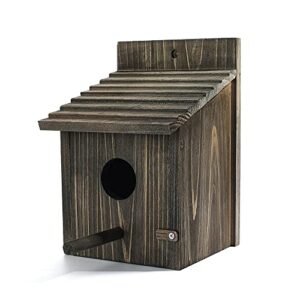
At $21.69, the NATUREYLWL Weatherproof Wooden Bird House punches above its price point for small homestead setups. The 1.57-inch entrance hole suits finches and bluebirds well, and the side door makes fall cleanouts genuinely painless.
It hangs from a pre-drilled hook or mounts on a nail — no tools, no fuss.
One thing to watch: inspect your unit out of the box, since a few buyers have flagged minor defects like cracked doors that need a quick DIY fix before hanging.
| Best For | Backyard birders and small homestead owners who want a low-maintenance, budget-friendly house for finches, bluebirds, or similar small birds. |
|---|---|
| Price | $21.69 |
| Material | Natural Wood |
| Weight | 1.25 lb |
| Assembly Required | No |
| Cleaning Access | Side door |
| Bird Size Suitability | Small to medium |
| Additional Features |
|
- Solid value at $21.69 — weatherproof wood that holds up through rain and snow without breaking the bank
- Side door makes seasonal cleaning quick and easy, no struggle involved
- Hangs or mounts in minutes with no tools required
- Some units arrive with minor defects like cracked doors or chipped dowels, so give it a once-over before hanging
- Durability over the long haul is hit or miss according to a handful of reviewers
- Fixed 1.57-inch entrance locks out larger bird species entirely
5. Natural Wood Bird House Feeder
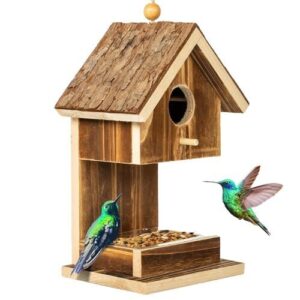
If you want something compact and dual-purpose, the Karlliu Natural Wood Bird House Feeder ($14.99) deserves a look. It combines a nesting cavity with a small plastic feeding tray — no tools required to hang it.
The 1.25-inch inlet works well for tiny species like wrens. That said, it’s a better fit for decoration or occasional visitors than serious nesting.
The feeder tray is small, and a few buyers note inconsistent build quality, so inspect it carefully on arrival.
| Best For | Gardeners who want a charming decorative accent that might attract a wren or hummingbird now and then. |
|---|---|
| Price | $14.99 |
| Material | Solid Wood |
| Weight | 11.2 oz |
| Assembly Required | No |
| Cleaning Access | N/A |
| Bird Size Suitability | Tiny birds only |
| Additional Features |
|
- Natural wood look blends nicely into any backyard or garden setup
- Super easy to hang — no tools, no assembly, just pick your spot
- Lightweight enough to move around whenever you want a change
- Tiny size means only one small bird at a time, and larger birds won’t fit at all
- The plastic feeder tray is pretty much too small to be useful
- Build quality can be hit or miss, so give it a good look when it arrives
Frequently Asked Questions (FAQs)
Can birdhouses attract pest birds like starlings?
Yes, birdhouses can attract starlings if the entrance hole is too large. Keeping the diameter at 1 to 25 inches favors smaller native species and effectively shuts the door on starlings.
Which bird species avoid birdhouses entirely?
Robins, mockingbirds, orioles, eagles, and ground-nesting birds like pigeons and cranes won’t use birdhouses at all — they’re hardwired for open nests, branches, ledges, or wetlands instead.
Do birdhouses work in cold winter climates?
Birdhouses absolutely work in cold climates — many small birds like chickadees and wrens use them as winter roosts, huddling inside for warmth on frigid nights rather than waiting for nesting season.
Can multiple species share one birdhouse structure?
Sharing one box is like two families splitting a single bedroom — it rarely ends well.
Most species are territorial, so separate entrance holes or dedicated structures work far better for nesting success.
Are seed-coated birdhouses safe for wild birds?
Seed-coated birdhouses aren’t the safest choice for nesting birds. The coating can attract ants, mold, and pests inside the cavity, creating conditions that harm nestlings over time.
Conclusion
By nurturing a haven for birds, you’re cultivating a thriving ecosystem on your rural homestead. As you welcome these feathered friends, remember that birdhouses for rural homesteads play an essential role in maintaining balance.
With the right choices, installations, and care, you’ll enjoy a harmonious relationship with nature. Your efforts will yield a bounty of benefits from pest control to biodiversity.
As the seasons unfold, your birdhouses will become a haven for generations to come, silently supporting your homestead’s harmony with nature, always.