This site is supported by our readers. We may earn a commission, at no cost to you, if you purchase through links.
An ostrich sprinting at 43 miles per hour looks less like a bird and more like a feathered sports car with attitude. That speed isn’t luck—it’s the product of legs engineered over millions of years for power, reach, and survival.
Birds with long legs aren’t just visually striking; they’re some of nature’s most specialized creatures, each pair of stilts finely tuned for a specific purpose, whether stalking prey through murky shallows or scanning grasslands from above. From the Great Blue Heron‘s patient, motionless hunt to the flamingo filtering brine with its oddly elegant stance, long-legged birds reveal how radically form follows function in the wild.
Table Of Contents
- Key Takeaways
- What Are Birds With Long Legs?
- Why Do Some Birds Have Such Long Legs?
- 10 Fascinating Long-Legged Birds to Know
- Where Do Long-Legged Birds Live?
- Are Long-Legged Birds Under Threat?
- Frequently Asked Questions (FAQs)
- Why do birds have long legs?
- Do egrets have long legs?
- Are there any birds with long legs in North America?
- What is a bird with long legs?
- Are hummingbirds long legs?
- What kind of bird has long legs?
- What is a grey bird with long skinny legs?
- What kind of bird has long legs in the pond?
- What are the black and white birds with long legs?
- What bird is known for its long legs?
- Conclusion
Key Takeaways
- Long legs aren’t just a physical trait—they’re a full survival toolkit, letting birds wade, sprint, cool down, court mates, and dodge predators depending on the species.
- Wading birds and flightless birds both rock long legs but use them in completely opposite ways: one for standing still in water, the other for blazing across open ground.
- Several long-legged species are in serious trouble, with wetland loss, climate shifts, and habitat fragmentation pushing birds like the whooping crane and Siberian crane toward extinction.
- Conservation efforts are actually working—whooping crane populations have climbed past 500 wild birds, proving that targeted protection and habitat funding can pull species back from the brink.
What Are Birds With Long Legs?

Not all long-legged birds wade through marshes—some sprint across open plains, and others barely leave the ground at all.
From the elegant heron to the surprisingly land-bound secretary bird, long-legged marsh birds have evolved remarkably diverse lifestyles far beyond the wetlands we imagine them in.
The group breaks down in ways that might surprise you, from how scientists classify leg length to the real differences between waders and flightless giants. Here’s a closer look at what pulls these birds together under one umbrella.
Defining Long-Legged Bird Groups
Long-legged avian species span several taxonomic groupings, each shaped by distinct evolutionary lineages and habitat specialization. Recent fossils reveal an advanced ornithuromorph lineage from the Early Cretaceous. Here are the key groups you’ll encounter:
- Wading birds — herons, egrets, and spoonbills near wetlands
- Shorebirds — stilts with extreme leg morphology types
- Ratites — flightless birds like ostriches, built for running
- Cranes — tall species with specialized foraging strategies
- Flamingos — filter feeders from ancient evolutionary lineages
Wading Birds Vs. Flightless Birds
Wading birds and flightless birds both have long legs, but for very different reasons. Wading birds like herons and stilts use their legs to stand in shallow wetland habitats without getting wet. Flightless birds like ostriches use theirs purely for speed across open ground.
| Feature | Wading Birds | Flightless Birds |
|---|---|---|
| Primary habitat | Wetlands, marshes | Grasslands, savannas |
| Leg function | Wading, balance | Running, locomotion |
| Feeding strategy | Aquatic prey hunting | Terrestrial foraging |
Thermoregulation differences matter too — wading birds lose heat through legs submerged in cool water, while flightless birds conserve warmth over dry land. Their predator avoidance tactics also split sharply: herons freeze motionless; ostriches sprint away. Two groups, one shared trait — used in completely opposite ways.
How Leg Length is Classified
Not all long legs are equal — and scientists have ways to classify exactly that. In avian anatomy, leg length classification mirrors clinical frameworks: structural differences come from actual bone proportions, while functional differences reflect posture and mechanics. For long-legged avian species, three severity bands apply:
- Mild – minimal limb variation
- Moderate – notable functional impact
- Severe – significant morphological divergence
Why Do Some Birds Have Such Long Legs?
Long legs aren’t just a look — they’re a whole survival strategy built up over millions of years. Every structural detail, from heat-managing blood vessels to feet designed for soft ground, has a job to do. Here’s a closer look at what’s actually going on beneath the feathers.
From hollow bones to heat-regulating veins, birds with unique physical adaptations show just how precise evolution can be when survival is on the line.
Evolutionary Advantages of Long Legs
Think of long legs as nature’s Swiss Army knife — one feature, many survival advantages. Evolution didn’t grow them by accident.
Birds with longer legs cover more ground per stride, burning less energy across open terrain. That energy efficiency frees up resources for feeding, breeding, and staying alert.
In warm climates, exposed leg surface area also helps dump excess body heat, keeping birds active longer.
Physical Adaptations for Wading and Hunting
Every feature on a wading bird’s body solves a specific problem.
Spread-out toes distribute weight across soft mud like natural snowshoes, preventing the bird from sinking mid-hunt. Long legs keep the body dry and elevated above the waterline.
An S-shaped neck coils like a compressed spring, releasing in milliseconds to strike prey. Waterproof plumage and high-density rods in the eyes complete the kit — one for endurance, one for hunting day or night.
Role in Balance, Display, and Mating
Those remarkably long legs do more than wade through water — they’re central to balance, courtship, and finding a mate.
- Crane courtship dances combine bowing, wing flapping, and jumping in precise sequences
- Flamingo group displays include synchronized marching and head-flagging
- Long legs help birds maintain poised stances on soft wetland ground
- Display complexity signals physical fitness to potential mates
- Paired birds repeat dances to reinforce bond strength
Thermoregulation Through Leg Structure
Bare, featherless legs aren’t just a quirky design choice — they’re a built-in cooling system. Long-legged avian species like flamingos and herons release heat directly through exposed skin, using featherless leg cooling to regulate core body temperature.
In cold weather, birds reduce blood flow or tuck one leg into their plumage, conserving warmth without burning extra energy.
10 Fascinating Long-Legged Birds to Know
Long legs aren’t just a fashion statement in the bird world — they’re the whole toolkit. From flamingos standing pink and patient in salty shallows to ostriches thundering across open plains, each species on this list uses those legs in a surprisingly different way.
Here are five long-legged birds worth knowing.
Great Blue Heron

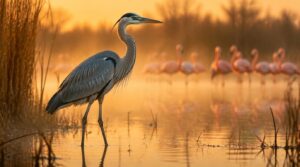
The Great Blue Heron is North America’s largest heron, standing up to four feet tall with a wingspan stretching nearly seven feet. Despite that imposing frame, it weighs just five to six pounds — hollow bones are nature’s clever engineering.
A master of heron hunting, it stands motionless in wetlands, then strikes with a spear-like bill in an instant.
American Flamingo

The American flamingo stands about five feet tall, draped in pink to reddish-orange plumage earned entirely from carotenoid pigments in its diet — shrimp, algae, and invertebrates filtered from shallow salt lagoons. Its downward-curved bill works like a natural sieve, straining food from muddy water.
Colonial breeders by nature, flamingos nest in massive groups across Caribbean wetlands, and their conservation status sits comfortably at Least Concern.
Whooping Crane
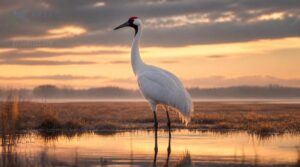
The whooping crane is North America’s tallest bird, standing nearly five feet, with a wingspan stretching seven feet or more. Snowy white with striking red crown markings, it’s hard to miss. Its long legs are built for wading through wetlands, probing for crabs, frogs, and fish across rich estuarine flats.
Once nearly gone — bottoming out at just 18 birds in the 1940s — this species clawed back through captive breeding and protected breeding grounds in Canada’s Wood Buffalo National Park. Today, over 500 wild birds travel the central migration corridor each year, a genuine population recovery story. Their elaborate courtship dance, full of leaping and wing-spreading, remains one of nature’s most compelling performances.
From just 18 birds in the 1940s, the whooping crane has soared past 500 wild individuals today
Ostrich and Emu
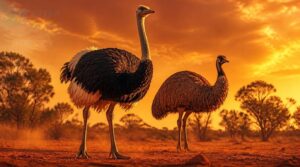
From the elegant grace of cranes, we land on pure power. Ostriches and emus are flightless birds built not for the sky but for the ground — and they own it completely.
- Ostriches sprint at 43 miles per hour
- Emu fathers incubate eggs alone for eight weeks
- Ostrich eggs weigh around three pounds
- Emu feathers have a double-shafted structure
- Ostriches practice communal social nesting
Black-Necked Stilt
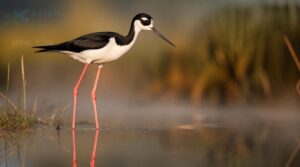
After the raw power of ostriches and emus, meet something almost opposite — small, sharp, and built for the water’s edge.
The black-necked stilt is a striking wading bird with bold black-and-white plumage and vivid pink legs so long they seem borrowed from a much bigger bird. Only flamingos beat them proportionally.
Where Do Long-Legged Birds Live?

Long-legged birds don’t stick to one corner of the map — they’ve claimed wetlands, open plains, and coastlines across nearly every continent. Where a bird lives shapes everything about it, from what it eats to how it hunts. Here’s a look at the main habitats these birds call home.
Wetlands, Marshes, and Coastal Habitats
Wetlands are where long-legged birds truly come into their own. Tidal marsh plants like cordgrass define the salt marsh zones that herons and egrets patrol daily, moving between low-marsh shallows and higher ground as tides shift.
Mudflat ecology sustains dense invertebrate communities that fuel entire coastal wetland bird populations, while healthy marshes also provide critical storm surge protection for nearby shorelines.
Grasslands and Open Savannas
Not every long-legged bird belongs near water. Ostriches, emus, and secretary birds thrive in open grasslands and savannas, where fire, grazing, and nutrient-poor soils keep vegetation low enough for ground-level hunting.
That open sightline isn’t accidental — it’s survival. Periodic burning and large grazers working together maintain the clear, grassy structure these birds depend on.
Global Distribution and Migration Routes
Long-legged birds span every major flyway network on Earth. Many wading species follow broad north-south migration routes, shifting between breeding and wintering grounds seasonally. Bar-tailed godwits travel roughly 11,680 km non-stop, while white storks cross between Europe and Africa via Gibraltar or the Bosporus.
Tracking tools like GPS and the Motus telemetry network continue revealing how these routes shift over time.
Are Long-Legged Birds Under Threat?

The short answer is yes — many of these birds are in real trouble. Wetland destruction, hunting history, and climate shifts have quietly pushed several species to the edge. Here’s what’s threatening them, and what’s actually being done about it.
Habitat Loss and Wetland Destruction
The ground beneath long-legged avian species is literally disappearing. Wetland drainage impact has cost the U.S. alone 221,000 acres between 2009 and 2019. Here’s what’s driving that loss:
- Agricultural expansion effects convert marshes into farmland
- Roads and levees disrupt hydrology alteration consequences
- Fragmentation creates migration barriers for wading birds
- Pollution degrades remaining habitat
- Restoration timeframes span decades
Endangered Long-Legged Species Worldwide
Several long-legged avian species are now racing against extinction.
The whooping crane, North America’s only native crane, numbers just 329 birds in the wild — fewer than 250 are mature individuals. The Siberian crane faces a genetic bottleneck risk, with over 98% concentrated in a single eastern population of roughly 3,800 birds.
Meanwhile, the slender-billed curlew was formally declared extinct in 2025.
Conservation Efforts Making a Difference
Good news travels slowly in conservation — but it does travel.
Whooping crane populations have climbed past 500 wild birds through decades of federal protection, habitat funding, and captive breeding. NAWCA grants alone have helped conserve over 548,000 acres of wetland across North America, giving migratory birds the stopover habitat they desperately need along flyways like the Central.
Frequently Asked Questions (FAQs)
Why do birds have long legs?
Picture a bird standing still in a marsh—barely a ripple. Long legs let birds wade deeper, hunt faster, cool down efficiently, impress mates, and outrun predators through open terrain.
Do egrets have long legs?
Yes, egrets have long legs. Great egrets stand over four feet tall, with black legs built for wading through shallow wetlands, striking prey fast, and balancing on soft mud.
Are there any birds with long legs in North America?
North America is home to quite a few long-legged wading birds. The Great Blue Heron, Whooping Crane, Black-necked Stilt, American Flamingo, and Cattle Egret are standout examples found across wetlands and coastal regions.
What is a bird with long legs?
A wading bird navigates shallow wetlands on elongated legs, keeping its body dry while hunting. These long-legged avian species span herons, storks, cranes, and flamingos — each shaped by habitat and feeding strategy.
Are hummingbirds long legs?
Hummingbirds are basically the opposite of long-legged avian species. Their legs are tiny by design — reduced through evolution to save weight. They perch, cling, and hover, never walk. In bird morphology, that makes them short-legged specialists.
What kind of bird has long legs?
Wading birds like herons, egrets, and storks are the most recognized long-legged avian species. Flightless runners — ostriches and emus — also qualify, using leg muscle power for speed across open grasslands.
What is a grey bird with long skinny legs?
The grey heron (Ardea cinerea) is your answer — a tall wading bird with grey plumage, a dagger-like bill, and long skinny legs built for stalking fish across European and Asian wetlands.
What kind of bird has long legs in the pond?
If you spot a tall bird standing still in a pond, it’s likely a heron, stilt, or flamingo — classic wading birds that use shallow water hunting to catch fish, frogs, and insects.
What are the black and white birds with long legs?
Black and white stilts are nature’s stilettos—sharp, striking, and built for purpose. The black-necked stilt stands out with bold plumage, pink legs, and precise bill probing through shallow wetland mudflats.
What bird is known for its long legs?
Several birds are famous for their striking leg length. Ostriches, flamingos, storks, and cranes top the list — each using those long legs for running, wading, or migrating across vast distances.
Conclusion
Ancient Romans had no Twitter feed, yet they still observed birds with long legs as reliable omens of changing seasons—solid proof that human curiosity about these notable creatures runs far deeper than modern science.
Today, rapid wetland destruction threatens what millions of years of evolution so precisely engineered. Every heron frozen mid-hunt and every flamingo filtering brine with quiet grace is a living argument for conservation. Nature’s finest designs don’t come with a spare.
- https://www.wwt.org.uk/discover-wetlands/wetland-wildlife/meet-the-family/wading-birds-found-in-uk-wetlands
- https://birdnationblog.wordpress.com/category/wading-birds
- https://www.knowitall.org/series/sc-life/salt-marsh/11-wading-birds
- https://www.audubonadventures.org/wading_birds_essay.htm
- https://www.birdsandblooms.com/birding/wading-birds