This site is supported by our readers. We may earn a commission, at no cost to you, if you purchase through links.
 You’ll find a thorough large bird species list that includes both flying and flightless giants.
The Andean Condor tops flying birds with its 11-foot wingspan, while ostriches dominate land at nearly 9 feet tall and 350 pounds.
Dalmatian pelicans, trumpeter swans, and great bustards round out the heavyweight champions of the sky.
Don’t overlook prehistoric titans like Argentavis magnificens, whose 20-foot wingspan dwarfed today’s largest birds.
From cassowaries in Australia to emperor penguins in Antarctica, these avian giants showcase nature’s incredible size diversity.
Each species has evolved unique adaptations that’ll surprise you with their remarkable survival strategies.
Table Of Contents
- Key Takeaways
- Largest Flying Birds
- Largest Flightless Birds
- Prehistoric Large Birds
- Large Birds of Prey
- Large Waterbirds and Species
- Frequently Asked Questions (FAQs)
- What is the top 10 biggest bird?
- What bird weighs 50 pounds?
- What is the largest bird you can legally own?
- What bird is 6 feet tall?
- What are those giant birds called?
- What are examples of large birds?
- Which bird is very very large?
- How fast can the largest birds fly?
- Whats the lifespan of large bird species?
- Which large birds are most endangered today?
- Conclusion
Key Takeaways
- You’ll discover that ostriches dominate as the world’s largest birds, reaching 9 feet tall and 346 pounds, while flightless giants like cassowaries and emus have traded flight for impressive size and speed on land.
- You can witness flying birds that push the limits of aerial capability, including the Andean condor with its 11-foot wingspan and the Dalmatian pelican weighing up to 33 pounds while still maintaining powered flight.
- You’ll find that prehistoric birds were absolute giants compared to today’s species, with extinct titans like Vorombe weighing 1,750 pounds and Pelagornis sandersi achieving wingspans of 20-24 feet.
- You’ll encounter remarkable size diversity across different bird families, from 38-pound trumpeter swans in wetlands to lightning-fast peregrine falcons that dive at 240+ mph, proving that large birds have evolved specialized adaptations for every environment.
Largest Flying Birds
When you observe the world’s largest flying birds, you’ll witness nature’s remarkable engineering achievements that combine massive size with aerial capability.
These giants, including the Dalmatian pelican with its 12-foot wingspan and the Andean condor weighing up to 33 pounds, demonstrate how evolution has pushed the boundaries of what’s possible in powered flight.
Dalmatian Pelican Characteristics

Picture a feathered giant gliding over European wetlands—that’s the Dalmatian pelican, one of our largest bird species.
Witness nature’s living giants—where massive wings meet impossible flight in Earth’s most spectacular aerial displays.
You’ll recognize these magnificent birds by their silvery-white plumage color and massive 15.3-inch bills designed for pelican feeding on fish.
Their social behavior shines during breeding season when colonies gather for pelican nesting.
Despite their impressive 126-inch wingspan, their conservation status remains vulnerable due to shrinking habitat range across southern Europe and Asia.
Their specialized pelican diet keeps freshwater ecosystems balanced.
Andean Condor Weight and Wingspan

When you encounter an Andean condor soaring through mountain thermals, you’re witnessing nature’s ultimate gliding machine.
These South American giants possess remarkable physical specifications that make them the heaviest flying birds in the Western Hemisphere.
Condor Flight Mechanics rely on their impressive dimensions:
- Wingspan: Stretches 10-11 feet (3-3.3 meters) across
- Bird weight: Males reach 24-33 pounds (11-15 kg)
- Wing loading: Optimized for effortless soaring at high altitudes
- Condor habitat range: Andean peaks from Venezuela to Chile
- Condor lifespan: Up to 70 years in captivity
The Andean condor diet consists primarily of carrion, while their condor conservation status remains vulnerable.
These magnificent bird species represent evolutionary perfection in bird size optimization for mountain flight.
Trumpeter Swan Size and Weight

You’ll find the Trumpeter Swan reaching impressive proportions as North America’s heaviest waterfowl.
These magnificent birds achieve swan maturity weight up to 38 pounds, with Cygnus buccinator size spanning 10-foot wingspans.
Their large waterfowl status directly correlates with habitat and weight requirements – needing expansive wetlands to support their bulk.
The wingspan correlation enables powerful flight despite their bird weight, while their substantial bird size demands protein-rich aquatic vegetation for ideal development.
Other birds, such as the Dalmatian Pelican wingspan, also reach impressive sizes.
Great Bustard and Kori Bustard Weight

The Great bustard and Kori bustard claim the title of heaviest flying birds, with males reaching impressive weights that challenge their aerial abilities.
These ground-dwelling giants demonstrate remarkable adaptations for their dual lifestyle.
Here’s what makes these bird weight comparison champions exceptional:
- Bustard Weight Range spans 3-18 kg, with males substantially outweighing females
- Kori Bustard Diet includes insects, small mammals, and vegetation across African savannas
- Bustard Physical Traits feature powerful legs, broad wings, and distinctive plumage patterns
- Bustard vs. Habitat shows perfect adaptation to open grasslands and semi-arid regions
- Bustard Conservation Status remains vulnerable due to habitat loss and hunting pressure
The details provided highlight the unique characteristics and challenges faced by these remarkable birds.
Argentavis Magnificens Weight and Size

While living bustards impress with their considerable weight, Argentavis magnificens stands as the ultimate giant among flying birds. This prehistoric titan soared across Argentina’s skies around 6 million years ago, dwarfing any modern species you’ll encounter today.
Argentavis Weight reached an astounding 154-216 pounds, making it heavier than most humans. Argentavis Size was equally remarkable, with its massive wingspan stretching 20-23 feet—comparable to a small aircraft’s dimensions.
The classification of this bird places it within the Teratornithidae family.
Key characteristics of this ancient giant include:
- Flight Capabilities relied on thermal soaring rather than flapping
- Fossil Discovery revealed bones indicating exceptional bird size and bird weight
- Ecological Niche positioned it as a dominant scavenger across South American landscapes.
Argentavis magnificens exemplifies how prehistoric birds achieved extraordinary proportions that modern aviation engineers still study for insights into large-scale flight mechanics.
Largest Flightless Birds
You’ll encounter some of nature’s most impressive giants when examining flightless birds, from the towering ostrich that can reach 9 feet tall and weigh up to 346 pounds to the formidable cassowary with its razor-sharp claws.
These ground-bound species have traded flight for size and power, developing robust legs for running at speeds up to 43 mph and specialized adaptations that make them perfectly suited for terrestrial life.
Ostrich Height and Weight

While flying birds impress with their aerial abilities, you’ll discover that size champions exist firmly on the ground. The ostrich towers above all other birds, reaching heights of 9 feet (2.8 meters) and weighing up to 346 pounds (157 kg).
Sexual dimorphism plays a significant role in ostrich subspecies, with males typically larger than females. The Somali Ostrich demonstrates similar impressive bird size measurements, though weight fluctuations occur seasonally based on food availability and breeding cycles.
These impressive birds are considered one of the tallest bird species in the world, with remarkable characteristics that set them apart.
Growth factors including genetics and nutrition influence height variations, while their powerful legs enable remarkable 16-foot strides when reaching speeds of 43 mph across African savannas, making them a unique species with impressive abilities.
Emu Height and Weight

Australia’s iconic Emu stands impressively at 5.7-6.2 feet tall, making it the world’s second-largest bird species.
These flightless birds showcase remarkable Emu Height Variation and weigh 66-132 pounds, with females typically larger due to Emu Sexual Dimorphism.
Their Emu Average Weight reflects rapid Emu Growth Rate during development.
Despite their substantial bird weight and bird height, emus maintain excellent mobility across diverse Australian landscapes, securing their Emu Conservation Status as stable members of any large bird species list.
Cassowary Species and Characteristics

You’ll find cassowaries among nature’s most formidable flightless birds. The Southern cassowary towers at 6.6 feet, while the Northern cassowary and Dwarf cassowary complete this trio.
Their claw function serves as deadly defense, with dagger-like talons slicing through threats.
Habitat loss threatens their conservation status.
Their cassowary diet includes rainforest fruits, maintaining ecological balance with profound cultural significance in indigenous communities.
These birds are classified under the order Casuariiformes also includes the emu.
Rhea Species and Size
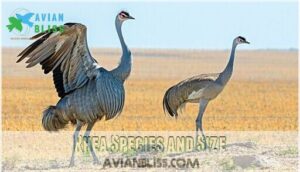
South American grasslands host two remarkable Rhea species that showcase fascinating Rhea Evolution and Rhea Behavior.
The Greater Rhea dominates this bird size comparison, reaching 5.6 feet tall and weighing 88 pounds, while Darwin’s Rhea stands smaller at 3 feet.
Both species demonstrate unique Rhea Habitat adaptation, spreading wings like natural sails while running through their expansive territories, despite being flightless birds requiring ongoing Rhea Conservation efforts.
Penguin Species and Weight

Emperor Penguins dominate the penguin world as true heavyweights, reaching 130 cm tall and weighing up to 45 kg.
These remarkable bird species showcase incredible size diversity across Antarctica’s icy landscape.
- Emperor penguin: 22-45 kg, tallest penguin species with distinctive yellow neck patches
- King Penguin: 15-20 kg, elegant orange-yellow markings around head and neck
- Adelie Penguin: 3.8-8.2 kg, classic tuxedo appearance with white eye rings
- Rockhopper Penguin: 2-4 kg, spiky yellow crests and aggressive hopping behavior
Penguin Conservation efforts protect these extraordinary bird weights variations.
Prehistoric Large Birds

You’ll discover that prehistoric birds weren’t just larger versions of today’s species—they were absolute giants that make modern ostriches look small.
These ancient aviators, from the 1,750-pound Vorombe titan to the 24-foot wingspan Pelagornis sandersi, dominated Earth’s skies and landscapes millions of years ago with sizes that seem almost impossible by today’s standards.
Elephant Birds Size and Weight
You’ll find that Vorombe titan dwarfed all other birds throughout history, reaching towering heights of 10 feet and weighing an incredible 1,750 pounds.
Aepyornis maximus, another elephant bird species, wasn’t far behind at 880 pounds.
These Madagascar giants lived in diverse habitats until extinction causes like human hunting eliminated them around 1,000 years ago.
Their bird size and bird weight made modern ostriches look tiny—imagine a creature seven times heavier than today’s largest bird species roaming ancient landscapes.
Australian Dromornis Stirtoni Size
Dromornis stirtoni claimed the title among Australia’s largest bird species, standing 3 meters tall with a Dromornis Weight reaching 650 kg.
These flightless Thunderbirds roamed terrestrial woodlands on powerful ostrich legs, making them formidable giants of their time.
Dromornis Height and bulk details reveal:
- Weight: 450-650 kg (equivalent to a small horse)
- Height: 3 meters tall (nearly 10 feet)
- Habitat Analysis: Subtropical open woodlands across Australia
- Extinction Causes: Climate changes during late Miocene epoch
Giant Moa Height and Weight
Giant Moa fossils showcase nature’s most towering birds, with complete Moa skeletons revealing heights reaching 3.6 meters.
These New Zealand giants displayed remarkable Moa Sexual Dimorphism – females towered over males in most species. Moa Weight Estimates suggest they reached 280 kilograms, while Moa Height Variation ranged dramatically across species.
These birds were similar in size to other prehistoric giants such as the Vorombe Titan.
Bird size enthusiasts marvel at these prehistoric records:
- Moa Bone Density supported massive frames despite flightlessness
- Moa Egg Size featured surprisingly fragile 1.4mm shells
- Bird weight peaked at nearly 620 pounds
- Bird height exceeded modern ostriches substantially
Pelagornis Sandersi Wingspan
You’ll be amazed by Pelagornis sandersi, whose wingspan evolution produced the most immense prehistoric birds ever recorded.
This ancient giant achieved bird wingspan records of 6.1-7.4 meters (20-24 feet), dwarfing today’s largest flyers.
Fossil discovery in South Carolina revealed flight mechanics that let it soar over prehistoric oceans 25 million years ago.
Its habitat range spanned vast oceanic territories, using thermal currents for efficient gliding.
While extinction causes remain debated, Pelagornis sandersi represents the pinnacle of prehistoric birds’ aerial dominance.
Quetzalcoatlus Northropi Wingspan
While Argentavis magnificens ruled ancient South American skies, Quetzalcoatlus Northropi dwarfed even that giant with its colossal wingspan reaching 33-36 feet.
You’re looking at the largest flying creature ever discovered, though size estimates from fossil discoveries have sparked heated scientific debates.
These pterosaurs dominated prehistoric skies with flight capabilities that still puzzle researchers today.
Recent extinction theories suggest habitat range changes contributed to their disappearance.
Unlike prehistoric birds, these reptilian giants launched themselves using powerful forearms:
- Wingspan comparable to a small airplane’s length
- Weight estimates ranging from 440-550 pounds
- Quadrupedal takeoff requiring 8-foot vertical leaps
- Soaring speeds potentially reaching 80 mph
Large Birds of Prey

You’ll encounter nature’s most formidable aerial hunters when you explore large birds of prey, from the lightning-fast peregrine falcon that reaches speeds over 240 mph to the massive Andean condor with its 10-foot wingspan.
These raptors combine incredible size with specialized hunting adaptations, including razor-sharp talons, powerful beaks, and exceptional eyesight that’s up to eight times sharper than human vision, making them a prime example of formidable aerial hunters.
Peregrine Falcon Speed and Dive
In terms of sheer velocity, the Peregrine Falcon reigns as the fastest animal on Earth. During hunting dives, these aerial predators achieve Falcon Dive Speed exceeding 320 km/h (200 mph), with experimental records reaching 389 km/h (242 mph).
Their Hunting Techniques involve spectacular stoops from heights of 17,000 feet, where Air Pressure Effects would crush ordinary birds. However, Evolutionary Adaptations have equipped them perfectly for these extreme bird speed records.
Capturing these dives requires specialized camera equipment to properly record the action.
bird flight
Their exceptional Visual Acuity allows precise targeting during high-speed pursuits, while their bird agility enables split-second course corrections that showcase nature’s engineering masterpiece.
Bald Eagle Habitat and Size
Majesty defines the Bald Eagle’s presence across North America, where these magnificent raptors establish territories near lakes, rivers, and coastlines.
You’ll find them building massive stick nests in tall trees, with females reaching 14 pounds and 8-foot wingspans—significantly larger than 6-9 pound males.
Their nesting choices reflect specific habitat needs.
Eagle Habitats and nesting habits that inspire awe:
- Towering nest fortresses reaching 13 feet deep and 8 feet wide
- Waterfront real estate providing abundant fish and waterfowl prey choices
- Multi-generational homes used for decades, growing larger each breeding season
Golden Eagle Speed and Agility
Golden Eagles rank among the most agile large birds of prey, with Flight Mechanics that’ll leave you speechless.
Their Hunting Techniques include jaw-dropping stoops reaching 150-200 mph, and they cruise at 28-32 mph during normal flight.
Their Aerodynamic Adaptations feature distinctive "V" wing positioning that maximizes efficiency during pursuit, and Terrain Mastery allows them to navigate mountainous regions with precision.
Their Prey Capture success relies on split-second timing, and Bird agility records consistently place Golden Eagles among nature’s most skilled aerial hunters, with bird speed assessments confirming their exceptional hunting prowess.
Some enthusiasts even study specific hunting products to better understand these techniques.
Gyrfalcon Size and Wingspan
The Gyrfalcon reigns supreme among falcon species, showcasing remarkable wingspan measurements of 43-63 inches and dramatic Gyrfalcon dimorphism where females outweigh males substantially.
These Arctic adaptation specialists demonstrate exceptional hunting techniques across northern territories.
- Plumage variations range from pristine white to charcoal gray
- Weights span 1.8-4.6 pounds with pronounced sexual size differences
- Raptors identification becomes easier through their robust build
- Conservation status remains stable despite climate pressures
Andean Condor Wingspan and Weight
Soaring majestically through South American skies, the Andean condor commands respect with its extraordinary wingspan reaching 10.5 feet.
These magnificent raptors showcase remarkable weightwingspan ratio efficiency, with males weighing 17-33 pounds while females remain slightly smaller.
Their Flight Adaptations enable effortless gliding across vast Habitat Range territories spanning Andean peaks to coastal regions.
Despite their impressive size and Cultural Significance in indigenous folklore, these giants face challenging Conservation Status due to habitat loss, making Diet Analysis essential for protection efforts.
Large Waterbirds and Species

You’ll encounter some of nature’s most impressive giants when you examine large waterbirds, from the 38-pound Trumpeter Swan with its 10-foot wingspan to the massive American White Pelican that stretches nearly 10 feet across.
These aquatic specialists combine remarkable size with precise adaptations for life in wetland environments, making them among the most successful large birds on Earth, with remarkable size being a key factor in their success.
Whooper Swan Migration and Size
You’ll find whooper swans among nature’s most impressive migrants, traveling thousands of miles between Arctic breeding grounds and southern European wintering sites.
These magnificent Swans showcase remarkable Swan Morphology with weights reaching 15.5 kg and wingspan stretching 275 cm.
Their Migration Patterns demonstrate incredible endurance, flying at altitudes up to 1,700 meters when crossing oceans.
Climate Effects and Habitat Impact influence their routes, making Conservation Status monitoring essential.
Unlike Trumpeter Swan and Tundra Swan species, whoopers display distinctive yellow-black beak patterns during bird migration seasons.
Trumpeter Swan Weight and Size
Trumpeter Swan dominance in North American waterways stems from their remarkable physical dimensions and conservation status recovery.
- Bird weight reaches 38 pounds in mature males, making them continental heavyweights
- Bird length stretches 5-6 feet from bill to tail with graceful proportions
- Bird wingspan extends 10 feet across, creating spectacular flight displays
- Weight fluctuations occur seasonally, affecting habitat impact and territorial behaviors
Swan maturity brings distinctive plumage variation in these magnificent creatures.
American White Pelican Size and Weight
Looking across North America’s wetlands, you’ll spot the American White Pelican—a true heavyweight among Pelicans.
This impressive bird species reaches 50-70 inches in length with a remarkable Pelican Wingspan stretching 8-10 feet.
Adult bird weight ranges 10-30 pounds, making them one of North America’s heaviest flying birds.
Their specialized Pelican Diet of fish supports their massive frame, while Pelican Habitat preferences include shallow lakes and marshes where Pelican Behavior involves cooperative feeding strategies.
These birds often engage in cooperative foraging techniques to effectively herd fish.
Great Egret Plumes and Size
Great Egret’s breeding plumage creates spectacular displays when feathery plumes cascade from their backs during mating season.
These wading birds stand 3.3 feet tall with 4.7-foot wingspans, weighing 1.5-3.3 pounds. Their bird size makes them impressive longlegged birds in wetland habitats.
The historic Plume Trade nearly eliminated these elegant species, but Conservation Efforts helped populations recover from devastating Habitat Impact caused by fashion demands.
Sandhill Crane Calls and Migration
Sandhill Cranes produce rattling bugle calls audible up to 2.5 miles away, thanks to their coiled trachea structure. These impressive waterbirds follow established migration routes, with over 80% gathering along Nebraska’s Platte River each spring.
Crane Vocalizations include moans, hisses, and distinctive bugling sounds that facilitate communication during their remarkable journeys.
- Bird migration patterns span from northern breeding grounds to southern wintering areas
- Mating Rituals feature synchronized dancing, jumping, and wing displays
- Migration flocks can exceed hundreds of thousands of individuals
- Habitat Conservation efforts focus on protecting critical stopover sites
- Population Threats include wetland loss and human development pressures
Frequently Asked Questions (FAQs)
What is the top 10 biggest bird?
You’ll find ostriches leading the pack at 346 pounds, followed by cassowaries, emus, and rheas among living giants.
While extinct titans like Vorombe weighed nearly 2,000 pounds—true feathered behemoths that’d dwarf today’s birds.
What bird weighs 50 pounds?
Like titans striding through ancient landscapes, several magnificent birds tip the scales around fifty pounds.
You’ll find emperor penguins weighing up to forty-five pounds, while greater rheas and domesticated turkeys can reach this impressive weight milestone.
What is the largest bird you can legally own?
You can legally own domesticated turkeys, which reach up to 86 pounds, making them the largest commonly available birds.
Some states allow emus or rheas with permits, but regulations vary substantially by location.
What bird is 6 feet tall?
Standing tall at around 6 feet, you’ll find the magnificent emu roaming Australia’s outback.
These impressive birds can reach heights of 7 to 2 feet, making them the second-largest living bird species after ostriches.
What are those giant birds called?
You’re thinking of ratites – those towering flightless birds like ostriches, emus, and cassowaries.
These prehistoric giants can reach heights of 6-9 feet, with ostriches being the tallest living birds today.
What are examples of large birds?
You’ll find ostriches towering at 9 feet and weighing 346 pounds, cassowaries with dagger-like claws, emus racing across Australia, and massive condors soaring overhead with 10-foot wingspans through mountain valleys.
Which bird is very very large?
The ostrich stands as nature’s heavyweight champion among birds, reaching up to 346 pounds and towering 9 feet tall. You’ll find these African giants outweighing most other birds by hundreds of pounds.
How fast can the largest birds fly?
You’ll find that the largest birds can’t actually fly at all.
Ostriches, emus, and cassowaries are flightless, but they compensate by running incredibly fast—ostriches can sprint up to 43 mph across open terrain.
Whats the lifespan of large bird species?
You’ll find large bird lifespans vary dramatically – ostriches live 40-45 years, cassowaries reach 60, while emus average 10-20 years in wild conditions.
Captive birds often live longer with proper care and nutrition.
Which large birds are most endangered today?
Critically concerning cassowaries face habitat destruction in rainforests.
You’ll find Philippine eagles teetering on extinction with fewer than 900 remaining.
Southern cassowaries, northern cassowaries, and wandering albatrosses desperately need protection from deforestation and climate change.
Conclusion
Remarkably, you’ve just discovered that nature’s largest birds share striking similarities across continents—from Australia’s cassowaries to South America’s condors, each species evolved massive proportions for survival advantages.
This exhaustive large bird species list reveals how size becomes nature’s ultimate adaptation tool.
Whether you’re spotting a 350-pound ostrich or watching a pelican’s graceful flight, you’ll now appreciate the incredible diversity these avian giants represent.
Each encounter with these magnificent creatures offers glimpses into millions of years of evolutionary perfection, and showcases how size is a key factor in their survival, making it nature’s ultimate adaptation tool.