
This site is supported by our readers. We may earn a commission, at no cost to you, if you purchase through links.

Watch a flock of American white pelicans work a shallow bay together, and you’ll witness something that looks less like birds feeding and more like a coordinated fishing crew.
Wingspans stretching nearly nine feet, bodies weighing up to eighteen pounds—these are among the largest birds in North America, yet most people couldn’t pick one out of a lineup. They’re not rare; they’re simply overlooked.
The American white pelican breeds across Canadian prairie wetlands, winters along Gulf Coast estuaries, and follows ancient flyways connecting both worlds.
Understanding how this bird lives, hunts, and raises its young reveals a surprisingly complex picture.
Table Of Contents
- Key Takeaways
- Taxonomy and Distinctive Traits
- Size, Plumage, and Field Marks
- Habitat, Range, and Migration
- Breeding Range Across Canada, The Western United States, and Mexico
- Wintering Grounds Along Coasts, Estuaries, and Inland Lakes
- Preferred Habitats in Summer and Winter
- Isolated Island Nesting Sites and Wetland Dependence
- Major Migration Routes and Stopover Areas
- Year-round Resident Areas Versus Seasonal Visitors
- Notable Birdwatching Hotspots for Sightings
- Diet and Cooperative Foraging
- Breeding, Life Cycle, and Threats
- Colony Nesting Behavior and Social Breeding Structure
- Nest Placement on Gravel, Sand, and Bare Islands
- Egg Laying, Clutch Size, and Incubation Period
- Chick Feeding, Brooding, and Parental Care
- Fledging Timeline and Juvenile Development
- Current Conservation Status and Population Trends
- Human Disturbance, Wetland Loss, and Climate-related Threats
- Legal Protections and Citizen-science Monitoring Efforts
- Frequently Asked Questions (FAQs)
- What scares away pelicans?
- Can you hunt American White Pelicans?
- What is the difference between an American White Pelican and a Brown Pelican?
- What does the american white pelican eat?
- What are some of the threats to the American white pelican population?
- What is the population of American white pelicans?
- Where do American white pelicans live?
- Are American white pelicans rare?
- What is the difference between male and female American white pelican?
- What is a fun fact about the American white pelican?
- Conclusion
Key Takeaways
- American white pelicans are cooperative hunters, using coordinated group formations to herd fish into shallow water before scooping them up — a strategy far more sophisticated than solo feeding.
- Despite spanning nearly nine feet and weighing up to eighteen pounds, these birds go largely unnoticed because most people simply don’t know what to look for.
- Their survival depends on a delicate chain of habitat — isolated freshwater islands for breeding, shallow wetlands for foraging, and intact flyway corridors connecting Canadian prairies to Gulf Coast wintering grounds.
- While populations have recovered to around 450,000 birds and hold a Least Concern status, threats like wetland loss, human disturbance at nesting colonies, and climate-driven storms can wipe out local breeding success in a single event.
Taxonomy and Distinctive Traits

Before you can truly appreciate the American White Pelican, it helps to know exactly where it sits in the bird family tree. Its scientific name, common names across three languages, and its standing as North America’s only native large white pelican all tell a surprisingly clear story.
Its place among North America’s most striking large white birds makes the American White Pelican a standout even in impressive company.
Here’s what the classification looks like up close.
Scientific Name and Classification
Meet Pelecanus erythrorhynchos — the American White Pelican’s scientific name under the Linnaean Classification System. Binomial nomenclature rules give every species a two-part Latin identity, and this one’s species epithet meaning is straightforward: ‘red-billed.’ Here’s what that taxonomic classification of the American White Pelican tells you:
- Kingdom: Animalia
- Class: Aves
- Order: Pelecaniformes
- Family: Pelecanidae
- Genus: Pelecanus
Phylogenetic relationships confirm its scientific classification is well-established within Genus Pelecanus Overview.
Family, Order, and Genus Placement
The taxonomic classification of the American White Pelican places it within order Pelecaniformes, family Pelecanidae, and genus Pelecanus — a grouping shaped by both fossil record evidence and genetic markers.
Molecular taxonomy and phylogenetic relationships confirm that Pelecanus erythrorhynchos shares its evolutionary history with other large-pouched waterbirds worldwide.
Think of it as a family tree written in DNA: precise, deep-rooted, and still being read.
family rank between order and genus highlights its position in the hierarchy.
Common Names in English, Spanish, and French
Names carry real information. Across English, Spanish, and French, this species follows a color-geographic naming pattern that makes American White Pelican identification and distribution easier to communicate:
- English: American White Pelican or simply White Pelican
- Spanish: Pelícano Norteamericano or Pelícano blanco Americano
- French: Pélican d’Amérique or Pélican blanc américain
- Citizen science labeling consistently uses these language qualifiers across regional field guide terms worldwide.
Why It is Unique Among North American Pelicans
North America has two pelican species, but the American White Pelican stands apart in almost every meaningful way. Its freshwater adaptation sets it apart from the coastal-focused Brown Pelican.
It’s one of the largest North American birds, built for thermal soaring efficiency, colonial breeding on inland islands, herding fish cooperatively, and bill elasticity that rivals any pouched bill on the continent.
Lack of Recognized Subspecies
Unlike many wide-ranging birds, the American White Pelican claims no recognized subspecies — making it a monotypic species in formal taxonomic classification. Genetic differentiation gaps across its range distribution reveal why: gene flow continuity keeps regional populations closely linked.
Subspecies definition debate and conservation unit ambiguity persist among researchers, and legal naming inconsistencies reflect that reality.
Population trends get monitored as a whole rather than by distinct regional units.
Size, Plumage, and Field Marks
Once you see an American White Pelican in the field, you won’t forget it — this bird is built on a grand scale, and every physical detail tells a story. Knowing what to look for makes identification straightforward, whether you’re watching from a lakeshore or scanning the sky.
Here’s what sets this species apart, from its sheer size down to the last feather.
Body Length, Weight, and Wingspan

When you first spot an American White Pelican gliding overhead, its sheer scale stops you mid-step. Adults stretch 4 ft 7 in to 5 ft 10 in in body length, weigh 9 lb 4 oz to 17 lb 10 oz, and can spread nearly a 9-foot wingspan.
Sexual dimorphism means males are noticeably larger.
Seasonal mass variation, favorable wing loading, and consistent morphometric ratios make this large waterbird one of North America’s most impressive fliers.
White Plumage and Black Flight Feathers
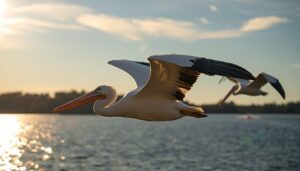
The pelican’s snowy white feathers do more than look striking — they’re working hard on multiple fronts. White plumage boosts light reflection, helping birds blend into sunlit water surfaces.
Black flight feathers serve three clear roles:
- Absorbing excess light to reduce glare
- Resisting feather wear from coastal winds
- Sharpening signal contrast for in-flight identification
Together, these plumage coloration strategies balance camouflage, thermal regulation, and visibility.
Bill Shape, Color, and Throat Pouch Function
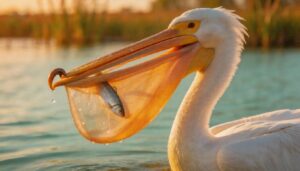
That long, pale yellow to orange bill isn’t just impressive — it’s precision-built. The slight hook at the tip reflects careful Bill Hook Geometry, gripping slippery fish with control.
Feeding Kinematics Coordination kicks in as the lower mandible drops, inflating the gular pouch through Pouch Elasticity Mechanics to scoop water and prey together. Seasonal Bill Coloration deepens during breeding, serving as Visual Cue Signaling to potential mates.
Breeding-season Crest and Bill Plate
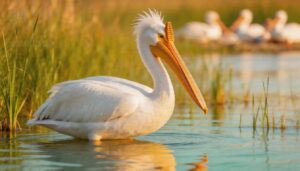
During the breeding season, two ornaments appear that transform an already striking bird. A crest of white airy feathers rises from the forehead, growing more pronounced as Hormonal Regulation peaks, while a raised vertical plate develops on the upper bill.
Both features serve Mate Selection — their Seasonal Coloration and Display Timing are coordinated precisely.
Colony Density Effects can influence how long these signals remain vivid.
Juvenile Versus Adult Appearance
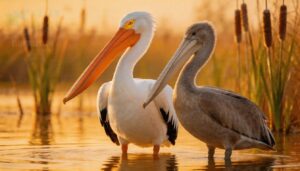
Young birds fresh out of the nest look noticeably different from the gleaming adults beside them. Fledglings carry a grayish hue across their wings and back, with Wing Edge Tint fading to brownish rather than crisp black.
Their Bill Keratin Roughness and duller bills contrast sharply with the polished orange of adults. Eye Color Contrast, Facial Skin Tone, and Feather Softness Variation all sharpen gradually through the first year.
Flight Profile and In-flight Identification

Once those gray-tipped wings fill out, watch how this bird moves through the sky. The Flight Silhouette is unmistakable — broad wing span held flat, neck tucked close, short squared tail trailing behind.
Key in-flight markers include:
- Black flight feathers edging bright white wings
- Visible Pouch Visibility even at distance
- V-shaped flight formation during thermal soaring
Wingbeat Rhythm slows dramatically mid-glide mechanics, signaling pure efficiency.
Comparison With The Brown Pelican and Other Large Waterbirds

Set the American White Pelican beside a Brown Pelican, and the differences become immediately clear. The white pelican’s wingspan stretches up to 120 inches — nearly 40 inches wider than its coastal cousin.
While brown pelicans plunge-dive alone near marine shorelines, American White Pelicans cooperate on inland lakes, herding fish together. Their flight formation differences, quieter vocalizations, and distinct thermoregulation strategies reflect genuinely separate ecological paths.
Habitat, Range, and Migration

The American White Pelican doesn’t stay in one place — its life is shaped by a constant push and pull between seasons, water levels, and the availability of fish. Knowing where these birds go and when is one of the best ways to actually find them in the field.
Here’s a closer look at the key aspects of their range and movement throughout the year.
Breeding Range Across Canada, The Western United States, and Mexico
From Canadian prairie wetland networks down through Intermountain river basins and into Mexico’s highland reservoir colonies, American White Pelicans follow a remarkably broad breeding range.
Alberta and Saskatchewan support dense nesting populations, while western U.S. lakes host island nesting preferences that minimize predator pressure. Cross-border migration corridors tie these populations together, and range mapping confirms this species thrives wherever shallow, fish-rich water exists.
Wintering Grounds Along Coasts, Estuaries, and Inland Lakes
Once breeding wraps up, American White Pelicans scatter across a wide network of wintering grounds — from Coastal Bay Shelters along the Gulf of Mexico to Estuarine Nutrient Hotspots where mixing freshwater meets salt.
Key wintering sites include:
- Protected bays and coastal lagoons
- Tidal estuaries with rich fish nurseries
- Inland Reservoir Ice-Free zones in the southern U.S.
- Mangrove Fringe Foraging areas along Mexico’s Pacific Coast
- Artificial Pond Utilization sites offering open, shallow water
Preferred Habitats in Summer and Winter
Habitat preferences in summer and winter shift noticeably as the seasons turn.
In summer, American White Pelicans favor Shallow Lake Foraging across freshwater wetlands and Braided River Deltas, where fish concentrate in warm, productive shallows and Mudflat Feeding Zones expose easy prey.
Come winter, they trade inland lakes for Coastal Estuary Roosts, sheltered coastlines, and Winter Ice-Free Reservoirs that keep fish reliably accessible through colder months.
Isolated Island Nesting Sites and Wetland Dependence
Concerning colonial nesting, American White Pelicans are remarkably selective.
They favor isolated islands where Island Elevation Effects and Wave Action Stability keep nests above flood risk, and where Predator Access Management happens naturally — no foxes, no raccoons.
Vegetation Cover Influence stays minimal, keeping sight lines open.
Nearby Wetland Water Quality directly shapes fish availability, making wetland habitats and island nesting inseparable for successful breeding colonies.
Major Migration Routes and Stopover Areas
Once nesting wraps up, American White Pelicans push south along well-established migratory routes and seasonal movements, following the Central and Pacific flyways toward coastal wintering grounds. Flyway connectivity links key stopover wetlands — prairie potholes, Great Plains lakes, Texas estuaries — where birds refuel on schedule.
Migration timing tightens around wetland availability, and cross-border conservation efforts protect these corridors from artificial light pollution and habitat loss.
Year-round Resident Areas Versus Seasonal Visitors
Not every American White Pelican packs up and leaves for winter. Some colonies hold year-round residency in stable coastal wetlands, where open water and reliable prey make seasonal range shifts unnecessary. Others follow migratory routes and seasonal movements tied directly to seasonal water levels and fish availability.
Here’s how these two groups differ:
- Resident colonies maintain long-term nesting sites with consistent breeding colony locations and numbers across years.
- Seasonal visitors time migration timing around spawning runs and peak prey windows.
- Habitat preferences in summer and winter diverge sharply — residents favor permanent estuaries; migrants shift between inland lakes and coastal bays.
- Regulatory frameworks protecting year-round zones tend to be more stable and thorough.
- Tourism revenue peaks seasonally at migration hotspots but flows steadily through resident areas year-round.
Notable Birdwatching Hotspots for Sightings
Regional birdwatching hotspots for pelicans sit along well-documented Coastal Migration Corridors — Smith Point hawkwatch and Hazel Bazemore hawkwatch in Texas, both see impressive seasonal flyovers.
Delta Wetland Refuges in California’s Central Valley and the Salton Sea attract large foraging flocks.
Great Lakes Stopovers, Pacific Northwest Estuaries, and Florida Everglades Sanctuaries round out the map with reliable, accessible sightings year-round.
Diet and Cooperative Foraging

The American White Pelican is a remarkably skilled feeder, and the way it hunts tells you a lot about how intelligent and social this bird really is. From cooperative fish-herding to nighttime tactile feeding, its strategies are more varied than most people expect.
Here’s a closer look at what it eats and how it gets the job done.
Main Prey Species, Including Fish and Aquatic Animals
Fish form the backbone of the American White Pelican’s diet, and the variety might surprise you. Along coastal and inland waters, shad and menhaden top the menu, joined by panfish, perch, carp, and smaller species like eel and minnow during seasonal fish shifts.
estuarine shrimp or crayfish and other crustaceans are available near shallow mudflats, pelicans take full advantage of those resources too.
How The Bill and Pouch Capture Prey
The bill-and-pouch system is one of nature’s most efficient feeding tools. Using Bill Angle Optimization, a pelican tilts its pouched bill at just the right angle to scoop up fish, triggering rapid Pouch Expansion Dynamics that net water and prey together.
Key mechanics behind every strike:
- Water Exclusion Technique drains excess water before swallowing
- Prey Retention Structures keep slippery fish secured inside the gular pouch
- Suction Capture Mechanics concentrate schooling fish into a single efficient scoop
These feeding techniques make each dip remarkably precise.
Cooperative Fish-herding Behavior
What the bill-and-pouch can’t do alone, the flock works together.
In groups of fewer than 20, American White Pelicans practice cooperative feeding by using Herd Formation Dynamics to encircle fish in shallow water. Vocal Coordination and Visual Signaling keep each bird aligned. Younger pelicans learn these fish herding behavior techniques through Social Learning, following experienced adults until Prey Density Thresholds trigger tighter, more coordinated formation sweeps.
Surface Feeding Versus Plunge Diving
Once the flock has herded fish into shallow water, individual birds must still decide how to strike. American White Pelicans rely almost entirely on water surface feeding — scooping prey while afloat — rather than plunge diving. Here’s what shapes that choice:
- Energetic Trade-offs favor surface feeding; plunging burns considerably more energy per catch.
- Prey Depth Preference matters — surface methods target schooling fish near the top.
- Water Clarity Effects influence success, since murky conditions reduce visual accuracy.
- Wind Conditions affect calm-water feeding opportunities across their habitat preferences.
- Group Coordination amplifies catch rates by driving fish toward the surface together.
Night Feeding During Breeding Season
Surface feeding works well in daylight, but during breeding season, American white pelicans extend their aquatic foraging well into darkness.
Moonlit foraging and crepuscular activity give adults extra feeding windows, reducing competition and supporting predator avoidance near nesting colonies.
Artificial light influence along shorelines draws prey closer, while tidal timing shapes where birds concentrate.
| Condition | Foraging Benefit | Breeding Relevance |
|---|---|---|
| Bright moonlight | Improves surface visibility | Extends cooperative foraging hours |
| Incoming tides | Concentrates shallow-water prey | Boosts chick provisioning efficiency |
| Artificial shoreline lighting | Attracts emergent aquatic prey | Increases nighttime catch success |
Daytime Feeding and Visual Hunting
When daylight arrives, the American white pelican shifts into a visually driven hunting mode. Using keen eyesight and glide altitude scanning, it reads prey motion cues and water surface glare to locate fish schools below.
Daytime aquatic foraging relies on four key behaviors:
- Soaring low to improve visual cue detection
- Adjusting flight angle against sun glare
- Timing group dive timing for synchronized strikes
- Using cooperative foraging to herd fish into the shallows
Occasional Kleptoparasitism and Opportunistic Feeding
Not every meal comes from honest work. When crowded shorelines draw gulls and terns into shared feeding frenzies, American white pelicans sometimes shift into opportunistic feeders, using stealing tactics to harass successful foragers into dropping their catch.
Weather-driven kleptoparasitism spikes under choppy conditions, and social learning dynamics mean some individuals repeat the behavior consistently.
These energy trade-offs shape opportunistic foraging networks across wetland habitats.
Breeding, Life Cycle, and Threats

Breeding season reveals some of the most fascinating behaviors in the American White Pelican’s life cycle. From the moment colonies gather on bare, windswept islands to the day young birds take their first flight, every stage tells you something real about how this species survives.
Here’s a closer look at how they nest, raise their young, and face the pressures threatening their future.
Colony Nesting Behavior and Social Breeding Structure
American White Pelicans don’t just nest near each other — they operate like a finely tuned community. Colony nesting behavior revolves around Breeding Synchrony, where monogamous pairs lay eggs within the same narrow window, spreading predation risk across hundreds of nests at once.
Key social traits include:
- Non-breeding Helpers assisting with chick protection
- Coordinated Feeding Times maximizing juvenile nutrition
- Predator Mobbing driving off eagles and mammals collectively
- Colony Site Fidelity drawing pairs back to proven reproductive colonies
- Synchronized incubation across neighboring nesting islands
Nest Placement on Gravel, Sand, and Bare Islands
Regarding where pelicans actually set up their nests, microhabitat selection matters more than you might expect. They favor gravel, sand, and bare island substrates for good reason — these surfaces support substrate thermal regulation, helping eggs stay warm without overhead cover. Sparse vegetation also reduces predator concealment strategies near the nest.
Remote nesting islands naturally support human disturbance mitigation, and artificial nesting platforms now supplement shrinking natural sites.
Egg Laying, Clutch Size, and Incubation Period
Once nesting sites are claimed, egg laying timing kicks off quickly. Females lay one to three chalky-white eggs over several days, with clutch size variation tied directly to food availability and habitat quality.
Both parents rotate incubation duties — that parental turn-taking keeps incubation temperature stable across the roughly 28-to-32-day period.
Watch how egg development stages unfold: hatching often happens within just a few days of each other.
Chick Feeding, Brooding, and Parental Care
Once the eggs hatch — after incubation lasting 63–70 days — parental role shifts entirely toward chick survival. Both adults share brooding thermoregulation duties, keeping young warm during cold fronts while alternating feeding visits throughout the day.
Key behaviors shaping chick growth rate include:
- Regurgitation feeding directly from the gular pouch, scaled to chick age
- Feeding frequency increases when chicks beg more vigorously
- Nest defense tactics against corvids and neighboring colony members
- Colony nesting behavior enabling coordinated, synchronized parental presence
Fledging Timeline and Juvenile Development
After weeks of pouch feeding, chicks make a critical shift — trading regurgitated meals for self-caught fish as wing muscle maturation accelerates around weeks 10–11.
Watch for gray-tinged juveniles practicing social foraging learning alongside adults, sharpening predator avoidance skills in open shallows.
| Developmental Stage | Key Benchmark |
|---|---|
| Weeks 1–5 | Gular pouch expansion; chicks squawk for food |
| Weeks 6–9 | Pouch feeding change; molting begins |
| Weeks 10–11 | Habitat shift timing; fledging; sexual maturity years away |
Current Conservation Status and Population Trends
Once those gray-tipped juveniles leave the colony, you might wonder: are there enough of them making it?
The good news is solid. The American White Pelican holds Least Concern IUCN Status, with population estimates exceeding 250,000 individuals across North America — a genuine recovery story.
Five trends shaping where things stand today:
- Regional Trends show stable-to-increasing numbers across most U.S. and Canadian breeding grounds.
- Water Management practices that maintain shallow, fish-rich wetlands directly support higher survival rates.
- Habitat Loss from drainage and drought creates localized pressure in altered basins.
- Climate Impact is shifting wetland hydrology and reducing prey availability in some areas.
- Range mapping and population trends confirm modest growth overall, though Conservation status and threats to pelicans vary by region.
Human Disturbance, Wetland Loss, and Climate-related Threats
Population numbers look promising, but the pressures are real. Human disturbance causes disturbance abandonment at nesting colonies — boats or foot traffic flushes adults off nests, exposing eggs and chicks to predators.
Wetland fragmentation shrinks foraging habitat. Climate change impact creates phenology mismatch: pelicans arrive earlier, yet severe spring storms hit harder.
At Chase Lake, storm chick mortality reached 80 percent in a single weather event. Water level change can erase island isolation overnight.
At Chase Lake, a single storm killed 80 percent of pelican chicks, and one flood can erase an island colony overnight
Legal Protections and Citizen-science Monitoring Efforts
Fortunately, the Migratory Bird Treaty Act gives American White Pelicans federal protection, making deliberate disturbance or harm illegal. Community science programs like the Christmas Bird Count track population shifts year to year, following strict Community Monitoring Protocols and Open Data Licensing standards.
Permit Requirements govern organized field projects, while Data Privacy Standards protect volunteer contributors. The IUCN assessment for American White Pelican reflects these birdwatching and citizen science contributions directly.
Frequently Asked Questions (FAQs)
What scares away pelicans?
Acoustic deterrents, predator decoys, visual barriers, water misting, and human crowding all discourage pelicans from settling.
Even sudden movements or persistent human disturbance near feeding and nesting areas can push them toward quieter, safer waters.
Can you hunt American White Pelicans?
No, you can’t. American White Pelicans are federally protected under the Migratory Bird Treaty Act, making sport hunting illegal. Only depredation permits allow limited lethal control — never recreational harvest.
What is the difference between an American White Pelican and a Brown Pelican?
Size tells the story first: the White Pelican spans nearly nine feet across, dwarfing the Brown Pelican’s six-and-a-half-foot wingspan. One dives dramatically; the other herds fish from the surface.
What does the american white pelican eat?
Fish make up the core of their diet — mostly minnows, carp, perch, and catfish.
Dietary flexibility lets them shift prey based on water level influence and local abundance, with crayfish and salamanders rounding things out.
What are some of the threats to the American white pelican population?
Several threats hit close to home for these birds: wetland drainage, habitat fragmentation, pesticide bioaccumulation, disease outbreaks, and extreme weather all drive population decline and habitat degradation across breeding and wintering grounds.
What is the population of American white pelicans?
Estimates vary by survey methodology and count accuracy, but the global breeding population sits around 450,000 birds — a strong recovery reflecting positive population trends and sustained conservation efforts since mid-20th-century declines.
Where do American white pelicans live?
American white pelicans live across a wide range — breeding on freshwater wetland islands from Canada to Mexico, then migrating coastward each winter to sheltered bays, estuaries, and warm inland lakes.
Are American white pelicans rare?
Not rare at all. The IUCN lists them as Least Concern, with populations exceeding 100,000 birds.
After a Historical Decline, Breeding Success Rates and stronger Protected Area Coverage helped drive a steady recovery.
What is the difference between male and female American white pelican?
American white pelicans look nearly identical, but males are slightly larger — a classic case of sexual size dimorphism.
Both share the pale pink to yellow bill, though males tend to develop a more prominent breeding bill plate.
What is a fun fact about the American white pelican?
One fun fact: During courtship, these birds perform a unique courtship dance, coordinating movements with pouched bills raised, and heads swaying — a synchronized display that’s surprisingly graceful for birds with such large heads and huge, heavy bills.
Conclusion
Consider a flock of American white pelicans working together, their large wingspans are proof of their unique cooperative foraging behavior. As you observe these birds, you’ll notice their distinctive white plumage and black flight feathers.
The ability to thrive in various habitats is a significant example of adaptability, making it a fascinating species to study and appreciate in its natural habitat.