This site is supported by our readers. We may earn a commission, at no cost to you, if you purchase through links.
A flash of red at your feeder on a gray January morning stops you cold. That’s a Northern Cardinal — and in Pennsylvania, he’s just one of over a dozen birds that might visit your yard before noon.
Pennsylvania sits inside one of the most active bird corridors in the eastern United States. The state’s mix of woodlands, open fields, and suburban edges draws year-round residents alongside seasonal migrants that travel hundreds of miles to spend a few months in your backyard.
Knowing which birds to expect — and when — changes everything about how you set up your feeders, what food you stock, and which week you hang out the oriole jelly.
Table Of Contents
- Key Takeaways
- Most Common Backyard Birds in Pennsylvania
- Pennsylvania’s Top 10 Backyard Birds Ranked
- Year-Round Birds That Never Leave Pennsylvania
- Seasonal Migratory Birds to Watch For
- How to Identify Backyard Birds by Sight
- Best Foods to Attract Pennsylvania Backyard Birds
- Best Bird Feeders for Pennsylvania Backyards
- How to Attract Baltimore Orioles to Your Yard
- Creating a Bird-Friendly Backyard in Pennsylvania
- Best Times of Year for Backyard Bird Watching
- Frequently Asked Questions (FAQs)
- What are the top 10 birds in PA?
- What are some common bird species found in Pennsylvania?
- Where is the best place to go birdwatching in Pennsylvania?
- What time of year is the best for birdwatching in Pennsylvania?
- What should I bring on a birdwatching trip in Pennsylvania?
- Can I feed the birds in Pennsylvania?
- What are the most common backyard birds in Pennsylvania?
- What do acrobatic birds look like in Pennsylvania?
- Are mockingbirds common in Pennsylvania?
- What does a Bluebird look like in Pennsylvania?
- Conclusion
Key Takeaways
- Pennsylvania’s bird-friendly geography draws both year-round residents like Northern Cardinals and Blue Jays and seasonal migrants like Baltimore Orioles and Dark-eyed Juncos, making timing your feeder setup as important as what you put in it.
- Matching food to species — black oil sunflower seeds for cardinals, nyjer for goldfinches, suet for woodpeckers, and grape jelly for orioles — dramatically increases which birds visit and how often they return.
- Feeder placement matters as much as feeder type: mount them 5–6 feet high, 10–15 feet from trees, and within 15 feet of shrubs to balance predator protection with natural bird behavior.
- Late April is Pennsylvania’s peak window for diversity, when migrating warblers, orioles, and grosbeaks pass through alongside nesting residents — making it the single best week to have feeders, water, and nest boxes already in place.
Most Common Backyard Birds in Pennsylvania
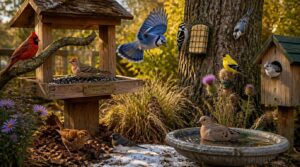
Pennsylvania is home to a surprisingly lively mix of birds, and some of them are probably already visiting your yard. A few stick around all year, while others show up only during certain seasons. Here’s a look at who’s coming and going, how often they tend to appear, and where in your yard you’re most likely to spot them.
Woodland species are especially well represented — check out this guide to woodpeckers in Pennsylvania if you’ve been hearing that telltale drumming from the trees.
Year-Round Residents Vs. Seasonal Visitors
Some birds never leave your yard. Year-round residents like Northern Cardinals and Blue Jays stay through every season, keeping feeders busy even in January.
Seasonal visitors work differently — they arrive, then disappear:
- Spring/summer visitors like Baltimore Orioles arrive in late April
- Winter arrivals like Dark-eyed Juncos appear in fall
- Migratory stopovers pass through briefly during migration windows
Knowing which is which helps you attract more birds year-round.
How Often Each Species Appears in Checklists
Knowing which birds show up helps you plan your setup. Northern Cardinals appear on roughly 55% of summer checklists and 47% of winter ones. American Robins top summer lists at 67%.
Winter visitors like Dark-eyed Juncos stay above 50% during cold months. Yards with feeders and water features can boost those numbers by 15–25 percentage points.
Where to Spot Them in Your Yard
Different birds claim different corners of your yard. Yard edges and fence lines within 15 feet of shrubs draw the most mixed activity. Cardinals prefer dense cover; robins work open ground.
Place feeders 6 to 12 feet from shrubs for the best results. A shallow bird bath nearby pulls in sparrows and robins almost immediately. Be mindful of common ground-level nesting when maintaining your landscape.
Pennsylvania’s Top 10 Backyard Birds Ranked
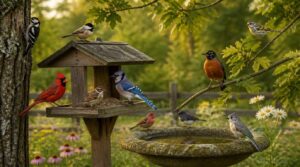
Pennsylvania is home to some truly dependable backyard visitors, and a handful of species show up more reliably than the rest. These ten birds top the charts for statewide sighting frequency, which makes them the best starting point for any backyard birder. Here’s who’s leading the flock.
Northern Cardinal, Blue Jay, and Mourning Dove
Three birds dominate Pennsylvania backyards year-round. Male Cardinals glow bright red against winter snow, while females wear warm brown with reddish hints.
Blue Jays aren’t just loud — they’re smart, caching food in hidden spots for later.
Mourning Doves keep things simple: they forage quietly on open ground, their soft cooing drifting across your yard like a familiar soundtrack.
Black-capped Chickadee and Tufted Titmouse
Two small birds share your feeders daily. The Tufted Titmouse stands 6 inches tall with a gray crest and black forehead. The Black-capped Chickadee is smaller, with a bold black cap and white cheeks.
- Titmouse sings peter-peter-peter; Chickadee calls chick-a-dee-dee
- Titmouse forages mid-canopy; Chickadee hops lower
- Both love tube and suet feeders
- Look for the crest to tell them apart
American Robin, Dark-eyed Junco, and More
The American Robin is a thrush — broader and rounder than any sparrow, measuring 9 to 11 inches long. Its brick-red breast makes it easy to spot as it tugs earthworms from your open lawn. The Dark-eyed Junco arrives each fall, a compact slate-gray bird that flashes white outer tail feathers when it hops through leaf litter at your feet.
| Bird | Type | Key Field Mark |
|---|---|---|
| American Robin | Thrush | Brick-red breast |
| Dark-eyed Junco | Sparrow-like | White outer tail feathers |
| Northern Cardinal | Year-round resident | Vivid red plumage |
Ranked by Statewide Sighting Frequency
Across Pennsylvania, Northern Cardinals top the charts at 55% of summer checklists, followed closely by Blue Jays at 46%. American Robins lead seasonal visitors at 67%.
Rural counties skew toward woodpeckers and nuthatches, while suburban yards favor House Sparrows and Mourning Doves. Shoulder seasons — early spring and late fall — pack the most species variety into a single week.
Year-Round Birds That Never Leave Pennsylvania
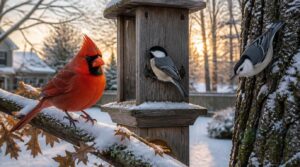
Some birds don’t need a ticket south — they’re here all year, showing up at your feeder whether it’s July or January. Pennsylvania’s most loyal backyard visitors are easy to recognize once you know what to look for. Here are three year-round residents worth getting familiar with.
Keeping your feeder in top shape year-round matters too — wet weather can spoil seed faster than you’d expect, so a little seasonal maintenance goes a long way for your loyal visitors.
Northern Cardinal Habits and Markings
The Northern Cardinal (Cardinalis cardinalis) is hard to miss. Males wear vivid red plumage year-round, paired with a black facial mask stretching from bill to cheek. That pointed crest isn’t just decorative — it flattens when relaxed and rises when alarmed. Females show buffy brown with reddish highlights.
Their thick orange-red bill is built for cracking seeds, and their sharp whistles mark territory clearly.
Blue Jay Behavior and Identification Tips
Blue Jays (Cyanocitta cristata) are loud, bold, and impossible to ignore. That raised crest tells you exactly how they’re feeling — curious, tense, or relaxed. Watch for the white face and black necklace against bright blue upperparts when one lands at your feeder.
They’re smarter than they look. Jays cache acorns and nuts, returning to hidden spots weeks later with surprising accuracy.
Mourning Dove Appearance and Nesting Traits
The Mourning Dove looks plain at first — soft gray-brown plumage, small rounded head, and a long pointed tail. But watch it take flight. Those white outer tail feathers flash brightly against darker inner ones.
- Black spots dot both closed wings
- Males show iridescent neck sheen in sunlight
- Juveniles display scaled feather edging
- Nests are loose twig platforms, built surprisingly fast
Seasonal Migratory Birds to Watch For
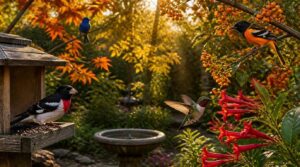
Not every bird sticks around once the seasons change — and that’s actually what makes Pennsylvania’s backyard so interesting to watch. Some of the most colorful visitors only show up for a few weeks, then disappear just as quietly as they came. Here are the seasonal migrants worth keeping an eye out for throughout the year.
Spring and Summer Visitors (April–August)
Five species reliably show up between April and August, turning your yard into a busy rest stop. American Robins arrive by early March and forage your lawn daily through August. Baltimore Orioles peak in mid-May, drawn to nectar and fruit.
Indigo Buntings flash bright blue from late April. Warbler migration peaks in May, while Goldfinches shift from olive to vivid yellow by late summer.
Fall and Winter Arrivals (August–December)
As summer winds down, a new wave takes over. Dark-eyed Juncos arrive in September, foraging in ground-level flocks. Cold fronts push birds south along the Appalachian flyway, concentrating them in your yard.
Three signs fall migration has arrived:
- Juncos scratching beneath feeders daily
- White-throated Sparrows singing softly at dusk
- Blue Jays flocking noisily at sunflower feeders
Keep your birdbath unfrozen — water draws more birds than seed alone in December.
Baltimore Orioles and Indigo Buntings
Two birds that stop visitors mid-sentence arrive in late April. Male Baltimore Orioles flash vivid orange against black wings and head, while females wear soft yellow-brown with white wing bars. Male Indigo Buntings appear almost electric blue in sunlight.
Set out orange slices and grape jelly by mid-April. Scattered seeds near shrubby borders draw Buntings reliably.
Rose-breasted Grosbeak Migration Routes
While Orioles and Buntings draw your eye skyward, the Rose-breasted Grosbeak pulls off something quietly special. Each spring, these birds complete an overnight Gulf crossing — roughly 500 miles of open water — before pushing north through Pennsylvania from mid-April onward.
Each spring, the Rose-breasted Grosbeak crosses 500 miles of open Gulf water overnight before arriving in Pennsylvania
Fall migration swings inland, avoiding open water entirely. They winter in tropical forests and shade-grown coffee plantations across Central America.
How to Identify Backyard Birds by Sight
Once you know when birds visit, the next step is knowing which bird you’re actually looking at. A few simple things — size, shape, behavior, and habitat — can tell you a lot more than you might expect. Here’s how to read those clues the next time a mystery bird lands in your yard.
Using Size, Shape, and Bill Type
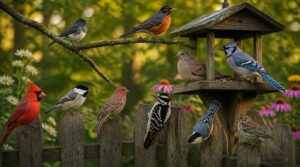
Bill shape tells you more than color will. That’s why most birders always scan the silhouette first.
Five quick ID checks:
- Conical short bill = seed eater, like finches and cardinals
- Slender pointed bill = insect or nectar feeder
- Hooked bill = raptor or predatory bird
- Size: compare it to a sparrow or pigeon
- Foraging posture: probing birds will usually have longer bills
Observing Flock Vs. Solo Foraging Behavior
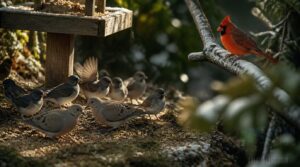
Watch how a bird eats — it tells you a lot. Flocking species like Dark-eyed Juncos and Mourning Doves forage together because more eyes catch both food and predators faster. Cardinals and chickadees often feed solo, relying on personal memory to revisit reliable patches.
If a bird freezes and scans before eating, it’s practicing predator vigilance — a key identification clue.
Matching Birds to Woodland or Yard Habitats
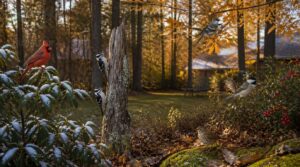
Where a bird hangs out is half the clue. Species like woodpeckers favor dead trees and snags, while thrushes work through leaf litter and ground cover. Cardinals and chickadees prefer shrubby edge habitats where woods meet open yards. Warblers stay higher up, foraging across canopy layers.
Match the location to the bird, and identification gets much easier.
Best Foods to Attract Pennsylvania Backyard Birds
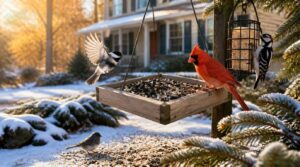
The right food makes all the difference in which birds show up at your feeder. Pennsylvania’s backyard birds each have their own preferences, and matching the food to the species is simpler than you might think. Here are the best options to bring the most birds to your yard.
Black Oil Sunflower Seeds for Cardinals
Cardinals love black oil sunflower seeds for one simple reason: the shells crack easily with their strong beaks, making feeding fast and efficient.
Three things make these seeds hard to beat:
- ~40% fat content fuels cardinals through cold Pennsylvania winters
- Vitamin E helps with feather health year-round
- Dense calories mean fewer seeds needed daily
Place them in a platform or hopper feeder for best results.
Thistle (Nyjer) Seed for American Goldfinches
American Goldfinches have tiny beaks — about as wide as a 2mm nyjer seed — which is exactly why thistle works so well for them. That high oil content delivers concentrated energy, especially during winter cold snaps or spring molts.
Mount your nyjer feeder 5–8 feet up, clean it every two weeks, and store extra seed sealed and cool to prevent clumping.
Suet Cakes for Woodpeckers and Nuthatches
Suet cakes are basically high-energy fuel blocks — rendered beef fat packed with peanuts, almonds, sunflower seeds, and cracked corn. That dense fat content helps woodpeckers and nuthatches stay warm when temperatures drop.
Hang your suet cage 5–6 feet up, close to tree lines. Replace cakes before they go rancid, and store extras somewhere cool and dry.
Platform Feeders for Sparrows and Doves
While suet works for clinging birds, platform feeders serve a different crowd — sparrows and Mourning Doves (Zenaida macroura) that prefer open, flat surfaces.
Choose a tray with a mesh or perforated base so rain drains away and seed stays dry. Place it at eye level, near shrubs. Fill it with millet or black oil sunflower seeds.
Best Bird Feeders for Pennsylvania Backyards
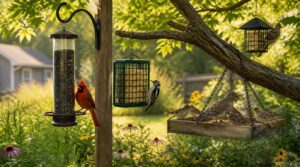
Not all bird feeders are created equal, and the type you hang can make a real difference in which birds show up. Pennsylvania’s backyard birds have distinct feeding habits, so matching the right feeder to the right species is the key. Here are the best feeder options to bring more birds into your yard.
Tube Feeders for Chickadees and Finches
Tube feeders are one of the smartest investments for a Pennsylvania backyard. Small port holes — usually 1.0 to 2.0 mm — keep larger birds out while letting Goldfinches and Chickadees feed comfortably. Most tubes use UV-stabilized polycarbonate, which holds up through harsh winters.
Look for removable bases so cleaning takes minutes, not an afternoon. Less mess, healthier birds.
Suet Feeders for Clinging Bird Species
Woodpeckers and Nuthatches don’t perch — they cling straight down tree bark. Vertical suet feeders are built for exactly that.
- Powder-coated metal sleeves resist rust in Pennsylvania winters
- Standard 1.25–1.5 inch suet cakes fit most models
- Hang 5–8 feet high to block ground predators
- Clear mesh panels let you check cake levels fast
- Clean feeders every 1–2 weeks in warm months
Platform Trays for Ground-Feeding Birds
Clinging birds have their feeders — but Sparrows, Mourning Doves, and Juncos prefer eating low. A platform tray feeder suits them perfectly.
Look for models with mesh or grated bases so rainwater drains fast and seed stays dry. Fill yours with mixed seeds or peanuts, and place it near shrubs where ground feeders already forage naturally.
Feeder Placement Tips for Maximum Visits
Where you hang your feeder matters as much as what’s inside it.
- Mount feeders 5–6 feet high to reduce ground predator access
- Stay 10–15 feet from trees to limit squirrel jumps
- Keep 3 feet from windows to prevent collisions
- Avoid deep shade for better bird visibility
- Rotate locations seasonally to offer fresh foraging routes
How to Attract Baltimore Orioles to Your Yard
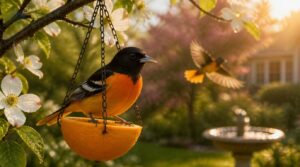
Baltimore Orioles (Icteria virens) show up in Pennsylvania from late April, and they won’t stick around long if your yard isn’t ready for them. A few simple changes to what you offer — and how you offer it — can make a real difference in whether they stop by or fly past. Here’s what works best to bring them in.
Best Time to Set Out Oriole Feeders
Put oriole feeders out by late April in Pennsylvania — Baltimore Orioles usually arrive between late April and early May. Don’t wait until you spot one; they move fast and won’t linger if food isn’t ready.
Weather fronts can push migration earlier or later, so watch spring bloom timing in your yard as a reliable natural cue.
Nectar, Fruit, and Jelly Feeding Options
Baltimore Orioles eat three things: nectar, fresh fruit, and jelly.
For nectar, mix 1 part sugar to 4 parts water — no dyes, no artificial sweeteners. Orange halves or apple slices work well for fruit, but remove any pieces after 24 hours before mold sets in. Stick to plain grape jelly, and clean jelly dishes daily.
Bright Orange Feeders and Color Attraction
Orioles see orange the same way you see a stop sign — instantly. That’s why feeder color matters.
- Place feeders 3–6 feet from other feeders
- Use vivid orange ports or housing
- Stock with nectar or fruit
- Choose high-contrast black-and-orange designs
- Refresh food daily
Orange mimics ripe fruit. Position your feeders in open, sheltered spots near fruiting shrubs for best results.
Creating a Bird-Friendly Backyard in Pennsylvania
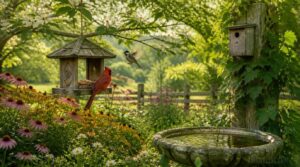
Attracting more birds starts with making your backyard feel like home to them. A few simple changes — the right plants, a water source, a nest box, and cutting back on pesticides — can make a real difference. Here’s what to focus on first.
Planting Native Shrubs and Flowering Plants
Your yard becomes a living pantry when you plant native shrubs and flowering plants. Choose species with staggered bloom cycles — coneflowers, goldenrods, and asters carry nectar from spring through fall.
| Plant Type | Bird Benefit |
|---|---|
| Native shrubs | Nesting cover |
| Coneflowers | Seed foraging |
| Goldenrod | Insect prey source |
| Asters | Late-season nectar |
| Native grasses | Winter shelter |
Layered garden design draws the most species.
Adding a Fresh Water Source or Bird Bath
Birds need water as much as food. Place your bath near shrubs or cover so species like Northern Cardinals and Black-capped Chickadees can escape quickly.
Keep the basin one to two inches deep — shallow enough for fledglings to stand safely. Change the water daily in warm months to prevent mosquito breeding and keep it genuinely fresh.
Installing a Bluebird House (Woodlink Cedar)
Water sets the table — a bluebird house brings nesting birds to stay. The Woodlink Cedar model features a 1.625-inch entrance hole sized for bluebirds but narrow enough to block starlings. Mount it 5–6 feet high in open sun.
- Clean the nest box each fall
- Keep ventilation slots clear of debris
- Face the hole away from prevailing wind
Cedar resists rot naturally, lasting seasons without treatment.
Avoiding Pesticides Near Feeding Areas
Pesticides can undo everything your bluebird house and feeders work to build. Keep feeders at least 15 feet from any treated lawn or garden bed, and maintain a 10-meter buffer between spray zones and feeding stations to reduce drift risk.
Don’t spray when wind speeds exceed 5 mph or rain is expected within 24 hours — residues travel fast. Spot treatments beat broadcast spraying every time. Manual removal, pheromone traps, and native plant barriers around feeders absorb runoff and support the same Cardinals (Cardinalis cardinalis) and Chickadees you’re trying to attract.
Best Times of Year for Backyard Bird Watching
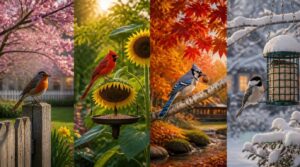
Bird watching in your Pennsylvania backyard changes with every season, and knowing when to look makes all the difference. Each time of year brings its own cast of characters — some passing through, others settling in to nest or wait out the cold. Here’s what to expect across the four seasons so you’re always ready when the birds show up.
Peak Spring Migration (March Through May)
Spring migration peaks late April to early May, when warblers and thrushes flood Pennsylvania overnight. Most songbirds fly at night, then drop into yards and hedgerows at dawn to refuel.
A warm southerly front can trigger sudden surges — one morning your yard feels empty, the next it’s alive with Baltimore Orioles and Indigo Buntings passing through.
Summer Nesting and Breeding Activity
Once migrants settle in, the yard quiets into something steadier — the business of raising young.
Watch for these signs of active nesting:
- Dense shrubs and low forks shelter cardinal cup nests
- Nest box holes (1½ inches) suit chickadees perfectly
- Incubation runs 12–14 days for most small songbirds
- Caterpillar abundance directly boosts nestling survival rates
- Raccoons and cats are the top nest predators to guard against
Fall Migration Arrivals (August–December)
As summer fades, your yard quietly fills with travelers. Warblers and thrushes move at night, riding clear skies and north winds — peak movement often hits in September and early October. A cold front can shift everything by two weeks.
Watch fruiting shrubs for thrushes, keep suet and seed stocked, and log what you see through a birding app to track arrivals by county.
Winter Feeder Birds That Stay in Pennsylvania
Five species keep your feeders busy all winter long.
- Northern Cardinals cluster near dense cover, especially during cold snaps
- Black-capped Chickadees and Tufted Titmice forage together in mixed-species groups
- Dark-eyed Juncos drop to ground feeders when snow covers the grass
Stock black oil sunflower seeds and suet, and they won’t go far.
Frequently Asked Questions (FAQs)
What are the top 10 birds in PA?
Pennsylvania is home to 448 bird species, but your backyard likely hosts just a handful regularly. The top 10 include Northern Cardinal, Blue Jay, Mourning Dove, Chickadee, Titmouse, Robin, Goldfinch, Junco, Nuthatch, and Downy Woodpecker.
What are some common bird species found in Pennsylvania?
Common backyard birds in Pennsylvania include the Northern Cardinal, Blue Jay, Mourning Dove, Black-capped Chickadee, and American Robin. The state records 448 bird species total, giving backyard birders plenty to spot year-round.
Where is the best place to go birdwatching in Pennsylvania?
Hawk Mountain Sanctuary tops most lists for raptor watching. John Heinz NWR offers urban waterfowl refuge access near Philadelphia. Pymatuning State Park draws huge migratory waterfowl flocks each fall.
What time of year is the best for birdwatching in Pennsylvania?
Late April hits the sweet spot. Warblers, tanagers, and migrating songbirds flood Pennsylvania’s woodlands all at once, giving you the highest species variety of the entire year in a single morning.
What should I bring on a birdwatching trip in Pennsylvania?
Like packing for a hike you can’t reschedule, gear choices matter. Bring 8×42 binoculars, a Pennsylvania field guide, waterproof shoes, light layers, insect repellent, sunscreen, snacks, water, a birding app, and a small notebook.
Can I feed the birds in Pennsylvania?
Yes, you can feed birds in Pennsylvania. No state permit is required. Check local township rules, especially in bear-prone areas. Pause feeding during disease advisories and clean feeders with a 10% bleach solution regularly.
What are the most common backyard birds in Pennsylvania?
Pennsylvania holds 448 recorded bird species, but your yard likely draws the same familiar faces season after season. Northern Cardinals and Blue Jays top the list, alongside Chickadees, Mourning Doves, and American Robins year-round.
What do acrobatic birds look like in Pennsylvania?
Pennsylvania’s acrobats — like the Northern Cardinal and Blue Jay — show bold colors, compact bodies, and rounded wings. Watch for quick wingbeats, tight mid-air turns, and brief hovering bursts that reveal their agile flight silhouette.
Are mockingbirds common in Pennsylvania?
Northern Mockingbirds aren’t rare in Pennsylvania, but they’re not everywhere either. You’re most likely to spot them in southeastern PA, especially near suburban edges, rooftops, and shrubby yards.
What does a Bluebird look like in Pennsylvania?
Evoking a splash of fallen sky, the male shows bright electric blue upperparts and an orange-washed breast. Females are softer, grayer. Juveniles lack contrast entirely. Watch for the distinctive dark eye line.
Conclusion
You don’t need a wildlife degree to enjoy the backyard birds of Pennsylvania — ironically, the birds have already chosen your yard as their field station. They’re studying you as much as you’re watching them.
Put out the right food, time your feeders with the seasons, and add a clean water source. The birds handle the rest. One well-stocked feeder on a quiet Tuesday morning can make Pennsylvania’s entire eastern corridor feel like it lands in your hands.
- https://avianreport.com/pennsylvania-feeder-birds-id-sound-guide
- https://data.oklahoman.com/most-sighted-winter-and-spring-birds/location/pennsylvania/42/may
- https://pittsburgh.wbu.com/bird-seed
- https://philadelphiacountymastergardeners.blogspot.com/2014/11/for-birds.html
- https://www.perkypet.com/advice/bird-watching/bird-migration-facts/timing